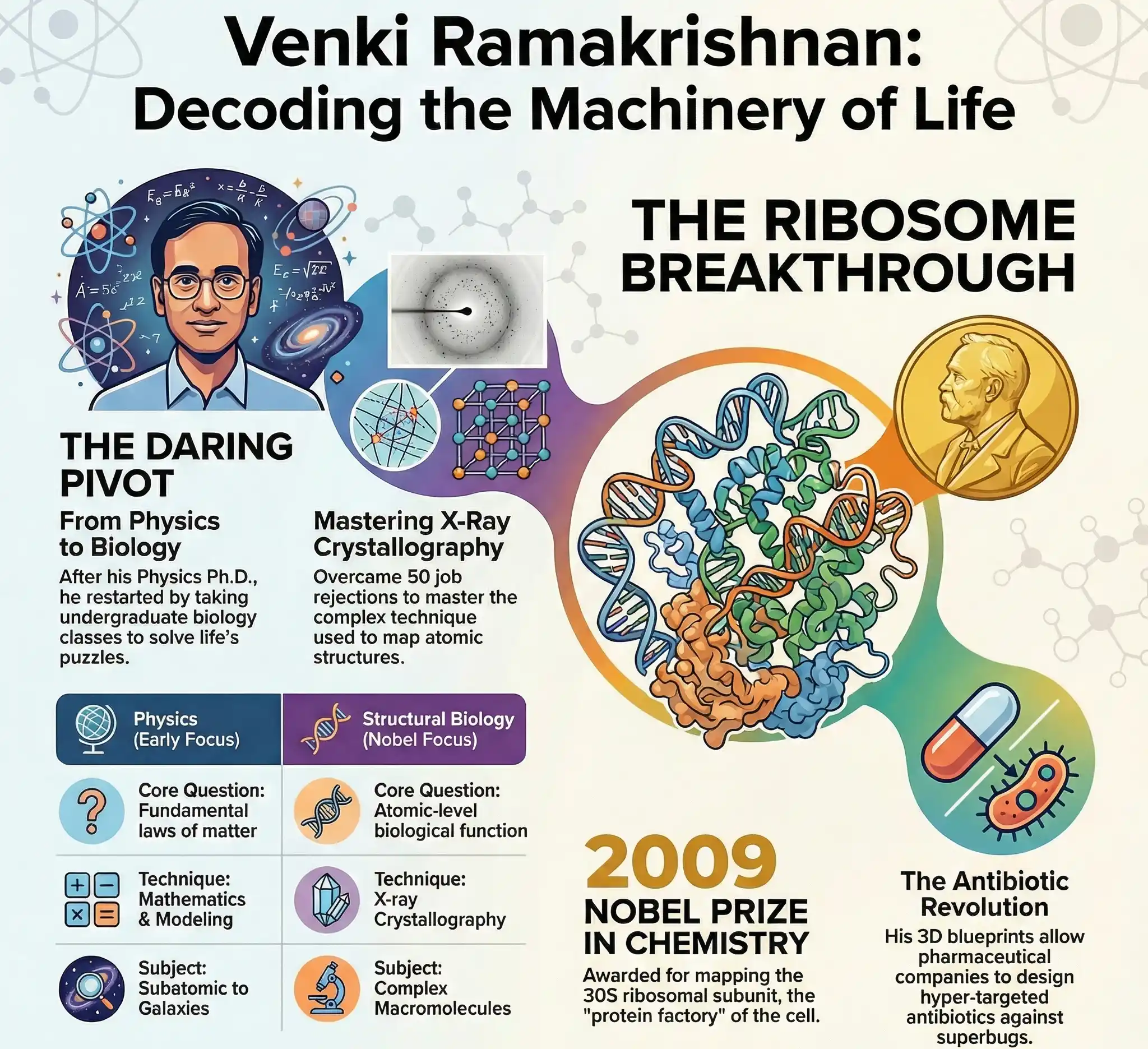
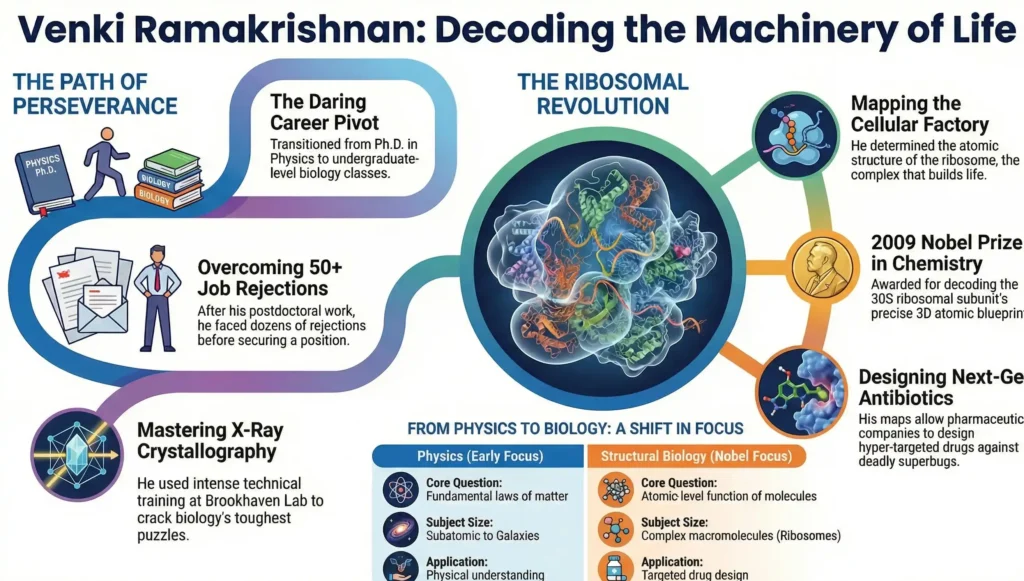
Chicago, February 2000: Venki Ramakrishnan had moved continents and taken a forty per cent pay cut to chase one molecule. Now he had two days of X-rays to show it had been worth it
On a bone-cold morning in February 2000, a plane from England landed at O’Hare Airport in Chicago. A few hours later, four scientists from Cambridge were hurrying to Argonne National Laboratory, a sprawling government research site south-west of the city.
They were carrying crystals. And they had forty-eight hours.
The leader of the group was Venkatraman Ramakrishnan, known to everyone as Venki. He was forty-seven, born in Chidambaram in Tamil Nadu, trained first as a physicist, and for more than twenty years he had been working on one thing: the ribosome.
They were carrying crystals. And they had forty-eight hours.
The machine
Every living cell is full of ribosomes. They are the machines that read the instructions written in our genes and use them to build proteins, one building block at a time. Many of the antibiotics we rely on work by jamming the ribosomes of bacteria. Knowing exactly what a ribosome looks like, atom by atom, would show how life turns genetic information into working parts.
But the ribosome is enormous by the standards of molecules, hundreds of thousands of atoms, and many scientists thought its full structure was beyond reach. To see it, you had to coax it into forming a crystal, then shine very bright X-rays through the crystal and work backwards from the pattern they made.
Ramakrishnan had chosen the smaller of the ribosome’s two parts, called the 30S subunit, the part that reads the genetic message. And he was not alone. At Israel’s Weizmann Institute, Ada Yonath, who had pioneered ribosome crystals, was racing for the same prize.
Shivkar Bapuji Talpade: (1864- 1916)
Har Gobind Khorana: (1922- 2011)
The move
To give himself a chance, he had already gambled once.
In 1999 he was a professor in Utah. He and his wife, Vera, loved the outdoor life there. But the resources for an all-out assault on the ribosome were at the Laboratory of Molecular Biology in Cambridge, and a position had come up. Taking it meant a forty per cent pay cut. It meant leaving their grown children behind in America.
Vera agreed. She had one condition: they would stay in Cambridge, and he would make no more moves for the sake of his career. In April 1999 they went.
Vera agreed, on one condition: no more moves.
In Cambridge the team produced crystals of the 30S subunit good enough to give a respectable picture. But respectable was not enough. They needed detail fine enough to place individual atoms, and for that they needed the brightest X-rays in the Western Hemisphere, at Argonne’s Advanced Photon Source. The trip had taken months to plan. It could make their name, or it could fizzle.
Argonne
Time on a synchrotron like the Advanced Photon Source is precious and rationed. Groups get a slot, and when the slot ends, it ends. For two days the team worked in shifts through the day and the night, mounting crystals, putting them in the beam, collecting the patterns and checking whether each one was good enough.
Crystals of something as big and delicate as a ribosome are fragile. They can be damaged by the very beam used to study them. Everything depended on the crystals lasting and the data being good.
The gamble paid off. The team flew back to Cambridge with the data they had come for.
Daulat Singh Kothari : (1906–1993)
A tie
Months of work followed, fitting the atoms of the 30S subunit into the maps the data produced. On 21 September 2000, the journal Nature published the result: the atomic structure of the 30S subunit, from a heat-loving bacterium called Thermus thermophilus. The paper was signed by Brian Wimberly, Ditlev Brodersen, William Clemons, Robert Morgan-Warren, Andrew Carter, Clemens Vonrhein, Thomas Hartsch and Ramakrishnan.
At almost the same moment, Ada Yonath’s group published its own high-resolution structure. The fierce race had ended in a tie.
Nine years later, in 2009, Ramakrishnan, Yonath and Thomas Steitz of Yale shared the Nobel Prize in Chemistry for their work on the structure and function of the ribosome.
The condition
For Ramakrishnan, the prize had never been the Nobel. It was the structure: to see, at last, the machine at the heart of every living cell.
He got to see it because of two gambles. One was forty-eight hours of X-rays in Illinois. The other was a move across the Atlantic, a smaller salary, and a promise to his wife that this time, whatever happened, they would stay. They stayed.
Manjul Bhargava: (1974- Present)
If you think you have remembered everything about this topic take this QUIZ
Results


#1. What did Venkatraman Ramakrishnan successfully map the exact atomic structure of, earning him a Nobel Prize?
#2. Before making his daring pivot to structural biology, in which field did Ramakrishnan earn his Ph.D. in 1976?
#3. Which immensely difficult technique did Ramakrishnan master to determine the atomic structure of crystals?
#4. According to the text, what is the primary function of the cellular factory known as the ribosome?
#5. Ramakrishnan’s precise 3D blueprint of the bacterial ribosome handed pharmaceutical companies the exact tool needed to design what?
#6. In 2015, Ramakrishnan was elected President of which of the world’s oldest and most prestigious scientific academies?
#7. What is the title of the highly acclaimed memoir authored by Venki Ramakrishnan detailing the human drama behind his discovery?
#8. With which two competing scientists did Venkatraman Ramakrishnan share the 2009 Nobel Prize in Chemistry?
What did Venkatraman Ramakrishnan win the Nobel Prize for?
He won the 2009 Nobel Prize in Chemistry for his studies of the structure and function of the ribosome, determining its atomic blueprint using X-ray crystallography.
What is the function of the ribosome?
The ribosome is a complex molecular machine found within all living cells that acts as a biological factory, reading genetic code and synthesizing proteins.
How did Ramakrishnan’s discovery help medicine?
By providing a precise 3D atomic map of the bacterial ribosome, his research allowed scientists to understand exactly how antibiotics bind to bacteria, paving the way for the creation of new drugs to fight antibiotic-resistant superbugs.
Did Ramakrishnan start his career as a biologist?
No, he initially earned his Bachelor’s and Ph.D. degrees in Physics before transitioning to biology as a graduate student.
Which prestigious scientific institution did he lead?
He served as the President of the Royal Society in the United Kingdom from 2015 to 2020.
Sources & References
Proceedings of the National Academy of Sciences, “Profile of Venkatraman Ramakrishnan” (20 September 2011) — the February 2000 trip to Argonne, the 48-hour window, the race with Ada Yonath and the 2000 Nature paper.
Academy of Achievement, “Venki Ramakrishnan, Ph.D.” — the decision to leave Utah, the pay cut, Vera’s condition and the move in April 1999.
Natural History Museum of Utah, “Regarding Ribosomes with Venki Ramakrishnan, PhD” (28 September 2023) — his view that the prize was the structure, not the Nobel.
Lindau Nobel Laureate Meetings, “Venki Ramakrishnan: CV” — his early life, the move to the LMB and the use of the Advanced Photon Source.
B.T. Wimberly et al., “Structure of the 30S ribosomal subunit”, Nature 407, 327–339 (21 September 2000) — the published structure and its authors.
Author


Exploring the Soul of Bharat through History, Science, Culture, and its Diversity
Our Mission
Curious Indian is a definitive knowledge portal dedicated to chronicling the events, personalities, and cultural shifts that defined the Indian subcontinent. From the ancient Vedic Period to the complexities of 21st-century politics, our goal is to provide deep-dive analysis that inspires.
Editorial Standards & E-E-A-T
Every article published under our brand undergoes a rigorous fact-checking process. We prioritize primary historical records, academic citations, and credible archives to ensure our readers receive accurate, high-authority information.
Historical Integrity Directly sourcing from ASI archives and academic journals.Topical Authority Comprehensive clustering of Indian Science, Biographies, and Wars.Managed by Paripurna Datta and TEAM | Dedicated to the Knowledge of India.