Bengaluru, the night of 6 to 7 September 2019: India’s moon lander was minutes from touching down, and the man in charge was a mango farmer’s son who had not owned a pair of shoes as a boy
Late on the night of 6 September 2019, the mission control room at ISRO’s tracking centre in Bengaluru was full. Rows of engineers sat at their consoles. The Prime Minister had come to watch. Across the country, millions of people had stayed up for it.
Nearly 384,000 kilometres away, a lander called Vikram, named after Vikram Sarabhai, the founder of India’s space programme, and carrying a small rover called Pragyan, was about to try something no one had done before: a soft landing near the Moon’s south pole.
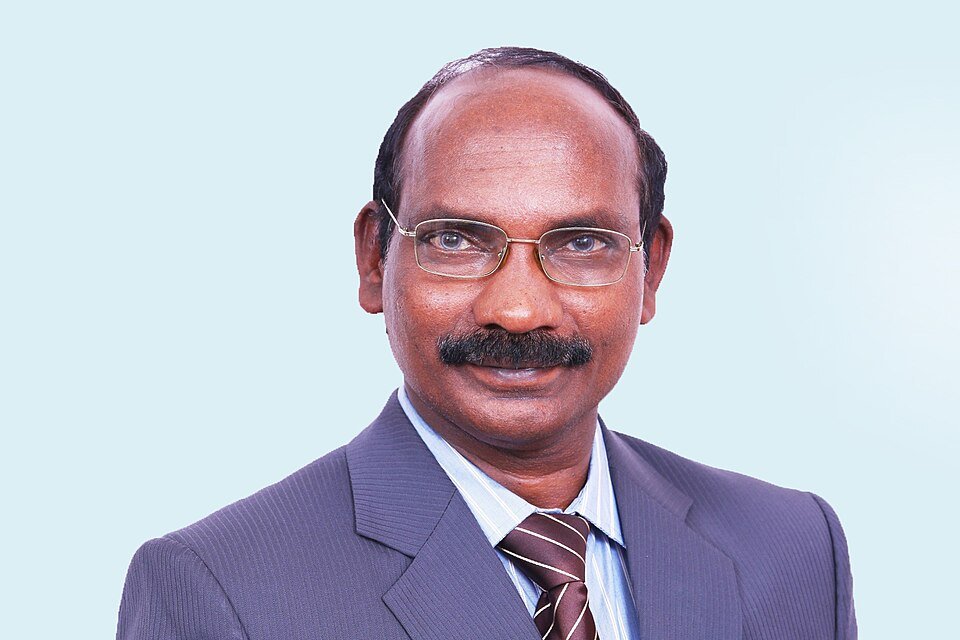
The man responsible for all of it was ISRO’s chairman, Kailasavadivoo Sivan. He was sixty-two.
No one had ever soft-landed near the Moon’s south pole. India was going to try it in the middle of the night.
The farmer’s son
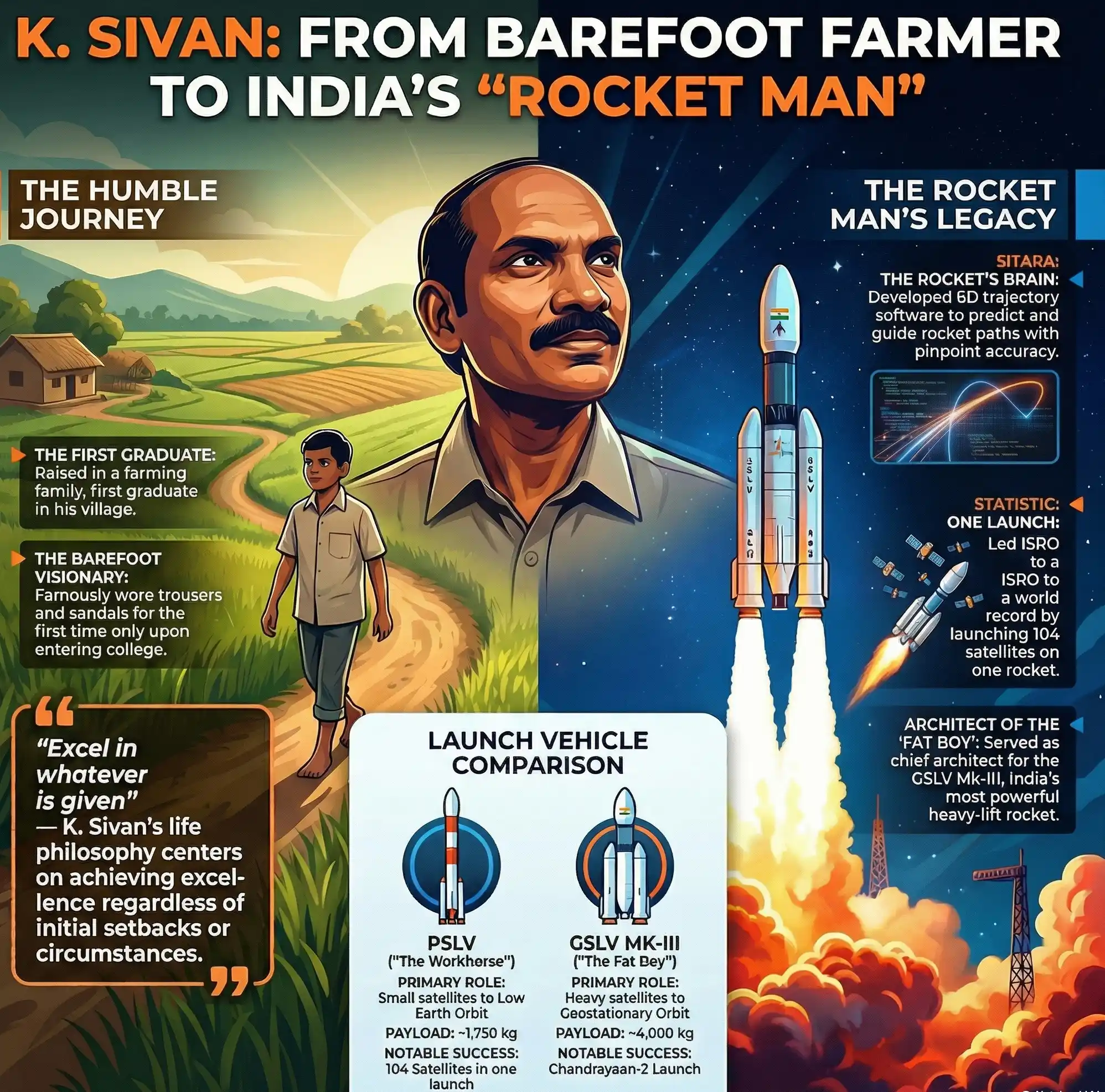
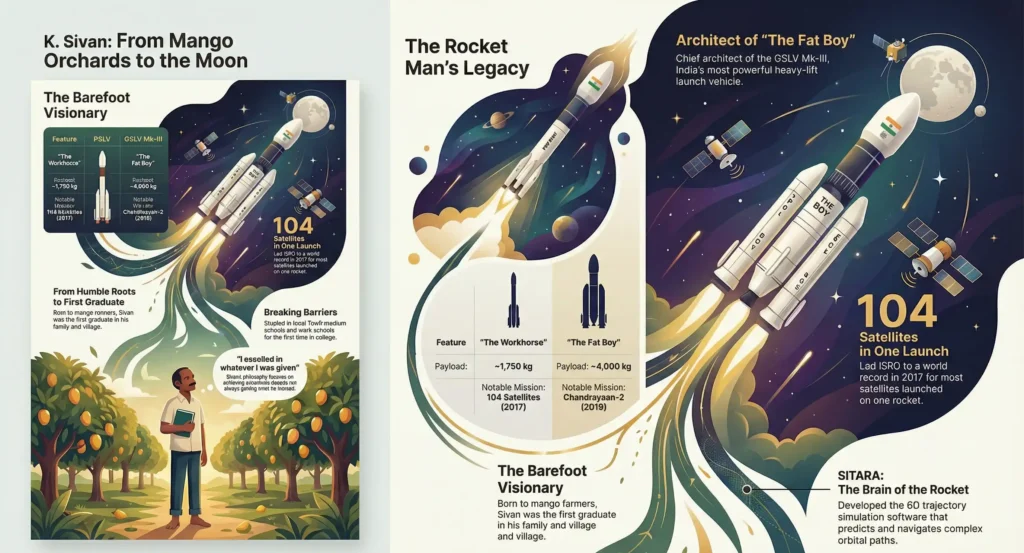
Sivan came from Sarakkalvilai, a village near Nagercoil at the southern tip of India. His father, Kailasa Vadivu, grew mangoes, and the boy helped him in the fields and sold mangoes in the market. He studied in a Tamil-medium government school. He told an interviewer that he went without shoes for his whole childhood, and wore his first pair of trousers only when he went to engineering college.
He was the first graduate in his family. He studied aeronautical engineering at the Madras Institute of Technology, joined ISRO in 1982, and spent his career on rockets, well enough that the people around him called him the Rocket Man. In 2018 he became chairman. Chandrayaan-2 was his first great mission in charge.
Har Gobind Khorana: (1922- 2011)
The descent
Vikram began its descent in the small hours of 7 September. It had to kill its speed from thousands of kilometres an hour to almost nothing, using its own engines, with no one able to steer it from Earth in time. It had to do it by itself.
For the first part of the descent, everything went as planned. At about a quarter to two, the lander began its fine braking phase, with a few kilometres to go. The control room watched the numbers come down.
Then the data stopped.
The lander had been at an altitude of 2.1 kilometres, a little over a mile, when its signal was lost. For some minutes nobody in the room said anything to the watching country. The screens showed nothing new. Sivan briefed the Prime Minister.
The lander was 2.1 kilometres above the Moon when the signal stopped.
The announcement
At about sixteen minutes past two, Sivan took the microphone. The descent had gone as planned, he said, and normal performance had been seen down to 2.1 kilometres. After that, communication from the lander to the ground station had been lost. “The data is being analysed.”
That was all he could say. In that room, everyone knew what it probably meant.
The Prime Minister spoke to the scientists and told them to be courageous and that the country was proud of them. Then he left, and the long night went on.
Venkatraman Ramakrishnan: (1952- Present)
Morning
A few hours later, on the morning of 7 September, the Prime Minister came back to ISRO to address the scientists and the nation. As the Prime Minister was leaving, Sivan came to see him off.
And the Rocket Man, the chairman of the Indian Space Research Organisation, the farmer’s son who had built a career on staying calm, broke down and wept.
The Prime Minister put his arms around him and held him for a long time, patting his back. The footage went round the country within hours. Many people who had never heard Sivan’s name before saw him first like that: a man in tears because his lander had not made the last two kilometres.
Two kilometres
The next day ISRO found Vikram. The orbiter, still circling the Moon, had spotted it on the surface. It must have been a hard landing, Sivan said. The orbiter itself was working, and would keep working for years.
Four years later, on 23 August 2023, India’s next lander, Chandrayaan-3’s Vikram, touched down softly near the Moon’s south pole. It had been built with the lessons of the night it fell short. Sivan was no longer chairman. He had watched a mission miss by two kilometres, and then watched the next one make them.
Manjul Bhargava: (1974- Present)
Har Gobind Khorana: (1922- 2011)
If you think you have remembered everything about this topic take this QUIZ
Results


#1. What popular nickname was given to Dr. K. Sivan due to his mastery of launch vehicle technology?
#2. Before entering the Madras Institute of Technology (MIT), Dr. Sivan famously walked barefoot in his village and wore which traditional garment?
#3. What is the name of the critical 6D trajectory simulation software developed by Dr. Sivan that helps rockets navigate their path to orbit?
#4. Under his leadership as Director of the Vikram Sarabhai Space Centre, ISRO set a world record in 2017 by launching how many satellites on a single PSLV rocket?
#5. Dr. Sivan was the chief architect of India’s most powerful launch vehicle, affectionately nicknamed “The Fat Boy.” What is its official name?
#6. How did Dr. Sivan famously describe the final automated landing phase of the Chandrayaan-2 Vikram lander?
#7. According to the comparison table, what is the approximate payload capacity of the GSLV Mk-III to Geostationary Transfer Orbit (GTO)?
#8. Passionate about democratizing space education, what program did Sivan launch to train young schoolchildren in space technology?
Why is K. Sivan called the “Rocket Man of India”?
He earned this title due to his mastery of launch vehicle technology, particularly his role as the chief architect of the heavy-lifting GSLV Mk-III rocket and his development of the SITARA trajectory software.
Where did K. Sivan complete his education?
He did his BSc at Madurai University, his engineering degree at Madras Institute of Technology (MIT), his Master’s at IISc Bangalore, and his PhD at IIT Bombay.
What happened during the Chandrayaan-2 mission?
Under his chairmanship, the mission successfully placed an orbiter around the Moon, but the Vikram lander unfortunately lost communication and crashed during its final descent to the lunar surface in 2019.
What is the SITARA software?
It is a 6D trajectory simulation software developed by Sivan early in his career at ISRO. It is used to plan and predict the precise flight path of ISRO’s rockets.
Did K. Sivan study in English medium schools?
No, he studied entirely in the Tamil medium in local government schools during his childhood, proving that language is not a barrier to scientific excellence.
Sources & References
Scroll.in, “ISRO chief hugs Modi, breaks down after space agency loses contact with moon lander Vikram” (7 September 2019) — the morning address and the embrace.
Outlook, Chandrayaan-2 live updates (7 September 2019) — the timeline of the descent, the fine braking phase and the announcement at 2.16 am.
Deccan Herald, Chandrayaan-2 live blog (September 2019) — the loss of signal at 2.1 km and Sivan’s confirmation that Vikram had been located after a hard landing.
Deccan Chronicle, A. Ragu Raman, “Fighting odds: Once mango trader now Isro chairman” (12 January 2018), and The Logical Indian (8 September 2019) — his childhood in Sarakkalvilai.
Author


Exploring the Soul of Bharat through History, Science, Culture, and its Diversity
Our Mission
Curious Indian is a definitive knowledge portal dedicated to chronicling the events, personalities, and cultural shifts that defined the Indian subcontinent. From the ancient Vedic Period to the complexities of 21st-century politics, our goal is to provide deep-dive analysis that inspires.
Editorial Standards & E-E-A-T
Every article published under our brand undergoes a rigorous fact-checking process. We prioritize primary historical records, academic citations, and credible archives to ensure our readers receive accurate, high-authority information.
Historical Integrity Directly sourcing from ASI archives and academic journals.Topical Authority Comprehensive clustering of Indian Science, Biographies, and Wars.Managed by Paripurna Datta and TEAM | Dedicated to the Knowledge of India.