Sarnath, 1905: an engineer’s trench turned up a seated Buddha carved fifteen centuries earlier to an exact system of proportion. It has been copied across Asia ever since
In the cold season of 1904–05, an engineer named Friedrich Oertel started digging at Sarnath, a few miles outside Benares.
Oertel was not a trained archaeologist. He worked for the Public Works Department in the Benares division, building roads. But he had an interest in the ruins at Sarnath, the Deer Park where the Buddha is said to have given his first sermon, and he got permission from the Archaeological Survey of India to excavate there for a season.
That season Oertel’s men uncovered the lion capital of Ashoka, the four lions that are now India’s national emblem. And in an area south of the great Dhamek Stupa they found a seated Buddha in pale sandstone, about 1.6 metres high, broken in places but almost whole.
The Powerful Feminist Anthems Hidden in the Songs of Lalon Fakir
The sermon in stone
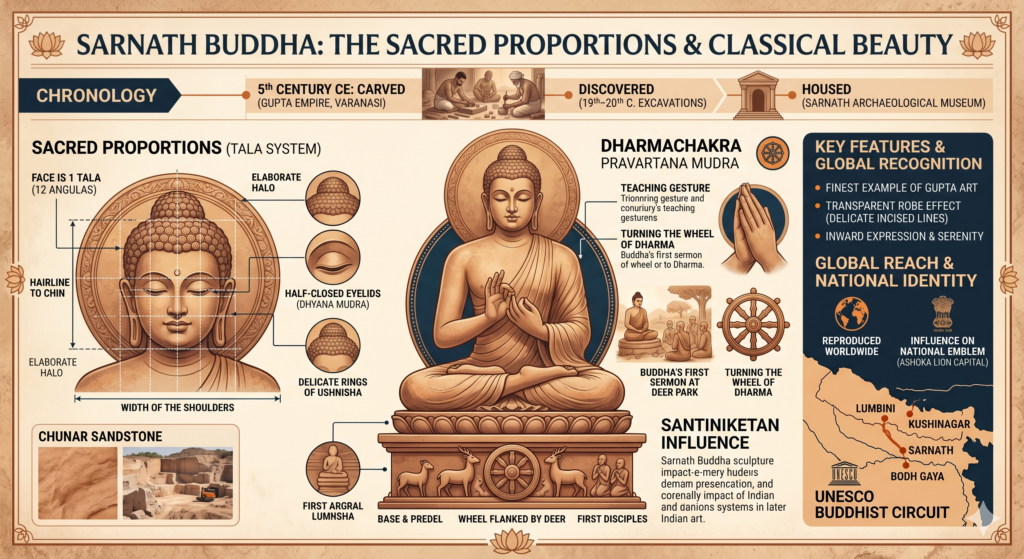
The Buddha sits cross-legged, his hands raised before his chest. The fingers of the two hands meet in the gesture called the dharmachakra pravartana mudra, turning the wheel of the dharma. It shows the moment the carving commemorates: the first sermon, preached at this place to five men who had once been his companions in austerity.
Those five sit below him on the pedestal, much smaller, around a wheel set between two resting deer, the emblem of the Deer Park. A kneeling woman and a child sit with them, probably the people who paid for the image. Behind the Buddha’s head is a large round halo carved with flowers and scrolling vines, and on either side of it a flying god brings an offering of flowers.
The robe is so fine it is almost not there. Only its edges show at the neck, the wrists and the ankles. The eyes are lowered and half closed.
It was carved in the fifth century, in the Gupta period, in a workshop at Sarnath itself. The stone came from Chunar, up the Ganga, a fine-grained sandstone that local carvers had been using since the time of Ashoka.
It is one of the most reproduced Buddha images in the world.
Kanaklata Barua: Assam’s Youngest Martyr of the Quit India Movement
The measure
What makes the image feel so settled is partly arithmetic.
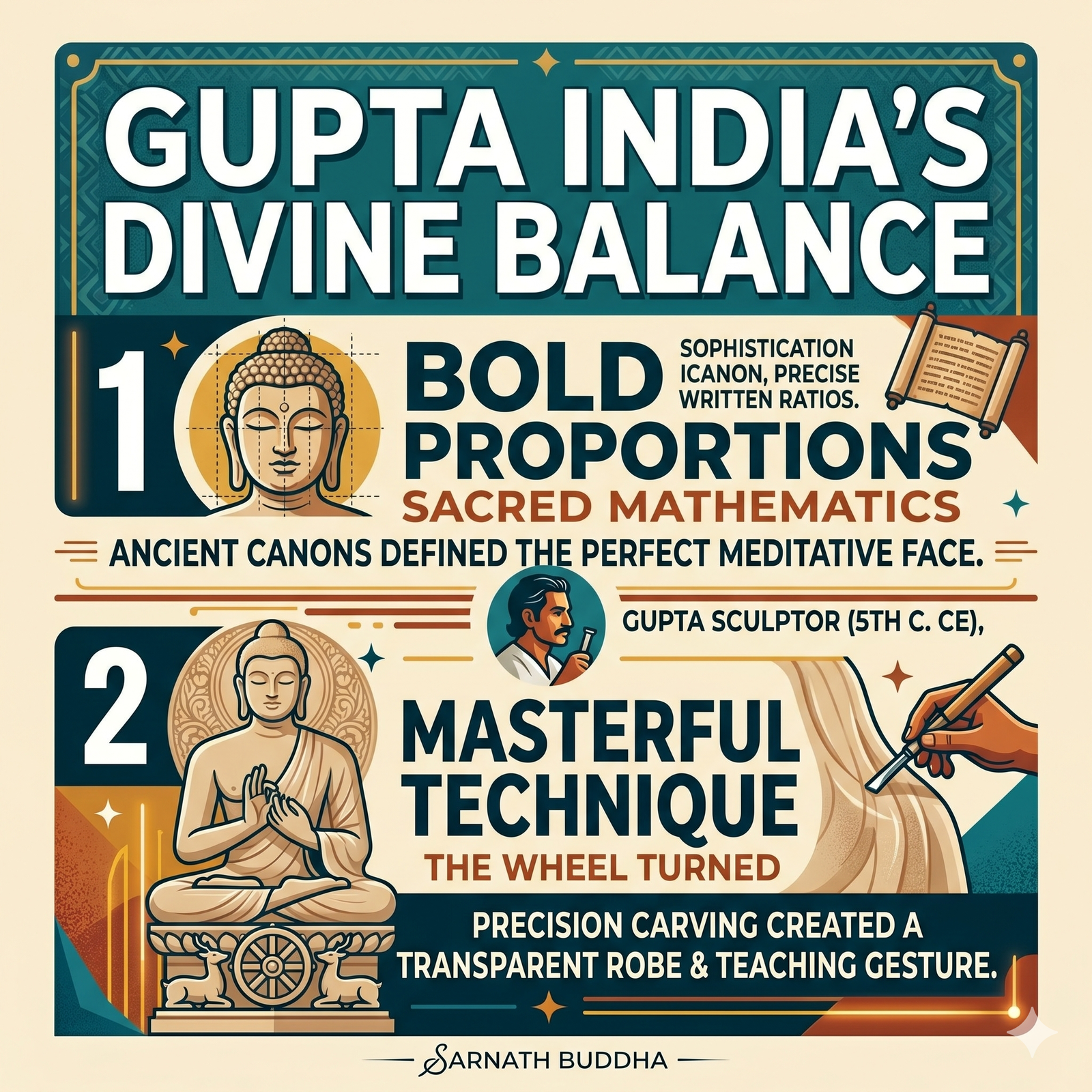
Indian sculptors worked to a system of measurement laid down in texts on image-making. The body of a god was not drawn freehand. It was built out of units taken from the figure itself: the finger-width, or angula, and the length of the face, the tala. Each part had its count, the height of the head, the span of the chest, the length of the arm, and the counts fixed how every part related to every other.
The scholar Diana Eck describes the Sarnath Buddha’s limbs as being in the perfect proportions prescribed by the iconometry of its day. The sculptor laid out the figure on a geometry of measured units and then carved it so smoothly that the geometry disappears. The fine Chunar stone helped. It allowed a polished surface and soft outlines, and the underlying grid could be hidden beneath them.
The result looks effortless, but it was measured, and that is why it could travel. A figure built from counted units can be rebuilt by anyone who knows the count.
Most people who know the image know a copy.
Unakoti Tripura: Jungle Sanctuary With a Million Stone Faces
The copies
When the Archaeological Survey built a museum at Sarnath, the first museum it ever built at an excavation site, the Buddha went on display. The museum opened in 1910. Daya Ram Sahni’s catalogue of 1914 listed it as sculpture B(b) 181. It has been there ever since.
It did not stay alone for long. In 1931 the Maha Bodhi Society, led by the Sri Lankan Buddhist reformer Anagarika Dharmapala, opened a new temple at Sarnath, the Mulagandha Kuti Vihara, and at its heart placed a gilded replica of Oertel’s Buddha. In 1939 Mahatma Gandhi inaugurated the Buddha Vihara in the Birla Mandir complex in Delhi, with another version of the image. In 2010 India gifted a sixteen-foot copy to the Temple of the Tooth in Kandy, Sri Lanka.
There are copies now in an Indian-style hall at the White Horse Temple in Luoyang, China, in temples in Singapore and Thailand, and on one face of the peace stupa at Rajgir. Small ones, in wood, marble, bronze and plaster, are sold around Sarnath. It is one of the most reproduced Buddha images in the world.
Back in the museum
Most people who know the image know a copy. The original is still in the museum at Sarnath, a few hundred metres from where Oertel’s men found it.
Scholars still argue about what it says. The art historian John Huntington has written that no image anywhere in Buddhist art shows the first sermon more clearly, and that it carries meanings on several levels at once. But you do not need the argument to see what the sculptor did. He took a moment that had no measure, a man deciding to teach what he had understood, and gave it the most exact form he knew.
How Verghese Kurien Turned a Small Village Struggle Into Amul Revolution
If you think you have remembered everything about this topic take this QUIZ
Where is the Sarnath Buddha sculpture currently housed?
The original sculpture is housed in the Sarnath Archaeological Museum in Sarnath, Uttar Pradesh. The museum was established in 1910 and sits very close to the archaeological site where the sculpture was originally discovered.
What does the Dharmachakra Pravartana mudra mean?
It is the gesture of the turning of the wheel of dharma, representing the moment the Buddha delivered his first sermon at the Deer Park in Sarnath. It is one of the most symbolically specific mudras in Buddhist iconography and directly connects the sculpture to its geographic location.
What makes the Sarnath Buddha different from other Buddha sculptures?
The Sarnath Buddha is distinctive for its transparent robe treatment, the extreme serenity of its facial expression and its strict adherence to the proportional canons of the Shilpa Shastras. The Gupta school’s technique of shallow surface carving to suggest fabric without interrupting the body’s smooth contours was unique to Sarnath and was not replicated elsewhere.
What is the Gupta school of sculpture?
The Gupta school refers to the style of sculpture that developed during the Gupta Empire in northern India between the 4th and 6th centuries CE. It is characterized by idealized human forms, refined surface treatment and a synthesis of spiritual symbolism with technical mastery. The Sarnath Buddha is considered its finest surviving example.
Why is Sarnath significant in Buddhist history?
Sarnath is the site where the Buddha delivered his first sermon after attaining enlightenment at Bodh Gaya. It is one of the four holiest sites in Buddhism and has been a place of pilgrimage and scholarship for over two thousand years. The Ashoka pillar erected at Sarnath by Emperor Ashoka in the 3rd century BCE marked it as a site of imperial and spiritual importance long before the Gupta period.
Dr. Pratap Reddy and the Patient Death That Built Apollo Hospitals
Sources & References
Wikipedia, “Buddha Preaching his First Sermon (Sarnath)” — size, Oertel’s 1904–05 excavation, findspot south of the Dhamek Stupa, description, Sahni’s catalogue number, the 1931 Mulagandha Kuti Vihara replica and later copies; draws on Sahni (1914) and Huntington (2009).
Daya Ram Sahni, Catalogue of the Museum of Archaeology at Sarnath (Calcutta, 1914), sculpture B(b) 181, pp. 70–71.
Diana L. Eck, Banaras, City of Light (Knopf, 1982), p. 63 — the proportions prescribed by the iconometry of the day.
Australian National University Open Research, archive entry on the Sarnath Buddha — fine Chunar sandstone and hidden geometric underdrawing.
Asian Art Newspaper, “Sarnath: Ancient Buddhist Site” — Oertel as Executive Engineer of the Benares division.
John C. Huntington, “Understanding the 5th Century Buddhas of Sarnath,” Orientations (March 2009).
Frederick M. Asher, Sarnath: A Critical History of the Place Where Buddhism Began (Getty Research Institute, 2020).