Verghese Kurien was a dairy engineer who arrived in Anand, Gujarat in 1949 intending to complete a government bond obligation and leave. Instead, he spent five decades building the cooperative dairy movement that transformed Indian agriculture, eliminated malnutrition caused by milk scarcity, created the Amul brand and made India the largest producer of milk in the world. His model of the farmer owned cooperative, managed professionally but owned by the people who produced the milk, is one of the most successful development interventions in the history of any country.| Detail | Information |
| Subject | Verghese Kurien and the Amul Revolution |
| Born | 26 November 1921, Kozhikode, Kerala, India |
| Died | 9 September 2012, Anand, Gujarat, India |
| Profession | Engineer, Dairy Technologist, Social Entrepreneur |
| Key Organisation | Gujarat Cooperative Milk Marketing Federation |
| Founded | Anand Milk Union Limited, 1946 onward |
| Model | Cooperative dairy, farmer owned |
| Legacy | Father of the White Revolution, Operation Flood |
A Farmer’s Problem and Five Decades of Solution
Verghese Kurien arrived in Anand, Gujarat in 1949 as a government dairy engineer with a scholarship education in America, expecting to serve out a government bond obligation for two years and leave for a more promising career elsewhere. A small cooperative of farmers in Kaira district, fighting to break free from the Polson Dairy Company’s monopoly on milk procurement, asked him to stay and help them solve a technical problem. He agreed to stay for two years. He remained for five decades, building the cooperative dairy movement that transformed Indian agriculture, eliminated milk scarcity as a constraint on nutrition and made India the world’s largest producer of milk. He was born on 26 November 1921 in Kozhikode, Kerala, and died on 9 September 2012 in Anand.
The Monopoly and the Cooperative
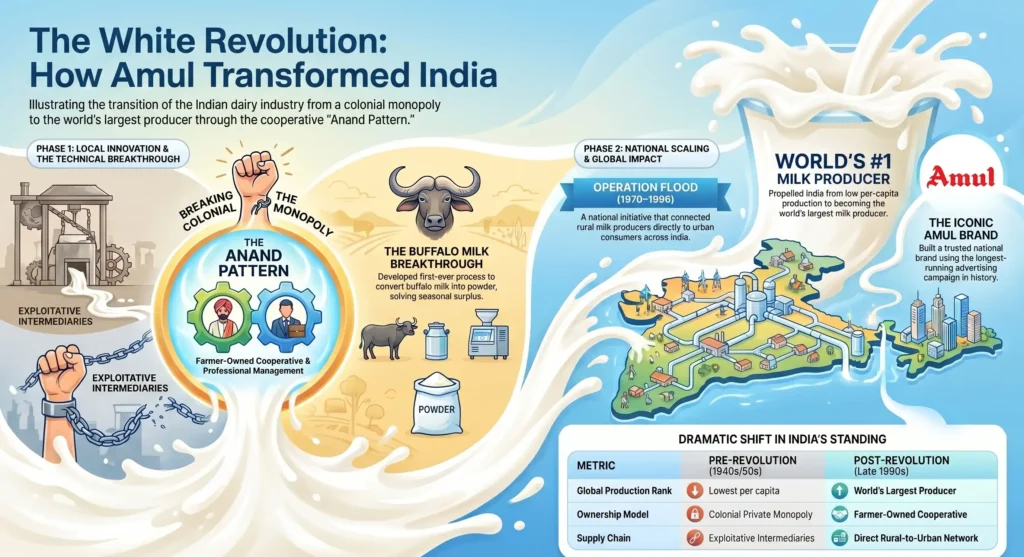
The Polson Dairy Company held a colonial era monopoly on milk procurement in Kaira district. The monopoly controlled every dimension of the milk trade in the district. Farmers were required to sell their milk to Polson at prices Polson set, with no alternative buyers and no leverage to negotiate. The arrangement was entirely profitable for Polson and its shareholders. It was exploitative for the farmers who produced the milk and received a fraction of the value that their animals and their labor generated.
The farmers had already begun organizing before Kurien arrived. Tribhuvandas Patel, a follower of Sardar Vallabhbhai Patel, had been working with the farmers of Kaira district to establish a cooperative that would allow them to collect, process and sell their own milk, cutting out the Polson middleman entirely. The Kaira District Cooperative Milk Producers Union had been established in 1946 with this purpose. What the cooperative lacked was technical capability. Processing milk at the scale required to supply the Bombay Milk Scheme, the government program that supplied pasteurized milk to the city of Bombay, required pasteurization equipment, refrigeration, quality control and the technical management of a perishable commodity across a complex supply chain. The farmers had the milk. They did not have the engineering knowledge to turn the milk into a commercially viable supply operation. Tribhuvandas Patel recognized that Kurien had that knowledge and persuaded the young engineer to stay in Anand and apply those skills to the cooperative’s development.
The Man Who Stayed When He Did Not Plan To
Understanding what Kurien built requires understanding what he gave up to build it. He was a Keralite Christian engineer with a government scholarship education in America and skills that would have given him access to comfortable professional careers in Indian cities or in international organizations. Anand in 1949 was a small town in Gujarat with few of the professional or social amenities that someone with his background and qualifications would have expected from a career posting.
Kurien later described the decision to stay as the moment that defined the rest of his life. Not a dramatic revelation but a simple recognition that the problem in front of him was real, that he had the capability to help address it and that walking away from it would be a form of abandonment he could not justify to himself. He stayed. He never really left.
The Buffalo Milk Breakthrough
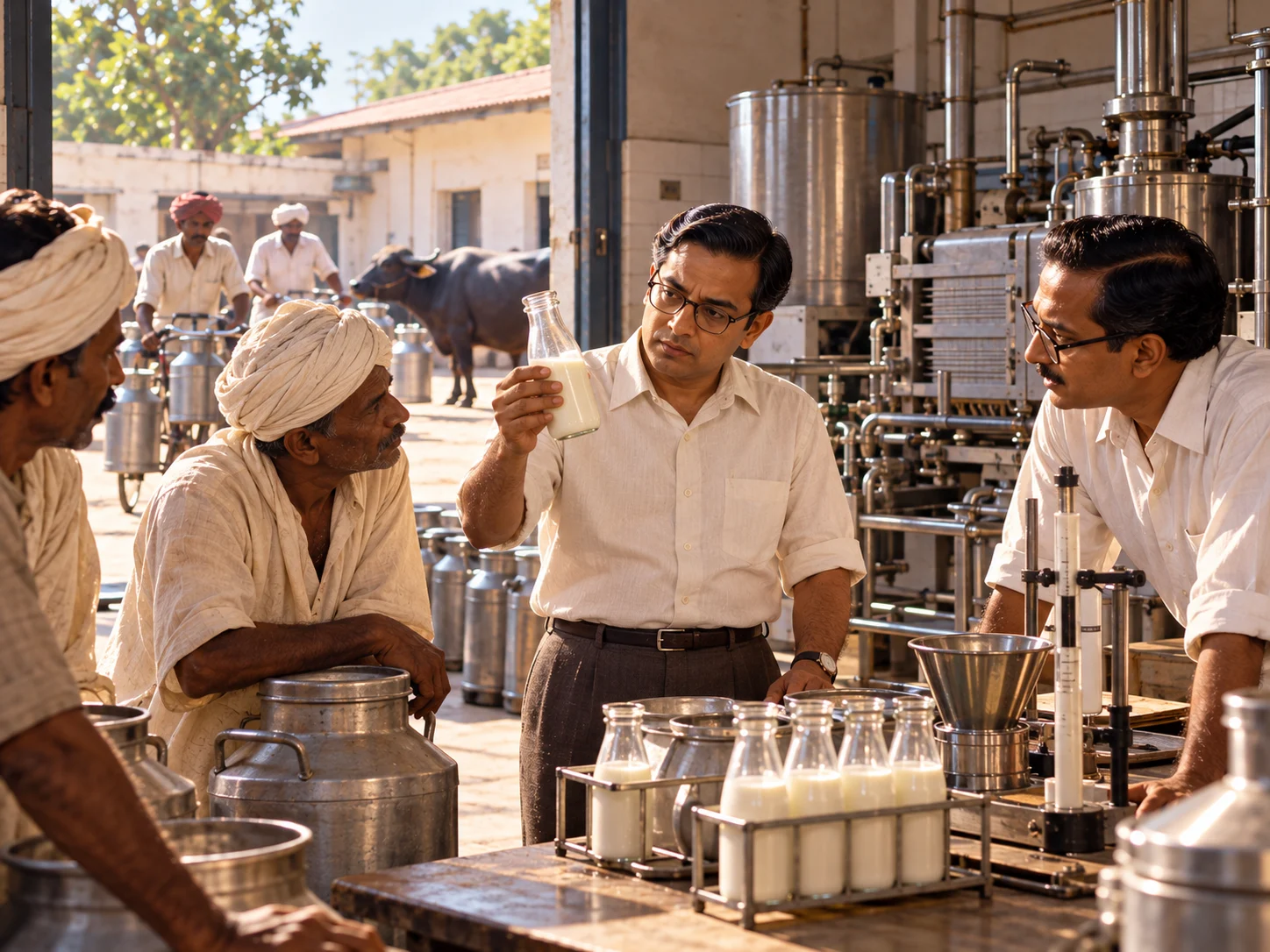
The breakthrough that established the Kaira cooperative’s viability and eventually created the foundation for the entire Amul enterprise was a technical one. The cooperative was competing with Polson to supply liquid milk to the Bombay Milk Scheme. But the farmers of Kaira district kept not only cows but also buffaloes, and buffalo milk presented a problem: it could not be processed using the milk powder technology that was standard at the time because the existing technology had been developed for cow’s milk.
Kurien, working with his colleague H.M. Dalaya, developed a process for making milk powder from buffalo milk. This was a technical achievement that no one had managed before, and it was significant not only for the Kaira cooperative but for the entire Indian dairy industry, which overwhelmingly relied on buffalo milk rather than cow’s milk. The process allowed the cooperative to convert surplus milk into powder during periods of high production and reconstitute it during periods of shortage, solving the fundamental problem of managing a perishable commodity across the irregular production cycles of small farmers.
This technical solution, developed in a small dairy in Anand by engineers working on a practical problem for a farmers cooperative, became the foundation on which the entire Amul enterprise was built. It also attracted the attention of the United Nations Children’s Fund, which recognized that the cooperative model being developed in Anand had the potential to address milk scarcity and childhood malnutrition across India.
Hidden Networks of Aruna Asaf Ali During Underground Years
Operation Flood and National Transformation
The success of the Kaira cooperative attracted the attention of Lal Bahadur Shastri, who visited Anand in 1964 and was sufficiently impressed by what Kurien had built to ask him to replicate the model across India. Shastri’s successor Indira Gandhi continued and expanded this support, commissioning Kurien to lead what became known as Operation Flood, the largest agricultural development program in Indian history.
Operation Flood, which ran from 1970 to 1996, used funding from the World Bank and commodity donations from the European Community to build a national network of dairy cooperatives modeled on the Anand pattern. The program connected rural milk producers across India to urban consumers through a cooperative infrastructure that gave farmers ownership of the supply chain rather than making them dependent on commercial intermediaries.
The results were extraordinary. India’s milk production, which had been among the lowest per capita in the world when Operation Flood began, grew to make India the largest producer of milk in the world by the late 1990s. The nutrition implications of this transformation were equally significant. Milk, which had been a scarce and expensive commodity for many Indian families, became widely available and affordable. The World Bank’s own evaluation of Operation Flood, published through its development research program, described it as one of the most successful agricultural development programs ever undertaken anywhere in the world, noting both the scale of the production increase and the fact that the benefits accrued primarily to the farmers who owned the cooperatives rather than to corporate intermediaries.
The Amul Brand
Amul as a brand was developed within the cooperative framework rather than by a private company seeking to maximize shareholder returns. The brand’s management, its advertising and its product development were all conducted in service of the cooperative’s primary purpose: ensuring that the farmers who produced the milk received a fair price for their product.
The Amul girl, the cartoon mascot created by the advertising agency daCunha Communications in 1966, became one of the most recognizable advertising figures in Indian history, appearing on hoardings across the country with topical commentary on current events for over five decades. The campaign is considered one of the longest-running advertising campaigns in the world and is remarkable for having built one of India’s most trusted brands in the service of a farmer owned cooperative rather than a private corporation.
The brand’s extension into products beyond liquid milk, into butter, cheese, ice cream, chocolate and an expanding range of processed dairy products, was driven by the same logic that drove the original cooperative: creating value from milk that went back to the farmers who produced it rather than to corporate shareholders.
Discovering The Hearty Zan Millet Porridge
The National Dairy Development Board and the Anand Pattern
Kurien led the National Dairy Development Board from 1965 to 1998, using it as the institutional vehicle for spreading the Anand pattern across India and for providing technical assistance to cooperative dairy development programs in other countries. The Anand pattern of cooperative dairy development, as the model Kurien built came to be called, has been studied and adapted by dairy development programs across Asia, Africa and Latin America. Its core principles, farmer ownership of the cooperative, professional management of the processing and marketing operations and democratic governance of the overall enterprise, have proven transferable across very different social and agricultural contexts.
Kurien’s approach to the relationship between technical expertise and farmer ownership was consistently clear throughout his decades of work. He believed that professional management was necessary to run a complex dairy processing and marketing operation efficiently. He was equally insistent that the ownership and the governance of the cooperative had to remain with the farmers who produced the milk. Professional managers worked for the cooperative. They did not own it. That distinction was not negotiable.
Strength of Kushal Konwar and the Assam Martyrs of 1942
Quick Comparison Table
| Feature | Verghese Kurien, Amul | G.D. Birla | Shiv Nadar, HCL | Kiran Mazumdar Shaw, Biocon |
| Industry | Dairy, cooperative | Textiles, cement | Information technology | Biotechnology |
| Model | Cooperative, farmer owned | Private corporate | Private corporate | Private corporate |
| Primary Beneficiary | Rural farmers, consumers | Shareholders, employees | Shareholders, employees | Patients, shareholders |
| Starting Point | Village milk cooperative | Family trading business | Calculator assembly | Enzyme license |
| National Impact | Transformed Indian dairy, nutrition | Built industrial India | Built Indian IT | Built Indian biotech |
Curious Indian: Fast Facts
- Verghese Kurien arrived in Anand in 1949 to serve out a government bond obligation and intended to leave as soon as it was completed.
- The technical breakthrough that made the Amul cooperative viable was a process for making milk powder from buffalo milk, developed by Kurien and his colleague H.M. Dalaya.
- Operation Flood, which Kurien led from 1970 to 1996, is described by the World Bank as one of the most successful agricultural development programs ever undertaken.
- India became the world’s largest producer of milk by the late 1990s as a direct result of the cooperative dairy network built through Operation Flood.
- The Amul girl advertising campaign, created in 1966, is one of the longest running advertising campaigns in the world.
- Kurien led the National Dairy Development Board from 1965 to 1998, using it to spread the Anand pattern of cooperative dairy development across India and internationally.
- Tribhuvandas Patel, the farmer leader who persuaded Kurien to stay in Anand, was the other essential figure in the founding of the Kaira cooperative.
- Kurien received the Ramon Magsaysay Award in 1963 and the Padma Vibhushan in 1999 for his contribution to Indian agricultural development.
The Recognition and the Legacy
Kurien received the Ramon Magsaysay Award in 1963 and the Padma Vibhushan in 1999 for his contribution to Indian agricultural development. The recognition came later than his achievement warranted, but it acknowledged what the dairy farmers of India had known for decades: that one engineer’s decision to stay in a small town in Gujarat for two years had led to a transformation that shaped the agricultural economy of the entire nation.
Verghese Kurien did not set out to transform Indian agriculture. He set out to complete a government bond obligation and find a better job. The transformation happened because he encountered a problem that he could help solve and because he was persuaded by a farmer leader named Tribhuvandas Patel that the problem was worth the years of his life it would take to solve it.
What he built was not simply a dairy company or even a network of dairy cooperatives. It was a proof of concept for a different way of organizing economic activity, one in which the people who produce something own the enterprise that processes and sells it, in which professional expertise serves farmer interests rather than extracting value from them and in which the scale of the operation is built in the service of the people at its base rather than at their expense.
That proof of concept worked in Kaira district. It worked across India. It has been studied and adapted across the developing world. India went from being among the lowest per capita milk producers in the world to being the largest milk producer in the world, and the nutritional implications of that transformation for hundreds of millions of Indian families are incalculable.
The man who did not want to stay in Anand stayed for five decades. He turned a village struggle against a colonial dairy monopoly into the largest dairy cooperative movement in the world. He made India self-sufficient in milk. He built a brand that every Indian knows. And he did all of it without ever losing sight of the principle that the farmer who produces the milk should be the one who benefits from it.
Double Ikat Patola of Patan and Why It Takes a Year to Weave
If you think you have remembered everything about this topic take this QUIZ
Results


#1. In which year did Verghese Kurien arrive in Anand, Gujarat, as a government dairy engineer to serve out his bond obligation?
#2. Which private company held a colonial-era monopoly on milk procurement in Kaira district before the cooperative movement challenged it?
#3. Who was the essential farmer leader who organized Kaira’s early cooperative and later persuaded Verghese Kurien to stay in Anand?
#4. Verghese Kurien and his colleague H.M. Dalaya achieved a major global technical breakthrough by creating milk powder from what source?
#5. Launched in 1970 under Kurien’s leadership, what is the name of the historic project recognized as the largest agricultural development program in Indian history?
#6. Which international organization recognized Amul’s early cooperative model for its potential to simultaneously fight childhood malnutrition and milk scarcity?
#7. In which year was the iconic “Amul girl” cartoon mascot created by daCunha Communications, sparking one of the world’s longest-running ad campaigns?
#8. Which prestigious international honor did Verghese Kurien receive in 1963 for his monumental contribution to community leadership and agricultural development?
Who was Verghese Kurien and what did he build?
Verghese Kurien was a dairy engineer from Kerala who arrived in Anand, Gujarat in 1949 to serve a government bond obligation and stayed for five decades to build the cooperative dairy movement that transformed Indian agriculture. He developed the technical processes that made the Kaira District Cooperative Milk Producers Union viable, led Operation Flood from 1970 to 1996 and built the Gujarat Cooperative Milk Marketing Federation and the Amul brand into the institutions that made India the world’s largest producer of milk.
What was the Polson Dairy monopoly and why did it matter?
The Polson Dairy Company held a colonial era monopoly on milk procurement in Kaira district, allowing it to set the prices at which it bought milk from farmers with no competition and no farmer recourse. The monopoly meant that the value created by the farmers’ animals and labor was captured primarily by a British owned company rather than by the farmers themselves. The cooperative movement that produced Amul was founded specifically to break this monopoly and return the value of milk production to the farmers who created it.
What was the technical breakthrough that made the Amul cooperative viable?
Kurien and his colleague H.M. Dalaya develop a process for making milk powder from buffalo milk, which had not previously been achieved because existing milk powder technology had been developed for cow’s milk. This was significant because Indian farmers kept far more buffaloes than cows, and without the ability to process buffalo milk into powder the cooperative could not manage the surplus production that occurred during peak seasons. The breakthrough made it possible to operate a large-scale dairy cooperative in Indian conditions.
What was Operation Flood and what did it achieve?
Operation Flood was an agricultural development program that ran from 1970 to 1996 under Kurien’s leadership, using World Bank funding and European Community commodity donations to build a national network of dairy cooperatives modeled on the Anand pattern. It connected rural milk producers across India to urban consumers through a cooperative infrastructure that gave farmers ownership of the supply chain. India went from being among the lowest per capita milk producers in the world to being the largest producer of milk in the world during this period.
Why is the Amul cooperative model considered significant beyond India?
The Anand pattern of cooperative dairy development has been studied and adapted by dairy development programs across Asia, Africa and Latin America because its core principles have proven transferable across different social and agricultural contexts. The combination of farmer ownership, professional management and democratic governance of the overall enterprise represents an approach to agricultural development that delivers benefits to producers rather than to corporate intermediaries, and the scale of India’s dairy transformation provides evidence that the model can work at national scale.