Kushal Konwar was a schoolteacher, Congress worker, and freedom fighter from Golaghat district in Assam whose execution by the British colonial government on 15 June 1943 made him the last martyr of the Quit India Movement and one of the most significant figures of Assamese resistance to colonial rule. Accused of planning the derailment of a British troop train near Sarupathar in 1942, he was tried before a special wartime tribunal on evidence that was contested at the time and has been examined critically by historians since. His composure during trial and imprisonment, his refusal to seek clemency, and the specific quality of dignity he brought to his final weeks in Jorhat Central Jail place him in the company of the finest figures of the Indian revolutionary tradition. The Assam martyrs of 1942, including Kanaklata Barua, Mritunjoy Barua, and Mukunda Kakati, together represent a chapter of the freedom movement whose depth and courage the national narrative has never fully acknowledged.| Detail | Information |
|---|---|
| Full Name | Kushal Konwar |
| Born | 3 November 1905, Simen Chapori, Golaghat district, Assam |
| Died | 15 June 1943, Jorhat Central Jail, Assam |
| Age at Death | 37 years |
| Revolutionary Organisation | Indian National Congress, Quit India Movement |
| Primary Charge | Derailment of a British troop train near Sarupathar, 1942 |
| Trial | Special Tribunal, conducted under wartime emergency provisions |
| Sentence | Death by hanging |
| Title | Last martyr of the Quit India Movement |
| Associated Martyrs | Kanaklata Barua, Mritunjoy Barua, Mukunda Kakati |
| Spiritual Affiliation | Vaishnavite tradition of Assam, Ekasarana dharma |
| Legacy | Kushal Konwar is remembered as the last person hanged by the British in Assam |
How Assam’s Schoolteacher Was Hanged on Insufficient Evidence
Kushal Konwar was a schoolteacher and Congress worker from Golaghat district in Assam whose execution by the British colonial government on 15 June 1943 made him the last martyr of the Quit India Movement and one of the most significant figures of Assamese resistance to colonial rule. Accused of planning the derailment of a British troop train near Sarupathar in 1942, he was tried before a special wartime tribunal on evidence that was contested at the time and has been examined critically by historians since. His composure during trial and imprisonment, his refusal to seek clemency, and the specific quality of dignity he brought to his final weeks in Jorhat Central Jail place him in the company of the finest figures of the Indian revolutionary tradition. The Assam martyrs of 1942, including Kanaklata Barua, Mritunjoy Barua, and Mukunda Kakati, together represent a chapter of the freedom movement whose depth and courage the national narrative has never fully acknowledged.
The Weight of 1942 in Assam
The year 1942 arrived in Assam with a specific kind of weight that the rest of India did not quite share. The Japanese army had already occupied Burma. The bombing of Dibrugarh had made the war physically present in Assamese daily life in ways that no other Indian province was experiencing from the east. The British colonial administration, alarmed by the possibility of a Japanese advance into Assam and simultaneously confronted with the Quit India Movement that Gandhi had launched in August, was governing with the particular ruthlessness that colonial administrations adopt when they feel genuinely threatened from two directions at once.
Into this specific historical moment, Kushal Konwar walked with the deliberate calm of a man who had already decided what he was willing to give and was not going to be persuaded to give less.
He was a schoolteacher from Simen Chapori in Golaghat district, a man of modest material circumstances and immodest moral seriousness, formed by the Vaishnavite tradition of Assam that the sixteenth century saint-reformer Srimanta Shankardev had established and whose emphasis on devotion, simplicity, and the equality of all persons before the divine had shaped the spiritual imagination of the Assamese people across four centuries. He was a Congress worker of long standing, active in the civil disobedience movements of the 1930s, known in his district as a man of principle and effectiveness. When Gandhi gave the Quit India call from Bombay on 8 August 1942, Kushal Konwar was already prepared for whatever came next. What came next was the most consequential and the most terrible period of his life, and he faced it with a quality of strength that the British colonial record, despite its obvious interest in diminishing him, cannot entirely obscure.
The Quit India Movement in a Wartime Province
The Quit India Movement reached Assam with an intensity that reflected the province’s particular combination of political mobilisation and wartime anxiety. The British administration in Assam had already been governing under emergency conditions because of the Japanese threat, and the Quit India proclamation gave it the legal and political justification to escalate its repressive measures to a level that went beyond what was occurring in most other Indian provinces.
Congress leaders across Assam were arrested within days of the Quit India proclamation. The provincial leadership was in jail or in hiding. The movement that continued in the absence of its established leadership was necessarily more decentralised, more locally organised, and more dependent on the initiative and courage of individual workers and communities than the more structured phases of the freedom movement had been.
In Golaghat district, this decentralised resistance took various forms. Public meetings were organised despite the ban on such gatherings. Government offices were targeted for symbolic disruption. Communications infrastructure, which the British colonial government was using intensively for its wartime operations, became a target for sabotage by movement participants who understood that disrupting the colonial war machine was a form of resistance to colonial rule.
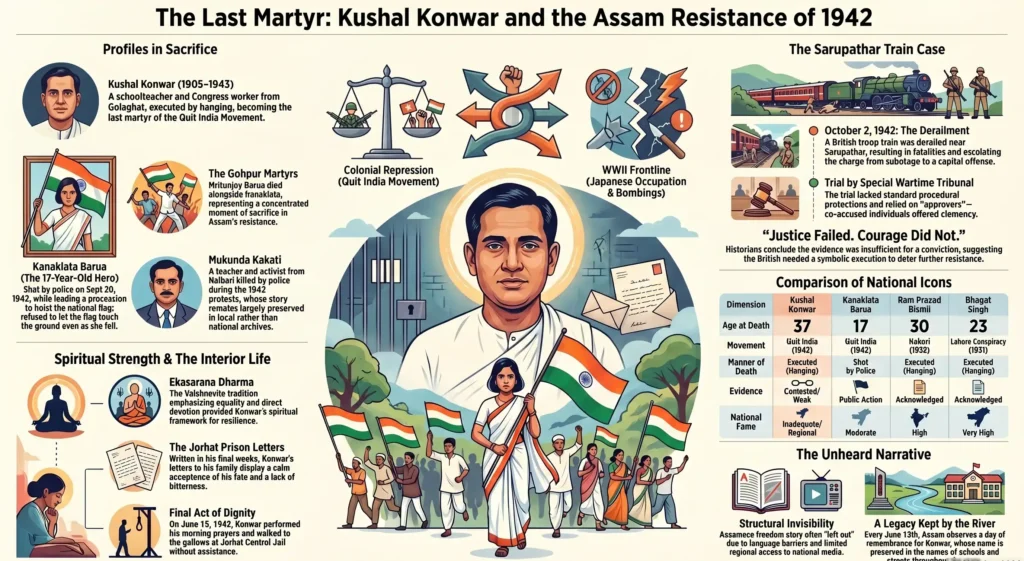
The specific act for which Kushal Konwar was ultimately hanged was the derailment of a British troop train near Sarupathar on 2 October 1942. The derailment caused the deaths of several soldiers, a fact that the British colonial government used to elevate the charge against the accused from sabotage to an offence carrying the death penalty.
The Question at the Heart of His Case
The question of who planned and executed the Sarupathar train derailment, and what Kushal Konwar’s actual involvement in it was, is the central factual dispute of his case and the point at which the historical record becomes most contested and most important to examine carefully.
Kushal Konwar was arrested in November 1942, several weeks after the Sarupathar derailment. The evidence against him was presented before a special tribunal constituted under the wartime emergency provisions that the colonial government had enacted following the Quit India proclamation. These special tribunals did not provide the procedural protections of ordinary criminal courts. Appeals were severely restricted. The rules of evidence were applied with a flexibility that favoured the prosecution.
The primary evidence against Kushal Konwar consisted of the testimony of approvers, co-accused individuals who had agreed to testify against their fellow accused in exchange for clemency. This form of evidence, dependent on the testimony of people who have a personal interest in the conviction of those they are testifying against, is treated with great caution in systems of criminal justice that take the reliability of evidence seriously. The special wartime tribunal under which Kushal Konwar was tried was not constituted with such caution as its primary concern.
The lawyers who represented Kushal Konwar and his co-accused argued at the time that the approver testimony was unreliable, that Kushal Konwar’s presence at the planning of the derailment had not been established beyond reasonable doubt, and that the application of the death penalty to a man whose involvement in the specific act charged had not been conclusively proven was a miscarriage of justice.
These arguments did not save Kushal Konwar. They were noted in the trial record, overruled by the tribunal, and the death sentence was confirmed.
Subsequent historical scholarship on the Quit India Movement in Assam, including research conducted by historians at Gauhati University and the Assam State Archives whose documentation of the 1942 movement in Assam provides the most comprehensive available record of the period, has revisited the evidence against Kushal Konwar with a critical attention that the wartime tribunal did not apply. The consensus among these scholars is that the evidence against him was insufficient by any standard of proof that would be applied outside the specific political emergency context in which his trial occurred.
The British colonial government needed a conviction. It needed to demonstrate that the disruption of its troop movements in Assam would be met with the most severe consequences available. Kushal Konwar was a known Congress worker of demonstrated commitment to the independence cause, present in Golaghat district at the time of the derailment, and connected through his organisational work to others who were more directly involved. In the colonial calculus, this was sufficient.
It was not sufficient by any honest standard of justice. Kushal Konwar appears to have understood this, and his response to the insufficiency of the case against him was not to argue his innocence more loudly but to accept the consequence of his political life with a grace that rendered the tribunal’s inadequacy more visible rather than less.
Bagha Jatin: German Plot That Shook Colonial India 1915
The Man and His Tradition
Kushal Konwar was born on 3 November 1905 in Simen Chapori, a village in Golaghat district in the Brahmaputra valley of Assam. His family was not wealthy but was not without education, and he trained as a teacher, a profession that placed him at the centre of his community’s aspirations for the future and gave him a platform of social respect from which his Congress work could proceed with some institutional credibility.
The Assam of his formation was a province that had been under British administration since 1826, following the Treaty of Yandabo that ended the First Anglo-Burmese War and transferred Assamese sovereignty to the East India Company. The specific texture of colonial rule in Assam was shaped by the province’s strategic importance as a source of tea, oil, and timber, and by the dramatic demographic changes brought by the immigration of tea garden labourers from central India and the settlement of Bengali Muslim agricultural communities in the Brahmaputra valley’s char lands.
The Assamese cultural and political identity that Kushal Konwar grew up within was therefore one already navigating the complexities of a colonial province whose demographic and economic landscape had been transformed by the specific requirements of imperial extraction. The Congress movement in Assam was not simply about independence from British rule. It was also about recovering an Assamese cultural and political voice in a province whose colonial transformation had made that voice increasingly difficult to hear.
The Vaishnavite tradition of Assam, rooted in Srimanta Shankardev’s sixteenth-century reform movement, provided Kushal Konwar with a spiritual framework whose emphasis on the equality of all persons, the sufficiency of direct devotion to the divine without caste-based intermediaries, and the moral imperative of a life lived in service to others was entirely consistent with the Congress movement’s values as he understood them. He was not a man for whom political conviction and spiritual life were separate dimensions of existence. They were expressions of the same fundamental orientation toward the world.
His Congress work in Golaghat district through the 1930s was of the patient, organisational kind that makes mass movements possible but rarely generates the kind of heroic individual narrative that historical memory preserves most easily. He organised, he persuaded, he built the local infrastructure of the movement’s presence in his district. When the Civil Disobedience Movement campaigns of the early 1930s required local workers willing to face arrest, he was among them.
By the time the Quit India call came in August 1942, Kushal Konwar had been a committed Congress worker for more than a decade. He had been arrested before. He knew what the inside of a British jail looked like. He was not under any illusion about what the renewed escalation of resistance against the colonial government would cost him personally.
He gave the Quit India call everything he had anyway.
Ceremonial Preparation of Karah Parshad in Sikh Gurdwaras
Kanaklata Barua and the Other Martyrs
Kushal Konwar’s execution in June 1943 is the most famous single act of British repression against the Quit India Movement in Assam, but it did not occur in isolation. The months between August 1942 and June 1943 produced a series of deaths in Assam that together constitute one of the most significant chapters of the freedom movement in the northeast, a chapter whose full weight the national narrative of independence has never quite absorbed.
Kanaklata Barua was seventeen years old on 20 September 1942 when she was shot by the police at Gohpur in Darrang district while leading a procession carrying the national flag to the local thana. She had taken up the flag when its previous bearer was shot and fallen. She carried it forward knowing what would happen. The police shot her. She fell with the flag, which another member of the procession picked up before it touched the ground.
Kanaklata Barua was born on 22 December 1924 in Barangabari village in Darrang district. She had lost her mother as a child and had grown up in the particular way that children who lose parents early sometimes grow up, with a seriousness and a self-sufficiency that her community recognised and respected. She had joined the Congress movement as a teenager, drawn by the same combination of political conviction and personal moral seriousness that characterised the best of her generation.
Her death at seventeen, carrying a flag toward a police line that she knew would shoot, is one of those acts of courage so complete and so simple that its full weight is almost impossible to carry in consciousness for very long. She knew what she was doing. She did it anyway. The flag did not touch the ground.
Kanaklata Barua received the Veer Chakra posthumously, recognising her courage in terms that the military tradition uses for soldiers under fire in battle, which is exactly what she was. She was seventeen.
Mritunjoy Barua died on the same day as Kanaklata, at the same police action at Gohpur, one of the several martyrs of that specific September morning whose deaths together constitute one of the most concentrated moments of sacrifice in the Quit India Movement anywhere in India.
Mukunda Kakati was a teacher and Congress worker from Nalbari district who was killed by police during the Quit India protests of 1942, one of the many movement participants in Assam whose deaths in police actions during this period are documented in the Assam State Archives but remain unknown outside the specific communities that mourned them.
These deaths, and the many others that occurred across Assam during the 1942 movement, formed the context within which Kushal Konwar’s trial and execution took place. The British colonial government was not simply trying one man for one act of sabotage. It was attempting, through the spectacle of a death sentence confirmed and carried out, to communicate to an entire province that the cost of resistance had no ceiling.
Kushal Konwar received this communication and declined to be deterred by it.
How Azim Premji Turned Cooking Oil Into a Technology Empire
The Prison Letters
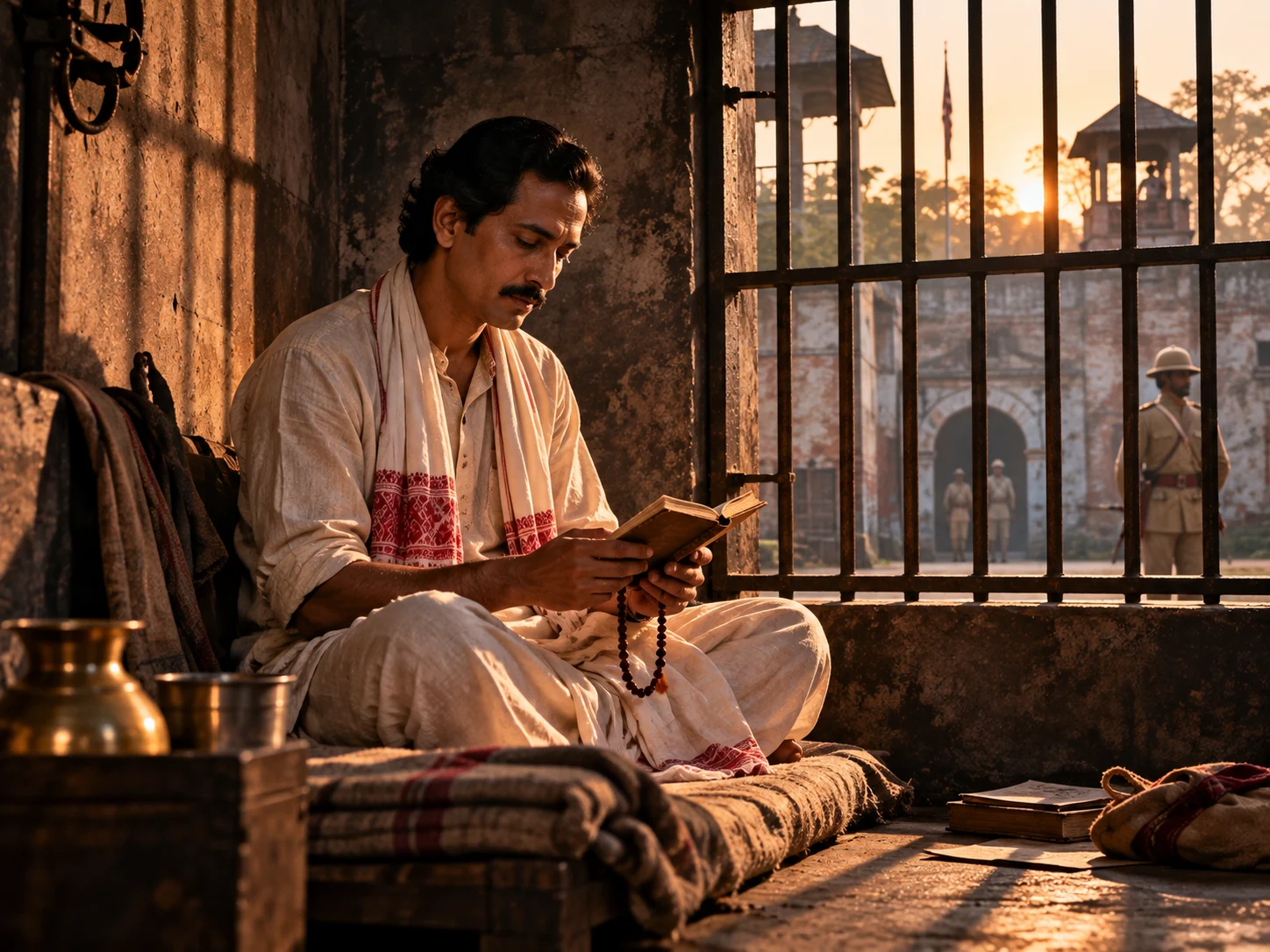
The letters that Kushal Konwar wrote from Jorhat Central Jail in the weeks between his sentencing and his execution are among the most important documents of the Assamese freedom movement and among the least known outside Assam. They have been preserved in family and community archives and partially published through Assamese-language historical compilations, but they have never received the English-language scholarly attention that comparable documents from the Bengal or Punjab revolutionary tradition have received.
What the letters reveal is a man of considerable intellectual and emotional range, using his final weeks not to dwell on his own situation but to address the people he loved and the cause he served with a quality of attention that reflects neither sentimentality nor bravado but something considerably more interesting than either.
He writes to his family with a directness about the finality of what is approaching that refuses to pretend the situation is other than it is, combined with an equal directness about why he has no regret for the choices that brought him to it. He writes about his children with the particular tenderness of a parent who knows he will not see them grow up, and who is trying to communicate, in whatever space a prison letter allows, the things he would have said to them over the decades he will not have.
He writes about the freedom movement with the long view of someone who understands that individual martyrdom is not the end of the story but a contribution to a process whose completion he will not witness but whose eventual outcome he does not doubt. He is not afraid. He is sad, specifically and humanly sad about what he will not see and what the people he loves will have to live through without him. But the sadness exists alongside, not instead of, a quality of conviction and peace that the letters communicate with remarkable consistency.
His references to the Vaishnavite tradition that formed him appear not as consolation in any desperate sense but as a framework through which he is able to understand his situation as continuous with the deepest values of his life rather than as a contradiction of them. The Ekasarana dharma of Shankardev, with its emphasis on the sufficiency of sincere devotion and the insignificance of external circumstance in relation to interior spiritual state, provided Kushal Konwar with exactly the tools his final weeks required.
He did not seek clemency. This is worth stating directly and clearly. He had opportunities to appeal, to petition, to make the kind of submission to colonial authority that might have reduced his sentence. He declined them all. Not from stubbornness or from a performative heroism that needed an audience, but from the same interior certainty that his letters express throughout: that the choices he had made were right, that the consequences of those choices were being imposed unjustly, and that seeking to escape those consequences by submitting to the authority that was imposing them would be a form of dishonesty about what he believed.
The Morning of 15 June 1943
The morning of 15 June 1943 in Jorhat Central Jail is documented in the prison records preserved in the Assam State Archives. Kushal Konwar woke before dawn. He performed his morning prayers in the Vaishnavite tradition, the ritual recitation of the names of Vishnu and the devotional practice that Shankardev had prescribed as sufficient for any sincere devotee. He ate the simple meal offered to him. He walked to the place of execution without assistance.
The accounts of those present describe a quality of stillness that the prison officials found difficult to categorise. He was not numb. He was not dissociated from what was happening. He was present, completely present, in the specific way that the letters from his final weeks had demonstrated he was capable of being present: with full awareness of the reality of his situation and full acceptance of the values that had brought him to it.
He was thirty-seven years old.
Double Ikat Patola of Patan and Why It Takes a Year to Weave
Quick Comparison Table
| Dimension | Kushal Konwar | Kanaklata Barua | Ram Prasad Bismil | Bhagat Singh |
|---|---|---|---|---|
| Born | 1905, Golaghat, Assam | 1924, Darrang, Assam | 1897, Shahjahanpur, UP | 1907, Lyallpur, Punjab |
| Age at Death | 37 | 17 | 30 | 23 |
| Movement | Quit India Movement, 1942 | Quit India Movement, 1942 | Non-cooperation, Kakori, 1925 | Non-cooperation, Lahore Conspiracy, 1931 |
| Manner of Death | Executed by hanging, Jorhat, 1943 | Shot by police, Gohpur, 1942 | Executed by hanging, Gorakhpur, 1927 | Executed by hanging, Lahore, 1931 |
| Evidence Against | Contested, approver testimony under wartime tribunal | Direct martyrdom in public action | Acknowledged revolutionary leader | Acknowledged revolutionary leader |
| Literary Legacy | Prison letters in Assamese | No written legacy | Sarfaroshi Ki Tamanna, Aatmakatha | Extensive ideological writings |
| Spiritual Identity | Vaishnavite, Ekasarana dharma of Shankardev | Vaishnavite Assamese tradition | Arya Samaj, Vedantic practice | Atheist, Marxist influence |
| National Recognition | Inadequate relative to significance | Veer Chakra, moderate recognition | Moderate national recognition | Very high, national icon |
Curious Indian: Fast Facts
- Kushal Konwar is remembered as the last martyr of the Quit India Movement, executed on 15 June 1943 in Jorhat Central Jail, Assam, making him the last person hanged by the British colonial government in Assam for freedom movement activities.
- The evidence on which Kushal Konwar was convicted for the Sarupathar train derailment of 2 October 1942 consisted primarily of approver testimony presented before a special wartime tribunal that did not provide the procedural protections of ordinary criminal courts, a fact that has led multiple historians to question the adequacy of his conviction.
- Kanaklata Barua, one of the most celebrated Assam martyrs of the Quit India Movement, was only seventeen years old when she was shot by police at Gohpur in Darrang district on 20 September 1942 while leading a flag-bearing procession, having picked up the national flag when its previous bearer was shot and fallen.
- The Vaishnavite tradition of Assam established by the sixteenth-century saint-reformer Srimanta Shankardev, called Ekasarana dharma, emphasises the equality of all persons before the divine and the sufficiency of sincere direct devotion, a spiritual framework that shaped Kushal Konwar’s interior life through his imprisonment and execution.
- The Assam Quit India Movement of 1942 was conducted under particularly severe colonial repression because the British administration in Assam was simultaneously managing the Japanese military threat from Burma, making the provincial government more willing to use extreme measures against freedom movement participants than administrations in less strategically threatened provinces.
- Kushal Konwar refused all opportunities to seek clemency or appeal his death sentence, not from stubbornness but from the interior certainty, expressed consistently in his prison letters, that the choices he had made were right and that seeking to escape their consequences by submitting to colonial authority would compromise the values that had made those choices necessary.
- The prison letters that Kushal Konwar wrote from Jorhat Central Jail in the weeks between his sentencing and execution are preserved in family and community archives in Assam and have been partially published in Assamese-language historical compilations, but they have never received the English-language scholarly attention that comparable documents from the Bengal or Punjab revolutionary tradition have received.
- Mritunjoy Barua died on the same day as Kanaklata Barua, 20 September 1942, in the same police action at Gohpur in Darrang district, one of multiple Assam martyrs of that single September morning whose deaths together constitute one of the most concentrated moments of sacrifice in the Quit India Movement anywhere in India.
- The Assam State Archives in Guwahati holds the most comprehensive available documentation of the Quit India Movement in Assam, including trial records, police reports, and administrative correspondence related to the 1942 movement and the cases of Kushal Konwar and his co-accused, providing the primary archival basis for historical research on this period.
- Kushal Konwar was a schoolteacher by profession, a detail that connects him to a significant pattern within the Indian freedom movement in which teachers, whose role placed them at the centre of their communities’ aspirations for the future, were disproportionately represented among those who gave the most to the independence cause.
What the National Narrative Missed
The freedom movement of India is remembered, in the national narrative that has consolidated since 1947, primarily through the figures and events of its most visible and most extensively documented arenas, the Bengal revolutionary tradition, the Punjab martyrs, the Gandhian campaigns of the Hindi heartland, the political negotiations of the Congress leadership in Bombay and Delhi and Allahabad. This narrative is not false. These things happened and they mattered.
What the national narrative consistently underweights is the freedom movement as it was experienced and fought in the regions that did not produce the most prominent figures or the most extensively covered events, the northeastern provinces, the princely states, the tribal areas, the communities whose contributions to independence were no less real for being less visible.
Assam’s contribution to the Quit India Movement of 1942 was extraordinary in relation to the province’s size and resources. The Assamese resistance to British rule in 1942 was conducted under conditions that were more physically dangerous than those faced by most freedom movement participants in other provinces, because the Japanese military threat in Assam made the colonial government’s repressive response more severe and less constrained by the need to maintain appearances before a watching international community.
The deaths of Kanaklata Barua, Mritunjoy Barua, Mukunda Kakati, and Kushal Konwar in 1942 and 1943 represent the visible peaks of a much larger pattern of sacrifice and resistance in Assam that has never been adequately incorporated into the national freedom movement story. The specific texture of Assamese resistance, shaped by the Vaishnavite tradition, by the particular demographic and political pressures of a colonial province whose character had been transformed by tea capitalism and immigration, and by the physical proximity of the Japanese military advance, deserves a scholarly and narrative attention it has not received.
The reasons for this neglect are not mysterious. The national narrative of the freedom movement was constructed primarily by those who had the resources, the language access, and the institutional connections to construct it. The Assamese freedom movement’s story was told primarily in Assamese, preserved primarily in local archives, and championed primarily by regional rather than national voices. It has remained regional in its reach not because it is less important than the stories that achieved national reach but because the mechanisms of national narrative construction were not equally accessible to all parts of India.
Correcting this imbalance does not require diminishing the national narrative. It requires expanding it to include what it has left out, and what it has left out, in the case of Assam and the northeast more broadly, is substantial.
The Legacy and the River
In Assam today, Kushal Konwar is remembered with a specificity and a warmth that reflects the depth of what his life and death meant to the community that witnessed them most closely. The 15th of June, the anniversary of his execution, is observed in Golaghat district and across Assam as a day of remembrance. Schools in Assam bear his name. Streets in Golaghat carry his memory into the daily geography of the town he came from.
Kanaklata Barua’s memory is similarly alive in Assam, particularly in the Darrang district where she grew up and died. The image of a seventeen-year-old girl walking toward a police line carrying a flag is an image that the Assamese community has refused to let become merely historical, and her presence in Assamese cultural memory, in song, in literature, in the naming of institutions, in the specific way that her story is told to children in Assam’s schools, reflects the community’s understanding that her courage was of a kind that cannot be adequately honoured and therefore must be continuously remembered.
The broader group of Assam martyrs of 1942 are commemorated through the Assam State Archives’ documentation of the period, through the scholarship of historians at Gauhati University and Cotton University whose research on the Quit India Movement in Assam has produced some of the most careful historical work on this period available in any language, and through the living memory of communities across the Brahmaputra valley that were directly involved in the 1942 resistance.
The Government of India’s recognition of Kushal Konwar’s contribution to the freedom movement has been less comprehensive than his historical significance warrants. He has been commemorated on postage stamps and in official state government recognition, but the kind of sustained national institutional attention that comparable figures from other provincial traditions have received has not been extended to him or to the Assam martyrs of 1942 with any consistency.
Assam is a province of rivers. The Brahmaputra, one of the great rivers of Asia, runs through its heart from east to west, flooding the valley every monsoon with a generosity and a destructiveness that have shaped Assamese culture and agriculture and spiritual imagination across all of recorded history and considerably before it.
Kushal Konwar grew up in the Brahmaputra valley. He learned the Vaishnavite devotional tradition that Shankardev had planted in this landscape four centuries before his birth. He became a schoolteacher in a district where education was understood as the primary tool available to an ordinary family for improving its circumstances and contributing to its community. He joined the Congress movement because independence from British rule was the political expression of the same moral convictions that his faith and his profession had already established.
He was hanged on evidence that was contested then and has been questioned consistently since by every historian who has examined it with care. He was thirty-seven years old. He had children who grew up without a father. He had a community that had to absorb the specific grief of watching one of its best people killed by the government he had spent his adult life resisting.
And he walked to the gallows in Jorhat Central Jail in the early morning of 15 June 1943 with the same quality of deliberate, unhurried, undefeated presence that the letters from his final weeks had demonstrated he was capable of, because the alternative was to be less than he had spent thirty-seven years becoming.
The Brahmaputra is still flowing. It will be flowing long after every building that the British colonial administration constructed in Assam has crumbled into its banks. The tea gardens that the colonial economy planted on the bodies and labour of imported workers still produce their harvest. The Vaishnavite namaghars where Assamese communities gather for devotional singing still receive their congregations on the days that Shankardev prescribed.
And in Golaghat district, on the 15th of June every year, people who remember and people who have only heard gather to say the name of Kushal Konwar, and to think about what it costs to mean what you believe, completely and without reservation, in a world that is not always kind to those who do.
It costs what it cost him. And it was worth it. He knew it was worth it. He said so, in the letters, in the composure of his final weeks, in the quality of his walk to the gallows.
Assam heard him. The rest of India is still catching up.
Hidden Networks of Aruna Asaf Ali During Underground Years
If you think you have remembered everything about this topic take this QUIZ
Results


#1. Kushal Konwar, a schoolteacher and freedom fighter executed in June 1943, is historically remembered by what prominent title?
#2. What primary wartime charge did the British colonial government level against Kushal Konwar, leading to his trial before a special tribunal?
#3. Why do modern historians critically question the adequacy of Kushal Konwar’s conviction and ultimate hanging?
#4. Which 16th-century Assamese spiritual tradition and faith framework shaped Kushal Konwar’s interior peace and composure during his final weeks?
#5. In which specific facility was Kushal Konwar executed on the morning of June 15, 1943?
#6. Who was the 17-year-old female freedom participant shot by colonial police at Gohpur while leading a flag-bearing procession in September 1942?
#7. What posthumous military honor was bestowed upon Kanaklata Barua for her incredible courage under fire?
#8. Why was British colonial repression against the 1942 Quit India Movement particularly severe and ruthless within the province of Assam?
Who was Kushal Konwar and why is he significant to India’s freedom movement?
Kushal Konwar was a schoolteacher and Congress worker from Golaghat district in Assam who was executed by the British colonial government on 15 June 1943 for his alleged role in the derailment of a British troop train near Sarupathar during the Quit India Movement of 1942. He is significant as the last martyr of the Quit India Movement and as the most prominent symbol of Assamese resistance to British colonial rule during the critical period of 1942 to 1943. His execution on evidence that historians have consistently questioned makes his story not only one of personal courage but one of colonial injustice that has never received adequate national attention.
What was the Sarupathar train derailment and what was Kushal Konwar’s actual involvement?
The Sarupathar train derailment occurred on 2 October 1942 when a British troop train was derailed near Sarupathar in Golaghat district, causing deaths among the soldiers on board. Kushal Konwar was charged with planning and organising the derailment. The evidence against him consisted primarily of approver testimony presented before a special wartime tribunal. His lawyers contested the reliability of this evidence at the time, and subsequent historical scholarship has consistently questioned whether the evidence was sufficient to sustain the conviction. Many historians have concluded that Kushal Konwar may not have planned or executed the derailment and that the colonial government’s determination to make an example of a known Congress leader drove the prosecution more than the evidence warranted.
Who was Kanaklata Barua and why is she remembered as an Assam martyr?
Kanaklata Barua was a seventeen-year-old freedom movement participant from Barangabari village in Darrang district, Assam, who was shot by police on 20 September 1942 at Gohpur while leading a procession carrying the national flag to the local thana as part of the Quit India Movement. She had taken up the flag when its previous bearer was shot and fallen, and she carried it forward knowing what the police had already demonstrated they would do. She was shot and killed. She is remembered as one of the most powerful symbols of the Assam freedom movement, was awarded the Veer Chakra posthumously, and is particularly celebrated in Darrang district and across Assam for the completeness of her courage.
Why does the Assam freedom movement receive less national attention than movements in other provinces?
The Assam freedom movement’s relative invisibility in the national narrative reflects several interconnected factors. The national narrative of the independence movement was constructed primarily by those with access to the dominant languages, institutions, and media of the time, and Assamese voices were less connected to these mechanisms than voices from Bengal, Punjab, and the Hindi heartland. The Assam movement’s story was told primarily in Assamese, preserved primarily in regional archives, and championed primarily by regional rather than national voices. This regional confinement reflects not the lesser importance of the Assamese contribution but the structural inequalities of how national narratives get made and whose stories they consistently include.
How did Kushal Konwar’s Vaishnavite faith shape his response to imprisonment and execution?
The Vaishnavite tradition of Assam established by the sixteenth-century saint-reformer Srimanta Shankardev, called Ekasarana dharma, emphasises the equality of all persons before the divine, the sufficiency of sincere direct devotion, and the relative insignificance of external circumstance in relation to interior spiritual state. Kushal Konwar’s prison letters reflect a man drawing on this tradition to maintain a quality of interior peace and clarity in the face of unjust execution. His references to devotional practice in his final weeks are not desperate appeals for divine rescue but expressions of a spiritual framework that allowed him to understand his situation as continuous with the deepest values of his life rather than as a contradiction of them.