A colonel from Gujranwala died within two days of landing in Kashmir, and the place he told his men to hold was where Srinagar was saved
Dewan Ranjit Rai was born in Gujranwala in 1913. By October 1947 Gujranwala was in Pakistan, and he was in Gurgaon, commanding the 1st Battalion of the Sikh Regiment and spending his days on the refugees coming the other way.
At one in the afternoon on 26 October, orders reached Delhi to send a battalion to Srinagar. By midnight Rai had his headquarters and one company at Palam airfield, drawing ammunition, warm clothing and rations on the tarmac. They were in the air by first light.
The instructions for the landing were unusual. The pilots were to circle Srinagar airfield first and make sure it had not already fallen. If there was any doubt, they were not to land. They were to turn round and fly to Jammu.
Nobody in Delhi could say for certain that there was still an airfield to land on.
Thirty-five miles
The raiders had come over the border from the frontier in the third week of October, thousands of tribesmen in lorries and buses, with Pakistani officers behind them. They took Muzaffarabad, then Uri, then Baramulla on 26 October. The Maharaja signed the Instrument of Accession the same day. Between Baramulla and Srinagar there were about thirty-five miles of tarmac and nothing else.
Rai’s Dakota touched down at about half past nine on the morning of 27 October. The airfield was still there. He had two companies, short of two platoons once he had left a guard on the runway, and the rest of the battalion would not arrive until the next day. He decided the fight should happen as far from the city as he could take it. About 150 men went up the road and dug in on a hill above Baramulla. The town below them was burning.
The 10th Century Legacy: Halayudha Life Story Unfolded

Sukaphaa’s Crossing: How the Ahom Kingdom Was Born in Assam
A place name
The raiders came up the road in strength, three to four thousand of them, and began climbing the heights on either side to cut the Sikhs off. The Sikhs held until the afternoon and then fell back under fire. Rai stayed forward to see his men out. A shot from the paddy fields killed him. He was thirty-four, and he had been in Kashmir less than two days.
Before he died he gave the battalion its orders: fall back to the Shalateng spill channel, about four miles from Srinagar, and stop the raiders there.
The last thing he gave his battalion was a place name.
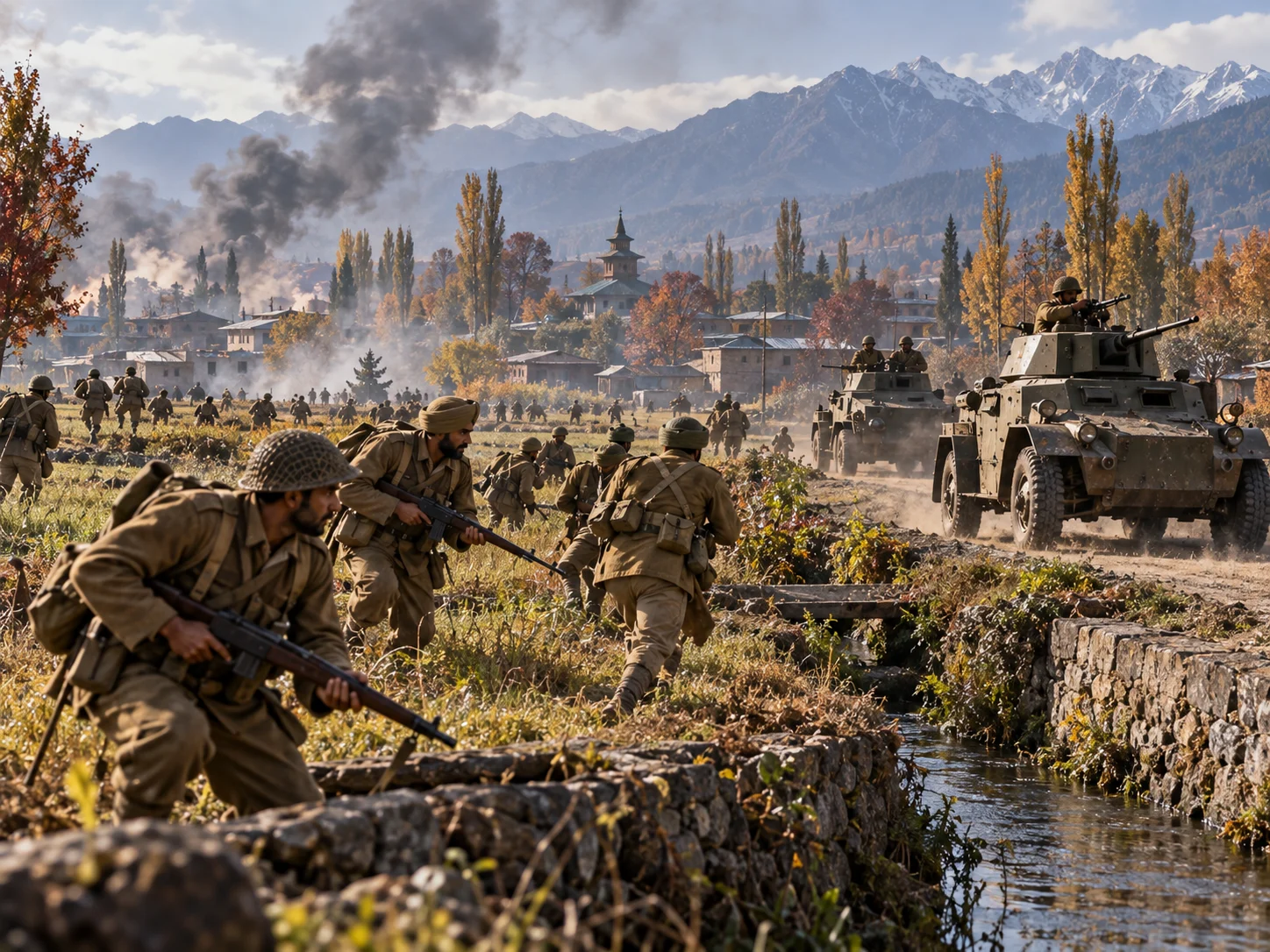
Major Harwant Singh took over. That night he judged the channel too easy to bypass and moved the battalion forward again to Pattan, halfway to Baramulla. At six the next morning the first raider vehicles drove into the Sikhs’ ambush, and the raiders spent the whole of 29 October trying to get past and could not. Behind them, the aircraft kept landing.
Eleven days
Srinagar filled up. More than a hundred civilian aircraft were pressed into flying troops and supplies. On 3 November Major Somnath Sharma’s company of 4 Kumaon was overrun at Badgam defending the airfield, and he was killed. A squadron of Daimler armoured cars of 7 Light Cavalry under Major Inder Jit Rikhye came up by road from Ambala, over the Banihal Pass at 9,000 feet, across bridges nobody had built for armour.
By then the Sikhs’ line had settled at the edge of the city, near Shalateng, where Rai had pointed. Major Sampuran Bachan Singh was commanding them. On 6 November an aerial patrol saw a large body of tribesmen gathered near the village, facing the Sikh positions and digging. They were getting ready for the last push into Srinagar.
Netaji Subhas Chandra Bose: Did He Really Die in 1945?
7 November
Brigadier L.P. Sen’s plan was to hold them from the front and close the ring behind. The Sikhs would stay where they were. 1 Kumaon and a company of 4 Kumaon would come in on the flanks. The armoured cars, arriving that morning, would go round the back.
A troop of them under Lieutenant Noel David worked its way behind the lashkar and opened fire from the rear. The Sikhs attacked from the front. Then 1 Kumaon under Lieutenant Colonel Pritam Singh came in on the flank, firing from the hip with bayonets fixed. Caught from three sides, the raiders broke and ran west across open fields, and the Spitfires and Tempests of the air force found them there. More than six hundred were left dead, with most of their weapons.
By evening 1 Sikh was back in Pattan. Baramulla was retaken by half past five the next day, and Uri by 13 November. The raiders never came that close to Srinagar again.
Eleven days after he named it, the battle that kept Srinagar in India was fought at Shalateng.
Infantry Day
Rai was awarded the Maha Vir Chakra after his death. The citation says he went forward at such personal risk that he was eventually killed, and that the raiders were stopped far enough away for the build-up that beat them. The Indian Army marks 27 October, the morning his battalion landed, as Infantry Day.
In September he had been finding room in Gurgaon for people who had lost their homes. In October he flew to a city that was about to lose its own, told his men where to stand, and did not live to see them stand there.
Koch Kingdom and Majuli Island: Assam’s Golden Age of Culture
Beyond the Stars: How Mahaviracharya Defined Modern Math
If you think you have remembered everything about this topic take this QUIZ
Results


#1. What was the primary ‘force multiplier’ Brigadier L.P. Sen used to overcome the numerical superiority of the tribal raiders?
#2. Which specific unit performed the daring wide-outflanking maneuver that surprised the raiders from the rear?
#3. Why did Brigadier L.P. Sen choose to maintain a ‘thin screen’ of defense initially?
#4. The Indian Air Force (IAF) provided critical support during the battle. Which aircraft were mentioned as being used to strafe the invaders?
#5. How long did the actual decisive phase of the Battle of Shalateng last once the assault began?
#6. What was the estimated strength of the tribal raider forces at Shalateng?
#7. What ‘human’ element proved vital to the Indian Army’s intelligence gathering before the battle?
#8. What happened immediately after the back of the invasion was broken at Shalateng?
Why was the Battle of Shalateng so important?
It was the decisive battle that saved Srinagar from being captured by tribal raiders in 1947. A loss here would have likely led to the fall of the entire Kashmir valley.
Who led the Indian forces at Shalateng?
The operations were led by Brigadier L.P. Sen, commander of the 161 Infantry Brigade.
What was the “Hammer and Anvil” tactic used in the battle?
It involved pinning the enemy in place with infantry (the anvil) while a mobile force of armored cars circled around to strike from the rear (the hammer).
Did the Indian Air Force participate?
Yes, IAF Spitfires and Tempests provided crucial aerial reconnaissance and strafing runs that broke the morale of the invaders.
What happened after the battle?
The Indian Army shifted from a defensive to an offensive posture, quickly reclaiming Baramulla and pushing the invaders back toward the border.
Sources & References
The Tribune, Karanvir Singh Sibia, “A giant leap that saved Srinagar in 1947” (13 December 2019) — the airlift orders, the landing instructions, the armoured cars over the Banihal Pass and the course of the battle on 7 November.
The Tribune, Col Devinder Singh Sidhu (Retd), “How Srinagar was saved from Pak raiders in 1947” (27 October 2022) — the stand above Baramulla, Rai’s death and his order to fall back to the Shalateng spill channel.
Maha Vir Chakra citation for Lt Col Dewan Ranjit Rai, reproduced by Honourpoint — the citation text and the landing time on 27 October.
Kuldip Singh Bajwa, Jammu and Kashmir War, 1947–1948 (Har-Anand Publications, 2003) — the raiders’ losses at Shalateng and the advance to Baramulla.