How the Toda tribe built a theology of the buffalo that changed how a man reads every hill and water source in the Nilgiri Hills.
The ordination
In the Nilgiri plateau, in the high villages called mundes where the Toda people live, a young man stands at a certain water source at a certain time, and for the first time in his life, begins the work that will define his place in the world. He is being ordained as a dairyman-priest.
This is not a simple ordination. There is no single ritual, no moment when someone pronounces him fit. Instead, there is a sequence of ceremonies specific to the grade of dairy temple he will serve. He will use thorny plants in precise ways. He will bathe in particular water sources. He will learn which plants he can touch, which he cannot. Which areas he can enter, which are forbidden to him now.
When this is complete—and it takes time, sometimes years—he will milk the sacred buffalo assigned to his grade of temple. He will turn their milk into butter, buttermilk, curd, and clarified ghee according to rituals so elaborate that they require the full attention of a trained mind. He will not rush. He will not improvise. Each movement has a reason.
This is the highest position in Toda society. Not a warrior chief. Not a merchant or a landowner. A man whose job is to milk an animal and transform its milk according to rules laid down long ago.
The Gold and Gems of Tanjore Painting: Devotion in Art
The buffalo that came from the earth
Shekhawati Murals and Stories Painted on Desert Walls
To understand why this matters, you need to understand the Toda story of creation.
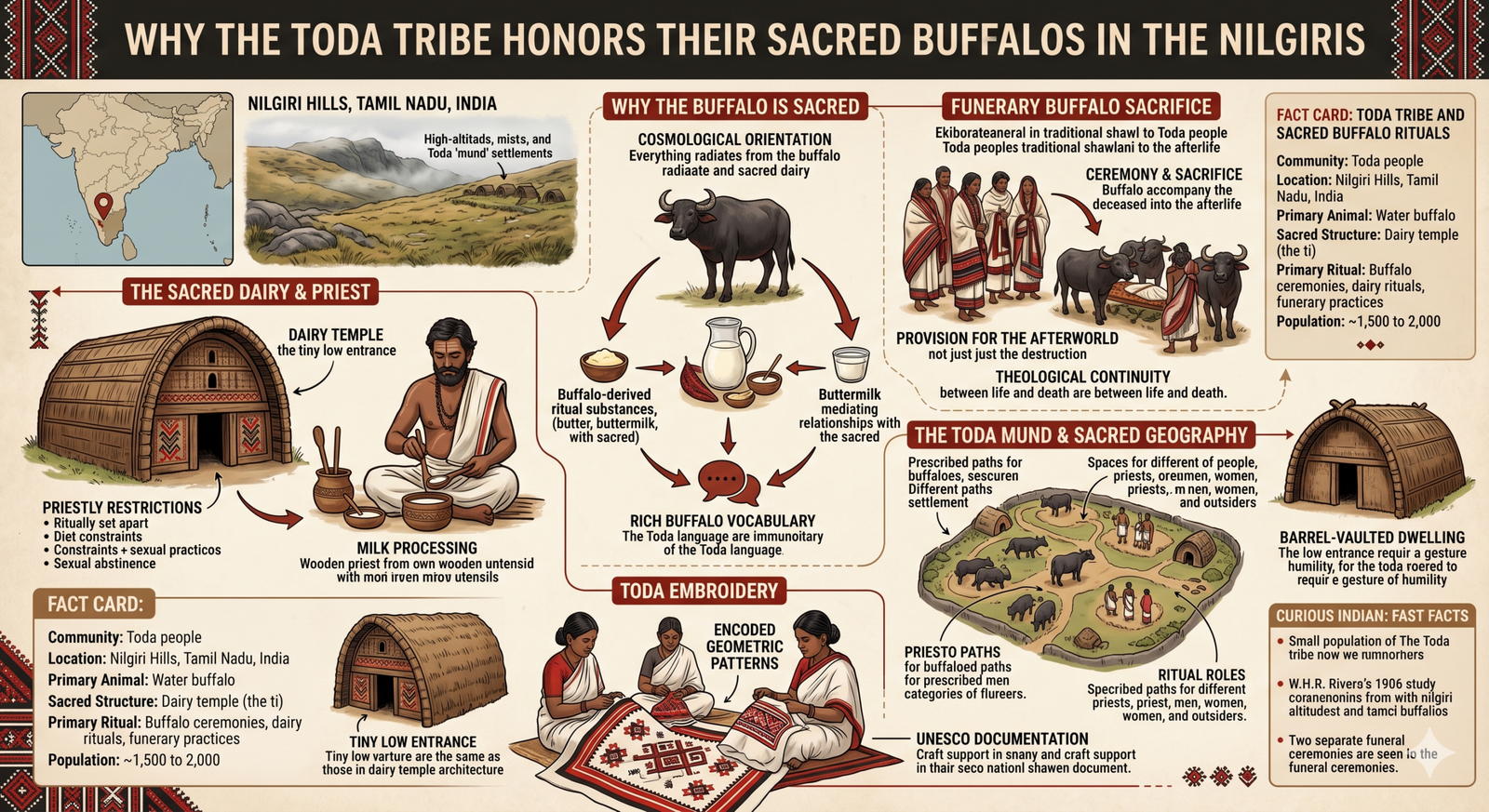
In the beginning, according to Toda belief, the goddess Teikirshy and her brother Ön stood at a place in the Kundahs, a region within the Nilgiris. They drew an iron bar from one end to the other. Ön stood at one end and pulled buffalo up from the earth. These were the sacred buffalo—they came first. Teikirshy stood at the other end and pulled up the ordinary buffalo, the secular herds that Toda families would keep and breed.
The first Toda man came holding onto the tail of the last buffalo Ön pulled from the earth. Ön then drew a rib from the man and created the first Toda woman.
Think about this story. The buffalo did not come after. The buffalo came first. The Toda came holding onto the buffalo’s tail. They came into existence in the wake of the sacred buffalo’s arrival. They were born from a buffalo.
Everything that followed—the entire structure of Toda life—was built on the understanding that the buffalo was not subordinate to them, but primary. The buffalo was the elder. The buffalo had been called first. And to live as a Toda meant to organize your entire existence around serving that prior claim.
The temple that is a dairy
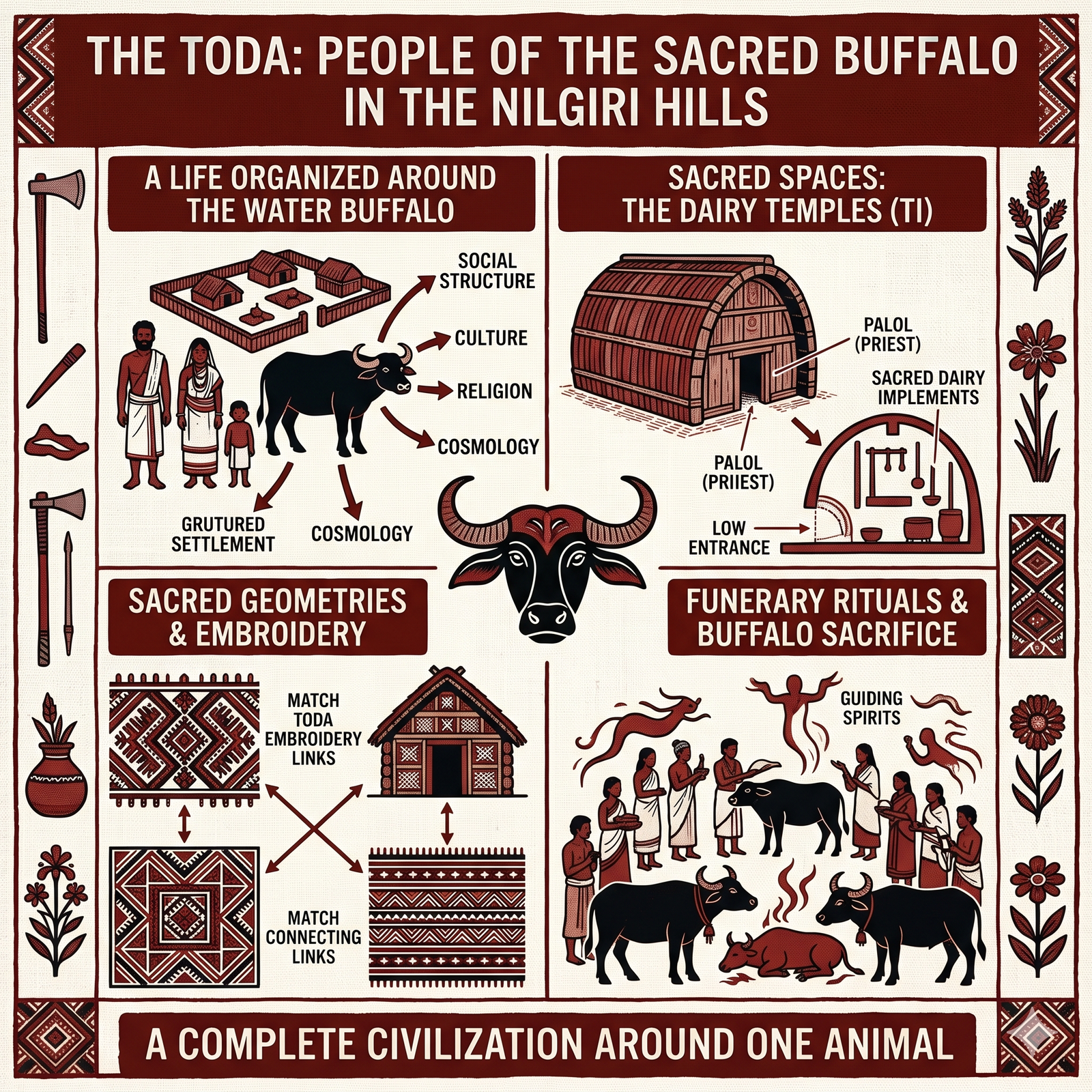
There is no separation in Toda life between what is sacred and what is mundane. The dairy where the milk is processed is also the temple. The priest is also the milkman. The ritual is also the work.
Sacred buffalo are divided into six grades. Each grade has a corresponding grade of dairy temple. Each dairy temple has its own rank in a hierarchy, and the higher the rank, the greater the need for ritual purity and the more elaborate the daily work.
The dairyman assigned to a high-grade dairy must live in a state of constant ritual consciousness. Some water sources are reserved only for the dairy temple. Others are for the ordination of new priests. Some are used only for the salt-pouring ritual that occurs at certain times of year to bless the herds. Others are for drawing water to cook food during temple ceremonies.
The dairyman learns that certain plant species can only be handled by priests of his grade. Others belong to other grades. Some plants are used only in specific rituals. The landscape itself becomes legible only to someone trained in the system.
A Toda child born into this world learns something every culture eventually teaches, but teaches it through the geography itself: that knowledge is not abstract. It is written onto the land. It is encoded in which water you can use and where. It is embedded in which plants you can touch.
What was lost, what was threatened
How Banjara Embroidery Maps the Journeys of a Nomadic People
During the last quarter of the twentieth century, something began to change. Agricultural workers moved into Toda territory and began farming Toda pasture. The Tamil Nadu government launched an afforestation program, planting trees on land that had been grassland for centuries. The sacred buffalo herds—kept in pure lines, bred according to ritual knowledge—began to decline. The land itself was shrinking.
To lose the land is to lose the possibility of the system itself. A dairyman-priest cannot do his work if there is no pasture for the sacred buffalo. The ritual cannot continue if the buffalo are gone.
What the Toda faced was not just economic hardship or cultural change. It was the possibility of forgetting—of a knowledge system so intricate, so dependent on the continuation of a pastoral way of life in a specific geography, that it could vanish in a generation.
In 1984, when anthropologists last conducted a careful census, the Toda population was around 1,500. The buffaloes were fewer. The pastures were diminished. The knowledge was being held by men who had undergone ordinations no younger man was undertaking.
But the knowledge did not die. In the early twenty-first century, an international effort at culturally sensitive environmental restoration began. The Nilgiri plateau was declared a UNESCO Biosphere Reserve. The Toda lands were recognized as a UNESCO World Heritage Site. Not to preserve the Toda as a museum piece, but to create the conditions under which the Toda could continue to be the Toda—a people whose entire relationship with the world is encoded in a sacred system of dairying and ritual.
The landscape that teaches
S.H. Raza and the Bindu: How a Dot Held the Universe
What the Toda system reveals—what it has always revealed—is that you cannot know a place unless you know how to behave in it. You cannot see the Nilgiris unless you understand which peaks are the homes of gods, which water sources serve which purposes, which plants belong to which rituals.
The Toda young person learns to read the landscape the way a literate person learns to read a book. The knowledge is not separate from the land. It is written on the land.
A peak is not just a geographic feature. It is the abode of a god—a ruling deity of a particular clan. A stream is not just water. It is water reserved for dairy rituals, or water for ordination, or water for the salt ceremony. A plant is not just a plant. It is a thing that can be touched only by certain priests at certain times.
And a buffalo is not just an animal. It is the first thing. The thing the goddess pulled from the earth before the Toda themselves existed. It is the foundation on which an entire understanding of the world is built.
The dairyman-priest, standing at his work, knows this in his bones. He knows it every time he milks. He knows it every time he churns. He knows it every time he looks at the Nilgiris and sees not just hills, but a landscape full of instruction.
Struggle of Walchand Hirachand Against British Shipping Laws
If you think you have remembered everything about this topic take this QUIZ
Who are the Toda and where do they live?
The Toda are a small pastoral tribe inhabiting the Nilgiri Hills of Tamil Nadu in South India. With a population of fewer than two thousand people, they are one of the smallest distinct tribal communities in India. They live in small settlements called munds scattered across the high grasslands of the Nilgiri plateau, where their sacred water buffaloes graze.
What is the ti and why is it significant in Toda culture?
The ti is the sacred dairy temple at the heart of every Toda settlement. It is a small stone and thatch structure with an entrance so low that entry requires crawling. Inside, the priestly dairy specialist processes buffalo milk using sacred wooden implements. The ti is inaccessible to most Toda, with women entirely excluded and ordinary men permitted entry only in specific ritual contexts. It is the most sacred space in Toda religious life and the center around which all other ritual and social structures are organized.
Why do the Toda sacrifice buffaloes at funerals?
The Toda afterlife is imagined as a continuation of Toda life, requiring the same buffalo-centered existence, dairy rituals and priestly structures as life in the Nilgiris. Sacrificing buffaloes at funerary ceremonies is understood as providing the deceased with the animals they will need in the next life. The sacrifice is not destruction but provision, a final act of care for the person who has died that reflects the same values organizing Toda life.
How are the Toda embroidery patterns connected to their sacred traditions?
The geometric patterns used in Toda embroidery are the same as those governing the architecture of the sacred dairy, the spatial organization of the mund and the ritual objects used in dairy ceremonies. A Toda embroidered shawl is therefore not simply a decorative textile. It encodes the same sacred geometry that organizes the spaces and practices of Toda religious life, making it a form of wearable sacred documentation.
What threats does the Toda tradition currently face?
The Toda face multiple pressures including the small size of the community itself, urbanization and tourism in the Nilgiri Hills, changes in land use affecting the grasslands where their buffaloes graze and the difficulty of maintaining hereditary priestly traditions when the community is so small. The embroidery tradition is particularly vulnerable because the number of women practicing the full tradition is extremely limited. Researchers and craft organizations have documented the tradition but the most critical factor in its survival is whether the Toda community itself can maintain the conditions that give the sacred buffalo practices their meaning.
Sources & References
Wikipedia. “Toda People.”
Every Culture. “Toda: Religion and Expressive Culture.”
Chhabra, Tarun. “Todas: The Naturalistic People.” Vikalp Sangam, 2018.
Keystone Foundation. “Pollinators and Cultural Traditions: The Toda of the Nilgiris.”
St. Philomena College. “Field Experience: Todas of Nilgiri, Tamil Nadu.”