How a Buddhist Monk Prepared His Own Death to Become a Sacred Relic
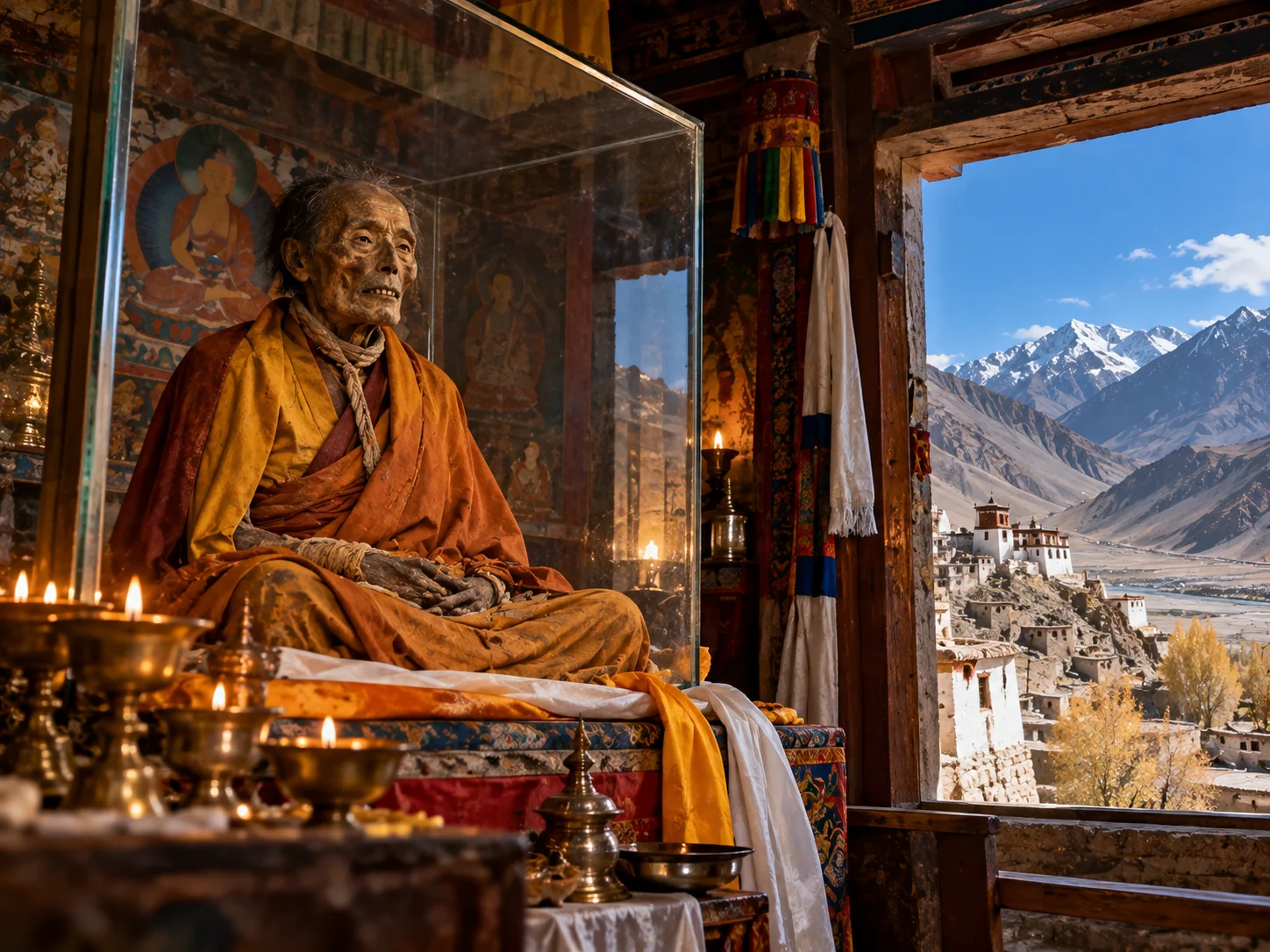
In the high-altitude village of Gue in Spiti Valley, at roughly ten thousand feet above sea level in the cold desert landscape of Himachal Pradesh, there sits in a glass enclosure inside a small monastery a Buddhist monk who has been sitting in the same meditative posture for approximately five hundred years. His name was Sangha Tenzin. His hair is still on his head. His teeth are still in his mouth. His skin, dried and darkened by five centuries in the thin, cold air of the Himalayan high country, is still intact over the bones of a man who, according to the tradition that venerates him, chose the manner and moment of his own death and prepared his body through decades of deliberate practice to survive that death in a form his community could continue to honor. The mysterious mummy of Sangha Tenzin is one of the most extraordinary physical objects in India, the preserved remains of a human being whose story sits at the precise intersection of religious practice, physical science, and the particular kind of mystery that neither framework alone can fully contain.
Why Paliwal Brahmins Left Kuldhara in a Single Night and Never Returned
The Man Who Sat Down and Did Not Stop
There is a particular quality of stillness in Gue that is different from the stillness of other high-altitude Himalayan villages. Spiti Valley as a whole has an austere, mineral beauty, a landscape of grey and ochre rock faces, blue sky pressed close by altitude, and the particular silence of a place where the population is sparse and the wind does not carry human sound for long before it disperses into the mountains.
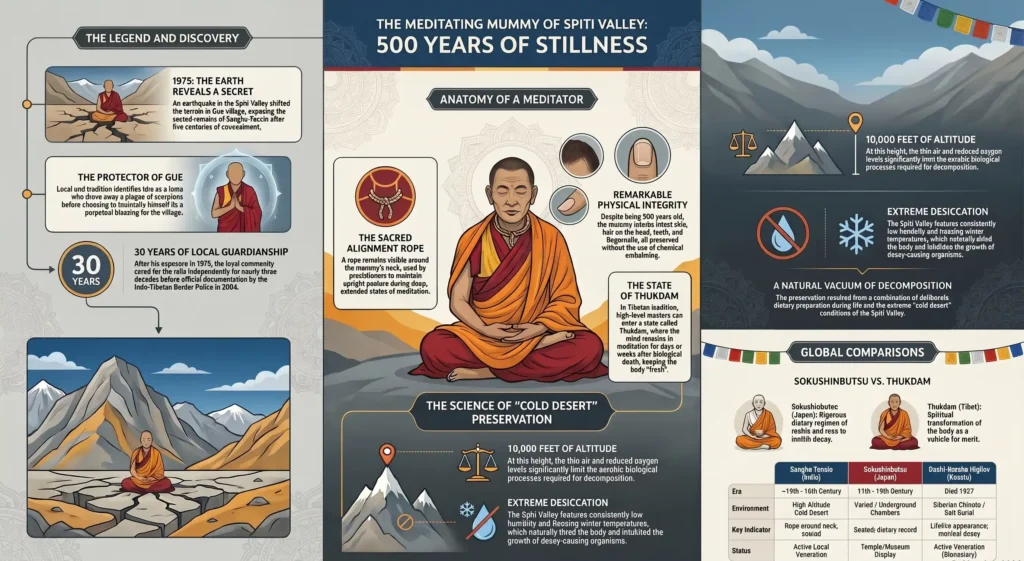
Inside that monastery, in a glass enclosure that protects him from the dust and from the hands of the pilgrims who come to see him, Sangha Tenzin sits in the cross-legged meditative posture that he assumed approximately five hundred years ago and has not changed since. The rope that practitioners of his tradition used to maintain their meditative alignment during extended periods of sitting is still visible around his neck. His eyes are partially open in the manner associated with deep meditative states. His body, dried and preserved by five centuries in the cold, dry air of the Spiti high country, carries the texture of extreme age without the dissolution that extreme age normally produces.
He is one of the most astonishing physical presences in India. He is also one of the least understood.
How the Bhotiya Weavers of Uttarakhand Kept a Himalayan Textile Tradition Alive
Spiti Valley and the World That Produced Him
To understand Sangha Tenzin, it is necessary to understand something about the world that produced him, the world of the Tibetan Buddhist communities of the western Himalayan high country in the fifteenth or sixteenth century, a world that is in some respects continuous with the world that the Spiti Valley communities inhabit today and in other respects as remote as the physical landscape suggests.
Spiti Valley sits at the intersection of the Tibetan cultural sphere and the Indian subcontinent, a high-altitude cold desert enclosed by some of the highest mountain ranges in the world. The communities of Spiti have maintained Tibetan Buddhist traditions for over a thousand years, and the monasteries of the valley, including the famous Tabo Monastery founded in 996 CE and the Ki Monastery on its dramatic hillside above the Spiti river, are among the oldest continuously functioning Buddhist institutions in the world.
The Buddhism practiced in Spiti belongs to the Vajrayana tradition, the tantric form of Buddhism that developed in Tibet and the Himalayan regions and that places particular emphasis on the transformation of the practitioner’s body, speech, and mind through specific contemplative and physical practices. This tradition has always understood the body as a vehicle for spiritual development rather than simply as a biological organism, and its understanding of death and the process of dying is correspondingly more complex and more intentional than the understanding that most Western frameworks bring to these events.
It is within this tradition that the practice that produced the mummy of Sangha Tenzin must be understood, and understanding it requires engaging with the concept of self-mummification as a deliberate spiritual practice rather than simply as a bizarre physical outcome.
The Practice of Self-Mummification
Goddess Kamakhya and Mythology Behind the Ambubachi Mela
The tradition of self-mummification, known in its Japanese Buddhist form as Sokushinbutsu, involves a monk deliberately preparing his body through a decades-long regimen of diet, meditation, and physical practice with the intention of achieving a state at death in which the body does not decompose in the normal way but remains intact as a continuing sacred presence for the community.
The Japanese Sokushinbutsu tradition, which produced over two dozen documented self-mummified monks between the eleventh and nineteenth centuries, has been studied in considerable detail by scholars of Japanese Buddhism and by forensic scientists. The preparation involved progressively reducing the body’s fat and moisture content through dietary restriction, consuming specific foods and teas that introduced compounds inhibiting the growth of the organisms responsible for decomposition, and spending the final stages of life in underground chambers where the conditions of temperature and humidity further promoted preservation.
The Tibetan Buddhist tradition has a related but distinct understanding of a particular meditative state called Thukdam, in which a highly accomplished practitioner who has died continues to remain in a state of meditation for days or weeks after the cessation of biological life signs, with the body retaining warmth and the facial expression of peaceful absorption. This tradition is associated with highly realized masters and is considered a sign of exceptional spiritual accomplishment.
Sangha Tenzin’s mummy appears to represent a confluence of these traditions, a practitioner who prepared his body through specific practices with the intention of leaving behind a physical relic, in an environment whose natural conditions, the extreme cold, the low humidity, and the thin air of high altitude, further promoted preservation in ways that the practitioner may or may not have deliberately incorporated into his preparation.
The Earthquake and the Discovery
Sangha Tenzin’s mummy was not known to the outside world until 1975, when an earthquake in the Spiti Valley area shifted the ground in Gue and exposed what appeared to be human remains in a seated meditative posture. The local community, familiar with the tradition of self-mummified lamas and aware of local oral history about a revered monk who had mummified himself, recognized the remains as a sacred relic and treated them with corresponding care.
The formal documentation of the mummy by authorities came in 2004, when officials from the Indo-Tibetan Border Police encountered the remains and brought them to wider attention. Subsequent visits by journalists and researchers have documented the mummy’s condition and attempted to establish its age and identity through the available evidence.
The oral tradition of the Gue community identifies the mummy as Sangha Tenzin, a lama who lived approximately five hundred years ago and who is credited with having driven away a plague of scorpions from the village through his spiritual power, after which he chose to mummify himself as a continuing blessing for the community. This tradition gives Sangha Tenzin a specific identity and a specific motivation, the desire to remain present as a protector of the village whose welfare he had secured during his lifetime.
The credibility of this identification rests primarily on the oral tradition of the community and on the approximate age that researchers have estimated from the mummy’s physical condition and the construction of the shrine that housed it. No comprehensive forensic examination including radiocarbon dating has been carried out, meaning that the precise dating of the remains and the confirmation of the identification remain uncertain by the standards of contemporary scientific verification.
What the Mummy Actually Shows
The physical state of Sangha Tenzin’s mummy is remarkable by any standard of comparison. The preservation extends beyond what the environmental conditions of Spiti Valley alone would typically produce, though those conditions are themselves significant contributors to the outcome.
The skin is intact over the entire body, dried and darkened but present, retaining the structure of the underlying anatomy in a way that allows the body’s form to be clearly read. The hair remains on the head, now sparse and bleached but identifiable as hair. The teeth are present and visible. The fingernails and toenails are described in some accounts as still present. The overall posture is that of a person sitting in deep meditation, with the legs crossed and the body upright, maintained over five centuries in a position that would require conscious effort to achieve and maintain in life.
The rope visible around the neck is a specific element that connects the mummy to the tradition of extended meditative sitting, in which practitioners sometimes used physical restraints to maintain their posture during periods of deep absorption when the normal muscular control of the body might relax. Its presence is one of the clearest physical indicators that the death occurred during or in preparation for a specific meditative state rather than through illness or accident.
The color of the skin and the texture of the preserved tissues indicate that the mummification process was primarily natural rather than chemical, relying on the desiccating effect of the dry, cold, high-altitude environment rather than on the application of preservative substances. This natural mummification is the mechanism most consistent with the environmental conditions of Spiti Valley, where the low humidity, the cold temperatures, and the thin air create conditions that inhibit the biological processes of decomposition more effectively than the conditions of most other environments.
The Scientific Perspective
Mythological Origins of the Kumbh Mela and Descent of the Ganga
The scientific study of Sangha Tenzin’s mummy has been limited, a fact that reflects both the practical challenges of conducting forensic research on a sacred relic in a remote location and the sensitivities that surround any scientific examination of human remains that a living community venerates.
What has been established through visual examination and preliminary assessment is that the preservation is genuine and extraordinary, that the mummy is in a seated meditative posture, that the rope around the neck is consistent with meditative practice, and that the approximate age of the remains is consistent with the five-hundred-year timeline suggested by oral tradition. Beyond these basic observations, the scientific picture is incomplete.
A comprehensive forensic examination would ideally include radiocarbon dating of organic material from the mummy to establish its age with precision, tissue analysis to determine the specific mechanisms of preservation and whether any deliberate preparation of the body contributed to the outcome, and imaging studies to examine the internal structure of the preserved body without destructive sampling. None of these studies have been completed. The local Buddhist community’s understandable reluctance to permit invasive examination of a sacred relic, combined with the logistical challenges of conducting sophisticated scientific work at ten thousand feet in a remote valley, have meant that the mummy remains scientifically underdocumented relative to its extraordinary physical condition.
The research that has been done on comparable self-mummified Buddhist monks in Japan and Mongolia provides useful comparative context. The Japanese Sokushinbutsu mummies have been extensively studied and the mechanisms of their preservation are well understood. The comparison suggests that the preservation of Sangha Tenzin’s body resulted from a combination of deliberate preparation during life and the exceptionally favorable natural preservation conditions of the Spiti high country.
The Community That Kept Him
The most human dimension of the Sangha Tenzin story is not the mummy itself but the community that has kept it for five hundred years. The people of Gue have lived with this presence in their village across generations, in conditions of physical remoteness and cultural continuity that have allowed the tradition of his veneration to survive intact from his own lifetime to the present.
The relationship between the village community and the mummified lama is not simply one of passive reverence for an historical artifact. It is an active devotional relationship in which Sangha Tenzin is understood as a continuing protective presence, the same lama who drove away the scorpions during his lifetime continuing to extend his protection over the village from within the glass enclosure at the monastery’s edge.
This understanding of the mummy as a living sacred presence rather than a dead historical object is fundamental to the tradition within which it exists and must be respected as such by anyone attempting to understand what Sangha Tenzin’s preservation actually means, both to the people who have cared for him and to the broader question of what it means for a human being to prepare deliberately for a death intended to leave behind something more than a memory.
The pilgrims who come to Gue from the broader Spiti Valley and from further afield do not come primarily as tourists viewing a curiosity. They come as devotees approaching a sacred presence, performing the circumambulation of the monastery, making offerings, and seeking the blessing of a lama whose exceptional spiritual accomplishment they believe is accessible through the preserved physical form he left behind. The glass enclosure that now protects the mummy from physical contact is a relatively recent addition to a site that was for most of its history openly accessible to the community it serves.
The Archaeological Survey of India has been involved in the documentation of the Gue mummy as part of its broader mandate to protect significant heritage sites and objects in India, and the site has received some official recognition as a heritage location within Himachal Pradesh’s cultural landscape.
The Altitude and the Cold
The environmental conditions of Gue at ten thousand feet deserve attention as factors in Sangha Tenzin’s preservation, because they are directly relevant to understanding why the mummy’s condition is as extraordinary as it is.
High-altitude cold desert environments like Spiti Valley create conditions that are exceptionally unfavorable for the biological processes that produce decomposition in ordinary environments. The low humidity, consistently below the levels found in any lowland environment, prevents the moisture that decomposing organisms require. The cold temperatures, which in Gue can fall well below freezing for extended periods during the winter months, inhibit biological activity generally. The thin air, with its reduced oxygen content, further limits the aerobic biological processes involved in decomposition.
These conditions, combined over five hundred years, would be expected to produce significant natural preservation of any organic material that survived the initial period following death, when decomposition is most active. The specific form of preservation observed in Sangha Tenzin, with skin, hair, and teeth intact but the body desiccated rather than frozen, is consistent with the kind of natural mummification that the Spiti Valley environment would produce, particularly if the initial conditions of the burial or enclosure were favorable.
The Mystery That Remains
After five hundred years of preservation, decades of documentation, and all the scientific and cultural frameworks that have been applied to the question of what Sangha Tenzin is and how he came to be in the condition in which he sits in Gue, there remain dimensions of his story that the available evidence does not fully resolve.
The precise mechanism of his preservation, specifically the relative contributions of deliberate preparation during life, the natural environmental conditions of Spiti Valley, and any exceptional biological or physiological characteristics of a highly practiced meditator at the end of a long contemplative life, has not been established with the scientific precision that a comprehensive forensic study would provide. The question of whether and to what extent the preparation associated with the self-mummification tradition actually contributes to preservation outcomes, beyond what the natural environment would achieve on its own, remains genuinely open.
The identification of the mummy as specifically Sangha Tenzin, the lama of the scorpion legend, rests on oral tradition and approximate dating rather than on documentary confirmation. The possibility that the mummy is someone else, or that its age is different from the five-hundred-year estimate, cannot be ruled out without the forensic dating that has not been performed.
And the deepest question, the question of what it means that a human being prepared themselves deliberately for a form of death intended to leave behind a sacred physical presence, remains a question that sits outside the reach of any purely scientific framework. It is a question about the nature of devotion, about the relationship between a practitioner and a community, about what a person can intend for their own body and what the body, given the right conditions, can actually do in response to that intention.
Sangha Tenzin chose his death. That is the claim of the tradition that preserved him and the most interesting claim that his physical presence in Gue raises for anyone who encounters it. Whether this understanding of the mummy’s origin is literally accurate in every detail is a question that the current state of scientific evidence cannot resolve. What it does not resolve, the question of whether a human being can genuinely prepare their body through spiritual practice for a form of death that results in exceptional preservation, is itself one of the most interesting questions that Sangha Tenzin raises, because it sits at the exact boundary between what contemporary science understands about the relationship between mind, practice, and body, and what it does not yet understand.
How Titu Singh’s Past Life Memories Led to a Murder Conviction in Agra
If you think you have remembered everything about this topic take this QUIZ
Results


#1. In which year was the mummy of Sangha Tenzin exposed by an earthquake in Spiti Valley?
#2. What specific physical indicator is still visible around the neck of Sangha Tenzin’s mummy?
#3. The village of Gue, where the mummy is housed in a glass enclosure, sits at what approximate altitude?
#4. What is the Japanese Buddhist term for the tradition of systematic self-mummification discussed as comparative context?
#5. Which official organization formally documented the mummy of Sangha Tenzin in the year 2004?
#6. According to the local oral tradition of Gue village, what plague did Sangha Tenzin drive away using his spiritual power?
#7. What specific term refers to the Tibetan Buddhist post-death meditative state where a practitioner’s body remains warm and peaceful?
#8. Which famous monastery founded in 996 CE highlights the ancient history of Tibetan Buddhist traditions in Spiti Valley?
Who was Sangha Tenzin and why is his mummy significant?
Sangha Tenzin was a Buddhist lama believed to have lived approximately five hundred years ago in the Spiti Valley region of Himachal Pradesh. His mummy is significant because it represents one of the most remarkably preserved examples of self-mummification in the Indian Buddhist tradition, displaying intact skin, hair, and teeth in a seated meditative posture after five centuries, and because it sits at the intersection of living devotional practice, environmental science, and the specific Tibetan Buddhist traditions of intentional death preparation that produced it.
How was Sangha Tenzin’s mummy discovered?
The mummy was exposed by an earthquake in the Spiti Valley area in 1975, which shifted the ground in Gue village and revealed what appeared to be human remains in a seated meditative posture. The local community, familiar with the tradition of self-mummified lamas, recognized the remains as a sacred relic and cared for them independently. The mummy was formally documented by officials from the Indo-Tibetan Border Police in 2004 and has since received increasing attention from researchers and tourists.
What is the practice of self-mummification in Buddhist tradition?
Self-mummification refers to the deliberate preparation of the body through specific practices of diet, meditation, and physical discipline with the intention of achieving preservation after death as a sacred relic. The best documented tradition is the Japanese Sokushinbutsu, in which monks undertook a multi-year regimen of dietary restriction and specific preparations. The Tibetan Buddhist tradition has a related understanding rooted in the concept of Thukdam, in which highly realized meditators remain in a post-death meditative state with their bodies showing exceptional preservation. Sangha Tenzin’s case appears to reflect a confluence of deliberate preparation and the exceptionally favorable natural preservation conditions of the high-altitude cold desert environment of Spiti Valley.
Why has no comprehensive scientific study been done on Sangha Tenzin’s mummy?
The absence of comprehensive forensic study reflects both the practical challenges of conducting sophisticated scientific work in a remote location at ten thousand feet and the sensitivities surrounding any invasive examination of human remains that a living community actively venerates as a sacred presence. The local Buddhist community’s relationship with Sangha Tenzin is one of living devotion rather than historical curiosity, and the permissions required for destructive sampling or comprehensive forensic examination involve negotiations between scientific interest and religious sensibility that have not yet been fully resolved.
How does the environment of Spiti Valley contribute to the mummy’s preservation?
Spiti Valley’s high-altitude cold desert environment creates conditions exceptionally unfavorable for the biological processes of decomposition. The extremely low humidity prevents the moisture that decomposing organisms require. The cold temperatures, which fall well below freezing during winter months, inhibit biological activity. The thin air at ten thousand feet reduces the oxygen available for aerobic decomposition processes. These combined environmental factors, sustained over five centuries, account for a significant portion of the mummy’s preservation, though the specific contribution of deliberate preparation during life cannot be determined without the forensic study that has not been completed.
Sources & References
Sangha Tenzin’s identification and oral tradition — The mummy in Gue village is identified by local Buddhist tradition as Sangha Tenzin, a lama from the fifteenth or sixteenth century credited with driving away a plague of scorpions from the village through spiritual power, after which he chose to mummify himself as a continuing blessing and protection for the community.
The practice of self-mummification in Buddhist traditions — Self-mummification represents a deliberate spiritual practice involving decades of dietary restriction, meditation, and physical discipline intended to prepare the body to remain intact after death as a sacred relic, with documented traditions in both Japanese Sokushinbutsu and Tibetan Buddhist Thukdam practices.
Physical state and preservation mechanisms — The mummy displays intact skin, hair, teeth, and nails in a seated meditative posture with a rope around the neck, indicating the preservation resulted from natural mummification in the high-altitude cold desert environment of Spiti Valley rather than chemical treatment.
Environmental factors and altitude — Gue village sits at approximately ten thousand feet above sea level in the cold desert of Spiti Valley, where extremely low humidity, freezing temperatures, and thin air create exceptionally unfavorable conditions for decomposition, contributing significantly to the mummy’s five-century preservation.
Discovery and scientific documentation — Exposed by an earthquake in 1975 and formally documented in 2004, the mummy has not undergone comprehensive forensic examination including radiocarbon dating, meaning its precise age and identity remain confirmed only through oral tradition and approximate assessment rather than scientific verification.