Madhava found the infinite series for pi, saw straight away that it was useless, and then repaired it. None of his own writings survive
3.14159265359.
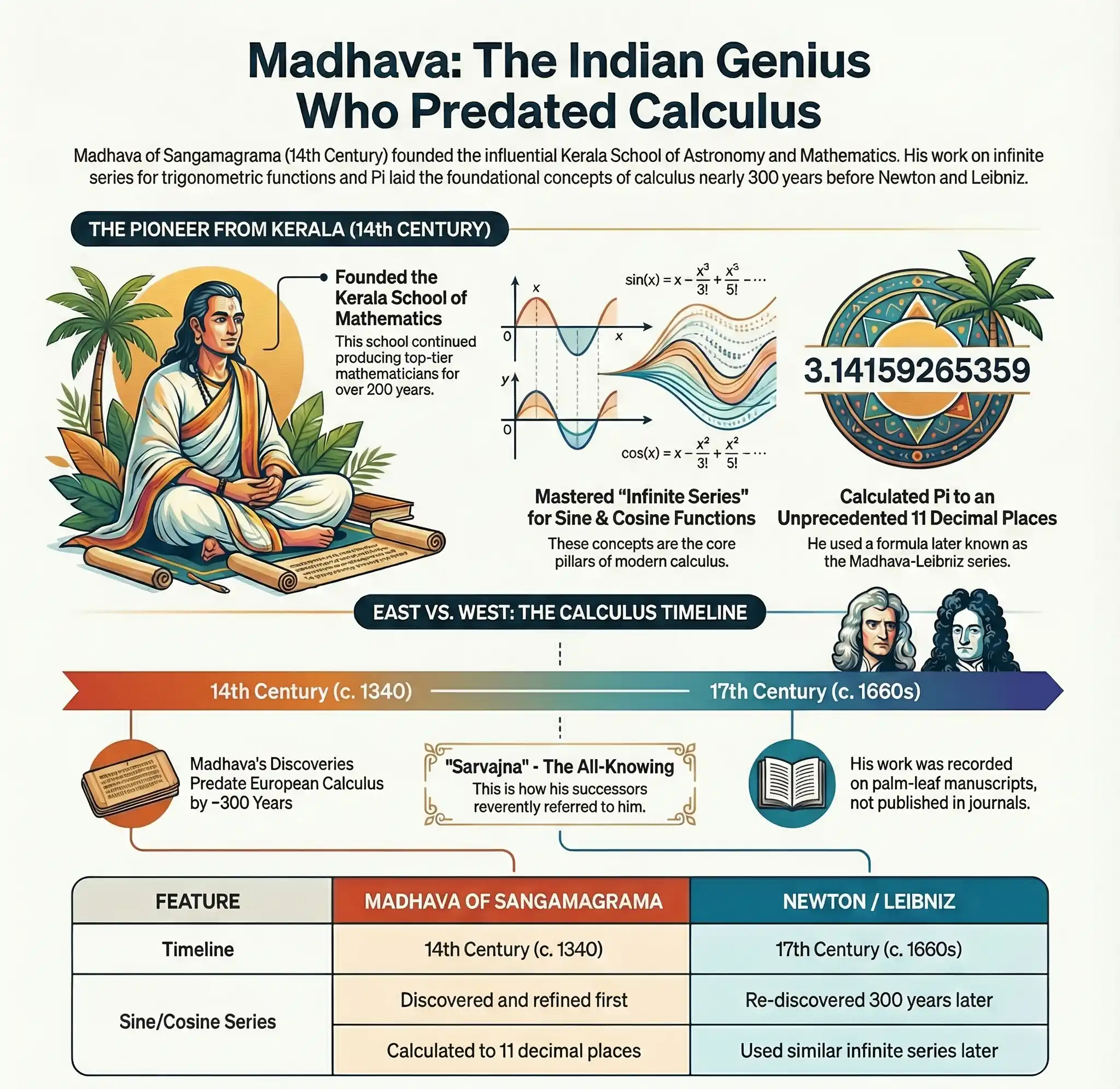
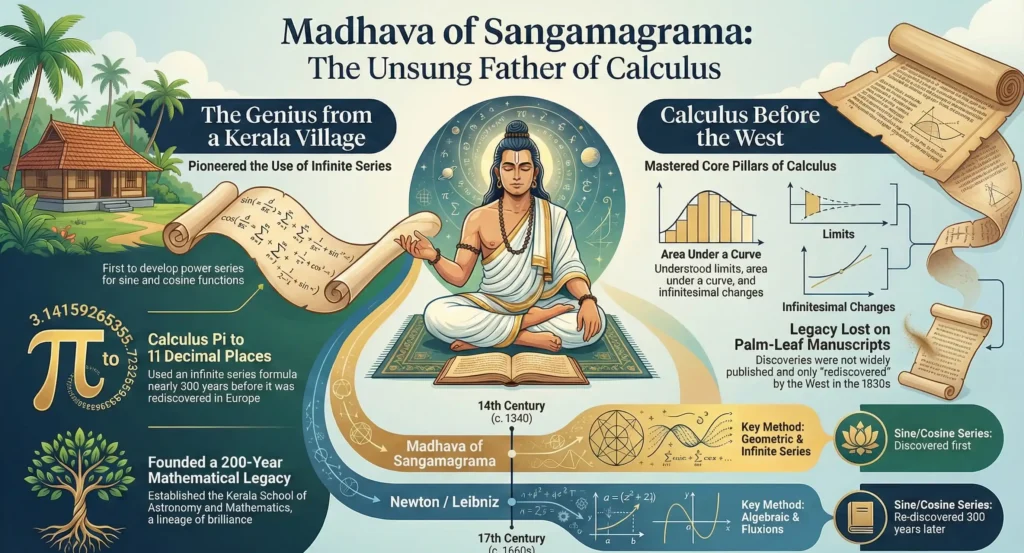
That is the value of pi given in a verse attributed to Madhava, in Kerala, around the year 1400. It is correct to eleven decimal places. Nobody in Europe would have a number that good for another two hundred years.
The interesting part is not the number. It is that he could not have got it the way he found it.
Dr. A.P.J. Abdul Kalam: (1931-2015)
1971 Nagarwala Case: India’s Great Bank Heist Mystery
An endless sum
What he found was a series. Take one, subtract a third, add a fifth, subtract a seventh, and keep going forever. Multiply what you end up with by four and you have pi exactly.
That is a very strange object to have in your hands in 1400. A quantity that no fraction can express, written as an infinitely long sum of the simplest possible fractions, exact if only you could finish it. Nobody else in the world had anything like it for a curved quantity. In Europe it turns up in 1676, with Leibniz, which is why the textbooks call it the Madhava-Leibniz series.
The problem with it
Now try to use it.
Add the first few terms and you get roughly three. Add a hundred and you have two decimal places, unreliably. To pin down the third decimal you need something like a thousand terms, and the fourth costs you ten thousand. Eleven decimal places would take more additions than a man could do in several lifetimes, by hand, on a palm leaf, in the tropics.
He had found the key to the door and then noticed that the door was a hundred miles away.
The repair
So he did the harder thing, which almost never gets mentioned.
He worked out a correction. Stop the sum after a manageable number of terms, then add a single expression that accounts for the entire infinite tail you have just thrown away. Get that expression right and a few dozen terms will give you what a billion terms would have given you.
Three successive versions of that correction are credited to him, each closer than the last. This is numerical analysis, the discipline of making an exact formula survive contact with an actual calculation, and it is a great deal more difficult than finding the series was.
Anyone can be given an infinite sum. Knowing exactly how wrong you are when you stop is the whole craft.
Not only pi
The same method gave him the sine and the cosine as infinite series, which is the result Europe met through Newton and Taylor in the late seventeenth century, and the arctangent series that is credited to James Gregory in 1671.
Used together with his correction terms, these produced sine tables accurate to eight or nine decimal places. Those tables were the practical point of the whole exercise. The astronomers of his school needed positions, and positions needed sines, and the sines they had were not good enough.
The school
Sangamagrama is generally identified with Irinjalakuda, inland from Cochin. He seems to have lived from about 1340 to about 1425.
What he started outlasted him by two centuries, in an unbroken line of teacher to student: Parameshvara, then Damodara, then Nilakantha Somayaji, then Jyeshthadeva, then Achyuta Pisharati. Five or six generations of mathematicians in one small stretch of the Kerala coast, each correcting and extending the last.
Around 1530 Jyeshthadeva wrote the Yuktibhasha, which sets the whole body of work out with demonstrations, step by step, showing why each result holds. And he wrote it in Malayalam, the language people actually spoke, not in Sanskrit.
What is missing
Not one of Madhava’s mathematical works survives. Two minor astronomical texts carry his name and that is all.
Everything else is quotation. The series, the corrections, the value of pi are known because Nilakantha and Jyeshthadeva and the others set them down with his name attached, saying plainly that this result is Madhava’s. They could have absorbed the lot and nobody would ever have known.
He exists because five generations of his own school kept writing somebody else’s name in the margin.
The question about Europe
Jesuit missionaries were active around Cochin in the sixteenth century, and some historians have argued that Kerala results reached Europe through them and fed the invention of the calculus.
No document has ever been produced that shows it happening, and the mainstream position remains that Newton and Leibniz got there independently. The case is worth knowing about and it is not worth asserting.
It also does not need to be true. Two hundred and fifty years before Europe, on a strip of coast between the hills and the sea, a man worked out how to add up infinitely many things and how to stop early without lying about it.
8 Defining Chapters in the Vikram Sarabhai Biography
The Purulia Arms Drop Mystery 1995: When the Sky Rained Guns
If you think you have remembered everything about this topic take this QUIZ
Results


#1. Which influential school of thought did Madhava of Sangamagrama found in the 14th century?
#2. To how many decimal places did Madhava successfully calculate the value of Pi ($pi$)?
#3. What mathematical concept, later credited to Leibniz in Europe, was actually described in Sanskrit verses by Madhava 300 years earlier?
#4. Why have none of Madhava’s original mathematical treatises survived to the present day?
#5. What does the term ‘Katapayadi’ refer to in the context of Madhava’s work?
#6. According to the comparison table, what was the primary medium Madhava used to record his discoveries?
#7. Madhava’s successors referred to him as ‘Sarvajna’. What does this title mean?
#8. Which 19th-century British administrator brought the Kerala School’s discoveries to the attention of the Western world?
Who is the Father of Calculus?
While Isaac Newton and Leibniz are traditionally called the fathers of calculus, the Madhava of Sangamagrama history shows that he developed the foundation of power series and calculus concepts 300 years earlier.
What is the Kerala School of Astronomy and Mathematics?
It was a school of mathematicians founded by Madhava in Kerala, India, which thrived between the 14th and 16th centuries, producing groundbreaking work in infinite series and trigonometry.
Did Madhava influence European mathematics?
There is a significant historical debate. Some scholars believe that Jesuit missionaries in Kerala may have transmitted Madhava’s findings to Europe, but there is no direct “smoking gun” evidence yet.
What is Madhava’s most famous formula?
His most famous formula is the infinite series for Pi ($\pi$), which allows for the calculation of the circle’s circumference with extreme precision.
Why are Madhava’s original books missing?
In ancient India, knowledge was often passed down orally or on perishable palm leaves. While his primary works are lost, his discoveries were meticulously preserved in the commentaries of his students.
Sources & References
Jyeshthadeva, Ganita-Yukti-Bhasa, translated and annotated by K.V. Sarma (Hindustan Book Agency, 2008) — the series, the correction terms and their demonstrations, with attributions to Madhava.
MacTutor History of Mathematics Archive, University of St Andrews (“Madhava of Sangamagramma”) — his dates, the value of pi and the results named after him.
Kim Plofker, Mathematics in India (Princeton University Press, 2009) — the Kerala school, its continuity and its methods.
George Gheverghese Joseph, The Crest of the Peacock: Non-European Roots of Mathematics (Princeton University Press) — the school’s achievements and the debate over possible transmission to Europe.
Author


Exploring the Soul of Bharat through History, Science, Culture, and its Diversity
Our Mission
Curious Indian is a definitive knowledge portal dedicated to chronicling the events, personalities, and cultural shifts that defined the Indian subcontinent. From the ancient Vedic Period to the complexities of 21st-century politics, our goal is to provide deep-dive analysis that inspires.
Editorial Standards & E-E-A-T
Every article published under our brand undergoes a rigorous fact-checking process. We prioritize primary historical records, academic citations, and credible archives to ensure our readers receive accurate, high-authority information.
Historical Integrity Directly sourcing from ASI archives and academic journals.Topical Authority Comprehensive clustering of Indian Science, Biographies, and Wars.Managed by Paripurna Datta and TEAM | Dedicated to the Knowledge of India.