Guru Nanak: The Teacher Who Said There Is No Hindu, No Muslim
Guru Nanak (1469–1539) founded Sikhism by articulating a radically simple, universal path to the Divine through Naam (remembrance of the One), honest labour (Kirat), and sharing (Vand Chhakna), while rejecting ritualism, caste hierarchy, and sectarian boundaries.
How the founder of Sikhism threw a bridge across a world divided by religion and caste
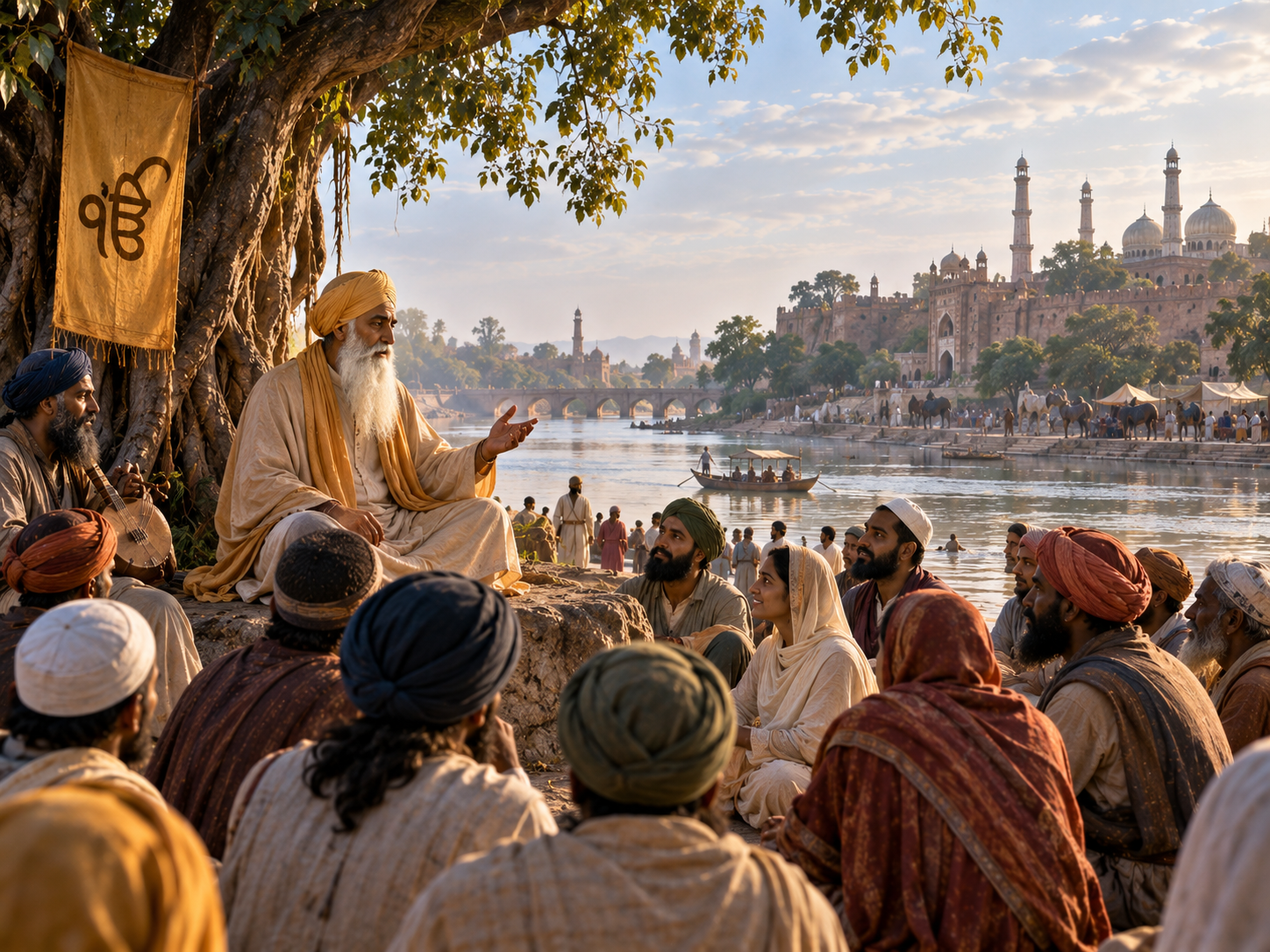
Guru Nanak was born into a world that was full of walls. Everywhere he looked, people were divided from one another, and taught to stay that way. Hindus stood on one side and Muslims on the other. The high castes were placed far above the low. Men were set over women. And everywhere, people were busy mistaking the empty performance of religious rituals for real goodness of the heart.
And into that walled and divided world, a little over five hundred years ago, one gentle man brought a single, simple, revolutionary idea, and then spent the whole of his life quietly living it out. The idea was this: that all of those walls were false. That there is only one God for everyone, and that before that one God, every single human being on earth is completely equal. This is the life of Guru Nanak, the founder of the Sikh faith, and the great prophet of oneness.
A traditional Janamsakhi painting depicting Guru Nanak. Source: Wikimedia Commons · Unknown authorUnknown author · Public domain
The boy who asked why
Nanak was born in the year 1469, in a village in the Punjab, into a devout Hindu family. But even as a small child, he was plainly not like the other children. He was thoughtful and endlessly questioning, forever wondering about God, and about why the world was arranged the way it was. His elder sister, Nanaki, seems to have been the very first to sense that there was something special, something luminous, about her little brother.
And from a young age, he gently refused to go along with things that struck him as hollow.
Asked to wear a sacred thread in the usual ceremony, the boy Nanak asked instead for a thread of kindness and truth, one that could never wear out or break or burn. Already, he cared more for the heart of a thing than for its outward show.
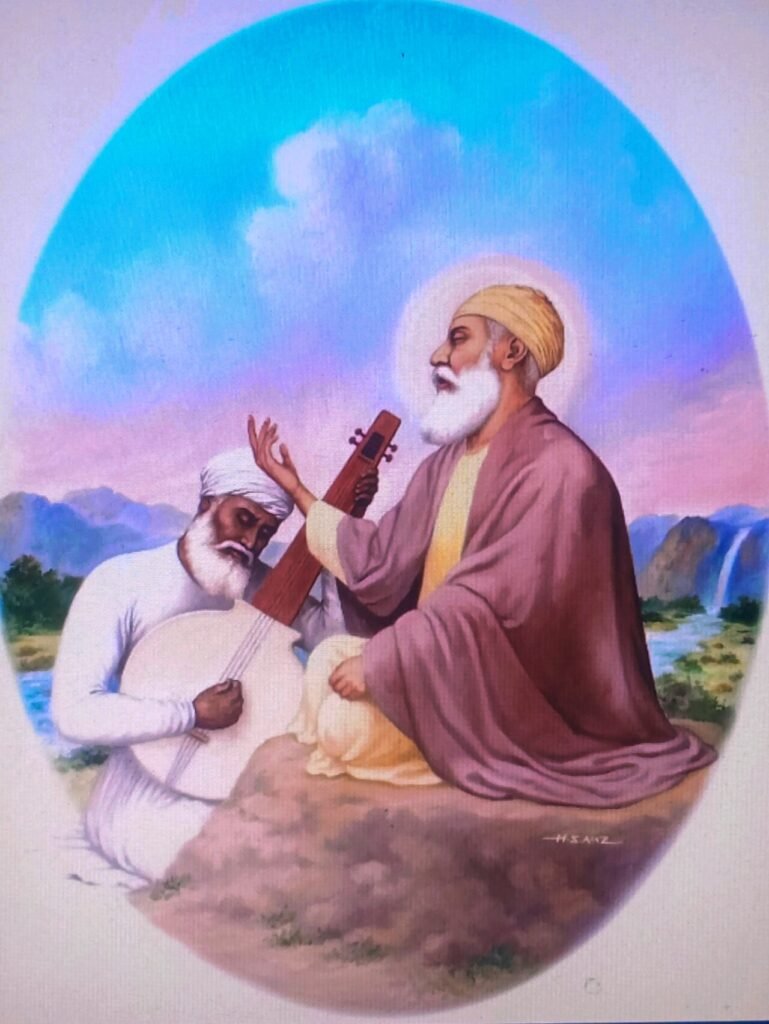
Traditional depiction of Guru Nanak with his companion Bhai Mardana. Source: Wikimedia Commons · Historiansimar · CC BY-SA 4.0
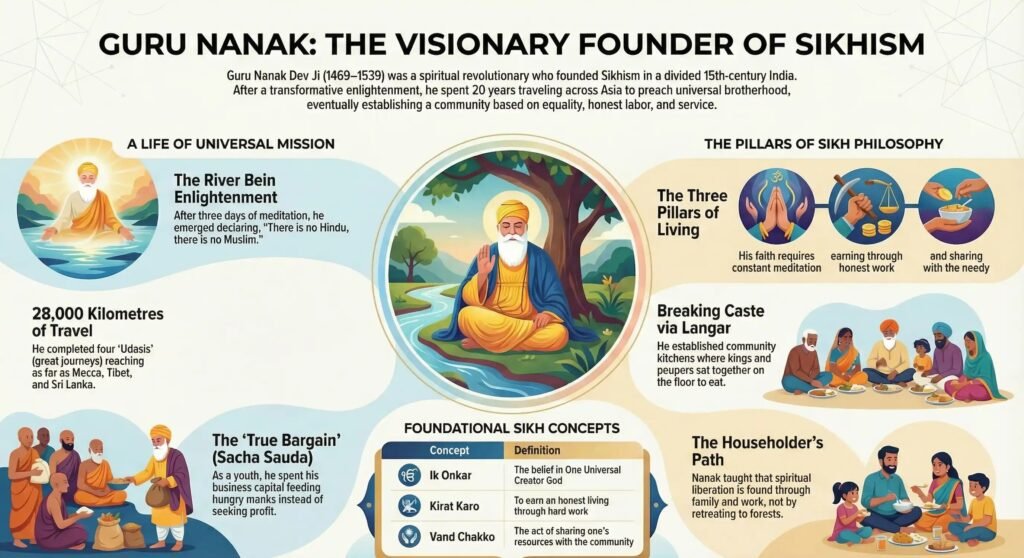
There is a beloved story that when the time came for his sacred-thread ceremony, a Hindu ritual of his day, the boy Nanak politely declined the thread, and asked instead for a different sort of thread altogether: one that could never wear out, or break, or burn, a thread woven of kindness and truth and worn quietly on the inside. And another story tells how his father once gave him some money to go and make a clever business deal, and young Nanak spent every last coin of it feeding a group of hungry holy men, then came home and told his puzzled father that this, the feeding of the hungry, was the only truly good bargain there had ever been. Even as a boy, he cared far more for compassion than for ritual, and far more for people than for profit.
Gurdwara Janam Asthan at Nankana Sahib, Guru Nanak’s birthplace. Source: Wikimedia Commons · Shahzaib Damn Cruze · CC BY-SA 4.0
The three days by the river
As a young man, Nanak took a job and started a family and lived, for a while, an ordinary sort of life. But his heart stayed restless for God. And then, one quite ordinary morning, everything changed. He went down to a river to bathe, as he did every single day, and he did not come back. For three whole days he was gone, and his friends and family began to fear that he had drowned. But on the third day, he returned. And Sikhs believe that during those three days, Nanak had been called into the very presence of God, and given a great mission: to teach the whole world the truth of the One.
And the first words that he is said to have spoken, when at last he came back, were the very words that would become the seed of an entire new faith.
“There is no Hindu, and there is no Muslim.” He did not mean that these faiths did not exist. He meant something far deeper: that in the eyes of God, the labels simply do not matter at all. There are only human beings.
Gurdwara Ber Sahib at Sultanpur Lodhi, associated with Guru Nanak’s transformative experience by the Bein. Source: Wikimedia Commons · Guglani · CC BY-SA 4.0
He did not mean, of course, that these religions did not exist. He meant something far deeper, and far more daring than that. He meant that in the eyes of God, these labels do not matter in the slightest, that a person is not saved by being called a Hindu, or by being called a Muslim, but only ever by their love of God and their goodness toward other people. Under God, he was saying, there are simply no such divisions between us. There are only human beings.
From that day forward, Guru Nanak began to teach, and his message was every bit as beautiful as it was bold. There is only one God, he said. Not a Hindu God and a Muslim God and a hundred others besides, but one single God, formless and present everywhere at once, living inside every single person, and inside every living thing.
Gurdwara Darbar Sahib at Kartarpur, where Guru Nanak established his later community. Source: Wikimedia Commons · Shahzaib Damn Cruze · CC BY-SA 4.0
And if the very same one God lives inside everyone, then it follows that everyone is equal, truly and completely equal, no matter their religion, no matter their caste, and no matter whether they happen to be a man or a woman. In an age that treated the lowest castes as untouchable, and women as lesser beings, Guru Nanak’s firm insistence that all people were the equal children of the one God was nothing short of a quiet revolution. And he built that equality straight into the very heart of his community, in a wonderful and thoroughly practical way.
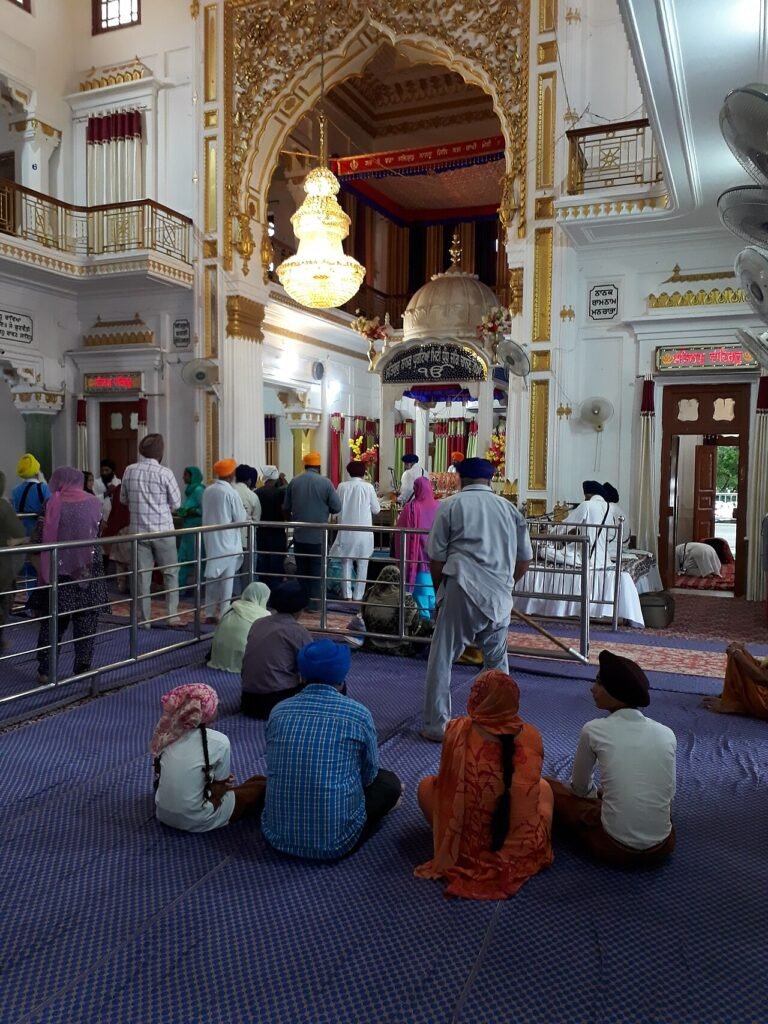
He began the tradition of the langar, the free community kitchen, where anyone at all, of any religion or caste, rich or poor, high or low, sits down together on the very same floor and shares the very same simple meal.
There could be no better way in all the world to teach that people are equal than to sit them down, side by side, to break bread together as one. To this very day, in Sikh places of worship all across the world, that free kitchen still stands open to absolutely everyone who comes. And his was a faith meant for living in the world, not for fleeing away from it. He taught three simple things to hold onto: to remember God always, to earn your daily bread by honest work, and to share what you have with those in need.
The long walk
To carry his message out to the world, Guru Nanak set off on foot, and over many long years he walked an astonishing distance: the whole length and breadth of India, and then far beyond it, all the way to the holy cities of the Muslims, to Mecca and to Baghdad, and up into the high mountains of Tibet.
And who walked beside him, all along those great journeys? A Muslim musician named Mardana, his dear friend and lifelong companion, who played sweet music upon his instrument while the Guru sang out his hymns. There could truly be no better picture of everything that Nanak taught than exactly that: a Hindu-born teacher and his beloved Muslim friend, walking the wide world together, singing of the one God who belongs to every one of us.
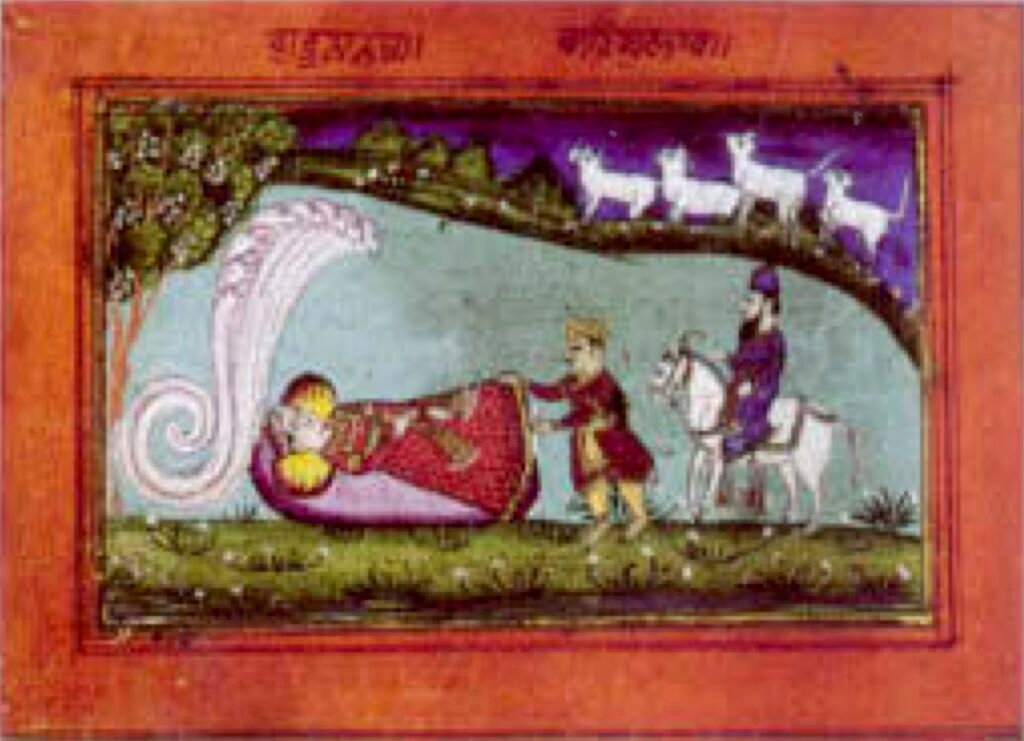
Told he should not sleep with his feet pointing toward the house of God at Mecca, Guru Nanak gently asked the man to turn his feet toward some direction in which God was not. There was none. God, he taught, is everywhere.
There is a famous and lovely story from his visit to Mecca. Nanak, weary from his travels, lay down to sleep with his feet happening to point toward the holy shrine. A man scolded him furiously for daring to point his feet at the house of God. And Nanak only replied, very gently, that the man should please turn his feet to point in some direction where God was not to be found. But of course, there was no such direction anywhere. God, Nanak was quietly teaching him, does not live in one single building, or one single direction, or one single religion. God is simply everywhere.
In his final years, Guru Nanak settled down at last in a town that he himself founded, called Kartarpur. And there he did a beautiful thing: he lived as a simple farmer, working the fields with his own two hands, showing all his followers that a truly holy life was never about running away to hide in a cave, but about living honestly and humbly right in the very middle of ordinary daily life. And when the time finally came to choose who should carry on his great work after he was gone, he did something quietly radical once again. He passed over his own two sons, and chose instead his most devoted follower, judging the man entirely by his goodness, and not at all by his blood.
And then there is the last, and the loveliest, of all the stories. When Guru Nanak died, in the year 1539, his grieving followers fell at once to arguing, for even at the very end, the old divisions still clung stubbornly on. His Hindu followers wished to cremate his body, in the Hindu way, while his Muslim followers wished to bury it, in the Muslim way.
When they lifted the cloth that covered him, his body was gone, and the flowers laid on both sides, the Hindus’ and the Muslims’, were still fresh and blooming. Even in death, he belonged to everyone.
He had told them, it is said, to lay flowers on either side of him, and to let whoever’s flowers stayed fresh be the ones to decide. But when at last they gently lifted the cloth that covered him, they found that his body had quietly gone, and that the flowers on both sides of him, the flowers of the Hindus and the flowers of the Muslims alike, were all still fresh, and still blooming. Even in death, he had slipped clean beyond their quarrel, and he belonged, just as he always had, to every one of them.
The bridge that still stands
Guru Nanak lived and died five hundred years ago now, but the faith that he founded lives on, followed with great love by tens of millions of people all around the world, and his simple message has never once grown old.
In a world that is still, so very often, busy building fresh walls between people, walls of religion, of caste, of wealth, of gender, the gentle voice of Guru Nanak still calls out across all the centuries with the very same clear truth that he first spoke beside that river so long ago. There is one God, he says, and that God lives inside every single one of us. And so, in the end, there is no Hindu and no Muslim, no high and no low, no one soul worth more and no other soul worth less. There is only the one great human family, all of us equal, and all of us loved. It was true when he first said it, standing dripping wet upon a riverbank in the Punjab. And it may well be a truth that the world has still not quite finished learning.
What are the three pillars of Guru Nanak’s teachings?
They are Naam Japo (Meditate), Kirat Karo (Work Honestly), and Vand Chakko (Share with others).
Who was Guru Nanak’s constant companion during his travels?
Bhai Mardana, a Muslim minstrel who played the Rabab, accompanied him for 27 years.
What is the significance of “Ik Onkar”?
It is the opening phrase of the Mool Mantar, meaning “There is One God”, emphasizing the monotheistic nature of Sikhism.
Who succeeded Guru Nanak?
Guru Angad Dev Ji (formerly Bhai Lehna) succeeded him as the second Sikh Guru.
Sources and references
Wikipedia (“Guru Nanak”) and the Government of Nankana Sahib — Guru Nanak (1469–1539) as the founder of Sikhism and first of the ten Gurus, born at Rai Bhoi Ki Talwandi (Nankana Sahib), his message of Ik Onkar (one God dwelling in all creation), and his platform of equality, love and virtue.
KBS Sidhu (555th anniversary) and SAGE Global Religion — his upbringing in a Hindu family educated in both Hindu texts and Persian, his revelatory immersion in the river Bein near Sultanpur Lodhi, the four Udasi journeys reaching Sri Lanka, the Himalayas, Mecca and Baghdad, and his companion Bhai Mardana.
Britannica for Kids and Demi’s “Guru Nanak: First of the Sikhs” — his teaching of one God, peace and equality from the Himalayas to Mecca, the saying “God is everywhere, in every direction,” and his being revered by Hindus and Muslims alike.
Standard accounts of Sikh tradition — the childhood stories of the refused sacred thread and the “true bargain” of feeding the poor, the founding declaration “na koi Hindu, na koi Musalman,” the three pillars (remember God, honest work, sharing), and the institution of langar.