How the fall of the Sikh Empire completed the British conquest of India
On a spring morning in 1849, in the great fort at Lahore, a ten-year-old boy sat on his father’s throne for the last time.
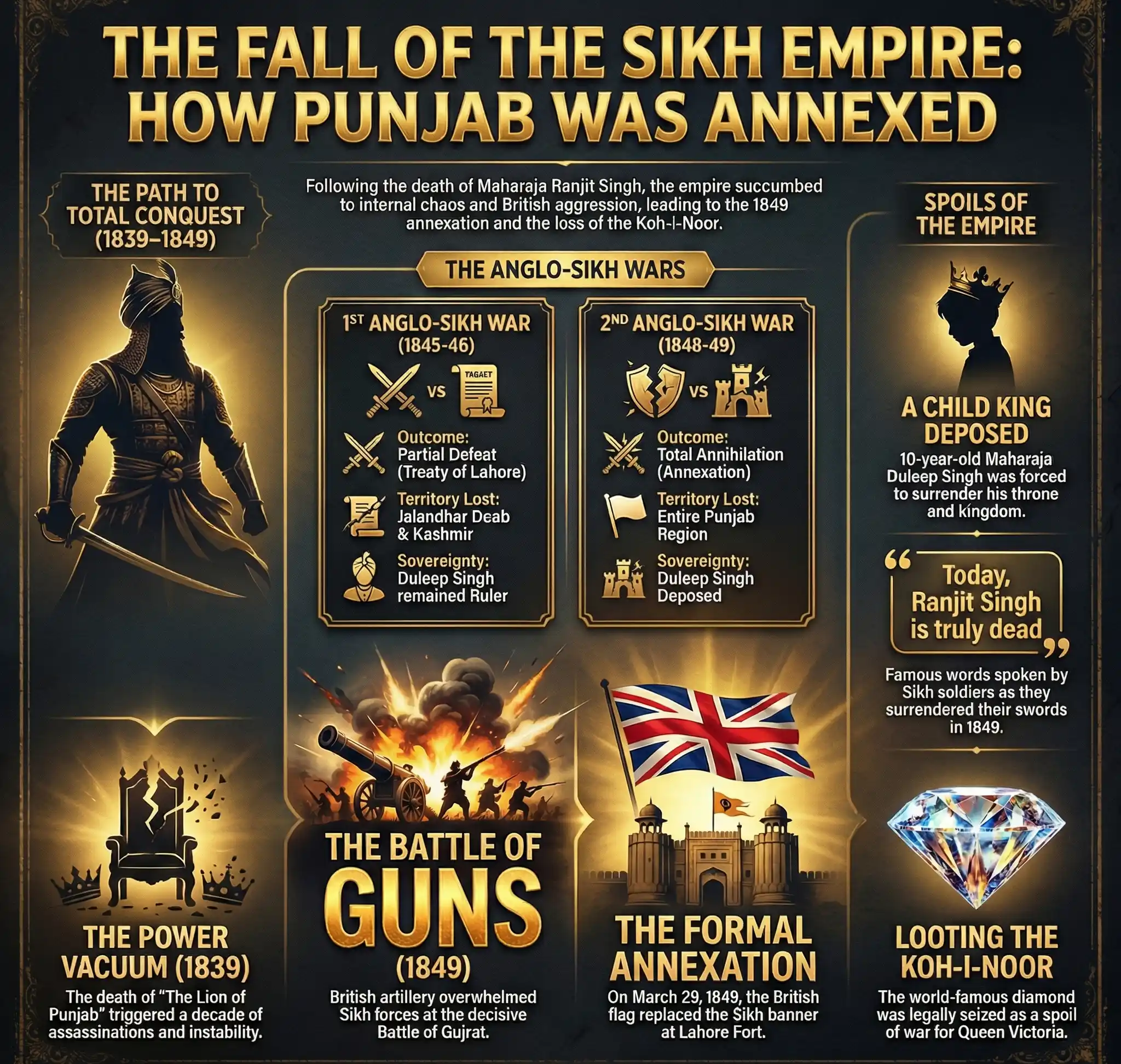
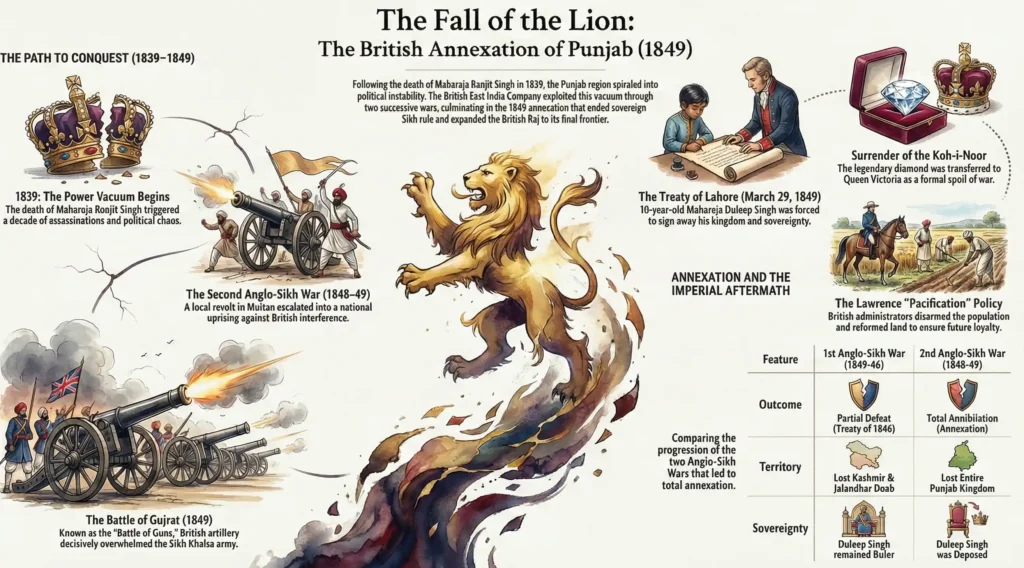
He was Duleep Singh, the last Maharaja of the Sikh Empire, and in front of the assembled court he was made to put his name to a document he can barely have understood. With that signature he handed his entire kingdom to the British, gave up the fabled Koh-i-Noor diamond, and brought to an end the last great independent power left in India.
Outside, as the British flag rose over the fort, hardened Sikh soldiers are said to have thrown down their weapons and wept.
This is the story of how the richest, strongest Indian kingdom of its day came to be signed away by a child, and of the long, sad life of the boy who signed it.
The vacuum after the Lion
For forty years, one man had held the British back.
Maharaja Ranjit Singh, remembered as the Lion of Punjab, had built a powerful, modern kingdom across the land of the five rivers. His army, the Khalsa, was drilled by European officers and respected by everyone, including the British, who were careful never to test it while he lived.
Then, in 1839, the Lion died, and everything he had built began to come apart. What followed was a decade of poison and daggers: a rapid series of rulers, murders in the palace, and factions fighting for control. In the end the throne came to rest on a small boy, Duleep Singh, still a child, with his mother, Rani Jindan, ruling in his name.
Where the world saw a kingdom in trouble, the British saw an opening. They pushed at the border, pressed and provoked, until in 1845 the uneasy peace broke into the First Anglo-Sikh War. It ended in a bruising, partial defeat for the Sikhs, and left the British one long step closer to the prize.
The Midnight of August 15: Freedom, Partition, and the Blood on the Map
The final stand
The peace that followed was bitter and brittle. The Sikh soldiers felt they had been sold out by their own commanders, and the anger simmered.
It boiled over in 1848 in the city of Multan, where a governor named Dewan Mulraj rose against his British overseers. What began as a local revolt spread quickly into a full national uprising, the Second Anglo-Sikh War.
The fighting was savage. At the Battle of Chillianwala, the Sikhs fought so fiercely that they handed the British one of the worst maulings they ever suffered in India, and the news sent a shock through London. But the British recovered, and brought up their guns.
The end came at the Battle of Gujrat in 1849, remembered as the Battle of Guns. It was decided almost entirely by artillery. British cannon pounded the Sikh army from a distance, so relentlessly that the famous Sikh soldiers could never close in to fight.
When the Sikh army finally laid down its arms, one of its soldiers is remembered to have said: today, Ranjit Singh is truly dead.
Dalhousie’s cold decision
The man who now held the fate of Punjab was the Governor-General, Lord Dalhousie, and he was not interested in half-measures.
Some advised him to keep the boy Duleep Singh on the throne as a harmless puppet, ruling in name while the British ruled in fact. Dalhousie refused. He did not want to control the Sikh kingdom. He wanted to erase it, to wipe it off the map and swallow it whole.
So on 29 March 1849, the court was summoned to the Lahore Fort, and the child Maharaja was brought out to sign away everything. His kingdom became British territory. And there was one more clause, and it was the cruellest.
The treaty did not ask for the Koh-i-Noor diamond. It ordered the boy to surrender it to the Queen of England. It was not a gift. It was a spoil of war, taken in writing from a child.
Jallianwala Bagh Massacre 1919: Inside the Tragedy That Ignited a Revolution
The long sorrow of Duleep Singh
For the young Maharaja, the conquest did not end with the throne. It reached into his life and took that too.
He was separated from his mother, Rani Jindan, who was imprisoned and then sent into exile. The boy was placed in the care of a British guardian, brought up as a Christian, and shipped off to England to live out his days as a kind of exotic country gentleman, a living trophy of the empire that had unmade him.
His mother, it should be said, did not go quietly. The fierce Rani Jindan, whom the British feared enough to lock away, once escaped her imprisonment disguised as a beggar woman and fled to Nepal.
Duleep Singh’s own ending was sadder. As an older man, far from home, he came to understand exactly what had been taken from him. He returned to the Sikh faith of his childhood and tried to come back to India to reclaim something of his past, but the British stopped him on the way and turned him back. He died, worn out and largely alone, in a hotel room in Paris, a maharaja without a kingdom.
Establishment of the British Raj 1858: The Dawn of Imperial India
What the conquest completed
With Punjab swallowed, the map was finished. There was no longer any large independent Indian power left to stand against the British. From the fall of Bengal at Plassey almost a century earlier, the slow work of conquest was, at last, complete.
The victors set about making Punjab quiet and profitable. They disarmed the people, pulled down the old forts, and won over the farmers with reforms carefully designed to keep them content and loyal. It worked so well that only eight years later, when much of northern India rose in the great revolt of 1857, Punjab stayed loyal to the British and even helped them retake Delhi.
And yet the story does not end in simple defeat. The soldiers the British had just conquered impressed them so deeply that they came to lean on Punjab to fill the ranks of their army, and the region’s martial traditions outlived the empire that tried to tame them. The kingdom was gone, but the people endured, through annexation, through the tearing of Partition, and beyond.
Only the diamond never came home. The Koh-i-Noor, signed away by a frightened boy in 1849, sits to this day in the crown jewels of Britain, the brightest and most bitter reminder of the morning the land of the five rivers lost its freedom.
Indian Rebellion of 1857: The First War of Independence
If you think you have remembered everything about this topic take this QUIZ
Results


#1. The Annexation of Punjab on March 29, 1849, marked the end of which empire?
#2. Who was the Governor-General of India responsible for the annexation of Punjab?
#3. Which decisive battle of the Second Anglo-Sikh War is known as the “Battle of Guns”?
#4. Who was the last Maharaja of the Sikh Empire, forced to step down at the age of 10?
#5. Under the Treaty of Lahore (1849), which famous diamond was surrendered to Queen Victoria?
#6. The rebellion that sparked the Second Anglo-Sikh War was started by Dewan Mulraj in which city?
#7. Which brothers were appointed to lead the Board of Administration to govern Punjab after annexation?
#8. After being imprisoned, the Queen Mother Rani Jindan famously escaped to which country disguised as a beggar?
When was Punjab annexed by the British?
Punjab was formally annexed on March 29, 1849.
Who was the Governor-General responsible for the annexation?
Lord Dalhousie ordered the annexation of Punjab.
Who was the last Maharaja of the Sikh Empire?
Maharaja Duleep Singh, the youngest son of Ranjit Singh, was the last ruler.
Which battle decided the fate of Punjab?
The Battle of Gujrat (1849), where the British decisively defeated the Sikh army, was the turning point.
What happened to the Koh-i-Noor diamond after annexation?
It was confiscated from Duleep Singh and presented to Queen Victoria as part of the Treaty of Lahore (1849).
Sources & References
- Encyclopaedia Britannica (“Anglo-Sikh Wars” and “Ranjit Singh”) — the Sikh Empire, the two wars, and the annexation of Punjab in 1849.
- Historic Royal Palaces (Duleep Singh and Sophia Duleep Singh) — the deposed Maharaja’s life in exile in England and his family’s later history.
- Royal Collection Trust (the Koh-i-Noor diamond) — the surrender of the diamond under the Treaty of Lahore and its passage to the British crown.
- National Army Museum (the Anglo-Sikh Wars) — the battles of Chillianwala and Gujrat and the defeat of the Khalsa army.
Author


Exploring the Soul of Bharat through History, Science, Culture, and its Diversity
Our Mission
Curious Indian is a definitive knowledge portal dedicated to chronicling the events, personalities, and cultural shifts that defined the Indian subcontinent. From the ancient Vedic Period to the complexities of 21st-century politics, our goal is to provide deep-dive analysis that inspires.
Editorial Standards & E-E-A-T
Every article published under our brand undergoes a rigorous fact-checking process. We prioritize primary historical records, academic citations, and credible archives to ensure our readers receive accurate, high-authority information.
Historical Integrity Directly sourcing from ASI archives and academic journals.Topical Authority Comprehensive clustering of Indian Science, Biographies, and Wars.Managed by Paripurna Datta and TEAM | Dedicated to the Knowledge of India.