How the Great Revolt of 1857 failed and still changed India
It began with a rumour about grease.
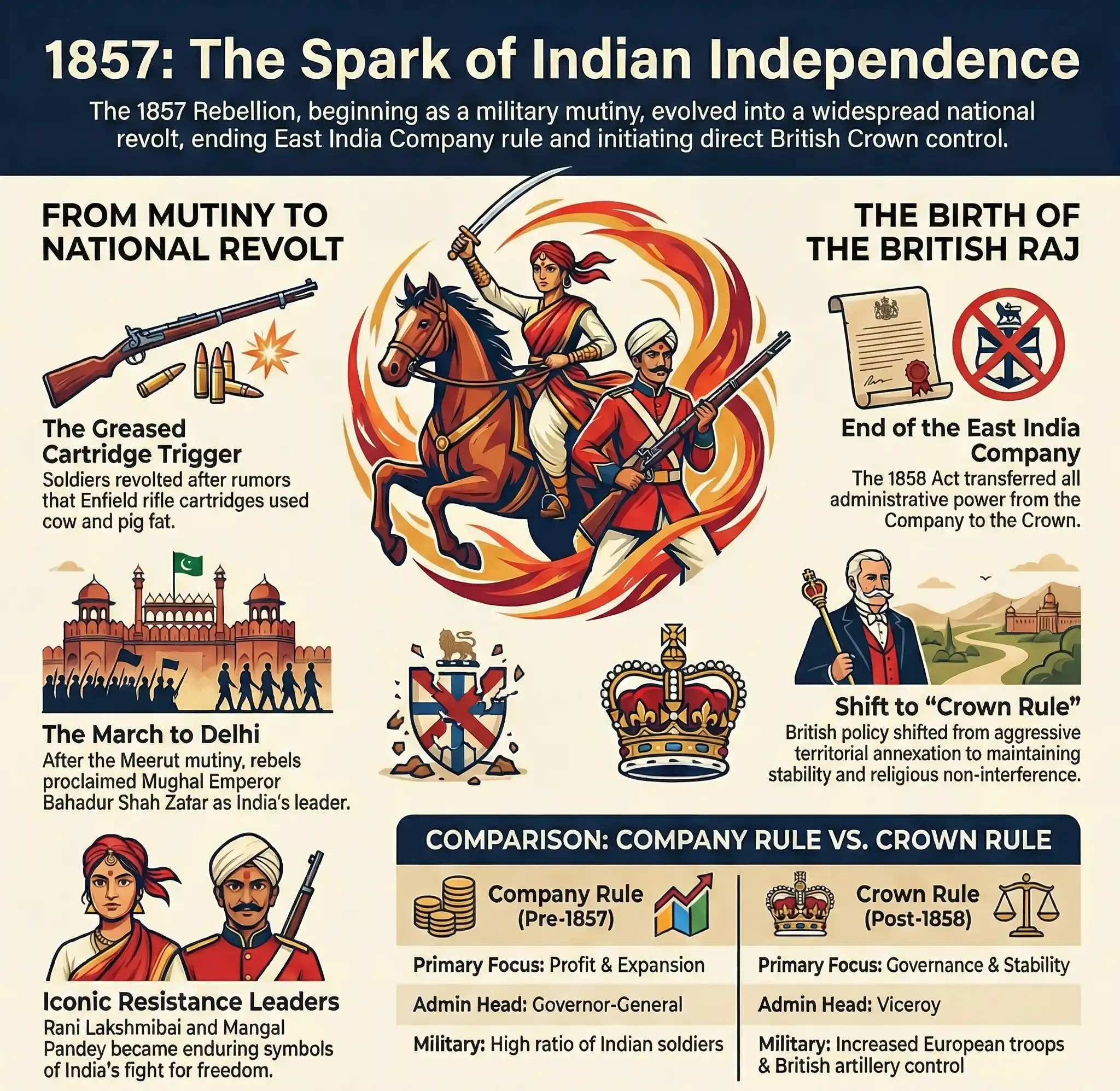
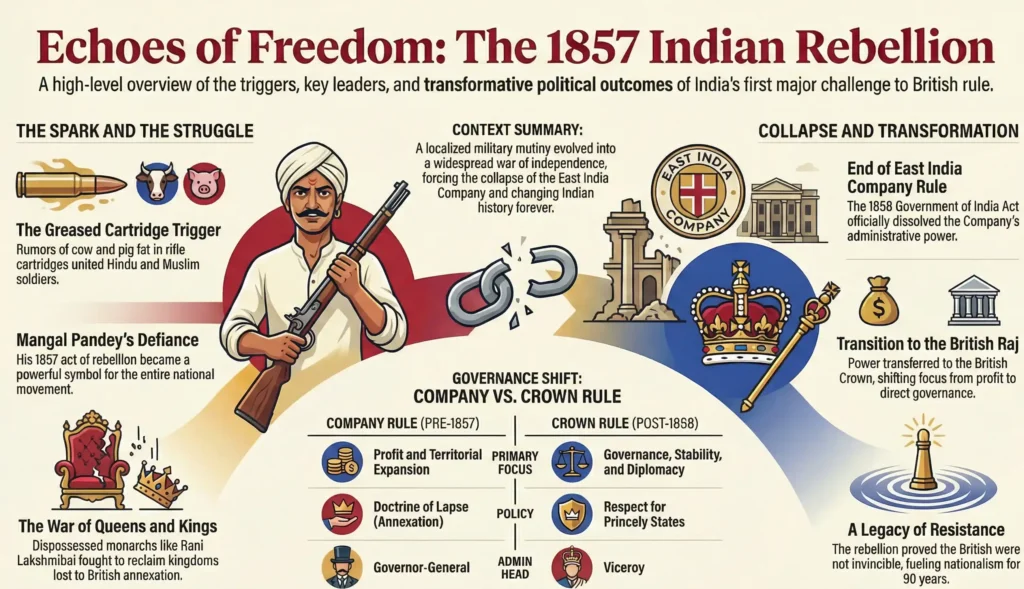
In the spring of 1857, a rumour ran through the barracks of the East India Company’s Indian soldiers, its sepoys, that the paper cartridges for their new rifles were smeared with a mixture of cow fat and pig fat. To load the gun, a soldier had to bite the cartridge open. For a Hindu the cow was sacred; for a Muslim the pig was unclean. To both, the order felt like a deliberate insult to their faith, and perhaps a plot to defile them and push them toward Christianity.
From that small, strange spark, within a matter of weeks, half of northern India was in flames.
The uprising that followed would be crushed within a year, and by every obvious measure it was a failure. And yet it destroyed the most powerful corporation the world had ever seen, ended a dynasty three centuries old, and left behind a memory of resistance that would one day help win India its freedom. This is the story of the revolt that failed, and won.
A greased cartridge
The cartridge was the spark, but it is worth being clear that it was only the spark.
The first flame flickered at Barrackpore, near Calcutta, in late March 1857. A young sepoy named Mangal Pandey, refusing to touch the new cartridges, turned his musket on his British officers. He was overpowered and hanged within days. But his defiance ran through the army like a current, and his name became a byword for a rebel.
The British thought they were dealing with a discipline problem about ammunition. They were not. They were about to learn that the ammunition had been dropped onto a heap of dry kindling that had been building for a very long time.
The Final Walk: The Conspiracy Behind Mahatma Gandhi’s Death
The kindling beneath
To understand why a single rumour could set a subcontinent alight, you have to look at what lay underneath it.
For a century the Company had been swallowing India, kingdom by kingdom. In the years just before 1857 it had grown especially greedy, using a rule called the Doctrine of Lapse to seize any princely state whose ruler died without a natural-born son, brushing aside adopted heirs who by Indian custom were perfectly legitimate. Old royal families found themselves dispossessed and humiliated. Peasants groaned under heavy taxes and lost their land. And across society there was a deep unease that the British meant to trample not only India’s kings but its customs and its faiths.
The cartridge was only the spark. The kindling had been piling up, dry and ready, for a hundred years.
So when the soldiers rose, they did not rise alone.
From Meerut to Delhi
The real explosion came on 10 May 1857, at the cantonment of Meerut.
Days earlier, dozens of sepoys had been court-martialled and shackled for refusing the cartridges. Now their comrades broke open the jails, turned on their officers, and set off through the night toward the old imperial capital, Delhi, some forty miles away. By the next morning they were pouring into the city.
There they did something that turned a mutiny into a cause. They went to the Red Fort and proclaimed the frail, elderly Bahadur Shah Zafar, the last of the Mughals, as the Emperor of Hindustan. Zafar was more a poet than a warrior, an old man of around eighty who had ruled little but his own palace for years, and he took up the role with great reluctance. But it hardly mattered. For a few extraordinary months, Delhi was once again the capital of a free India, and a Mughal sat on its throne.
A war of queens and kings
What spread out from Delhi was far larger than a soldiers’ quarrel.
Across the north and centre of India, the dispossessed and the angry rose together. At Jhansi, the young queen Rani Lakshmibai, whose kingdom the Company had seized after refusing to recognise her adopted son, took up arms and became the most famous rebel of all. At Kanpur, Nana Sahib, the cheated heir of the Marathas, led the revolt, aided by his brilliant general Tatya Tope. At Lucknow, Begum Hazrat Mahal fought on in the name of her young son. In Bihar, an eighty-year-old landlord named Kunwar Singh went to war against the British and proved that courage owes nothing to age.
This was no longer a soldiers’ mutiny. Queens, peasants, a reluctant old emperor and an eighty-year-old landlord had all been swept into the same fire.
Rani Lakshmibai’s end became the stuff of legend. She died sword in hand on the field at Gwalior, and the British general who defeated her paid her the highest compliment he could think of, calling her the bravest and best of all the rebel leaders.
Jallianwala Bagh Massacre 1919: Inside the Tragedy That Ignited a Revolution
The devil’s wind
The British struck back with a fury that shocked even some of their own.
This was a savage war, and honesty requires saying that terrible things were done on both sides. Rebels killed British men, and in some places their women and children too, in acts that horrified Britain and hardened its heart. And then the empire took its revenge, and its revenge was on a scale far greater still.
The British did not only want to win. They wanted to terrify. Villages suspected of sheltering rebels were burned. When Delhi was retaken in the autumn of 1857, the reprisals killed great numbers of its people. The aged Bahadur Shah Zafar was arrested and put on trial, his sons were shot dead by a British officer, and the last Mughal emperor was shipped into exile in Burma, where he died a forgotten man, far from home.
The retribution was so pitiless that Indians gave it a name of its own. They called it the Shaitan ki Hawa, the Devil’s Wind.
Why it failed
For all its fury, the rebellion never truly had the chance to win, and it is not hard to see why.
It was never really united. It flared across the north and the centre, but the south stayed largely quiet, and Bengal and Punjab, only lately conquered, stayed loyal to the British or were held firmly in check. Just as damaging, the rebels shared no single vision of what should come next. Some wanted to bring back the Mughals, some the Marathas, some simply their own lost lands. They were joined by their hatred of the British and divided by almost everything else. And against their courage the British had the telegraph, the railway, disciplined armies and hard, experienced generals.
By 1858, the great revolt had been ground down.
Mutiny, or war?
Ever since, people have argued about what to call it, and the argument itself tells you a great deal.
To the British, it was simply the Sepoy Mutiny, a breakdown of discipline in a hired army. To later Indian nationalists, it was something far grander: the First War of Independence, the opening shot of the struggle that would end in 1947. Even Karl Marx, watching from London, wrote that it was a national revolt and not a mere mutiny.
The honest answer sits somewhere in between. It was more than a mutiny, far more, a vast and furious rising of soldiers and civilians against a foreign power. But it was also less than a united war of independence, too divided and too backward-looking to speak for a nation that did not yet quite exist. It was both things at once, and neither of them completely.
What is not in doubt is what it left behind. The revolt failed to drive out the British. But it killed the East India Company, that strange corporation which had bought its first foothold in Bengal a hundred years before, and forced the British Crown to take over India directly. It ended the Mughal line forever. And it planted in the Indian imagination a memory that would never fade, of the year the people rose and made the greatest empire on earth bleed.
Ninety years later, when India finally won its freedom, it remembered 1857 as the beginning. A glorious failure, perhaps. But a beginning all the same.
Establishment of the British Raj 1858: The Dawn of Imperial India
If you think you have remembered everything about this topic take this QUIZ
Results


#1. What was the immediate cause that triggered the Revolt of 1857?
#2. Who was the first martyr of the revolt, hanged for defying British officers at Barrackpore?
#3. The revolt officially began on May 10, 1857, in which cantonment town?
#4. Who was proclaimed the “Shahenshah-e-Hindustan” (Emperor of India) by the rebels?
#5. Which 80-year-old leader led the rebellion in Bihar?
#6. What was the major political consequence of the revolt’s suppression in 1858?
#7. Just before the revolt, which mysterious food item was passed from village to village?
Who was the first martyr of the 1857 Revolt?
Mangal Pandey is considered the first martyr, executed on April 8, 1857, at Barrackpore.
Who led the revolt in Jhansi?
Rani Lakshmibai led the revolt in Jhansi against the Doctrine of Lapse.
What was the immediate cause of the 1857 Revolt?
The immediate cause was the introduction of Enfield rifle cartridges rumored to be greased with cow and pig fat.
Who was the Governor-General during the 1857 Revolt?
Lord Canning was the Governor-General during the revolt and became the first Viceroy after it.
What happened to the Mughal Empire after 1857?
The Mughal Empire was formally abolished. The last emperor, Bahadur Shah Zafar, was exiled to Rangoon, Burma, where he died in 1862.
Sources & References
- Encyclopaedia Britannica (“Indian Mutiny” and “Mangal Pandey”) — the outbreak of the revolt, its spread, and its suppression.
- The British Library (Bahadur Shah Zafar and the fall of Delhi) — the last Mughal emperor, his part in the revolt, and his exile.
- Amrit Mahotsav, Government of India (Rani Lakshmibai and the leaders of 1857) — the rebel leaders and their resistance.
- UK legislation and Parliament records (Government of India Act 1858) — the end of Company rule and the transfer of power to the British Crown.
Author


Exploring the Soul of Bharat through History, Science, Culture, and its Diversity
Our Mission
Curious Indian is a definitive knowledge portal dedicated to chronicling the events, personalities, and cultural shifts that defined the Indian subcontinent. From the ancient Vedic Period to the complexities of 21st-century politics, our goal is to provide deep-dive analysis that inspires.
Editorial Standards & E-E-A-T
Every article published under our brand undergoes a rigorous fact-checking process. We prioritize primary historical records, academic citations, and credible archives to ensure our readers receive accurate, high-authority information.
Historical Integrity Directly sourcing from ASI archives and academic journals.Topical Authority Comprehensive clustering of Indian Science, Biographies, and Wars.Managed by Paripurna Datta and TEAM | Dedicated to the Knowledge of India.