Jivaka was put out on a rubbish heap the day he was born and named for the answer to the only question anyone asked about him. He became physician to a king, and to the Buddha
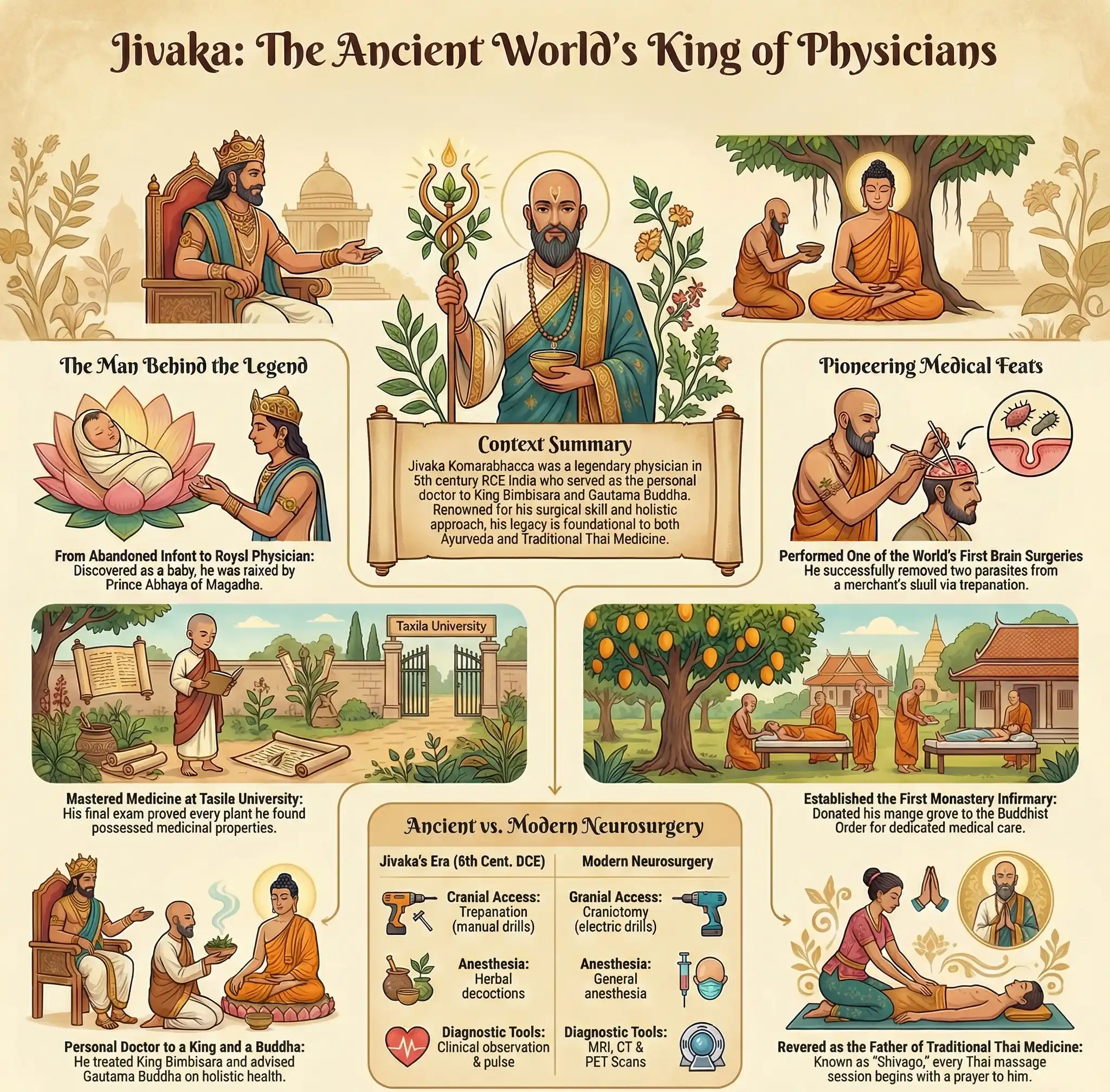
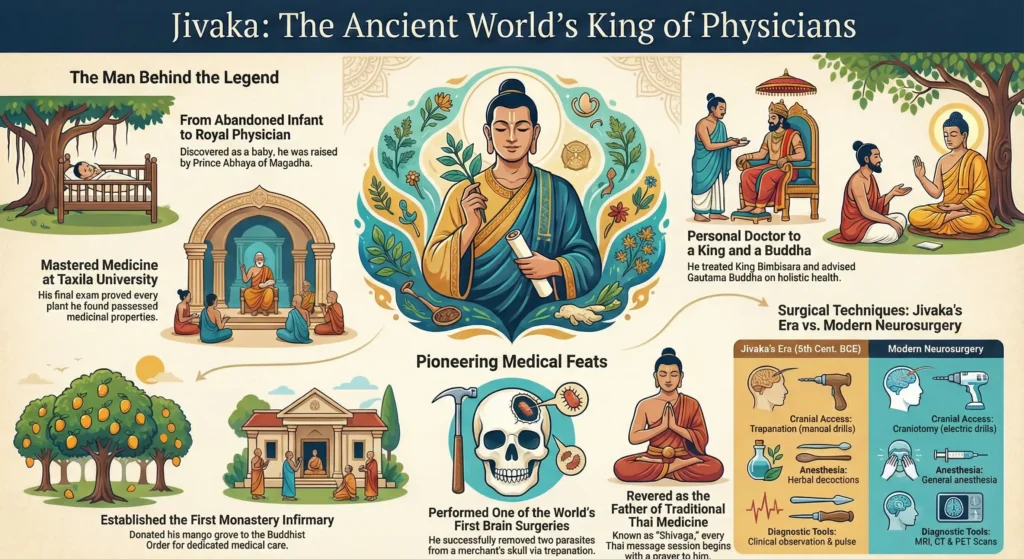
A courtesan of Rajagriha gave birth to a boy, had him put in a basket and had the basket left on a heap of refuse outside the city.
Prince Abhaya, riding past, saw crows gathered and sent someone to look. What is it, he asked. A child. Is he alive? He lives, they told him. Jivati.
So they called him Jivaka, which means he lives, and the prince took him home and brought him up. The second half of his name, Komarabhacca, is usually read as the one raised by the prince.
He was named for the fact that he had not died, by people who had expected him to.
He worked out as a boy that his place in the palace rested on somebody’s kindness rather than on any claim of his own, and that a man in that position needs a trade nobody can take away.
He went to Taxila, in the north-west, and studied medicine for seven years. At the end of it his teacher gave him one examination. Go out a day’s journey around the city, and bring me back any plant that is not medicine.
He searched and came back with his hands empty. His teacher told him he was finished, and gave him a small sum for the road home, which ran out before he arrived.
There is no plant that is not medicine. The correct answer to the examination was to fail to find one.
The caseload
What makes Jivaka unusual is that the Buddhist monastic code records his cases rather than his virtues. He comes down to us with a patient list.
A merchant’s wife at Saketa who had had headaches for seven years, treated with medicated ghee given through the nose. A merchant’s son at Benares with a twisted intestine, which Jivaka opened, untwisted and closed again. King Bimbisara’s fistula, cleared with a single application of ointment, after which the king offered him the women of his household and Jivaka asked instead to be allowed to serve him, the Buddha and the order.
Then a merchant of Rajagriha with a complaint in the head, which was opened and closed. As the text tells it, Jivaka instructed him to lie seven months on one side, seven on the other and seven on his back, knowing the man would rebel long before that, and later admitted he had named an absurd term to get him to manage the few days that were actually required.
A physician who lies to a patient about how long to lie still, in order that he will lie still long enough. That is not hagiography. That is somebody who has run a practice.
The Buddha’s physician
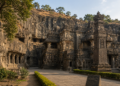
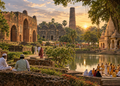
He treated the Buddha, and he gave his mango grove outside Rajagriha to the order as a place to stay. The site has been excavated at Rajgir in Bihar and the outlines of it can still be walked.
Two of the rules of the monastic code come from him. He asked that monks be permitted to accept robes offered by laypeople, rather than only using cloth taken from refuse heaps, which he had reason to feel strongly about.
The other request is stranger and more human. People were getting themselves ordained in order to be treated by him for nothing, and leaving the order once they were well.
He went to the Buddha and asked that the seriously ill be refused ordination, and the rule was made. A physician petitioning to have patients turned away sounds ugly until you notice what it actually describes: one man providing an unpriced service to a kingdom, being used up.
The question about meat
He also asked the Buddha a question that is still load-bearing. Was it true, he wanted to know, that animals were being killed specially for the Buddha, and that he ate the meat knowing it?
The answer given to him is the threefold rule that Theravada Buddhism still works from: a monk may not eat meat he has seen, heard or has reason to suspect was killed for him. A physician asked the question and the discipline followed from the answer.
Afterwards
He is venerated across Buddhist Asia as a king of medicine. In Thailand he is treated as the founder of the traditional medical and massage tradition, and his name is recited at the start of the day in schools that teach it, which has been going on for centuries.
The child that was left out for the crows is thanked every morning, twenty-five centuries later, by people who heal for a living.
He earned this title due to his peerless surgical skills, his role as the doctor to the highest royalty and the Buddha, and his mastery of all branches of medicine available in his time.
Did Jivaka really perform brain surgery?
Yes, Buddhist texts (the Vinaya Pitaka) record a specific instance where Jivaka opened a patient’s skull to remove parasites, which is an early form of neurosurgery.
What is Jivaka’s connection to Thai Massage?
Thai tradition holds that Jivaka traveled with the spread of Buddhism and established the foundations of Thai herbal medicine and massage therapy.
Where can I find Jivaka’s monastery today?
The ruins of the Jivakarama Vihara (his mango grove monastery) are located in Rajgir, Bihar, and are a popular pilgrimage and archaeological site.
Who was Jivaka’s teacher?
He was a disciple of Sage Atreya at the University of Taxila, where he studied for seven years.
Sources & References
Vinaya Pitaka, Mahavagga VIII, translated by I.B. Horner as The Book of the Discipline (Pali Text Society) — his birth and naming, the training at Taxila, the recorded cases and the rules he requested.
Majjhima Nikaya 55, the Jivaka Sutta — his question to the Buddha about meat and the threefold rule given in reply.
Kenneth G. Zysk, Asceticism and Healing in Ancient India: Medicine in the Buddhist Monastery (Oxford University Press) — the medical content of the Buddhist sources and what can be drawn from it historically. Archaeological Survey of India, Rajgir — the excavated remains of the mango grove he gave to the order
Exploring the Soul of Bharat through History, Science, Culture, and its Diversity
Our Mission
Curious Indian is a definitive knowledge portal dedicated to chronicling the events, personalities, and cultural shifts that defined the Indian subcontinent. From the ancient Vedic Period to the complexities of 21st-century politics, our goal is to provide deep-dive analysis that inspires.
Editorial Standards & E-E-A-T
Every article published under our brand undergoes a rigorous fact-checking process. We prioritize primary historical records, academic citations, and credible archives to ensure our readers receive accurate, high-authority information.
Historical IntegrityDirectly sourcing from ASI archives and academic journals.
Topical AuthorityComprehensive clustering of Indian Science, Biographies, and Wars.
Managed by Paripurna Datta and TEAM | Dedicated to the Knowledge of India.