How India’s First Non-Congress Government Won by Uniting Against One leader, and Fell Apart Once She Was Gone
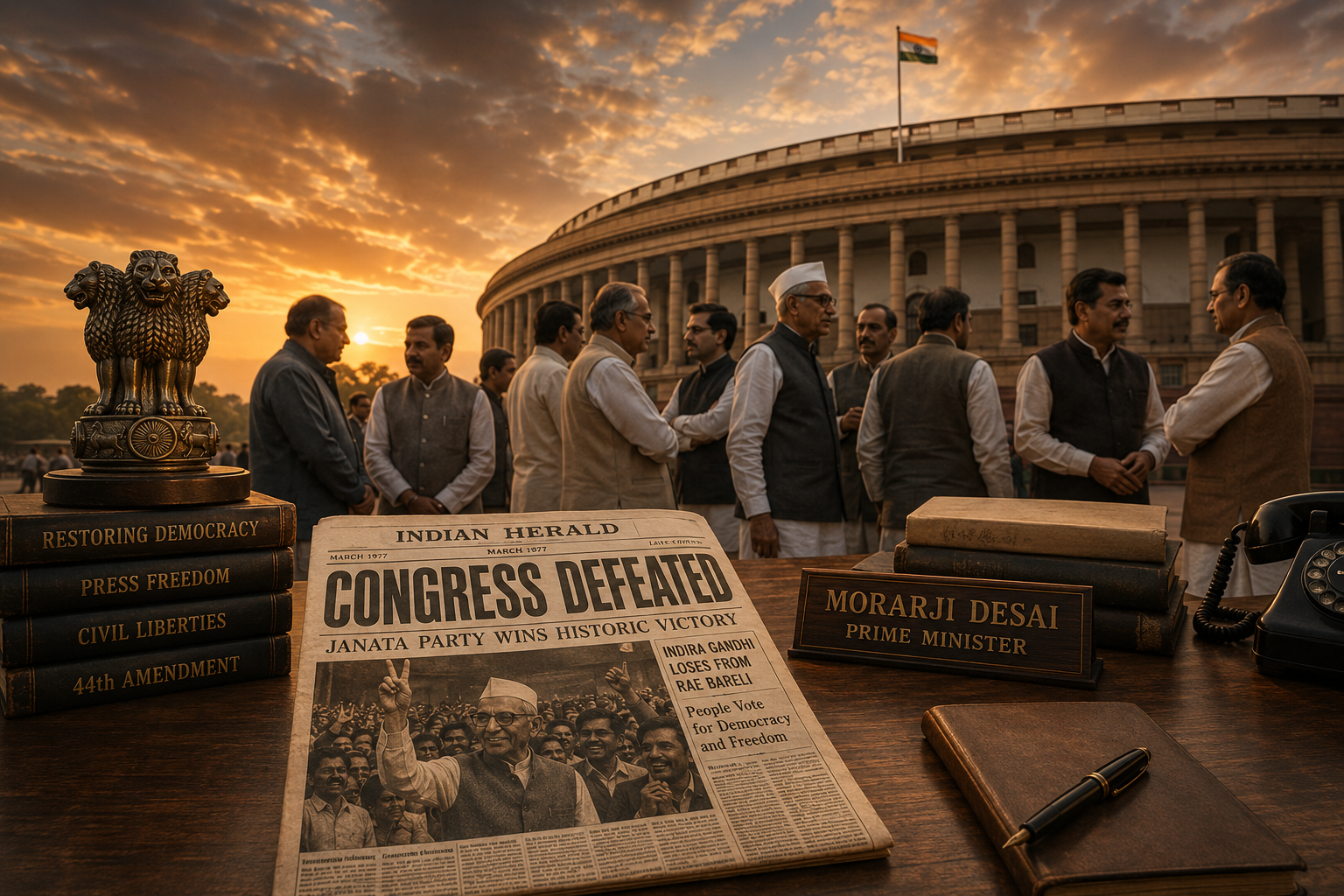
In 1977, for the first time since India had won its freedom thirty years earlier, a party that was not the Congress won power in Delhi. It was a genuine political earthquake.
The party that pulled it off, the Janata Party, was made up of people who disagreed about almost everything, socialists and conservatives, farmers’ leaders and Hindu nationalists, all bound together by a single shared belief: that Indira Gandhi had to be stopped. They stopped her. And then, having got their one great wish, they fell apart. This is the story of India’s first experiment with life beyond the Congress, and of what happens when a group is united only by what it stands against.
The Two Years Democracy was Switched Off
To understand 1977, you have to begin with the dark thing that came just before it.
In June 1975, Prime Minister Indira Gandhi, facing a court ruling against her and rising protests in the streets, did something drastic. She declared a state of “Emergency.” For nearly the next two years, India’s democracy was, in effect, switched off.
During the Emergency, opposition leaders were jailed without trial, newspapers were censored, and in places ordinary people suffered real cruelties, including forced sterilisations and the demolition of the homes of the poor.
It was the darkest chapter in the life of India’s young democracy. Then, early in 1977, Indira Gandhi surprised everyone. She lifted the Emergency and called a fresh election, most likely believing she would comfortably win it.
Vikram Sarabhai Biography: The Man Who Built India’s ISRO
An Alliance of Opposites
She had badly misjudged the country’s anger. Sensing their one great chance had finally come, the scattered opposition parties did something they had never managed to do before. They buried their many deep differences and merged into a single party to fight her.
Under the moral leadership of a beloved old freedom-fighter, Jayaprakash Narayan, whom everyone simply called “JP,” the most unlikely partners came together. Socialists joined hands with conservatives. A farmers’ party stood beside a Hindu-nationalist one. A respected Dalit leader who had walked out of Indira’s own cabinet joined them all. They named themselves the Janata Party, the “People’s Party.”
They agreed on hardly anything at all, except the one thing that mattered most to them: that Indira Gandhi and her Emergency had to go.
The Earthquake
The result shocked even the people who won it. Voters, especially across the north of India, turned on the Congress with real fury.
The Janata Party swept to an enormous victory. And most stunning of all, Indira Gandhi lost her own seat in Parliament, and so did her son Sanjay. For the first time in thirty years of freedom, the Congress was out of power in Delhi. An eighty-one-year-old veteran named Morarji Desai, chosen after some squabbling among the victors, became the first Prime Minister of India who did not belong to the Congress party.
Birbal Sahni: The Scientist Who Unlocked India’s Prehistoric Forests
The One Great Thing They Did
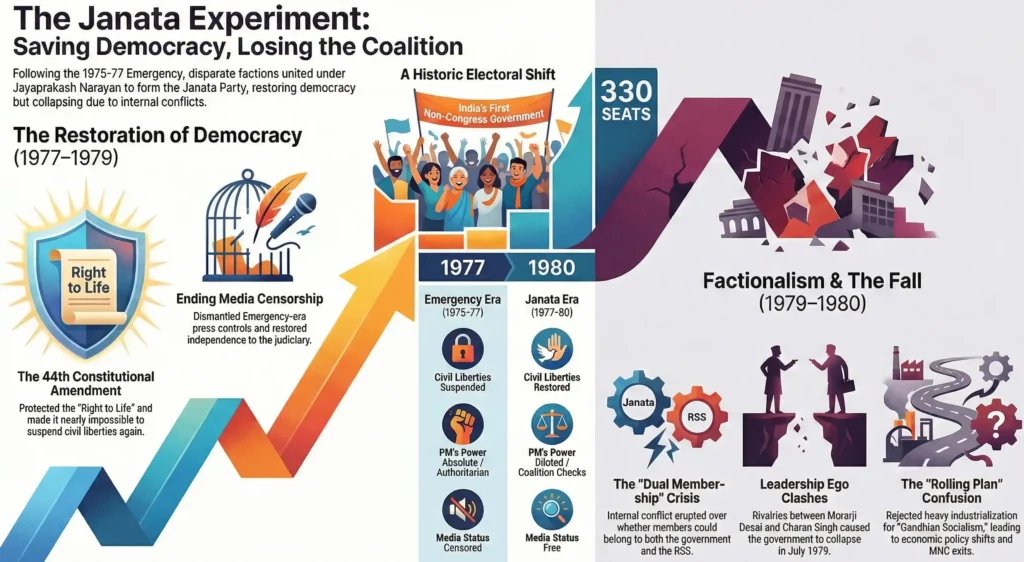
And the new government did do one enormous thing extremely well, the very thing it had been built to do. Piece by piece, it dismantled the machinery of the Emergency.
It set the press free. It restored the rights that had been snatched away. And it changed the Constitution itself to make it far harder for any future leader to switch off democracy so easily ever again. Whatever came afterwards, this truly mattered. India had shown the whole world something rare and precious.
India had proved that a democracy could peacefully vote out a leader who had turned against it, and then repair the damage, using ballots instead of bullets.
Tashkent Agreement 1966: Peace Treaty or Political Betrayal?
Nothing Left to Agree On
But this is exactly where the trouble began. The Janata Party had only ever been held together by one thing: a shared opposition to Indira Gandhi. Now that she was defeated and out of power, that glue simply dissolved. And beneath it, there was almost nothing.
The socialists and the conservatives, the Hindu nationalists and the farmers’ leaders, looked around at one another and remembered that, in truth, they agreed on hardly anything. The infighting that followed was ferocious, and a great deal of it came down to personal ambition. Powerful men who each felt that he should be the Prime Minister schemed and plotted against one another. Old arguments about beliefs and ideas reopened like wounds.
Within two years, the whole structure came crashing down. A key leader, Charan Singh, broke away with his followers, and Morarji Desai was forced to resign in July 1979. Charan Singh then got to be Prime Minister himself, but only for a matter of weeks, propped up by, of all people, Indira’s Congress, which promptly pulled the rug from under him before he had even faced Parliament. The great experiment had eaten itself alive.
Dr. Salim Ali: The Man Who Taught India to Look at the Skies
The Enemy Returns
Fresh elections were called in January 1980. And India’s voters, worn out and disappointed by the endless squabbling and the sense of a government that simply could not govern, made a startling choice.
They brought back the very woman they had thrown out less than three years before. Indira Gandhi swept back into power, and the Janata experiment was finished. JP, the good and gentle man who had dreamed the whole thing into being, had already watched his creation tear itself apart, and had died, heartbroken, only a few months earlier.
What the experiment taught
It is easy to remember the Janata years as nothing more than a failure. But they left India with two lasting lessons, and both still matter a great deal today.
The first is a hopeful one. Indian democracy turned out to be far tougher than it looked. Even after two years of near-dictatorship, the ordinary people held the power to put things right, and they used it. The second lesson is a warning, and it is one about politics everywhere, not just in India. You cannot run a country on opposition alone. A group joined together only by what it hates can win a hard fight, but it cannot build anything that lasts, because the very moment the fight is won, it no longer has any reason to stay together.
There is a long tail to the story, too. Out of the wreckage of the Janata Party, its Hindu-nationalist wing set off on its own and founded a brand-new party, the BJP, which would grow, decades later, into one of the two great forces of Indian politics. So the ruins of the experiment quietly became the seedbed of a future nobody in 1980 could have predicted. The Janata Party lived for less than three years. But in that short time it proved two things that India has never forgotten: that the country cannot be ruled without the people’s consent, and that such consent, once given, has to be earned with far more than a shared enemy.
Subramania Bharati: The Mahakavi of Indian Nationalism
If you think you have remembered everything about this topic take this QUIZ
Results


#1. What was the primary shared motivation that united the disparate political factions to form the Janata Party?
#2. Who served as the key guiding ideologue for the formation of the Janata Party?
#3. Which Constitutional Amendment did the Janata government pass to dismantle the authoritarian structures of the Emergency?
#4. What was the name of the economic planning concept introduced by the Janata government after terminating the 5th Five-Year Plan early?
#5. Which multinational companies were famously forced to leave India under Industry Minister George Fernandes?
#6. What contentious issue caused internal infighting and led to Charan Singh withdrawing his support from the government?
#7. Who holds the distinction of being the only Indian Prime Minister never to face Parliament?
#8. In 1978, the Morarji Desai government implemented demonetization to curb black money by withdrawing which high-value currency notes?
Who was the first non-Congress Prime Minister of India?
Morarji Desai.
Which amendment did the Janata government pass to restore civil liberties?
The 44th Constitutional Amendment Act (1978).
Why did the Janata government fall?
It fell due to internal infighting, particularly the Dual Membership issue (RSS ties of Jana Sangh members) and the rivalry between Morarji Desai and Charan Singh.
Which multinational companies were kicked out of India during this period?
Coca-Cola and IBM were forced to leave under FERA regulations.
Who became Prime Minister after Morarji Desai?
Charan Singh, who ruled for a few months with Congress support.
Sources and References
- Live History India (“Janata Party” and “How Dual Membership Brought Down India’s First Non-Congress Coalition”) — the 1977 formation under Jayaprakash Narayan from the merger of Congress (O), Bharatiya Lok Dal, Jana Sangh and Congress for Democracy, the Morarji Desai government, and its collapse over the “dual membership” (RSS) dispute and Charan Singh’s revolt.
- Wikipedia (“Premiership of Morarji Desai” and “Janata Party”) — the Desai ministry from 24 March 1977 to 28 July 1979, the majority won in 1977, the resignation of Desai, and Indira Gandhi’s return via Congress (I) in the 1980 election.
- Edukemy and Curious Indian’s own overview — the restoration of civil liberties, the 44th Amendment reversing Emergency-era changes, the Shah Commission, the three-way contest for Prime Minister settled in favour of the 81-year-old Desai, and the framing of the party as a “marriage of convenience.”
- Encyclopaedia.com (“Janata Party”) — Indira Gandhi and Sanjay Gandhi losing their seats in 1977, Charan Singh’s brief premiership dependent on Congress support, and the Congress sweeping back to power by an overwhelming majority in 1980.
- Background on the Emergency (1975–77) — the Allahabad High Court verdict against Indira Gandhi, the suspension of civil liberties, press censorship, and the forced sterilisations and demolitions that fuelled the opposition’s 1977 victory.
Author


Exploring the Soul of Bharat through History, Science, Culture, and its Diversity
Our Mission
Curious Indian is a definitive knowledge portal dedicated to chronicling the events, personalities, and cultural shifts that defined the Indian subcontinent. From the ancient Vedic Period to the complexities of 21st-century politics, our goal is to provide deep-dive analysis that inspires.
Editorial Standards & E-E-A-T
Every article published under our brand undergoes a rigorous fact-checking process. We prioritize primary historical records, academic citations, and credible archives to ensure our readers receive accurate, high-authority information.
Historical Integrity Directly sourcing from ASI archives and academic journals.Topical Authority Comprehensive clustering of Indian Science, Biographies, and Wars.Managed by Paripurna Datta and TEAM | Dedicated to the Knowledge of India.