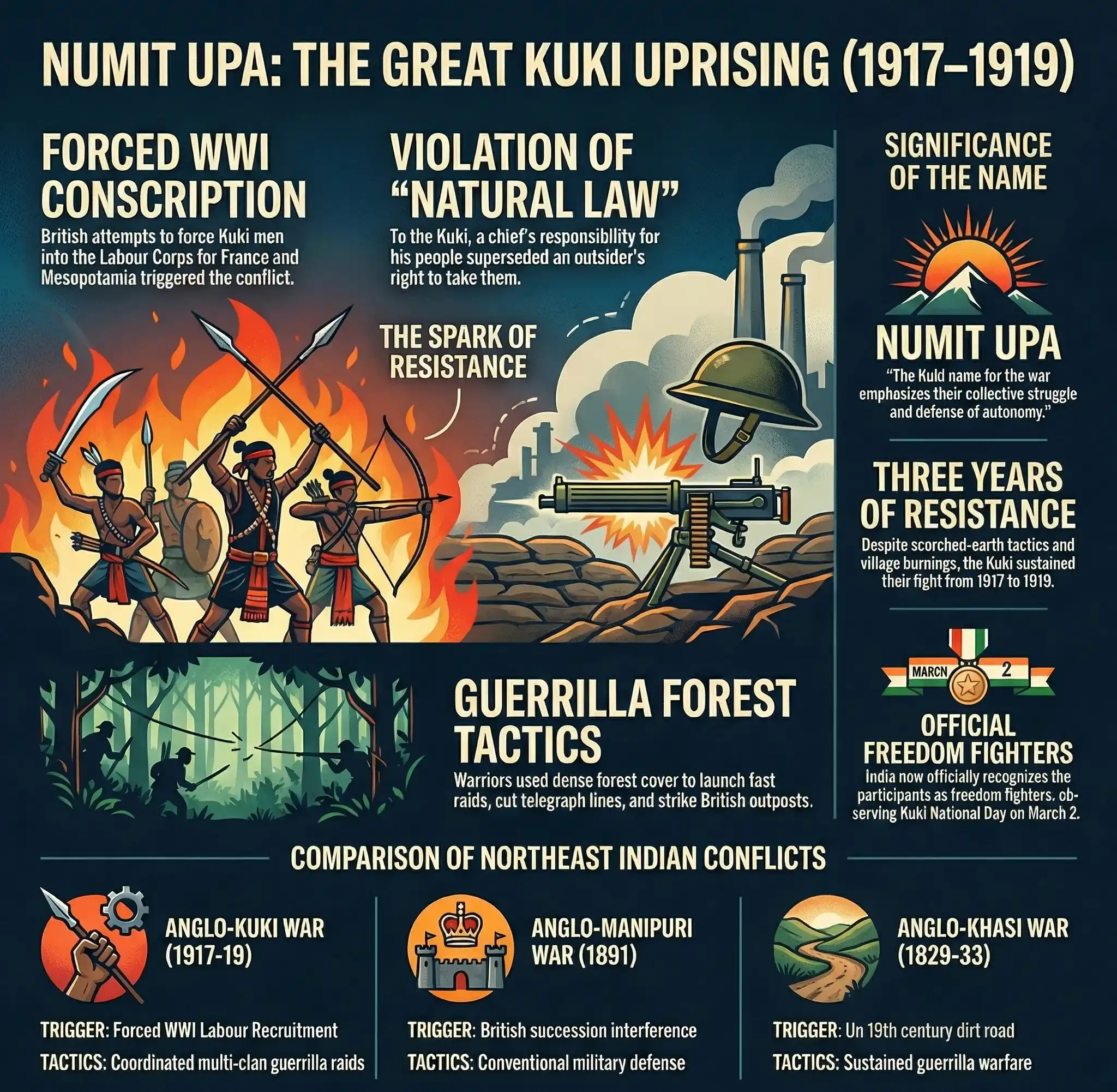
The Kuki hills, 1917 to 1919: the British Empire asked the Kuki chiefs for two thousand men to send to France. The chiefs said no, and the empire spent two years trying to make them say yes
Some time after the war, a Kuki chief came home.
His name was Chengjapao Doungel, chief of Aisan, and he had been a prisoner of the British, held far away at Sadiya in Assam. The other chiefs who had been tried with him had gone home a year earlier. He had been kept back, because the British regarded him as the senior leader of them all.
Back in his own village, he made a song about it. The drum his forefathers had made, he sang, had been silent for so long.
The drum his forefathers had made, he sang, had been silent for so long.
Two thousand men
The drum had fallen silent because of a war on the other side of the world.
By 1917 the First World War had eaten through the manpower of Europe, and Britain was drawing labour from every corner of its empire. From India it raised a Labour Corps, men who would dig trenches, build roads and carry loads behind the lines in France. At first it asked for volunteers. By 1917 it was setting quotas.
In the hills of Manipur and the country around it lived the Kukis, a people of many clans, governed by their own chiefs, who had long governed themselves. The British asked the Kuki chiefs for two thousand men for the Labour Corps in France.
The chiefs said no.
The refusal was about more than France. For years, colonial rule had been reaching further into Kuki life, into their land, their economy and the authority of their chiefs. Being told to hand over their young men to be shipped overseas was, for many, the moment the reach became too much.
The British asked for two thousand men for France. The chiefs said no.
The Integration of Princely States: The Making of a United India
The Burmese Invasions and the Treaty That Ended the Ahom Kingdom
The oath
In March 1917, as Kuki tradition remembers it, some twenty-three chiefs gathered at Chassad under Chengjapao’s leadership. A mithun, the great semi-wild ox that is the most valuable animal in the hills, was sacrificed, and they swore the sajam, the solemn oath of war, to defend their ancestral land.
At another council at Jampi, some chiefs hesitated. The Kukis had few guns against the arms of an empire. It is remembered that one of them, Tintong Haokip, answered that he would fight the British to his last bullet, because winning or losing was not the point. What mattered was defending their own rule.
To carry the call across the hills, the Kukis used the thingkho le malchapom, a token of fire and chilli passed from village to village. Anyone who received it knew what it meant. Within days, it could cross their whole scattered country.
Mombi
For months the Kukis simply refused, and talked, and waited. Then, on 17 October 1917, the British Political Agent in Manipur burned the village of Mombi.
After that, it was war.
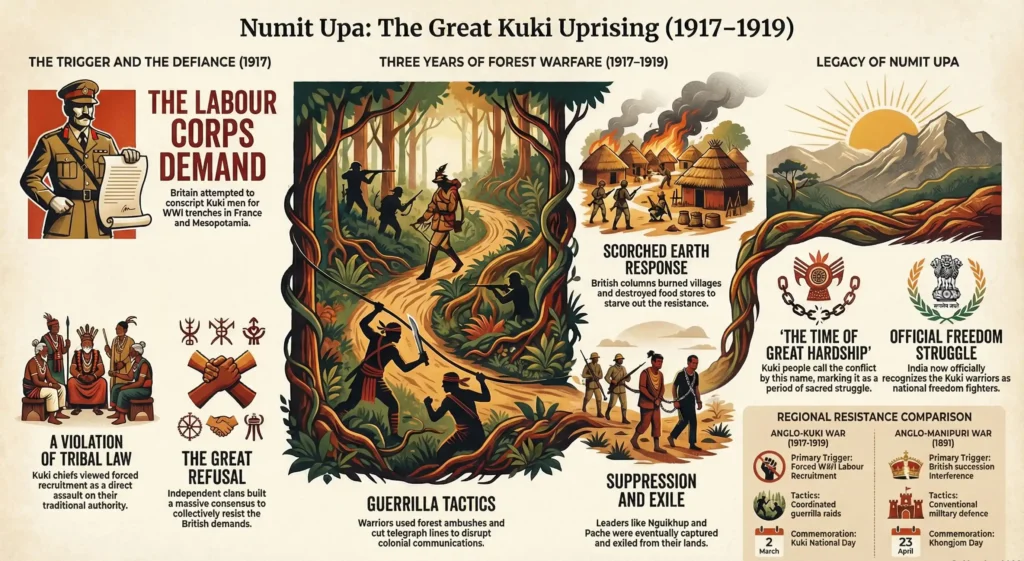
It was fought across a huge stretch of hill country, in Manipur, the Naga hills, the North Cachar hills, the Chin hills and the Somra tract. The Kukis fought as their country allowed them to: ambushes on narrow paths, stockades in the forest, bamboo spikes, and cannons they made themselves from leather. The British sent column after column, from the Assam Rifles and the Burma Military Police, more than six thousand men in all.
In the end, the British won the way armies in such country usually do. They burned at least a hundred and twenty-six Kuki villages and destroyed the food stores that kept the fighters alive. By the spring of 1919, the resistance was broken.
U Tirot Sing: The Khasi Chief Who Fought an Empire for Four Years
The prisoners
The chiefs surrendered or were captured, and were tried. Most were sentenced to three years. Chengjapao was given one year more.
In a song he made in prison, he watched the others go free before him. The English lord, he sang, was not done with him yet.
When at last he came home, he made another song. He had been imprisoned longer than the others, he sang, and now he had come back to his own land. The drum his forefathers had made had not been played while he was gone.
A hundred years on
The British called it the Kuki Rebellion, or the Kuki Rising. The Kukis have come to call it the Anglo-Kuki War: not a rising of subjects, but a war between two peoples, one of which happened to be an empire. Between 2017 and 2019, Kuki communities marked its centenary.
The two thousand men the empire demanded were never handed over by the Kuki chiefs. Refusing cost two years of war and more than a hundred burned villages. And it left behind an old chief’s songs, of a drum that fell silent, and the day he came home to hear it again.
Pa Togan Nengminza: The Garo Resistance Against British Annexation
Major Paona Brajabasi: Manipur’s Hero of the Last Stand at Khongjom
If you think you have remembered everything about this topic take this QUIZ
Results


#1. What was the immediate trigger for the 1917–1919 uprising of the Kuki tribes?
#2. What did the Kuki people call the uprising in their own language?
#3. Based on the text, who was the most important figure in Kuki social life, responsible for the wellbeing of the village?
#4. Which of the following leaders were among the prominent chiefs who led the Kuki resistance?
#5. What primary military tactic did the Kuki warriors use against the British forces?
#6. How did the British military respond to the uprising to make the cost of resistance too high for the Kuki communities?
#7. What was the outcome for many of the captured Kuki leaders after the uprising was suppressed in 1919?
#8. On what date is Kuki National Day observed to commemorate the history of the uprising?
How is the Anglo-Kuki War remembered today?
The Kuki community observes Kuki National Day on 2 March every year across Manipur, Mizoram, and other northeastern states. The Government of India has officially recognised participants in the Anglo-Kuki War as freedom fighters. The Kuki name for the uprising, Numit Upa, remains in active use across Kuki communities as the preferred way of describing this period of their history.
How did the Kuki tribes fight the British?
Kuki warriors used coordinated guerrilla tactics, striking British outposts, supply lines, and communication installations with small fast-moving groups and then retreating into the forest. Attacks were coordinated across a wide geographic area simultaneously, preventing the British from concentrating their forces effectively. The Kuki used traditional weapons including the dao, spears, and bows.
Who were the main leaders of the Anglo-Kuki War?
The uprising was led by multiple chiefs across dozens of clans rather than a single commander. Among the most prominent were Ngulkhup, Pache, Khotinthang, and Lunkim. The fact that so many independent clan leaders coordinated their resistance across a very large geographic area without a centralised command structure is one of the most remarkable features of the uprising.
Why did the Kuki tribes resist British labour recruitment?
The Kuki chiefs refused to allow their men to be taken to distant battlefields in France and Mesopotamia without their consent. In Kuki society, the chief is responsible for the wellbeing of every person in his village. Allowing the British to remove young men to a foreign war without negotiation or agreement was a fundamental violation of the authority and responsibility that defined what a Kuki chief was.
What was the Anglo-Kuki War and when did it happen?
The Anglo-Kuki War, also known as the Kuki Uprising or Numit Upa, was a coordinated three-year guerrilla war fought between 1917 and 1919 CE by Kuki tribes of Manipur, the Lushai Hills, and surrounding regions against the British Imperial administration. It was triggered by British attempts to forcibly recruit Kuki men as labourers for World War One.
Sources & References
Jangkhomang Guite and Thongkholal Haokip (eds.), The Anglo-Kuki War, 1917–1919: A Frontier Uprising against Imperialism during World War I (Routledge, 2019) — the refusal of the Labour Corps, the burning of Mombi on 17 October 1917 and the phases of the war.
The Sentinel, “The Kuki Raja who defied the British empire” (28 August 2025) — the Chassad conclave, the sajam oath, the Jampi council, the thingkho le malchapom, and Chengjapao’s imprisonment and songs.
Jangkhomang Guite, “Colonial Violence and Its ‘Small Wars’: Fighting the Kuki ‘Guerillas’ during the Great War in Northeast India, 1917–1919,” Small Wars & Insurgencies — the geography, conduct and scale of the Anglo-Kuki conflict.
Radhika Singha, “The Short Career of the Indian Labour Corps in France, 1917–1919”, International Labor and Working-Class History 87 (2015) — the Labour Corps and the move from volunteers to quotas.