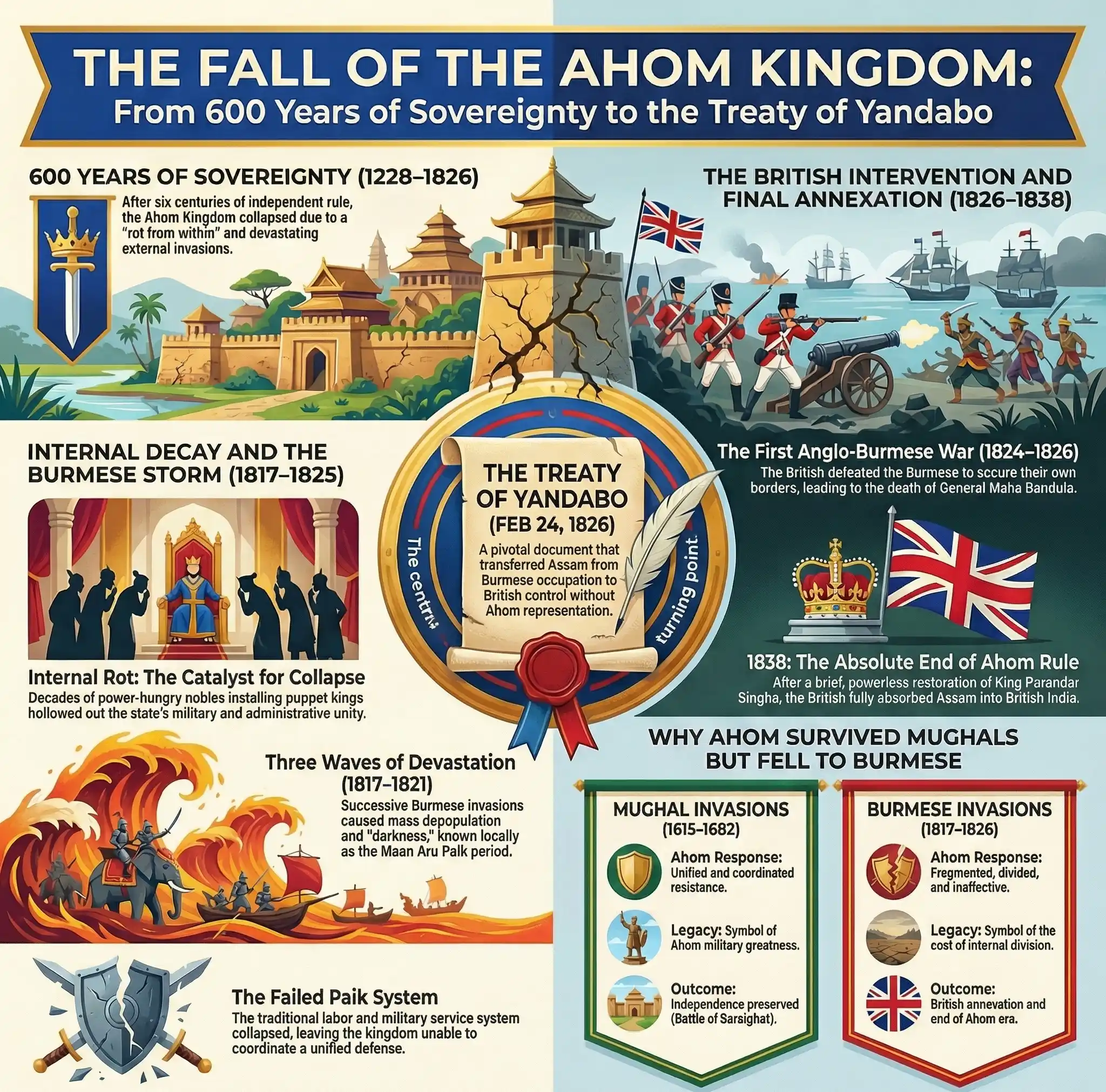
Yandabo, 24 February 1826: a British general and a Burmese governor signed a treaty in a village on the Irrawaddy that handed over Assam. Nobody from Assam was there
Yandabo is a small village on the Irrawaddy river in Burma, about eighty kilometres from the old royal capital of Ava. In February 1826 a British army was camped there, close enough to Ava that the Burmese king had run out of choices.
On 24 February, General Sir Archibald Campbell signed a treaty for the East India Company. On the Burmese side it was signed by the Governor of Legaing. Among its terms, the King of Ava gave up Assam.
Assam had been an independent kingdom for six hundred years. Its future was settled in a village in another country, between two foreign powers. No one from Assam signed it. No one from Assam had been asked.
Assam’s future was settled in a village in another country. No one from Assam had been asked.
Two kings
By then, there was not much of an Ahom kingdom left to ask.
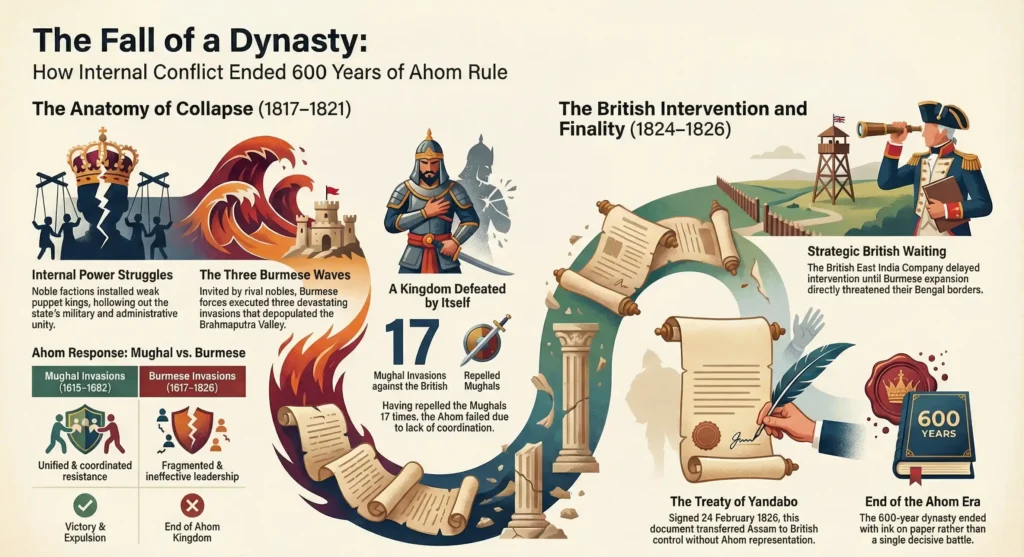
For half a century it had been tearing itself apart. First came the Moamoria rebellions of the 1770s and their bloody suppression. Then came the court feuds, as rival ministers made and unmade kings. One faction called in the Burmese to help. The Burmese came, went home with gifts and an Ahom princess, and came back again, and again, and stayed.
Caught in the middle were two young princes. One was Chandrakanta Singha. The other was his rival, Purandar Singha, born in 1807. In February 1818 the minister Ruchinath Burhagohain deposed Chandrakanta and put Purandar, still a boy of about eleven, on the throne. The next year the Burmese returned, defeated Purandar’s forces, and put Chandrakanta back. Before long they discarded him too, and installed a king of their own. The years that followed are remembered in Assam for Burmese looting and atrocities.
When the British came up the Brahmaputra in 1824 to drive the Burmese out, they came as liberators, and a country exhausted by invasion was glad to see the Burmese go.
Sukaphaa’s Crossing: How the Ahom Kingdom Was Born in Assam
Sati Sadhani: The Queen Who Chose Honour Over Surrender in Assam
The pension
After Yandabo, the liberators stayed.
From 1826 the Company ran Assam as part of the Bengal Presidency. Most of the Ahom royal family were given pensions. Chandrakanta Singha, who had twice been king, was granted five hundred rupees. He lived at Kaliabor and then at Guwahati, and he made the long journey to Calcutta to ask for his kingdom back. He was refused. He died in 1839.
Chandrakanta Singha, twice a king, was given a pension of five hundred rupees.
The tribute
For a moment it looked as though the dynasty might survive. The British found Upper Assam hard to run, and sensed discontent at foreign rule. So, on the suggestion of the Company’s agent David Scott, they decided to give Upper Assam back to an Ahom prince.
In 1833 they chose Purandar Singha. He was about twenty-six. He became king for the second time, as the boy who had been crowned and deposed fourteen years earlier.
But this time the crown came with conditions. The most important was money: fifty thousand rupees a year, to be paid to the British as tribute. Upper Assam had been through half a century of rebellion, civil war and invasion. The tribute had to come out of it.
Five years later, in 1838, the British announced that Purandar Singha had not governed well and had not paid his tribute regularly. They took Upper Assam back. There was no army to resist and no war. The Ahom monarchy, which had lasted since Sukaphaa came over the Patkai hills in the thirteenth century, was simply abolished.
The Koch Ascendancy: How a New Kingdom Changed Assam Forever
Charaideo
Purandar Singha lived on for eight more years, a king without a kingdom. He died on 1 October 1846, not yet forty.
He was buried at Charaideo, in the burial mounds of his ancestors, where the founder of the dynasty had been laid to rest nearly six hundred years before him.
The first Ahom king had crossed a mountain range and spent twenty-five years looking for a place to stay. The last one was made king twice, by other people, for other people’s reasons, and lost the kingdom both times without being asked. The treaty that began the end had been signed in a village he never saw, by two men who were not from Assam, over a country whose own people had no say in it.
The Integration of Princely States: The Making of a United India
If you think you have remembered everything about this topic take this QUIZ
Results


#1. During which period did the three devastating Burmese invasions of the Ahom Kingdom occur?
#2. What was the primary internal cause for the weakening of the Ahom state prior to the invasions?
#3. Which Burmese dynasty was responsible for the expansionist military campaigns into Assam?
#4. What is the name of the period of Burmese occupation as remembered in the local memory of Assam?
#5. Who was the prominent Burmese military commander killed in battle in 1825 CE?
#6. On what date was the Treaty of Yandabo signed, formally ending the First Anglo-Burmese War?
#7. What was the ultimate political outcome of the Treaty of Yandabo for the territory of Assam?
#8. Who was the last Ahom king to be briefly reinstated by the British before the kingdom was fully absorbed in 1838 CE?
What were the Burmese invasions of Assam?
The Burmese invasions of Assam were three waves of military incursions by the Konbaung Dynasty of Burma between 1817 and 1826 CE. They were made possible by the internal collapse of the Ahom Kingdom and caused enormous destruction and displacement across the Brahmaputra Valley.
What was the Treaty of Yandabo?
The Treaty of Yandabo was a peace agreement signed on 24 February 1826 CE that ended the First Anglo-Burmese War. Under its terms, Burma gave up its claims over Assam and several other territories, which then passed under British East India Company control. It effectively ended the Ahom Kingdom as an independent state.
Why could the Ahom Kingdom not defeat the Burmese as it had defeated the Mughals?
By the early 19th century, the Ahom Kingdom had been weakened by decades of internal court conflict, power struggles among noble families, and a series of ineffective kings. The unified military and political leadership that had defeated the Mughals no longer existed. Without unity, the Ahom could not mount an effective organised defence.
Who was the last Ahom king?
Purandar Singha is generally considered the last Ahom king. He was briefly reinstated by the British in 1833 CE as a nominal ruler over a small part of Assam but was deposed again in 1838 CE when the British absorbed the rest of Assam fully into their colonial administration.
What happened to Assam after the Treaty of Yandabo?
After the Treaty of Yandabo, Assam was gradually incorporated into British India. The British dismantled the Ahom administrative system, established tea plantations, brought in migrant workers from other parts of India, and integrated the Brahmaputra Valley into the wider colonial economy of British India. Assam remained under British rule until Indian independence in 1947 CE.
Sources & References
Encyclopædia Britannica, “Treaty of Yandabo” — the terms of the treaty.
Northeast Now, Dipanjon Konwar, “Yandabo Treaty of 1826: How British annexed Assam and the Northeast” (25 February 2026) — David Scott, the restoration of Purandar Singha in 1833, the tribute and the annexation of 1838.
Edward Gait, A History of Assam (1906) — the Burmese invasions, rival kings and the end of the Ahom monarchy.
H. K. Barpujari, Political History of Assam: 1826–1919, with S. L. Baruah, A Comprehensive History of Assam — the Treaty of Yandabo, the restoration experiment under Purandar Singha and the transition to British rule.