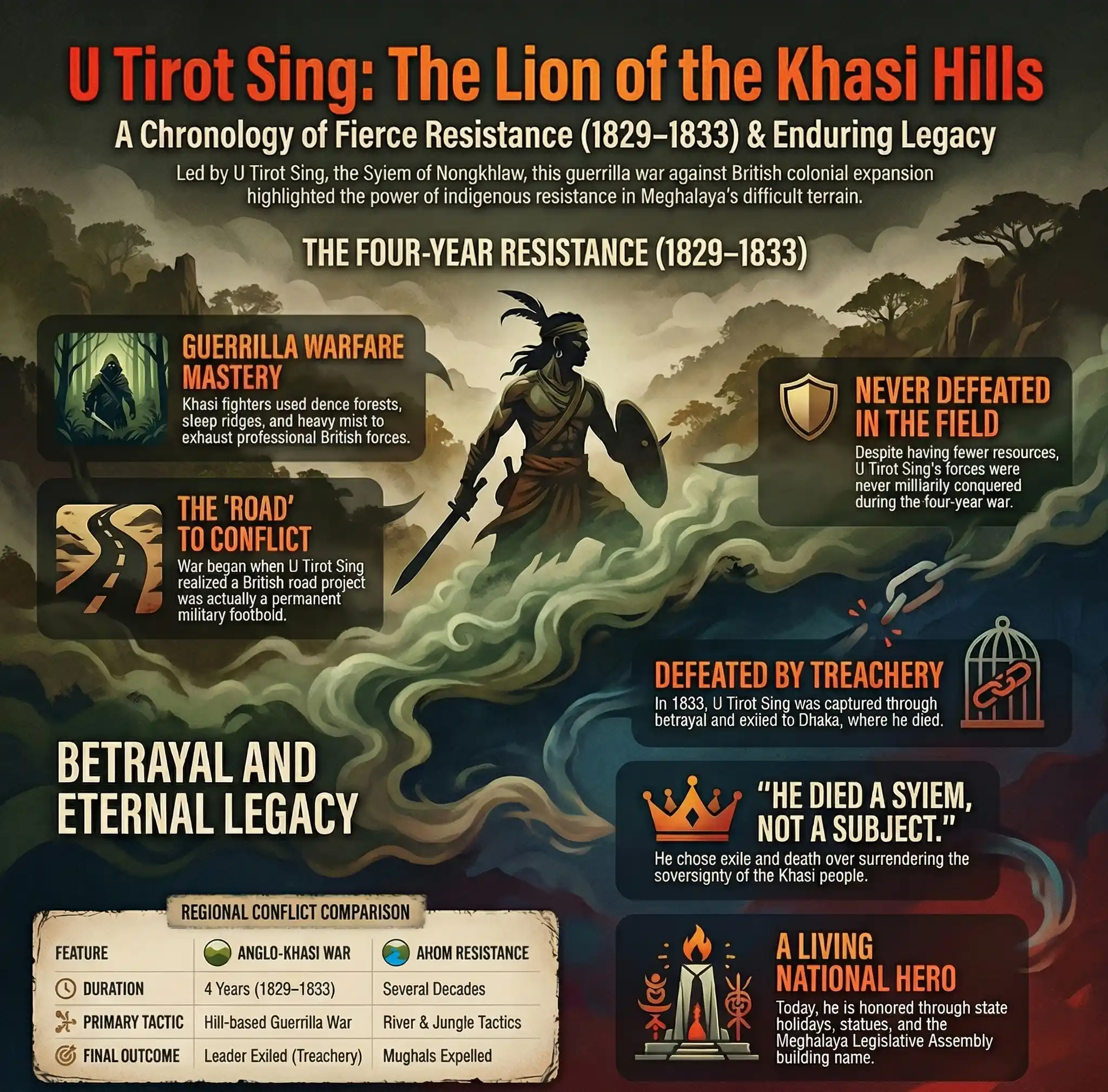
Khasi Hills, 1827 to 1835: a young Khasi chief agreed to let the British build a road through his land. Two years later he was at war with them, and he fought for four
In 1827, in the Khasi hills, the chiefs sat in durbar for two days.
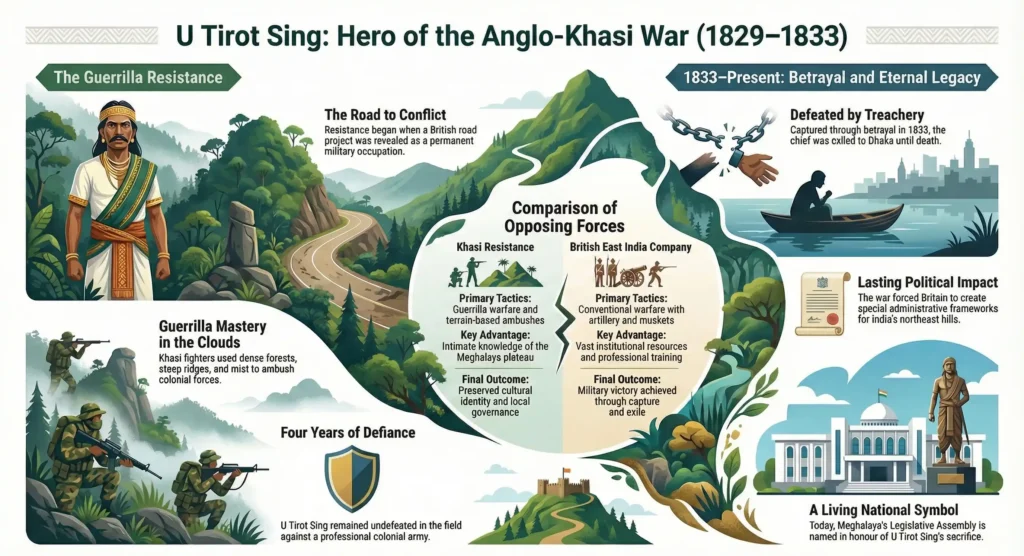
The question in front of them had been brought by David Scott, the East India Company’s agent on the north-east frontier. The year before, the Treaty of Yandabo had handed Assam to the British. Now the Company wanted a road to join its two new possessions, the Brahmaputra valley to the north of the hills and the Surma valley of Sylhet to the south. The only good way through ran across the Khasi state of Nongkhlaw.
Its Syiem, its chief, was a man in his twenties named U Tirot Sing.
The debate went on, in the Khasi way, until the assembly reached agreement. Scott was struck by it: the decency, the order, the quality of the argument. At the end, the chiefs said yes.
Scott was struck by the durbar: its decency, its order, the quality of its argument. At the end, the chiefs said yes.
The bargain
Tirot Sing had reasons of his own. He wanted to recover control of the duars, the passes down into the Assam plains, and he understood the British would back his claim in return for the road.
Work began. Bungalows went up at Nongkhlaw. For about eighteen months, by the accounts of the time, things went well: British officers and Khasi villagers mixed freely, and the road crept forward across the hills.
Then, in December 1828, a rival chief, the Raja of Rani, disputed Tirot Sing’s claim to the duars. Tirot Sing went down with armed men to assert it, confident the British would stand with him. Instead, a party of sepoys blocked his way.
Soon afterwards, word came that the Company was reinforcing its troops in Assam and Sylhet. There were rumours in Nongkhlaw about what the British really meant to do with the hills. Tirot Sing called the durbar again. This time it ordered the British to leave Nongkhlaw.
The British ignored the order.
This time the durbar ordered the British to leave Nongkhlaw. The British ignored the order.
The Koch Ascendancy: How a New Kingdom Changed Assam Forever
The Khasi Tribe: History, Culture and Matrilineal Legacy
4 April 1829
On 4 April 1829, Khasi fighters attacked the British post at Nongkhlaw. Lieutenant Richard Bedingfield was drawn out to a meeting and killed. Lieutenant Philip Burlton fought his way out and tried to reach Guwahati, but he was overtaken and killed too, along with a number of their sepoys. David Scott, the man the attack was most aimed at, had left for Cherrapunji shortly before, and escaped.
The road had become a war.
Four years
It should have been short. The Khasis had swords, shields, and bows and arrows. The Company had muskets and trained troops, and could kill at a distance. In open battle the hill men had no chance, and they learned that quickly.
So they stopped fighting in the open. They struck from the forests and the ridges, ambushed columns, raided and melted away into country they knew and the sepoys did not. Other Khasi chiefs joined. What the Company had expected to be a punitive expedition dragged on for almost four years.
David Scott did not live to see the end of it. He died in 1831, in the hills, at Cherrapunji.
Tirot Sing was wounded by a bullet. He hid in a cave in the hills near Nongkhlaw. In the end, according to Khasi tradition, someone betrayed his hiding place. In January 1833 he surrendered to the British.
The Burmese Invasions and the Treaty That Ended the Ahom Kingdom
Dhaka
He was not hanged. He was tried and sent into exile, down to Dhaka, far from the hills. The historian David Syiemlieh, working through the records, found that he was held there under a kind of house arrest, allowed to go about the city in a palanquin, but never allowed to go home.
He died in Dhaka on 17 July 1835. He was about thirty-three.
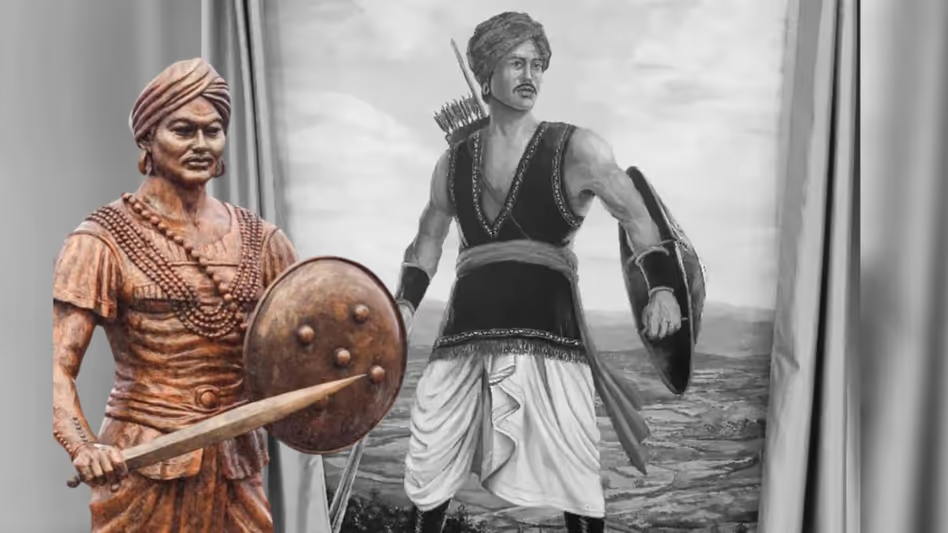
Meghalaya remembers him every year on that date. There is a memorial to him at Mairang, and the cave near Nongkhlaw where he hid is known by his name. In 2025 a statue of him was unveiled in Dhaka, the city where he died a prisoner.
Razia Sultan: The Woman Who Ruled Delhi as a Sultan
The road
The road was built. Part of it still exists, running through the East Khasi Hills between Mawphlang and Lad Mawphlang. Today it is a trekking trail, and it carries the name of the man who asked for it: the David Scott Trail.
People walk it for the views. Few of them know that it began with two days of careful argument in a Khasi durbar, with a young Syiem who said yes on terms he believed would be kept, and who spent the rest of his short life fighting over what that yes had been worth.
The Integration of Princely States: The Making of a United India
If you think you have remembered everything about this topic take this QUIZ
Results


#1. In which year did the British East India Company first propose building a road through the Khasi hills?
#2. Who was the British Agent to the Governor-General who negotiated with U Tirot Sing for the road construction?
#3. Who was the British Agent to the Governor-General who negotiated with U Tirot Sing for the road construction?
#4. U Tirot Sing was the Syiem (chief) of which specific Khasi Hima (chieftainship)?
#5. What type of warfare did U Tirot Sing and his fighters use to combat the professional British army in the hills?
#6. How long did the Anglo-Khasi War resistance led by U Tirot Sing last?
#7. How was U Tirot Sing ultimately captured by the British in 1833 CE?
#8. To which city was U Tirot Sing exiled after his capture, and where did he eventually die?
#9. What traditional Khasi governance system involves a council of clan heads that checks the authority of the Syiem?
Who was U Tirot Sing and why is he important?
U Tirot Sing was the Syiem, or chief, of Nongkhlaw in the Khasi hills of present-day Meghalaya. He led a four-year guerrilla war against British colonial expansion between 1829 and 1833 CE and is celebrated as one of the earliest and most determined freedom fighters in the history of Northeast India.
What caused the Anglo-Khasi War?
The war began when the British East India Company proposed building a road through Khasi territory to connect Assam and Bengal. U Tirot Sing initially agreed but soon realised the British intended to use the road to establish permanent control over the Khasi hills. He withdrew his cooperation and launched armed resistance in 1829 CE.
How did U Tirot Sing fight the British?
U Tirot Sing used guerrilla tactics suited to the difficult terrain of the Khasi hills. His fighters attacked British supply lines, ambushed small groups of soldiers, destroyed bridges and paths, and disappeared into the dense forest before the British could mount a coordinated response.
How was U Tirot Sing captured?
U Tirot Sing was not captured in battle. He was betrayed in 1833 CE when information about his location reached the British. Despite four years of evading a professional colonial army, he was taken through treachery rather than military defeat.
What happened to U Tirot Sing after his capture?
After his capture in 1833 CE, U Tirot Sing was exiled to Dhaka, then called Dacca, in present-day Bangladesh. He died there in 1835 CE without ever returning to the Khasi hills. He is commemorated today through public holidays, statues, and named institutions across Meghalaya.
Sources & References
Live History India, “U Tirot Singh & Meghalaya’s Fight For Freedom” (16 June 2019) — the 1827 durbar, the eighteen months of road-building, the attack of April 1829 and David Syiemlieh’s findings on the Dhaka years.
Edward Gait, A History of Assam (1906) — the attack at Nongkhlaw and David Scott’s escape.
Government of India, Azadi Ka Amrit Mahotsav, “U Tirot Sing” — the road negotiations, the duars dispute, the breakdown with the British and the subsequent Khasi resistance.
Government of India, Azadi Ka Amrit Mahotsav, “U Tirot Sing,” together with David R. Syiemlieh’s scholarship on the Anglo-Khasi War — Tirot Sing’s capture, removal from the Khasi Hills and death in Dhaka.