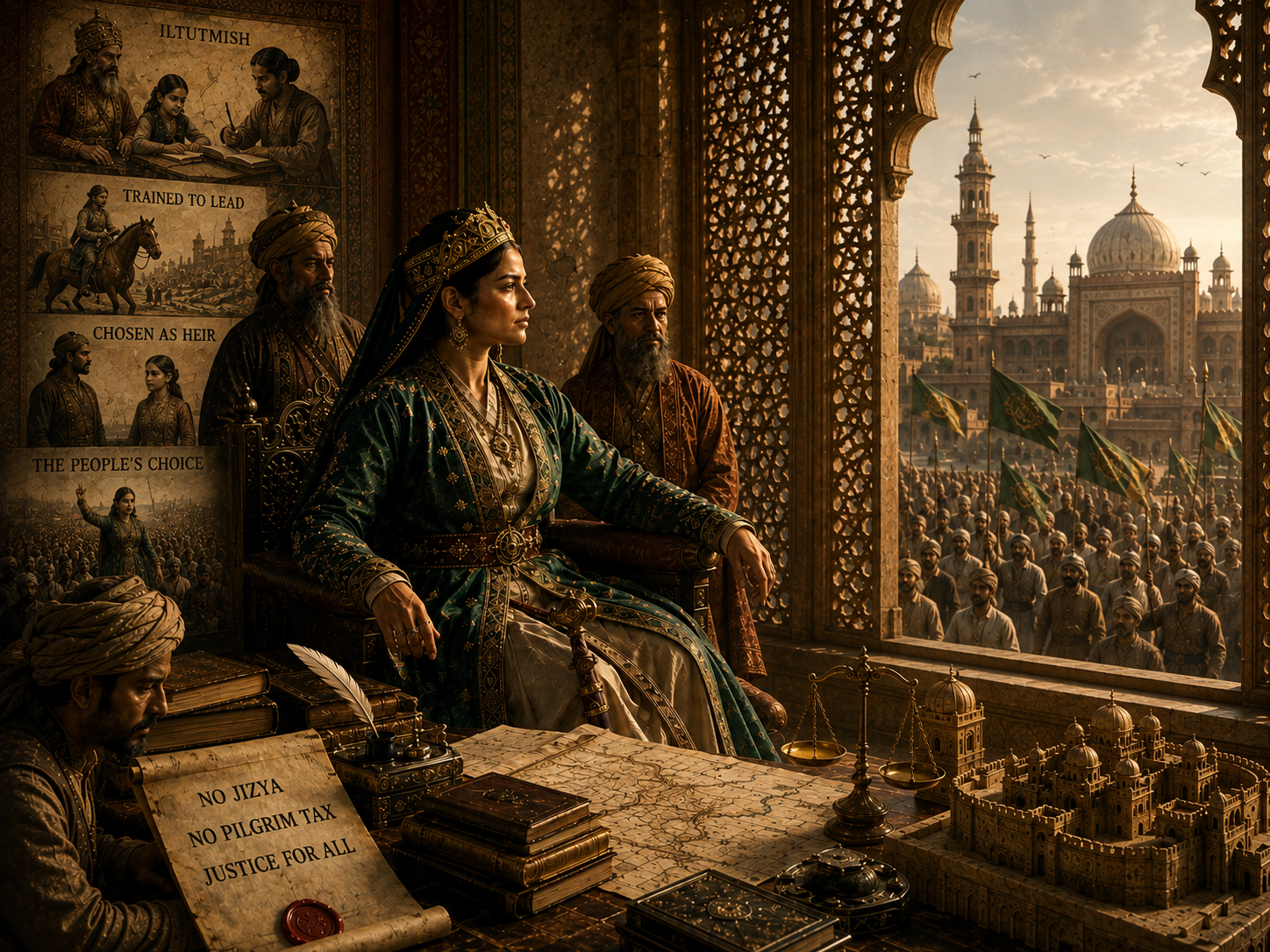
The First and only woman to Rule the Delhi Sultanate, brought down not for Failing but for being a Woman
Nearly eight hundred years ago, a man who watched Razia Sultan rule sat down and wrote his honest opinion of her. She had, he admitted, every single quality you could want in a great king. She was wise. She was just. She was brave. She was born to lead.
And then he added the one thing that, in his eyes, cancelled out all the rest: she was a woman. That single, cold sentence holds the whole tragedy of Razia, the first and only woman ever to sit on the throne of Delhi.
Second Battle of Tarain 1192: The Turning Point of Indian History
Reign of Akbar 1556-1605: The Golden Age of the Mughal Empire
A daughter worth twenty sons
Razia was the daughter of Iltutmish, the powerful Sultan of Delhi in the early 1200s. Unlike other royal daughters, she was not shut away behind the walls of the women’s quarters. Her father had her taught to read, to govern, and even to fight.
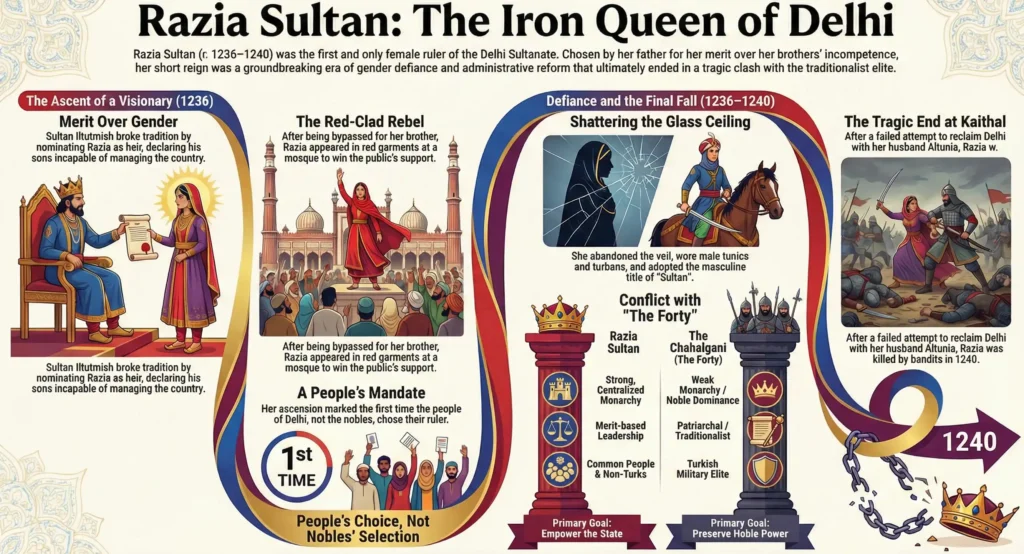
When Iltutmish rode off to war on a distant campaign, he did something almost no ruler of his age would have dreamed of. He left his daughter in charge of the entire capital city. Razia ran it so well that when her father returned, he made a decision that stunned his whole court. He passed over all of his sons, whom he judged idle and far too fond of pleasure, and named Razia, a woman, as the heir to his throne. He is said to have told his shocked nobles that this one daughter was worth more to him than twenty sons.
The throne they tried to keep from her
But Iltutmish’s most powerful nobles, a group of forty Turkic lords, could not stomach the thought of bowing down to a woman.
The very moment the old Sultan died, they brushed his wishes aside and placed one of his sons, Ruknuddin, on the throne instead. It was a disaster. The young man cared only for his own pleasures, and his mother began scheming to have Razia killed. But Razia refused to go quietly. One Friday, she dressed herself in red, the colour of protest, and stood up in front of the great crowd gathered for prayers. She reminded them that her father had chosen her with his own words, and she asked them, plainly and bravely, for justice. The people and the soldiers rose to her side. In November 1236, they swept her brother aside and set Razia upon the throne of Delhi.
The Sultan who would not be a “Sultana”
Once she held power, Razia flatly refused to rule in the small, hidden way that a woman was expected to.
She would not sit behind a veil. She cast off the purdah and held open court, where her people could look upon her face. She dressed for the work in a man’s tunic and cap, rode out through the city on elephants, and led her armies into the field herself. She even turned down the title everyone tried to hand her, “Sultana,” for a simple and pointed reason.
“Sultana” only meant “the wife of a Sultan.” Razia was nobody’s wife-of. She was the ruler herself, and so she took the ruler’s own title: Sultan.
And she was good at the job. Governors from Bengal in the east all the way to Sindh in the west accepted her authority. By any fair measure anyone cared to use, she was ruling, and ruling well.
Sunayani Devi: A Woman’s Voice in the Bengal School
The friendship they used against her
But the same nobles who hated seeing a woman on the throne were watching, all the while, for any weapon they could turn against her. They believed they had found one in her trust of a man named Jamal-ud-din Yaqut.
Yaqut was an Abyssinian, an African who had risen up out of slavery, and Razia gave him a high and trusted position at her court. Whether the bond between them was friendship, or loyalty, or something more, no one truly knows to this day, and much of what was whispered about it may simply have been her enemies’ invention. But to the proud Turkic lords, it was an outrage twice over: that an outsider had climbed so high, and that their queen so plainly refused to be what they thought a woman should be. Their resentment slowly hardened into open rebellion.
Captured, married, and defeated
When the revolt finally came, it was led by a governor named Altunia. In the fighting, Yaqut was killed, and Razia herself was taken prisoner.
What happened next reads almost like a tale. In her captivity, Razia married the very man who had captured her, Altunia, perhaps out of love, or perhaps as a clever move to gain a powerful ally. Together, the two of them gathered an army and marched on Delhi to win back her throne from the brother the nobles had by then installed. They lost the battle. Defeated and fleeing for their lives, Razia and Altunia were killed near Kaithal in October 1240. She had ruled for less than four years.
The verdict, and why it was wrong
And so we come back to that honest, terrible line, written by the very chronicler who had lived through her reign.
He listed out all her gifts, one by one. Wise, just, brave, every inch a ruler. And then he swept the entire list away with a single question: since she was not, as he put it, “of the right sex,” what use had any of them been?
He admitted she had every quality a great ruler could need. Then he dismissed all of it, for one reason only: she was a woman.
He wrote it as her epitaph. Read today, it sounds far more like the epitaph of the men who tore her down. Razia Sultan did not fall because she ruled badly. Even the enemies who hated her could not honestly claim that. She fell because the powerful men around her simply could not bear to be led by a woman, no matter how good she was at leading. Nearly eight centuries later, we still remember her name, and we have mostly forgotten theirs. Perhaps that is a small and very late justice of its own.
Bharat Mata Painting: The Icon of Indian Independence
If you think you have remembered everything about this topic take this QUIZ
Results


#1. Which dynasty did Razia Sultan belong to?
#2. Why did Sultan Iltutmish famously nominate his daughter Razia as his successor over his sons?
#3. How did Razia successfully appeal to the people of Delhi to overthrow her tyrannical brother, Rukn-ud-din?
#4. To emphasize her role as a ruler rather than the wife of a ruler, which specific title did Razia adopt?
#5. 5. Who were the “Chahalgani” that constantly opposed Razia Sultan’s rule?
#6. The appointment of which Abyssinian slave to the Superintendent of the Royal Stables enraged the Turkish elite?
#7. After being defeated and imprisoned, what brilliant diplomatic maneuver did Razia use to try and reclaim Delhi?
#8. According to the text, exactly how long did Razia Sultan’s impactful reign last?
Who was the father of Razia Sultan?
Shams-ud-din Iltutmish.
Why did Razia refuse the title “Sultana”?
Because “Sultana” meant “Wife of the Sultan,” and she was the sovereign ruler herself.
Who was the African slave favored by Razia?
Jamal-ud-Din Yaqut.
Who defeated and imprisoned Razia in Bhatinda?
Malik Altunia (who later became her husband).
Where is Razia Sultan’s tomb generally believed to be?
In the narrow lanes of Turkman Gate, Old Delhi (though Kaithal also claims it).
Sources and references
- Wikipedia (“Razia Sultan”) and Encyclopaedia sources — Razia as the fifth ruler of the Mamluk dynasty and the only female Sultan of Delhi (reigned 1236–1240), her administration of Delhi during Iltutmish’s 1231 Gwalior campaign, and his naming her heir over his sons.
- GKToday and Prepp (medieval India notes) — Razia’s education and military training, the opposition of the Turkic nobles (the Chihalgani or “Forty”), her discarding of the veil and use of male court dress, and the rebellion, capture, marriage to Altunia, and deaths near Kaithal in 1240.
- Ancient Origins and sister-hood — Razia’s appeal to the people at the Friday congregation in 1236 that won her the throne, Iltutmish reportedly valuing her above his sons, and her upbringing outside the harem.
- Historian Minhaj-i-Siraj (Tabaqat-i-Nasiri) — the near-contemporary assessment that Razia possessed all the qualities required of a king, discounted only because she was not “of the right sex.”
- Original Curious Indian article (“Razia Sultan”) — her insistence on the title “Sultan” rather than “Sultana,” her open court in a quba and kulah, the controversy over Jamal-ud-din Yaqut, and the framing of her fall as a failure of her society rather than of her competence.
Author


Exploring the Soul of Bharat through History, Science, Culture, and its Diversity
Our Mission
Curious Indian is a definitive knowledge portal dedicated to chronicling the events, personalities, and cultural shifts that defined the Indian subcontinent. From the ancient Vedic Period to the complexities of 21st-century politics, our goal is to provide deep-dive analysis that inspires.
Editorial Standards & E-E-A-T
Every article published under our brand undergoes a rigorous fact-checking process. We prioritize primary historical records, academic citations, and credible archives to ensure our readers receive accurate, high-authority information.
Historical Integrity Directly sourcing from ASI archives and academic journals.Topical Authority Comprehensive clustering of Indian Science, Biographies, and Wars.Managed by Paripurna Datta and TEAM | Dedicated to the Knowledge of India.