Wednesday, May 13, 2026
11 °c
London
Curious Indian
  • Arts & Culture
  • Festivals of India
  • Indian History
  • Indian Politics
  • Biography
    • Entertainment Personalities
    • Science Personalities
  • Unsolved India
No Result
View All Result
  • Arts & Culture
  • Festivals of India
  • Indian History
  • Indian Politics
  • Biography
    • Entertainment Personalities
    • Science Personalities
  • Unsolved India
No Result
View All Result
Curious Indian
No Result
View All Result
Home Indian History Ancient Civilizations & The Vedic Age

Sage Atreya and the Birth of Internal Medicine

The Founder of Ayurveda and Architect of the Tridosha Theory, Whose Ancient Teachings Still Define Holistic Health

Curious Indian by Curious Indian
in Ancient Civilizations & The Vedic Age, Biography, Indian History, Science Personalities, Scientific Discoveries
Reading Time: 9 mins read
0 0
A A
Father of Internal Medicine
Share on FacebookShare on Twitter

Table of Contents

Toggle
  • The Scholar of Ancient Taxila
  • Unlocking the Charaka Samhita Origins
  • The Blueprint of Ancient Indian Anatomy
  • The Three Doshas Theory: Personalized Healing
  • The Legacy of the Bhela Samhita and Clinical Ethics
  • Quick Comparison: Ancient vs. Modern Internal Medicine
  • Curious Indian: Fast Facts
  • Conclusion
  • If you think you have remembered everything about this topic take this QUIZ
  • Results
    • #1. In which ancient center of learning did Sage Atreya Punarvasu serve as the preeminent teacher of medicine?
    • #2. What was the radical shift Atreya introduced to the practice of medicine in ancient India?
    • #3. According to the history of the ‘Charaka Samhita’, who was the disciple that originally recorded Atreya’s teachings?
    • #4. What is the primary goal of the ‘Three Doshas’ theory developed by Atreya?
    • #5. Atreya described the heart in a very specific way. How did he view its function?
    • #6. What does ‘Pratyaksha’ mean in the context of Atreya’s teaching style?
    • #7. According to the comparison table, what is the core goal of ‘Atreya’s Internal Medicine’?
    • #8. According to the comparison table, what is the core goal of ‘Atreya’s Internal Medicine’?
    • #9. How many bones (including teeth and sockets) did Atreya identify in his pioneering study of ancient Indian anatomy?
    • Who is known as the Father of Internal Medicine?
    • What is the relationship between Atreya and Charaka?
    • Where is Taxila located?
    • What are the three Doshas?
    • Why is Atreya’s work considered scientific?
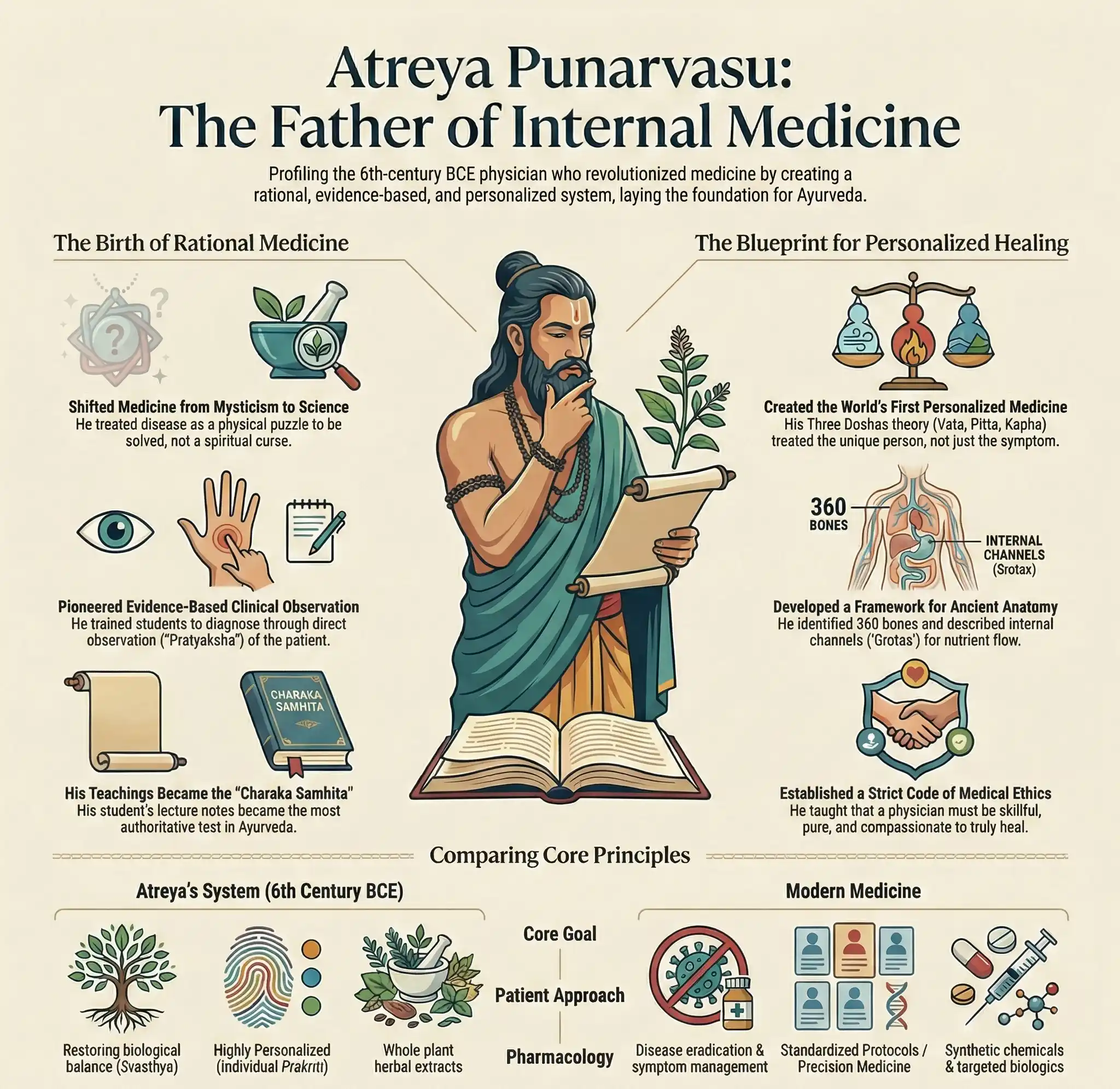
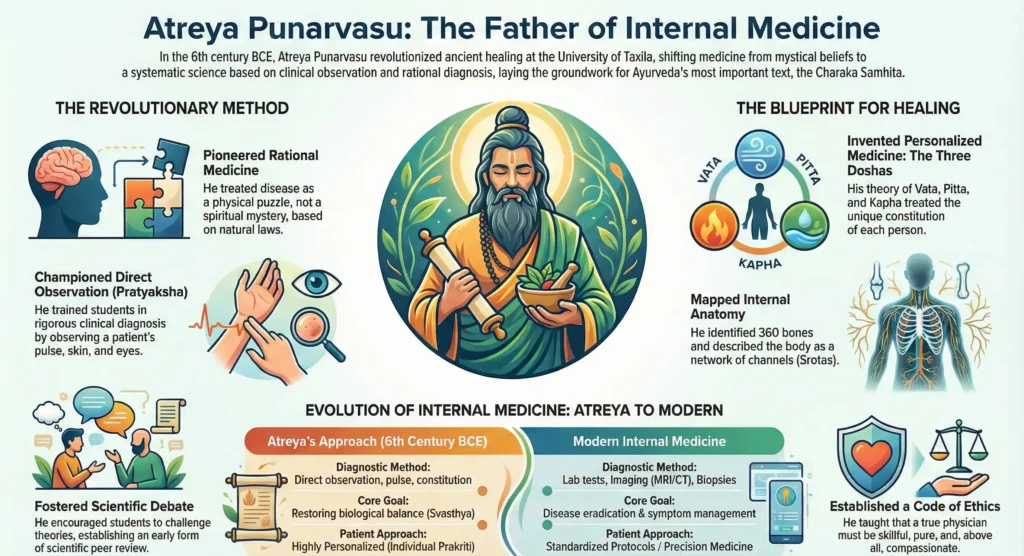
Sage Atreya Punarvasu was a visionary 6th-century BCE physician and the preeminent teacher at the University of Taxila, widely recognized as the Father of Internal Medicine. He revolutionized ancient healing by moving away from mystical explanations and establishing a rational, evidence-based system known as Kayachikitsa. His teachings, preserved by his disciples, formed the core of the Charaka Samhita, the most authoritative text in Ayurveda. By developing the Three Doshas theory and emphasizing clinical observation, Atreya created the world’s first personalized medical system, influencing global healthcare traditions for over two millennia.
AttributeHistorical Detail
Full NameAtreya Punarvasu
Historical TitleFather of Internal Medicine
Era~6th Century BCE
Teaching CenterTaxila (Gandhara)
Key ContributionSystematizing Kayachikitsa (Internal Medicine)
Primary WorkTeachings led to the Charaka Samhita

The Scholar of Ancient Taxila

In the 6th Century BCE, the city of Taxila was not just a hub of trade; it was the intellectual lighthouse of the world. Within its sprawling university complexes, a sage named Atreya Punarvasu was conducting a quiet revolution. Known today as the Father of Internal Medicine, Atreya was the first to categorize medicine as a systematic science that could be taught, debated, and refined. While others saw disease as a spiritual mystery, Atreya saw it as a physical puzzle. He argued that the human body functioned according to natural laws, and that healing was simply the art of restoring a broken balance.

READ MORE:  Reign of Aurangzeb: Emperor Who Conquered India but Lost the Empire

Atreya’s classroom was unlike any other in the ancient world. He did not ask his students to simply memorize prayers. Instead, he led them through rigorous clinical trials, asking them to observe the color of a patient’s eyes, the rhythm of their pulse, and the temperature of their skin. This insistence on “Pratyaksha” (direct observation) marked the birth of a rational medical tradition. As the head of the school of physicians, he ensured that India became the global destination for anyone seeking to understand the internal workings of the human body.

6 Unfoldings in the Subrahmanyan Chandrasekhar Biography

Sage Atreya and the Birth of Internal Medicine

Unlocking the Charaka Samhita Origins

When we open the pages of the Charaka Samhita today, we are actually reading the echoes of Atreya’s lectures. The Charaka Samhita origins are deeply rooted in a series of dialogues between Atreya and his six brilliant disciples. Among them was Agnivesa, who meticulously recorded every word, every diagnostic tip, and every herbal formula shared by the master. This record, originally titled the Agnivesa-tantra, was later refined by the physician Charaka, but the “soul” of the text belongs entirely to Atreya.

Atreya’s teaching style was based on the “Siddhanta”—the establishment of truth through debate. He encouraged his students to challenge his theories, believing that a medical truth could only be valid if it survived the fire of questioning. This peer-review process, occurring 2,500 years ago, is the direct ancestor of modern scientific discourse. It ensured that the medical wisdom leaving Taxila was not just tradition, but a tested and verified science of internal healing.

The Blueprint of Ancient Indian Anatomy

To treat the inside, one must know the inside. Atreya’s contributions to ancient Indian anatomy were staggering for his time. He was a pioneer in understanding the skeletal structure, identifying 360 bones including the teeth and bony sockets. He viewed the body as a complex network of channels (Srotas) through which nutrients, waste, and energy flowed. He understood that a blockage in these channels was the root of most internal ailments.

His understanding of the heart was particularly poetic and precise. He described it as the seat of consciousness and the starting point of the great vessels. By mapping the relationship between the digestive fire (Agni) and the formation of tissues (Dhatus), Atreya provided the first biological explanation for metabolism. He taught that every morsel of food we eat eventually becomes part of our blood, muscle, and bone—a fundamental truth that modern biology confirms every day.

READ MORE:  Dev Anand (1923–2011): The Evergreen Legend of Indian Cinema

The Three Doshas Theory: Personalized Healing

The most enduring legacy of the Father of Internal Medicine is the Three Doshas theory. Atreya proposed that human health is governed by three primary biological forces: Vata (movement), Pitta (transformation), and Kapha (structure). He argued that no two humans are identical; each person is born with a unique “Prakriti” or constitutional blueprint. This was the world’s first documented attempt at personalized medicine.

Instead of treating the symptom, Atreya treated the person. He taught that a fever in a Vata-dominant person required a different remedy than a fever in a Pitta-dominant person. This nuanced approach prevented the “one-size-fits-all” failures of early medicine. By balancing these three forces through diet, herbal preparations, and lifestyle adjustments, Atreya aimed not just to cure disease, but to achieve “Svasthya”—a state of being established in one’s own self.

Dr. A.P.J. Abdul Kalam: (1931-2015)

The Legacy of the Bhela Samhita and Clinical Ethics

While Agnivesa’s records became the most famous, another student named Bhela also captured Atreya’s wisdom in the Bhela Samhita. This text provides a slightly different perspective on Atreya’s pharmacology, detailing the use of hundreds of plants and minerals found in the foothills of the Himalayas. Atreya’s pharmacological genius lay in his ability to combine herbs to enhance their healing properties while neutralizing their side effects.

Beyond the medicines, Atreya established a strict code of ethics for physicians. He taught that a doctor must be “pure, skillful, and compassionate.” He believed that a physician who lacked empathy could never truly heal, because the mind and body are inextricably linked. This holistic focus on the “whole patient” is why his name is still invoked with reverence in Ayurvedic colleges across the globe. He transformed the healer from a magician into a scientist with a heart.

Quick Comparison: Ancient vs. Modern Internal Medicine

FeatureAtreya’s Internal Medicine (6th Century BCE)Modern Internal Medicine
Primary PhilosophyThree Doshas theory (Vata, Pitta, Kapha)Homeostasis and Systemic Biology
Diagnostic MethodDirect observation, pulse, and constitutionLab tests, Imaging (MRI/CT), and Biopsies
Core GoalRestoring biological balance (Svasthya)Disease eradication and Symptom management
PharmacologyWhole-plant herbal extracts and mineralsSynthetic chemicals and targeted biologics
Anatomy FocusAncient Indian anatomy (360 bones/Channels)Cellular and Molecular Anatomy
Patient ApproachHighly Personalized (Individual Prakriti)Standardized Protocols / Precision Medicine

Curious Indian: Fast Facts

  • Atreya is believed to have been the son of the sage Atri, one of the legendary Saptarishis.
  • He served as the personal physician to King Nagnajit of Gandhara.
  • Taxila, his primary place of teaching, is a UNESCO World Heritage site today.
  • The Charaka Samhita begins with a salute to Atreya, acknowledging him as the source of its knowledge.
  • He was the first to describe the “six stages of a disease” (Shad-kriyakala), allowing for early intervention.
READ MORE:  Mastering Political Power Through the Lens of Chanakya Neeti

10 Remarkable Facts About Meghnad Saha Life and Achievements

Conclusion

Atreya Punarvasu stands as a colossus in the history of science. As the Father of Internal Medicine, he gave humanity a roadmap to health that is as relevant in the age of genetics as it was in the age of the Vedas. His life at curiousindian.in serves as a bridge to a time when India led the world in medical innovation. By looking back at his work at Taxila, we find the roots of our own scientific temper—a reminder that the quest for health is a journey of logic, observation, and deep respect for the miracle of the human body.

If you think you have remembered everything about this topic take this QUIZ


Results

Share your score!
Tweet your score!
Tweet your score!
Share to other
QUIZ START

#1. In which ancient center of learning did Sage Atreya Punarvasu serve as the preeminent teacher of medicine?

Previous
Next

#2. What was the radical shift Atreya introduced to the practice of medicine in ancient India?

Previous
Next

#3. According to the history of the ‘Charaka Samhita’, who was the disciple that originally recorded Atreya’s teachings?

Previous
Next

#4. What is the primary goal of the ‘Three Doshas’ theory developed by Atreya?

Previous
Next

#5. Atreya described the heart in a very specific way. How did he view its function?

Previous
Next

#6. What does ‘Pratyaksha’ mean in the context of Atreya’s teaching style?

Previous
Next

#7. According to the comparison table, what is the core goal of ‘Atreya’s Internal Medicine’?

Previous
Next

#8. According to the comparison table, what is the core goal of ‘Atreya’s Internal Medicine’?

Previous
Next

#9. How many bones (including teeth and sockets) did Atreya identify in his pioneering study of ancient Indian anatomy?

Previous
Finish

8 Defining Chapters in the Vikram Sarabhai Biography

Who is known as the Father of Internal Medicine?

Sage Atreya Punarvasu is the recognized Father of Internal Medicine for his work in systematizing Kayachikitsa (internal medicine) at the University of Taxila.

What is the relationship between Atreya and Charaka?

Atreya was the original teacher. His student Agnivesa wrote the first manuscript, which was much later edited and expanded by Charaka to become the Charaka Samhita.

Where is Taxila located?

Ancient Taxila was located in the Gandhara region, which is in present-day Pakistan, near the capital city of Islamabad.

What are the three Doshas?

They are Vata (Air/Space), Pitta (Fire/Water), and Kapha (Water/Earth). Atreya taught that health is the balance of these three forces.

Why is Atreya’s work considered scientific?

Because he moved away from religious myths and used logical reasoning, direct observation, and clinical case studies to diagnose and treat patients.

Read More: https://curiousindian.in/jivaka-5th-century-bce/

Tags: Ancient PhysiciansAyurveda HistorySage AtreyaTaxila UniversityVedic Medicine
ShareTweetPin
Curious Indian

Curious Indian

Curious Indian Exploring the Soul of Bharat through History, Science, Culture, and its DIVERSITY
• Our Mission Curious Indian is a definitive knowledge portal dedicated to chronicling the events, personalities, and cultural shifts that defined the Indian subcontinent. From the ancient Vedic Period to the complexities of 21st-century politics, our goal is to provide deep-dive analysis that inspires.
• Editorial Standards & E-E-A-T Every article published under our brand undergoes a rigorous fact-checking process. We prioritize primary historical records, academic citations, and credible archives to ensure our readers receive accurate, high-authority information.
Historical Integrity Directly sourcing from ASI archives and academic journals.
Topical Authority Comprehensive clustering of Indian Science, Biographies, and Wars.
Managed by Paripurna Datta and TEAM | Dedicated to the Knowledge of India.

Related Posts

Son Bhandar Caves
Colonial India

The Mysterious Son Bhandar Caves Lost Gold Vault

May 6, 2026
Flight of Nana Saheb
Colonial India

The Flight Of Nana Saheb And The 1857 Uprising

May 6, 2026
Nidhivan Enigma
Indian History

Reason No One Stays In The Nidhivan Enigma

May 11, 2026
No Result
View All Result

Stay Updated

  • Trending
  • Latest
Life of Mahavira: From Prince Vardhamana to Great Conqueror

Life of Mahavira: From Prince Vardhamana to Great Conqueror

April 11, 2026
Life of Buddha: The Journey to Enlightenment

Life of Buddha: The Journey to Enlightenment

April 11, 2026
Christmas in India

Christmas in India: A Festive Blend of Faith, Flavors, and Tradition

April 11, 2026
From Shimla to Stardom: The Complete Biography of Anupam Kher

From Shimla to Stardom: The Complete Biography of Anupam Kher

April 11, 2026
Son Bhandar Caves

The Mysterious Son Bhandar Caves Lost Gold Vault

May 6, 2026
Flight of Nana Saheb

The Flight Of Nana Saheb And The 1857 Uprising

May 6, 2026
Nidhivan Enigma

Reason No One Stays In The Nidhivan Enigma

May 11, 2026
Muhnochwa attacks

Why The 2002 Muhnochwa Attacks Still Terrify Us

May 11, 2026

Widget Title

Facebook Twitter Youtube RSS
Curious Indian Logo

Explore the soul of Bharat with Curious Indian. A definitive guide to Indian history, arts, culture, biographies, and the events that defined our future.

Follow us on social media:

Recent News

  • The Mysterious Son Bhandar Caves Lost Gold Vault
  • The Flight Of Nana Saheb And The 1857 Uprising
  • Reason No One Stays In The Nidhivan Enigma

Category

  • Ancient Civilizations & The Vedic Age
  • Architecture
  • Artists & Cultural Icons
  • Arts & Culture
  • Battles of India
  • Biography
  • Business & Industrialists
  • Colonial India
  • Cultural Insights
  • Dance & Music
  • Entertainment Personalities
  • Festivals of India
  • Freedom Fighters
  • Freedom Movement
  • Historical Events & Turning Points
  • Indian History
  • Indian Politics
  • Major Festivals
  • Medieval India
  • North East India
  • Paintings & Visual Arts
  • Political Leaders
  • Post-Independence India
  • Regional Culture
  • Religious & Spiritual Figures
  • Science Personalities
  • Scientific Discoveries
  • Sculpture
  • Social Issues
  • SOCIETY & MYSTERIES
  • Strange & Unknown Stories
  • Textiles & Handicrafts
  • Unsolved India
  • Unsung Heroes

© 2026 Curious Indian- Everything about India

Welcome Back!

Login to your account below

Forgotten Password?

Retrieve your password

Please enter your username or email address to reset your password.

Log In

Add New Playlist

No Result
View All Result
  • Arts & Culture
  • Festivals of India
  • Indian History
  • Indian Politics
  • Biography
    • Entertainment Personalities
    • Science Personalities

© 2026 Curious Indian- Everything about India

This website uses cookies. By continuing to use this website you are giving consent to cookies being used. Visit our Privacy and Cookie Policy.
Are you sure want to unlock this post?
Unlock left : 0
Are you sure want to cancel subscription?
×