How a Pakistani Communist Made His Poetry More Powerful Than Dictators
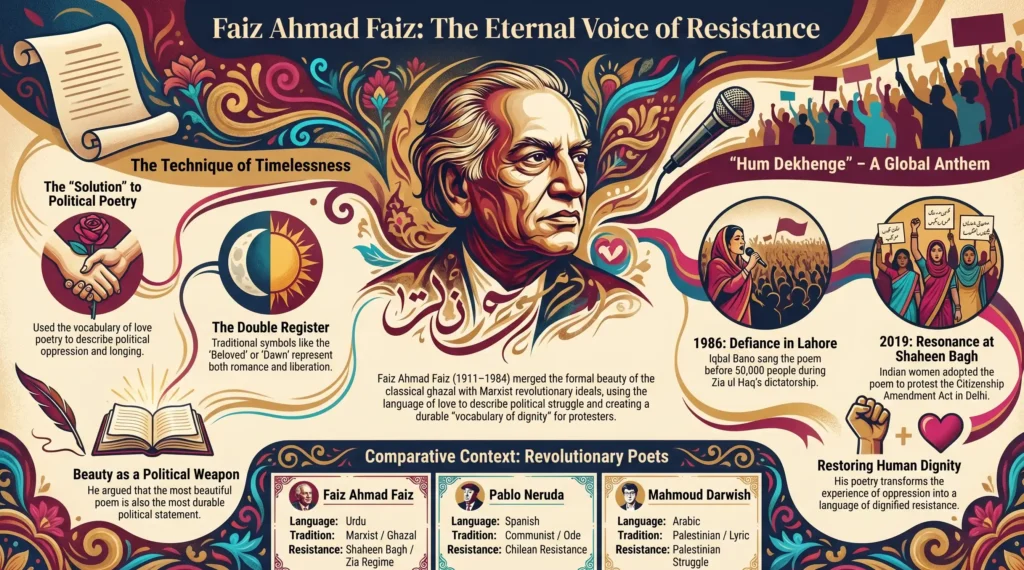
In December 2019, in the middle of India’s largest civilian protest movement in decades, women sitting in the cold of a Delhi winter at Shaheen Bagh began singing a poem written by a Pakistani communist who had been dead for thirty-five years. Hum Dekhenge—we shall witness—written during military dictatorship and sung in defiance of it, traveled across borders and decades to arrive in the streets of Delhi with its power not only intact but amplified by new circumstances it had never anticipated. The women sang it because it said exactly what they needed to say, precisely when they needed to say it. This is what Faiz Ahmad Faiz spent his life proving: that poetry, when it is beautiful enough and true enough, can outlast the systems it was written against.
The Problem Political Poetry Cannot Solve
Most political poetry dies when its political moment ends. The grievance becomes historical. The oppressor becomes a name in a textbook. The urgency disappears. The poem, which was written to capture a specific crisis, becomes a museum piece, something to study rather than something to sing. What separates Faiz from most political poets is that he solved this problem while other poets were still struggling to acknowledge it existed.
He did it by writing about oppression using the language of love. Not as a disguise or a code to evade censors, but as a philosophical position: that the experience of political oppression and the experience of loving what has been denied you are the same experience, described in different registers. The beloved in the ghazal tradition and lost freedom in the revolutionary tradition are the same absence. The heart’s cry for the lover and the people’s cry for justice are the same cry. Because he wrote at this level of fundamental human experience—love, loss, hope, endurance—rather than at the level of specific political moment, his poetry remained available to every generation that found itself in the condition he was describing. Oppression changed forms. The poetry stayed alive.
The Fearless Verses of Kabir That Challenged Orthodox Society
Born Into Music and Politics
Faiz Ahmad Faiz was born on 13 February 1911 in Sialkot, Punjab, in a household shaped by both intellectual aspiration and political awareness. He was educated at Government College Lahore, where he absorbed the English literary tradition alongside the Urdu tradition with equal seriousness, receiving master’s degrees in both English literature and Arabic. The education gave him the linguistic equipment to move fluidly between colonial culture and South Asian culture, to understand both traditions deeply, and to refuse the hierarchy that would have ranked one above the other.
His political consciousness developed in the 1930s, when the Soviet Union represented to the South Asian left a model of socialist transformation, when the Progressive Writers Movement was beginning to articulate an aesthetic program for literature in the service of liberation, and when independence was becoming conceivable as a real political possibility rather than an impossible dream. He served as a Lieutenant Colonel in the British Indian Army during the Second World War, an experience that gave him direct exposure to the machinery of empire and the specific solidarity that develops among people facing death together. In 1941, he married Alys George, a British communist activist, a union that was simultaneously a personal love match and a political alliance, marriage as a statement about what kind of world was possible.
The Ghazal as Revolutionary Form
To understand what Faiz did that no other twentieth-century poet had done quite as completely, you have to understand the ghazal and what he found inside it. The ghazal is one of the oldest poetic forms in the Urdu and Persian tradition, with formal requirements of extraordinary precision: a fixed rhyme and refrain pattern, couplets that stand alone as complete units while functioning as part of a whole, and a final couplet where the poet traditionally names himself. Its traditional subject is love, specifically the love of a devotee for a beloved who is absent, inaccessible, or indifferent. The love intensifies through denial rather than diminishing. It finds its most complete expression in the language of pain and longing rather than fulfillment.
Faiz understood that this emotional structure—love through denial, desire for what is withheld—maps onto political experience with exact precision. The oppressed person and the lover denied their beloved are structurally identical in what they feel. The vocabulary that the ghazal tradition had developed across centuries for describing one experience was perfectly suited for describing the other. What he did was exploit this correspondence with complete mastery. He used the traditional images of the ghazal—the candle and the moth, the rose and the nightingale, the wine and the beloved—and charged them with political meaning while leaving their emotional and aesthetic power untouched.
A reader encountering one of his poems could engage it purely as a love poem, following the classical tradition. Another reader could engage it as a revolutionary manifesto. A reader who brought both perspectives would find something that neither description alone could contain: a poem operating simultaneously on two registers without either cancelling out the other. The technique sounds simple only because he executed it with such complete mastery that it appears natural rather than achieved.
The Compassionate Teachings of Sant Tukaram in Maharashtra
Hum Dekhenge: The Poem That Would Not Die
Under General Zia ul Haq’s military dictatorship in Pakistan, when music was restricted and women’s public presence was regulated and dissent was brutally suppressed, Faiz composed Hum Dekhenge, a nazm poem arguing that there would come a day when thrones of oppression would be overturned, when the arrogant would be brought low, when those who had been waiting would witness the arrival of justice. In 1986, the singer Iqbal Bano performed it at a concert in Lahore, wearing a black saree in deliberate defiance of the regime’s dress codes. Fifty thousand people came. They sang the poem together. Multiple accounts describe weeping spreading through the crowd. The response was not to a literary performance. It was to the experience of hearing one’s own situation, one’s own endurance, expressed in language of such beauty and precision that recognition became physical rather than intellectual.
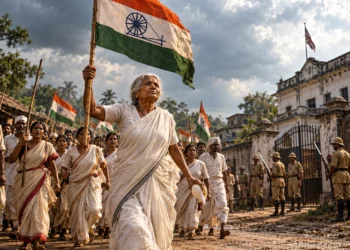
The journey of Hum Dekhenge from a Lahore concert in 1986 to the streets of Shaheen Bagh in Delhi in 2019 is the journey that demonstrates most clearly why Faiz’s poetry works the way it works. The women at Shaheen Bagh, protesting against a law they understood as a statement about Muslim belonging in India, sang a Pakistani poet’s poem about Pakistani military dictatorship. Why? Because the emotional and philosophical structure of the poem was already precisely adequate to their condition. They were waiting for justice in conditions of oppression with dignity intact. The poem was written for exactly that. Transfer across borders and decades required no adaptation because the poem was operating at the level of fundamental human experience rather than the level of specific political moment. Oppression had changed form. The poem remained available to those experiencing it.
The Prison Years and Philosophy of Endurance
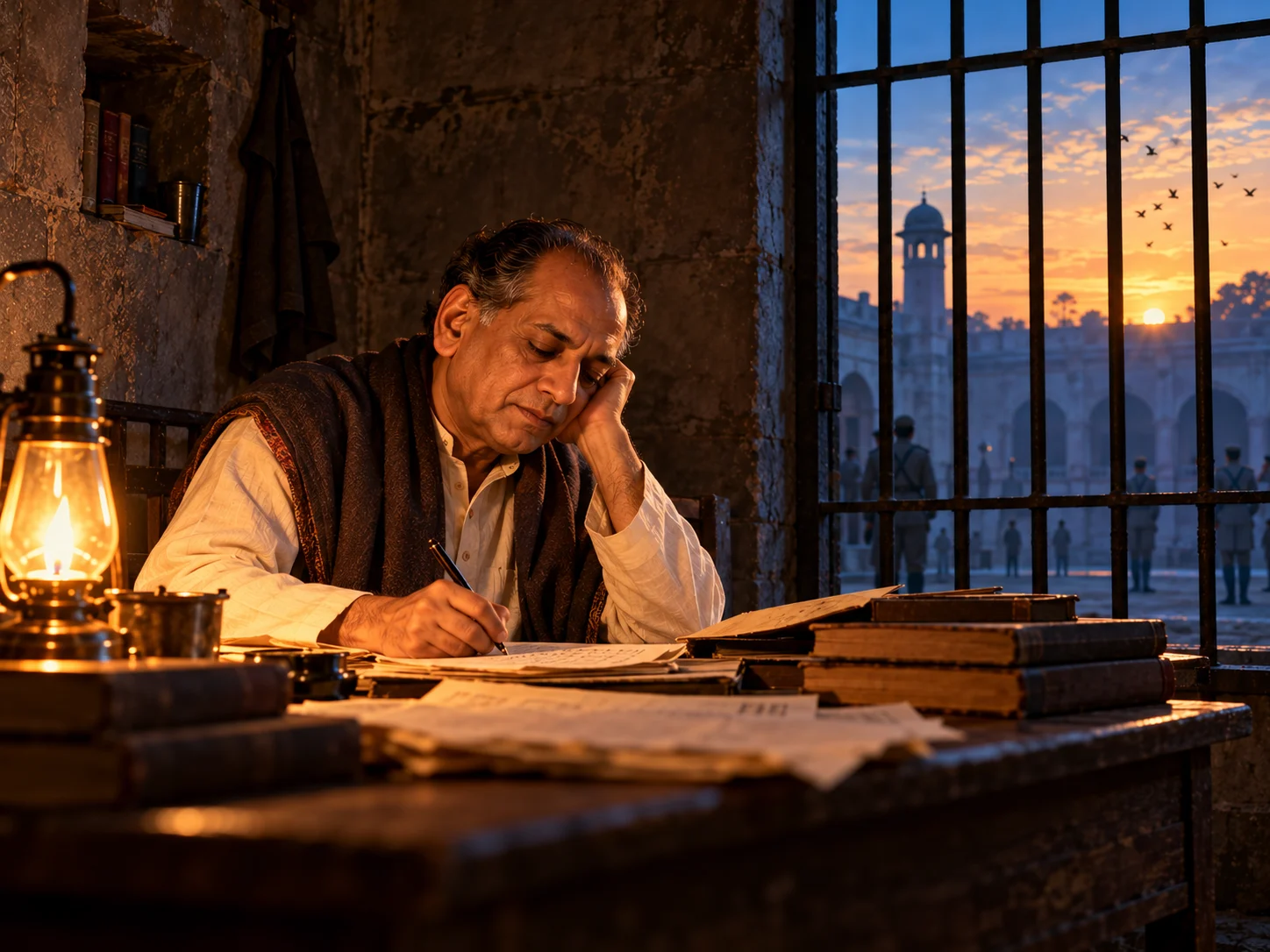
Faiz was imprisoned from 1951 to 1955 under the Rawalpindi Conspiracy Case, charges that historians have consistently questioned as politically motivated suppression of the communist left. He was imprisoned again later under Zia ul Haq’s dictatorship. Rather than diminishing his voice, imprisonment concentrated it. The poetry written in his cells, collected as Dast-e-Saba and Zindan Nama, constitutes some of the most sustained and philosophically developed political poetry in the Urdu tradition.
The prison poems have a quality of stillness that distinguishes them from his work written in freedom. Not passivity or resignation, but the specific stillness of a mind stripped of everything external and forced to confront its most essential concerns. The imagery is interior, concentrated, precise: the cell, the sky visible through the window, the passage of seasons, the sounds of the world outside that reach the prisoner without his being able to reach back. From within this stillness, he developed the philosophical argument that underlies all his political poetry: that the human capacity for beauty, for love, for the imagination of justice, is not diminished by oppression but intensified by it. The prisoner who can still imagine freedom is already partially free. The imagination of freedom is not separate from its eventual achievement but the first and most necessary step toward it.
How Bulleh Shah’s Poetry Transformed the Sufi World of Punjab
Love and Politics as One Thing
To understand the full depth of what Faiz accomplished, you have to spend time with a poem that is not primarily a protest poem at all, not immediately available as a political anthem. Mujhse Pehli Si Mohabbat Meri Mehboob Na Maang—do not ask of me, my love, that love I once had for you—is considered by many scholars of Urdu poetry to be his greatest single poem. It is addressed to a beloved, and its subject is the transformation of the poet’s capacity for love by his political consciousness.
The poem’s argument is that witnessing poverty, oppression, and suffering has transformed the poet’s relationship to private love, not by destroying it but by contextualizing it. He still loves the beloved. He can no longer love only the beloved, because the world’s suffering has become too present to ignore. This poem is not primarily about politics. It is about what happens to a person’s emotional life when it encounters public suffering and refuses to look away. And it represents the most complete expression of the philosophical position underlying all his work: that the political and the personal are not separate domains of human experience but dimensions of a single life, and that taking both seriously places a person in permanent productive tension between them.
Why Protest Chooses Poetry
When political crises develop sufficient intensity, people reach for Faiz. Not for speeches or slogans or contemporary songs, but for his poetry. The reason touches something essential about what poetry does that other forms of political language cannot do. Political speeches deliver arguments. Slogans deliver demands. News reports deliver facts. Poetry, when it is great enough, delivers dignity.
Dignity is the specific gift of great political poetry, and it is the gift that political crisis most urgently requires. When people are told, by law or force or cultural exclusion, that they do not fully belong, what they most need is a language that restores to them the full weight of their own experience, that names their situation with precision and beauty, and that places them within a tradition of human endurance larger than any particular crisis. Faiz’s poetry does this. It takes oppression and waiting and denial and gives them the formal beauty of the ghazal tradition, the philosophical depth of revolutionary consciousness, and the emotional truth of a man who lived what he was describing. The person who sings Hum Dekhenge is not only expressing a political position. They are claiming membership in a community of those who have endured, across time and circumstance, that extends across decades and borders and the specific coordinates of any particular struggle.
The Musical Revolution of Chaitanya Mahaprabhu in Medieval India
The Lasting Gift
Faiz died on 20 November 1984 in Lahore. His grave there has become a pilgrimage site. Visitors bring flowers and recite his poems. The attendance at his grave on his death anniversary has grown rather than diminished across the four decades since his death, a measure of a literary life that continues to accumulate meaning rather than fading into historical record. His poetry shows up in streets and squares and protest sites where he never imagined it would appear, finding new voices and new contexts and new necessities without losing any of the specific power the original context gave it.
The day he was singing about has not yet arrived. Thrones of oppression still stand. But the singing continues, and it continues because Faiz understood something essential about what great poetry can do: that it does not speak to a moment but to the condition. The condition recurs. The poetry is there. Decades after his death, in a country he never visited, under circumstances he could not have predicted, his words still do what he spent his life teaching them to do. They transform the experience of oppression into the language of dignified resistance without diminishing the reality of oppression or the cost of resistance.
Hum Dekhenge. We shall witness it. The singing continues. Faiz would have expected nothing less.
How Swami Vivekananda Brought Vedanta to the Modern World
If you think you have remembered everything about this topic take this QUIZ
Results


#1. Which iconic protest poem by Faiz Ahmad Faiz was famously sung by the women of Shaheen Bagh in Delhi during the 2019–2020 civilian protests?
#2. Faiz Ahmad Faiz solved the structural problem of political poetry by rendering political oppression through the emotional vocabulary of what genre?
#3. Under which Pakistani military dictator’s repressive regime was the revolutionary poem Hum Dekhenge originally composed?
#4. At a legendary 1986 Lahore concert, which celebrated singer defiantly performed Hum Dekhenge in a black saree before 50,000 people?
#5. In which city of British India was Faiz Ahmad Faiz born on February 13, 1911?
#6. Faiz Ahmad Faiz was a central and defining figure in which highly influential 20th-century South Asian literary collective?
#7. Which major international honor was bestowed upon Faiz Ahmad Faiz in 1962, reflecting his prominence on the global left?
#8. During his years of exile from 1979 to 1982, which international cultural magazine did Faiz edit while living in close proximity to the Palestinian struggle in Beirut?
Why does Faiz Ahmad Faiz’s poetry resonate so powerfully in modern protest movements?
Faiz’s poetry resonates in modern protest movements because it operates at the level of fundamental human experience rather than at the level of specific political circumstance. His central technique, using the classical ghazal tradition’s vocabulary of love and longing to describe the experience of political oppression, creates a double register in which the beloved’s absence and freedom’s absence are the same absence felt in the same way. This means the poetry does not age with its specific political moment. When the emotional structure of a new political crisis resembles the experience his poetry describes, the poems become immediately available as protest anthems, as precise and as urgent as the day they were written, because what they describe has not changed even as the specific historical coordinates have.
What is Hum Dekhenge and why was it sung at the Shaheen Bagh protests?
Hum Dekhenge is a nazm poem composed by Faiz Ahmad Faiz during Pakistan’s Zia ul Haq military dictatorship and first publicly performed by singer Iqbal Bano at a concert in Lahore in 1986. Its central argument is that there will come a day when the thrones of oppression will be overturned and those who have been denied justice will witness its arrival. It was sung at the Shaheen Bagh protests in Delhi in 2019 to 2020 against the Citizenship Amendment Act because its emotional and philosophical structure, the experience of waiting for justice in conditions of oppression with dignity intact, was precisely adequate to the situation of Muslim women in Delhi asserting their belonging in India against legislation that challenged it. The poem required no adaptation because it was already precisely adequate to the new context.
What was Faiz Ahmad Faiz’s relationship with the Progressive Writers Movement?
Faiz was one of the most important figures of the All India Progressive Writers Association, the literary movement founded in 1935 to 1936 that sought to place South Asian literature in the service of social and political liberation. His contribution to the Progressive Writers programme was distinctive because he refused to subordinate aesthetic quality to political utility, maintaining his commitment to the formal beauty of the classical Urdu ghazal tradition alongside his Marxist political consciousness. He argued implicitly and explicitly that the most powerful political statement is also the most beautiful one, and that the poem which moves its reader most deeply is also the most politically durable. This position distinguished his work from political poetry that is primarily about delivering a message and placed it in the category of poetry that is genuinely art.
How did Faiz’s imprisonment shape his poetry?
Faiz was imprisoned from 1951 to 1955 under the Rawalpindi Conspiracy Case, charges that historians have consistently questioned as politically motivated suppression of the communist left. The poetry written during this imprisonment, published as Dast-e-Saba and Zindan Nama, constitutes some of the most sustained and most philosophically developed political poetry in the Urdu tradition. Rather than diminishing his voice, imprisonment concentrated it, stripping away less essential elements and producing a poetry whose formal beauty and philosophical depth are in inverse proportion to the material deprivation of the conditions in which it was produced. The prison poems develop the philosophical argument that the human capacity for beauty, love, and the imagination of justice is not diminished by oppression but intensified by it.
What is the relationship between Faiz’s love poetry and his political poetry?
Faiz’s love poetry and political poetry are not separate categories but expressions of the same philosophical position, which is that the political and the personal are dimensions of a single life rather than separate domains of human experience. His poem Mujhse Pehli Si Mohabbat Meri Mehboob Na Maang is considered his greatest single poem and is a love poem that describes the transformation of private love by political consciousness, by the awareness of the world’s suffering that his political life had forced him to acknowledge. His political poems use the vocabulary and emotional structure of love poetry to describe political experience. The two bodies of work together constitute a unified philosophical position about the relationship between love, loss, and the imagination of justice.
Sources & References
Faiz Ahmad Faiz’s role as the most celebrated Urdu poet of the twentieth century and his Marxist political consciousness — Faiz Ahmad Faiz was born in Sialkot in 1911 and developed his political consciousness in the 1930s intellectual climate of South Asia, combining a deep commitment to the classical Urdu ghazal tradition with a sophisticated Marxist political philosophy developed through his engagement with the Progressive Writers Movement and the communist left’s vision of socialist transformation.
The specific technique of using ghazal tradition’s vocabulary of love to describe political oppression — Faiz’s central poetic innovation was recognizing that the emotional structure of the ghazal form, which describes love through denial and desire for what is withheld, maps precisely onto political experience, allowing him to write poems that operate simultaneously as love poems and revolutionary statements without either register diminishing the other.
The composition and political deployment of Hum Dekhenge during Zia ul Haq’s military dictatorship — Faiz composed Hum Dekhenge during Pakistan’s military dictatorship under General Zia ul Haq, and the poem was first performed publicly by singer Iqbal Bano at a concert in Lahore in 1986 before fifty thousand people who sang collectively in an act of political and cultural resistance, with the poem later becoming the protest anthem sung at the Shaheen Bagh demonstrations in Delhi in 2019 to 2020.
The philosophy of endurance developed through Faiz’s imprisonment and prison poetry — During his imprisonment from 1951 to 1955 under the Rawalpindi Conspiracy Case, Faiz developed a philosophical position that the human capacity for beauty, love, and the imagination of justice is not diminished by oppression but intensified by it, a position expressed in his prison poetry collections Dast-e-Saba and Zindan Nama considered among the finest in the Urdu tradition.
The relationship between political consciousness and private love expressed in Mujhse Pehli Si Mohabbat — Faiz’s poem Mujhse Pehli Si Mohabbat Meri Mehboob Na Maang describes the transformation of private love by political consciousness and represents his most complete statement of the philosophical position that the political and personal are dimensions of a single life rather than separate domains of human experience.