Bimal Roy took one look at the English lecturer in front of him and said so
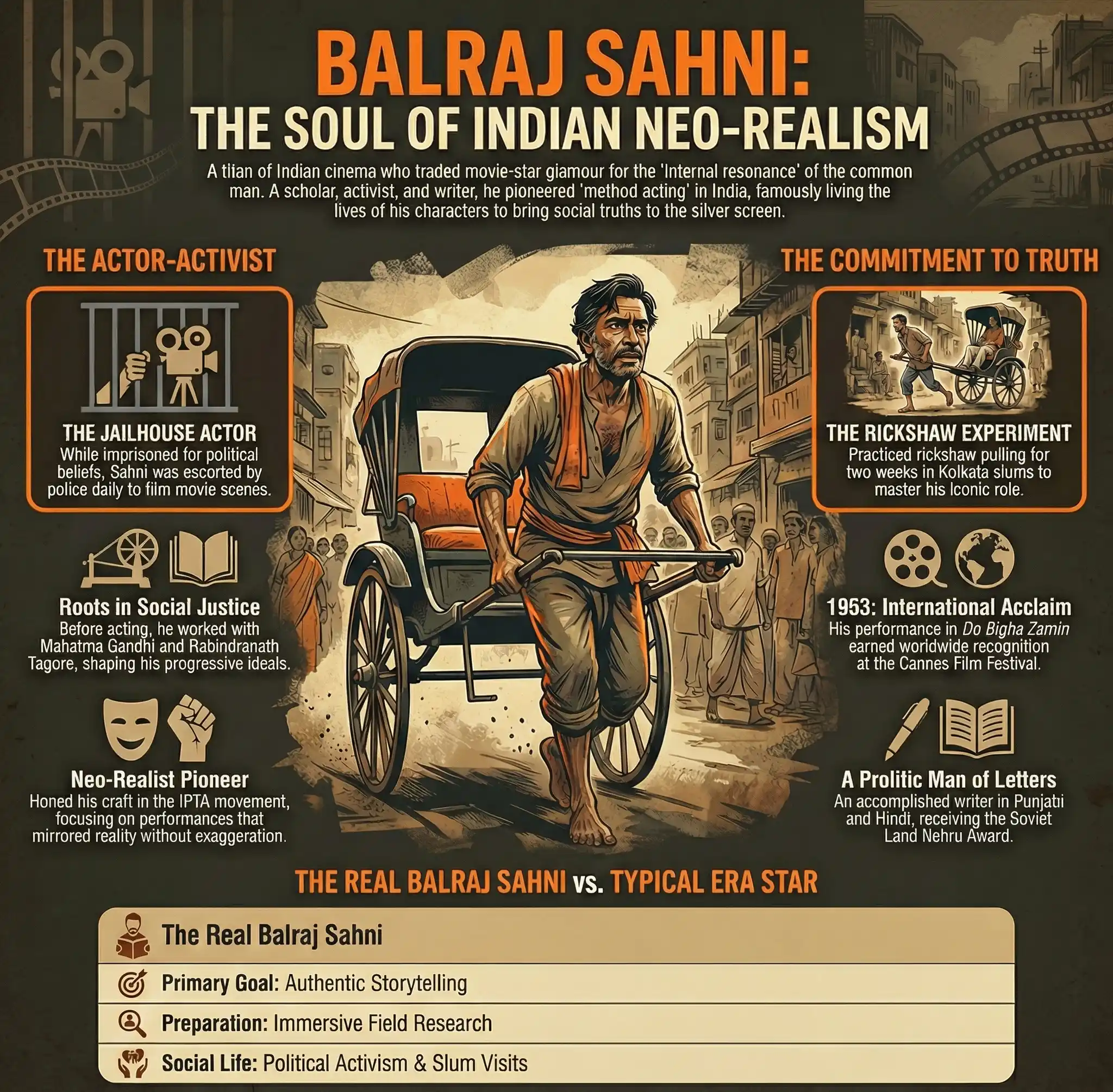
Balraj Sahni wrote in his autobiography about the day he was called to Bimal Roy’s office and not offered a chair. Roy told him his men had made a mistake and that he was entirely unsuited to the part.
The part was an uncouth villager. Sahni said he had already played one, in Khwaja Ahmad Abbas’s Dharti Ke Lal. Roy, who had assumed the man in front of him could not have, changed his mind and gave him Shambhu in Do Bigha Zamin.
The objection was not to his acting. It was that he looked and spoke like a man who had never gone without anything, which he was.
Rawalpindi to Bloomsbury
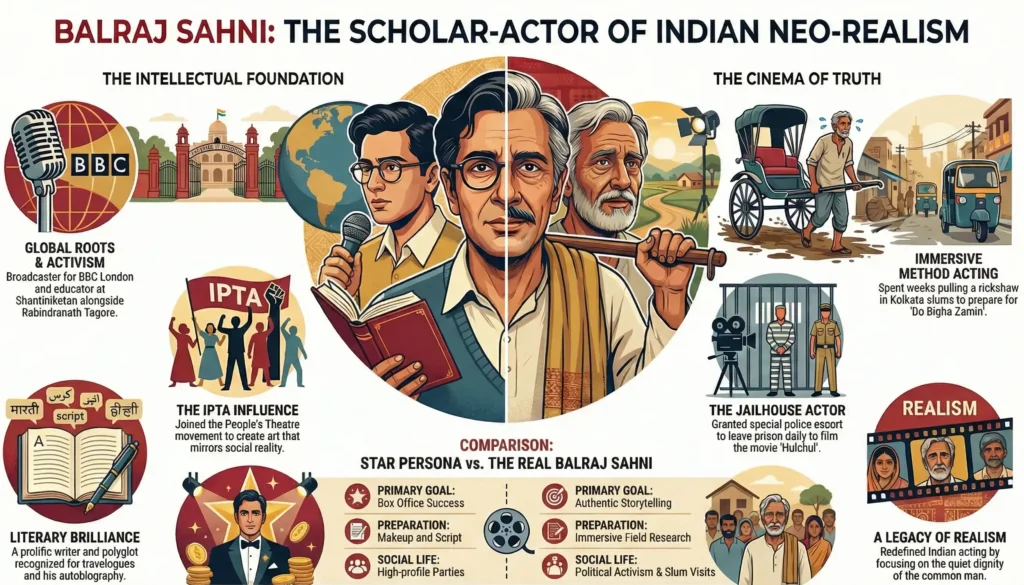
He was born Yudhishthir Sahni in Rawalpindi in May 1913, into a well-off Punjabi family. He took a master’s degree in English literature, taught at Rabindranath Tagore’s Shantiniketan, and then spent the war years in London as an announcer on the BBC’s Hindi service.
He came back to India in 1943. By the time he stood in a producer’s office being told he was wrong for a peasant role, he had been a university teacher and a broadcaster in two countries. His younger brother Bhisham Sahni would later write Tamas, the novel about Partition.
6 Unfoldings in the Subrahmanyan Chandrasekhar Biography
The jailer in jail
He acted with the Indian People’s Theatre Association and joined the Communist Party, and in 1951, during a government campaign against communists, he was arrested.
He was in the middle of shooting K. Asif’s Hulchul. Asif got permission from the police for him to come to the studio during the day under escort and return to his cell at night, and the shooting went on. The character he was playing was a jailer.
He was taken from a cell each morning to play a man who kept other men in cells, and taken back each evening.
Learning to be poor
For Do Bigha Zamin he went to Jogeshwari, on the edge of Bombay, and spent time among the migrants from the north who had come to the city for work, and he wrote about them in detail afterwards.
In Calcutta he went further. He got to know rickshaw pullers, dressed as they dressed, learned how they spoke, practised running barefoot on hot roads, and pulled a rickshaw through the streets with paying passengers who had no idea who was between the shafts.
The film went to Cannes and took a prize there, and it is one of the films that begins the parallel cinema tradition in India. What holds it up is not the politics but the ordinariness: Shambhu is a whole person with a marriage and jokes, and you watch the cheerfulness get worn off him.
Cooking the Manipuri Eromba Dish 365 Days
The rest of the working life
Kabuliwala in 1961, from Tagore, as the Afghan dry-fruit seller in Calcutta who misses his daughter. Waqt. Haqeeqat. He wrote the story of Baazi for Guru Dutt, with whom he did not get on. He wrote a great deal besides: an autobiography, journalism in Punjabi, a book about travelling in Pakistan.
He gave few interviews, kept no publicist and stayed out of the gossip trade entirely, which by the standards of the 1960s Bombay industry was close to eccentric.
1972
At a convocation address at Jawaharlal Nehru University he told the graduates something an actor at the top of his profession is not supposed to say: that the film world either leaves an actor idle or takes him over so completely that he is cut off from every other current of life. He listed the books he had not read and the events he had let pass, and said he sometimes felt terribly left behind.
That year his daughter Shabnam died. He did not recover from it.
The last week
M.S. Sathyu cast him in Garam Hava as Salim Mirza, a shoe manufacturer in Agra whose family is leaving for Pakistan one by one, and who will not go. The film is about the pressure on those who stayed, and the performance is generally held to be the best he gave.
Sahni was from Rawalpindi. He had lost that city in 1947 and knew precisely what the part was made of.
He finished dubbing the film and died of a heart attack the next day, 13 April 1973, a few weeks short of sixty. He never saw it.
A man who had already lost one country spent his last weeks playing a man deciding whether to leave another, and died before the film reached a cinema.
8 Fascinating Facts in the Homi Jehangir Bhabha Biography
The Powerful Meira Paibis Legacy In Northeast India
If you think you have remembered everything about this topic take this QUIZ
Results


#1. What was Balraj Sahni’s birth name before he became famous?
#2. Before his film career, Balraj Sahni taught at Shantiniketan and worked with which famous leader on the journal “Nai Talim”?
#3. During World War II, Balraj Sahni worked as a Hindi broadcaster for which international organization?
#4. To prepare for his role as a rickshaw puller in the film Do Bigha Zamin, what method did Sahni use?
#5. Which unique event occurred while Balraj Sahni was filming due to his political activism?
#6. Which of the following is a famous travelogue written by Balraj Sahni?
#7. Which film is considered his final masterpiece, where he portrayed a man caught in the aftermath of Partition?
#8. Balraj Sahni’s brother, Bhisham Sahni, is the celebrated author of which legendary novel?
Exploring The Assam Handloom Heritage And Silk
What is Balraj Sahni’s most famous film?
While he had many hits, Do Bigha Zamin (1953) is widely considered his most influential work, marking a turning point for neo-realist cinema in India.
Was Balraj Sahni involved in politics?
Yes, he was a committed member of the Communist Party and was heavily involved with the Indian People’s Theatre Association (IPTA), which focused on social and political issues.
Did Balraj Sahni write his own books?
Absolutely. He was a distinguished writer in Punjabi and Hindi. His autobiography, Meri Filmi Aatmakatha, is considered one of the best memoirs in Indian literature.
Read More: https://curiousindian.in/bhushan-kumar-november-1977-present/
Sources & References
Balraj Sahni, Meri Filmi Atmakatha (autobiography) — his account of the first meeting with Bimal Roy and of the time he spent among migrant workers in Jogeshwari.
Upperstall — his arrest in 1951, the arrangement that let him shoot Hulchul under police escort, and his work in Garam Hava.
ThePrint — his preparation for Do Bigha Zamin and his death the day after completing the dubbing of his last film.
Padma Awards portal, Government of India — the Padma Shri of 1969.
Author


Exploring the Soul of Bharat through History, Science, Culture, and its Diversity
Our Mission
Curious Indian is a definitive knowledge portal dedicated to chronicling the events, personalities, and cultural shifts that defined the Indian subcontinent. From the ancient Vedic Period to the complexities of 21st-century politics, our goal is to provide deep-dive analysis that inspires.
Editorial Standards & E-E-A-T
Every article published under our brand undergoes a rigorous fact-checking process. We prioritize primary historical records, academic citations, and credible archives to ensure our readers receive accurate, high-authority information.
Historical Integrity Directly sourcing from ASI archives and academic journals.Topical Authority Comprehensive clustering of Indian Science, Biographies, and Wars.Managed by Paripurna Datta and TEAM | Dedicated to the Knowledge of India.