The Bonfire, the Colours of Krishna, and the Day India’s Dividing Lines Wash Away
On most days, India is quietly full of invisible lines. Who is fair-skinned and who is dark. Who is rich and who is poor. Who is old and who is young, and who is allowed to sit where, or touch whom.
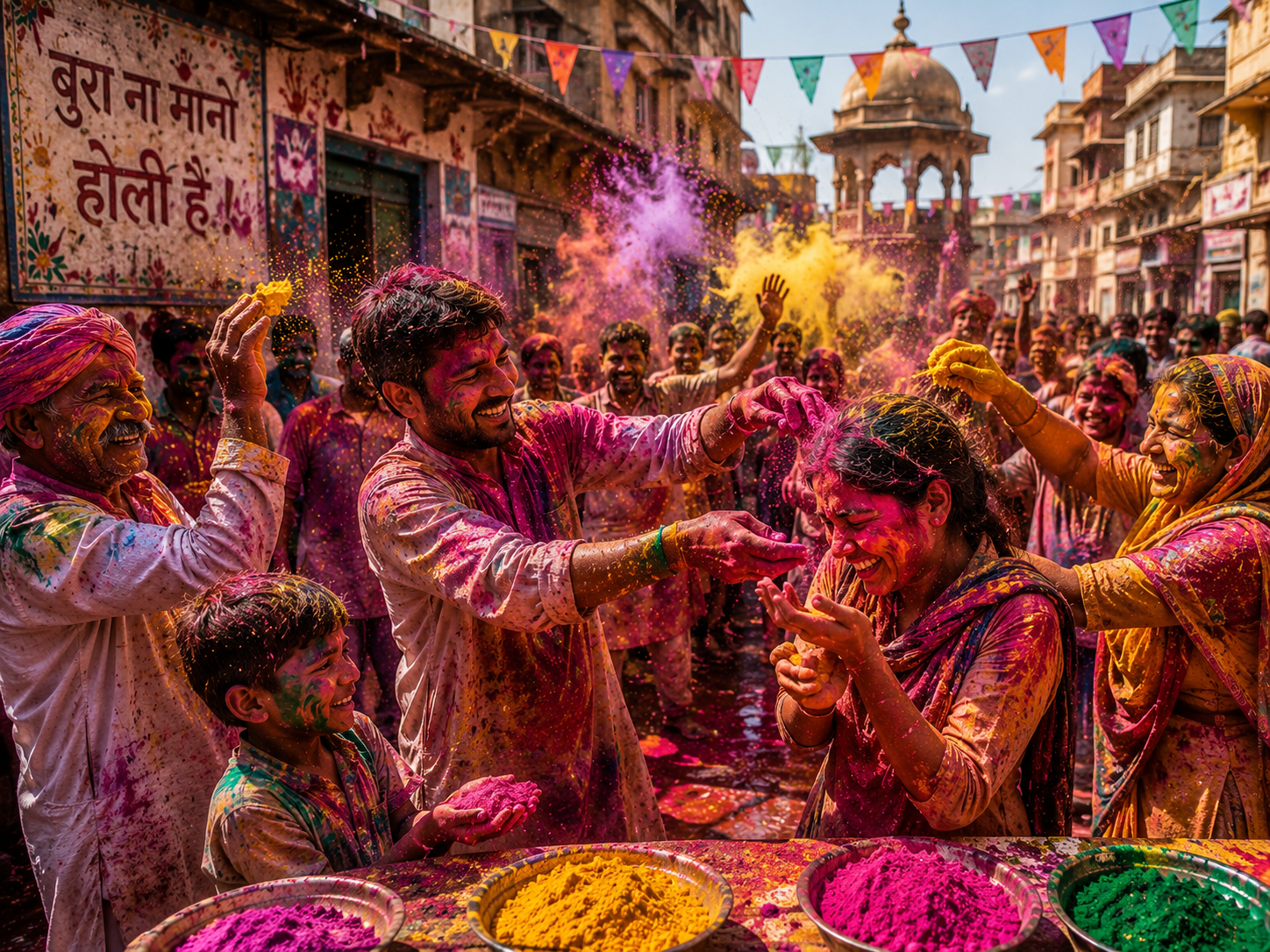
Then, for one wild and joyful day each spring, a stranger throws a fistful of bright powder into your face, and every one of those lines simply vanishes. Everyone ends up the same laughing, rainbow-stained mess. This is Holi, the festival of colours, and its real magic is that, for a single day, it makes everyone exactly the same.
The Bonfire that Burns Away Evil
Holi actually begins the night before, and it begins not with colour but with fire.
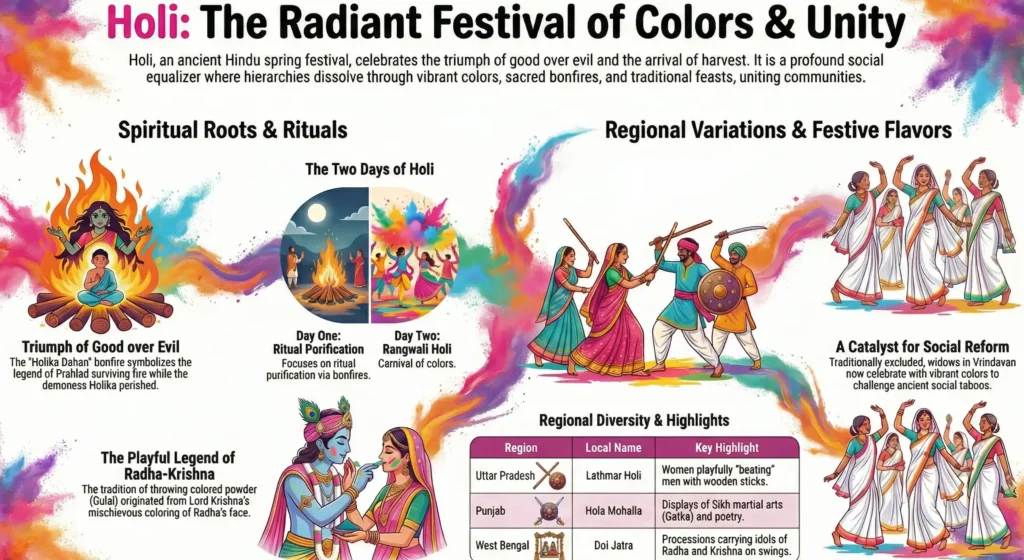
The story behind it is an old one. A proud demon king named Hiranyakashipu wanted everyone in his kingdom to worship him as a god. But his own young son, Prahlad, quietly kept praying to the god Vishnu instead. Furious, the king turned to his sister Holika, who had a special power: fire could not burn her. He told her to sit in the middle of a great bonfire holding the boy, so that Prahlad would die in the flames.
But it went terribly wrong for them. Because Holika was using her gift to do something cruel, it failed her. She burned to ashes, while little Prahlad walked out of the fire completely unharmed, protected by his god.
On the eve of Holi, people light great bonfires called Holika Dahan, and watch arrogance and evil burn away once again.
Ganesh Chaturthi: Honoring the Elephant-Headed God
Why We Throw Colour
The playful colour-throwing itself comes from a much gentler story, about the god Krishna as a boy.
Young Krishna had dark, bluish skin, and it made him shy and unhappy, because his beloved Radha was fair-skinned. One day he went to his mother, Yashoda, and complained: why is my skin so dark, when Radha’s is so light? His mother only smiled and gave him some mischievous advice. If it troubles you so much, she said, go and colour Radha’s face whatever colour you please. So Krishna ran off and smeared bright colour on Radha and all her friends, and just like that, the game of Holi was born.
There is something lovely hidden in that little tale. The very first Holi colours were thrown to turn a fair girl and a dark boy into the same colour.
From its very beginning, the message of Holi’s colours was simple: the shade of a person’s skin does not matter at all.
The Day the Rules Come Off
This is what makes Holi feel unlike any other festival in the year.
On this single day, the usual rules about who may do what to whom are quietly put away. A servant may throw colour on the master of the house. A child may cheekily paint an elder. The shyest person in the village may chase the boldest, and no one is allowed to take offence. There is even a little phrase that everyone repeats as they smear your face: “bura na maano, Holi hai”, which means “don’t take it badly, it’s Holi.”
Under a thick coat of pink and green and yellow, you simply cannot tell the rich from the poor, or the high from the low. Old quarrels are meant to be forgiven on this day, and enemies who colour each other are supposed to walk away as friends.
Durga Puja: Celebrating the Divine Feminine in Bengal
Winter Ends, and The World Turns Bright
There is a good reason all of this bursts out exactly when it does.
Holi arrives at the very end of winter, just as the cold, grey months give way to spring and the trees and fields begin to bloom again. It is a harvest time too. So the festival is really nature’s own celebration as much as anyone’s. The dull colours of winter are thrown off all at once, and the whole world, and every person in it, explodes into colour together.
Many Holis, One Country
Like all great Indian festivals, Holi changes its shape from place to place.
In the town of Barsana, tied to the legend of Radha, there is Lathmar Holi, where the women playfully chase the men away with sticks. In Bengal, the poet Rabindranath Tagore turned the day into Basanta Utsav, a graceful “spring festival” at Shantiniketan, full of songs, dance and yellow flowers instead of a colour riot. And the day after Holi, Sikhs gather at Anandpur Sahib for Hola Mohalla, a festival begun by Guru Gobind Singh, where the display is not of colours but of courage, with mock battles, sword skills and daring feats on horseback.
Christmas in India: A Festive Blend of Tradition
Sweets, Water, and a Little Care
Wherever you are, some things stay the same. There are sweets at every door, especially the fried, stuffed pastry called gujiya and tall glasses of cool, spiced thandai, shared freely with everyone who visits. There are water balloons and colour-squirters, drums, and dancing in the open streets.
In recent years, people have noticed that some of the cheap modern colours can be harsh on the skin and eyes. So many families have gone back to the older way, using gentler colours made from flowers and turmeric, so that the fun does not come at anyone’s cost. A little care simply keeps the joy safe for everybody.
Pongal and Makar Sankranti: India’s Harvest Festivals
What the Colour Washes Away
By the end of the day, everyone looks exactly the same: soaked, stained head to toe, tired out and grinning, every single face a smear of every colour at once. You truly cannot tell who arrived rich or poor, fair or dark, a friend or a stranger.
Then the colour washes off, the ordinary lines of daily life quietly slip back into place, and the world returns to work. But something has been said, loudly and messily, that is far too easy to forget the rest of the year. Underneath the colours we throw on ourselves, and the ones we happen to be born with, everyone is, in the end, just the same. Holi simply makes it impossible, for one bright and happy day, to pretend otherwise.
Reign of Akbar 1556-1605: The Golden Age of the Mughal Empire
If you think you have remembered everything about this topic take this QUIZ
Results


#1. In which Hindu month is the festival of Holi traditionally celebrated, marking the arrival of spring?
#2. According to the legend of Holika Dahan, who survived the massive fire due to divine intervention?
#3. In the unique tradition of Lathmar Holi in Barsana and Nandgaon, what do the women playfully use to “beat” the men?
#4. Which deep-fried, crescent-shaped pastry stuffed with khoya and dried fruits is considered the “undisputed king of Holi sweets”?
#5. During Holi, the cooling milk-based drink Thandai is traditionally laced with which ingredient to elevate the carefree, festive mood?
#6. What did Mughal Emperors like Akbar and Jahangir famously call the festival of Holi when celebrating it in their courts?
#7. In a powerful statement of social reform in recent years, which group of women in Vrindavan broke a long-standing taboo to play Holi inside temple courtyards?
#8. According to the comparison table, how is the festival known in Punjab, where it features Sikh martial arts displays and poetry?
Why do we celebrate Holi?
Holi celebrates the arrival of spring, the eternal love of Radha and Krishna, and the victory of good over evil (Prahlad surviving the fire of Holika).
What is Holika Dahan?
It is a ritual bonfire lit on the eve of Holi to symbolize the burning of the demoness Holika and the triumph of virtue over evil.
What is “Lathmar Holi”?
A unique celebration in Barsana and Nandgaon where women playfully beat men with wooden sticks (Lath), recreating the teasing between Lord Krishna and the Gopis.
What is the traditional sweet made during Holi?
Gujiya, a deep-fried dumpling stuffed with sweetened milk solids and dry fruits.
What is “Bhang”?
Bhang is an edible paste made from cannabis leaves, traditionally mixed into the milk drink Thandai to induce a festive, euphoric mood during Holi.
Sources and References
- Britannica (“Holi”) and History.com — the festival’s Hindu origins, the story of Prahlad and Hiranyakashipu behind the Holika Dahan bonfire, the Radha and Krishna legend behind the colour-play, and the two days of Holika Dahan and Rangwali Holi.
- Accounts of the Radha-Krishna legend (Zee Zest, bhaktiras.net) — the dark-skinned Krishna complaining to his mother Yashoda about Radha’s fair complexion, her playful suggestion that he colour Radha’s face, and the origin of the colours in the Braj region around Mathura, Vrindavan and Barsana.
- Regional festival sources — Lathmar Holi at Barsana, Rabindranath Tagore’s Basanta Utsav at Shantiniketan in Bengal, and Hola Mohalla at Anandpur Sahib, begun by Guru Gobind Singh, held the day after Holi.
- General festival guides — the meaning of “bura na maano, Holi hai,” the suspension of everyday social rules, the spring and harvest timing, the foods (gujiya and thandai), and the modern shift back toward gentler, plant-based colours.
- Original Curious Indian article (“Holi: The Festival of Colours”) — the framing of Holi as the arrival of spring and the triumph of good over evil, the regional variations, and the customs of colours, water and sweets.
Author


Exploring the Soul of Bharat through History, Science, Culture, and its Diversity
Our Mission
Curious Indian is a definitive knowledge portal dedicated to chronicling the events, personalities, and cultural shifts that defined the Indian subcontinent. From the ancient Vedic Period to the complexities of 21st-century politics, our goal is to provide deep-dive analysis that inspires.
Editorial Standards & E-E-A-T
Every article published under our brand undergoes a rigorous fact-checking process. We prioritize primary historical records, academic citations, and credible archives to ensure our readers receive accurate, high-authority information.
Historical Integrity Directly sourcing from ASI archives and academic journals.Topical Authority Comprehensive clustering of Indian Science, Biographies, and Wars.Managed by Paripurna Datta and TEAM | Dedicated to the Knowledge of India.