Baba Farid was a thirteenth-century Sufi saint of the Chishti order whose decision to compose spiritual verse in early Punjabi rather than in the Arabic or Persian of formal Islamic scholarship made him the founding figure of Punjabi devotional literature. His compositions, rooted in the imagery of everyday Punjab life and saturated with the Sufi understanding of love, impermanence, and the journey of the soul toward the divine, were so recognized for their spiritual authority that Guru Arjan Dev included them in the compilation of the Adi Granth in 1604, making Baba Farid one of the very few pre-Sikh voices to find a permanent home within Sikhism's sacred scripture. This piece traces his life, his spiritual formation, his poetry, and the long shadow he cast across the devotional culture of an entire region.| Detail | Information |
| Full Name | Fariduddin Masud Ganjshakar |
| Commonly Known As | Baba Farid, Farid ud-Din, Sheikh Farid |
| Born | Circa 1179, Khotwal, near Multan, Punjab (present-day Pakistan) |
| Died | Circa 1266, Pakpattan, Punjab (present-day Pakistan) |
| Spiritual Order | Chishti Sufi Order |
| Guru | Qutbuddin Bakhtiyar Kaki |
| Language of Poetry | Early Punjabi (Lehndi dialect) |
| Literary Form | Shabad (verse), Slok (couplet) |
| Collected Works | Included in the Adi Granth (Guru Granth Sahib) |
| Number of Compositions in Adi Granth | 4 Shabads and 112 Shloks |
| Shrine Location | Pakpattan Sharif, Punjab, Pakistan |
| Title | Ganj Shakar (Treasury of Sugar) |
The Saint at the Dry Lake
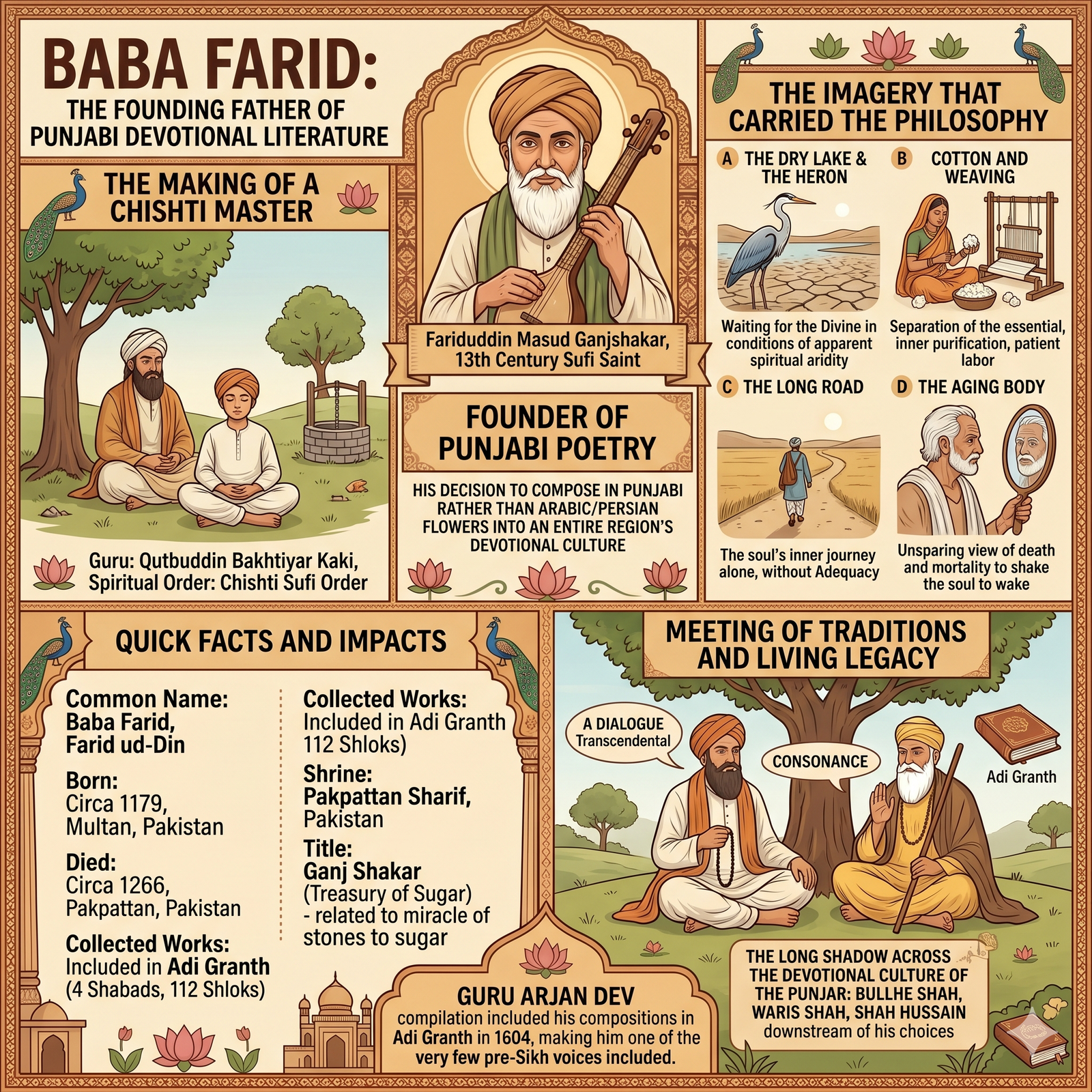
There is an image in one of Baba Farid’s most celebrated shloks that has stayed in the memory of Punjabi literature for eight centuries. He describes a heron standing at the edge of a dry lake, waiting for water that does not come, and uses this image to speak about the soul waiting for the divine in conditions of apparent spiritual aridity, in the long, unglamorous stretches of the path when nothing seems to be happening and the beloved seems to have forgotten entirely that you exist.
It is not a comfortable image. It does not offer reassurance or promise a quick resolution. It simply places you at the dry lake with the heron and asks you to stay there honestly. That quality, the willingness to describe the spiritual life as it actually is rather than as it is supposed to be in the instructional literature of any tradition, is what makes Baba Farid unlike most of what was being written in his century, and it is what has kept his verses alive in a way that more formally reassuring religious poetry rarely manages.
He was a Sufi of the Chishti order, one of the most beloved and widely followed of the Sufi orders in South Asia, and he brought to his practice of that tradition a quality of personal honesty that expressed itself most fully in the choice of Punjabi as his literary language and in the images he chose to inhabit that language with. He did not write about spiritual states in the abstract vocabulary of classical Sufi philosophy. He wrote about them through the heron at the dry lake, through the cotton being separated from its seed, through the aging of the body and the approach of death, through the long road that the traveler walks alone.
These images came from the Punjab around him and they returned to it as something transformed, as a literature that the Punjab would not stop reading.
How R.K. Narayan Built Malgudi From Real Memories
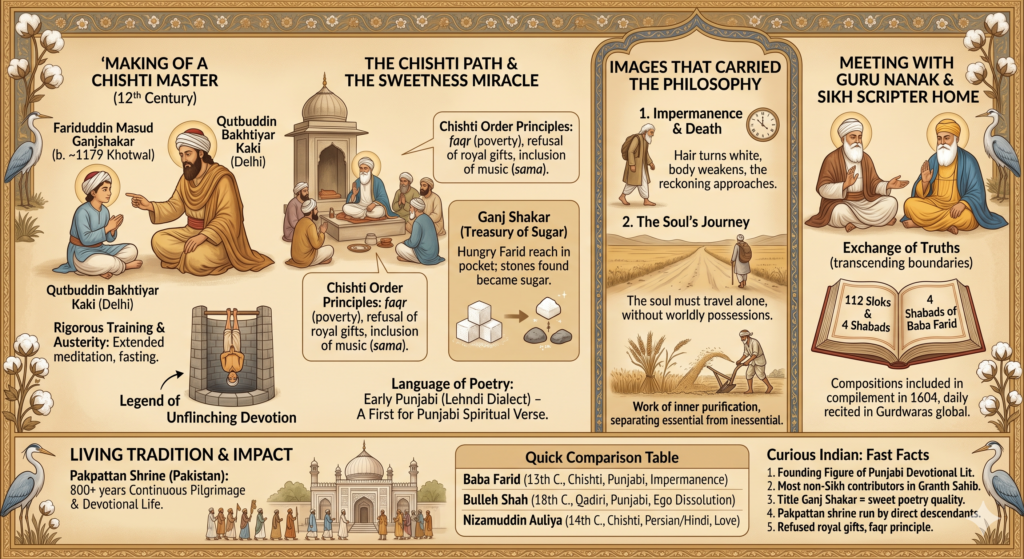
The Making of a Chishti Master
Fariduddin Masud was born around 1179 in Khotwal, a village near Multan in the southern Punjab. His family background was one of learning and religious standing, and from an early age he received the kind of formal Islamic education that was available to the children of the educated Muslim classes of the region, grounding him in Arabic, in the Quran, in the traditions of Islamic jurisprudence, and in the literary culture of Persian poetry that was the prestige literature of the Muslim world.
His spiritual formation began when he came into contact with Qutbuddin Bakhtiyar Kaki, a senior master of the Chishti order who had established himself in Delhi and whose own teacher, Moinuddin Chishti, had brought the Chishti tradition from Central Asia to the Indian subcontinent in the late twelfth century. The Chishti order had a specific character that distinguished it from other Sufi orders operating in the subcontinent at the time. It insisted on poverty as a spiritual discipline, refusing royal patronage and endowments. It placed music, specifically sama, the devotional listening practice, at the center of its spiritual methodology. And it maintained an unusual degree of openness to people of all backgrounds, including non-Muslims, in a way that gave it a distinctive place in the religious landscape of medieval India.
Farid came to Qutbuddin and stayed. The accounts of his formation under Qutbuddin describe a disciple of extraordinary intensity and commitment, someone who brought to the practices of the Chishti path the full force of an intellect that had been thoroughly trained and was now being asked to go somewhere that formal training alone could not take it.
The stories of Baba Farid’s spiritual austerities during his years of training have become part of the defining mythology of the Chishti order in South Asia. He is said to have hung himself upside down in a well for periods of extended meditation, to have fasted for days at a time, and to have maintained disciplines of physical and spiritual rigor that his contemporaries found extraordinary. These accounts, whether received as literal history or as the tradition’s way of encoding the intensity of genuine spiritual formation, communicate something true about the quality of commitment that Baba Farid brought to his path.
The Title That Stayed
The name by which Fariduddin Masud has been known for eight centuries, Ganj Shakar, the Treasury of Sugar, arrived through one of the most repeated stories in the hagiographic tradition surrounding him. During a period of particularly severe fasting and austerity, his mother, wanting to sustain him without breaking his discipline, is said to have placed stones in his pocket telling him they were sugar, which he could put in his mouth when the hunger became unbearable. When he reached into his pocket, the stones had become sugar.
The story belongs to the genre of miracle accounts that surround every major Sufi saint, and it carries within it the characteristic Sufi theological point about how the quality of a mother’s love and a disciple’s faith can transform the material world. What matters for the history of Punjabi literature is that the name stuck, and that the sweetness implied by Ganj Shakar became one of the consistent qualities attributed to his poetry, which despite its unflinching engagement with themes of death, loss, and spiritual aridity, carries within it a sweetness that readers have been responding to for eight centuries.
After Qutbuddin’s death, Baba Farid eventually settled in Pakpattan, then called Ajodhan, on the banks of the Sutlej river in the southern Punjab. This town became the center of his teaching and the base from which his influence spread across the Punjab, eventually reaching a spiritual population far beyond the Muslim community that formally identified with the Chishti tradition.
Why Ismat Chughtai Faced a Trial for Her Fearless Storytelling
The Punjabi Choice and Its Consequences
The decision to compose spiritual verse in Punjabi was the most consequential literary decision Baba Farid made, and it deserves careful attention because it was made against the grain of everything the formal Islamic literary culture of his time considered appropriate.
Arabic was the language of the Quran, the language of god’s direct speech to humanity, and the language in which the formal theological and legal tradition of Islam was conducted. Persian was the prestige literary language of the Islamic world from Persia to India, the language of the great Sufi poets including Rumi, Attar, and Sanai, whose masnavi poems and ghazals were the summit of what Sufi literature was understood to be. A Sufi master composing serious spiritual poetry in a regional vernacular like Punjabi was doing something that had no established precedent and no guaranteed reception.
Baba Farid did it anyway, and the reason seems to have been the same reason that drove Kabir to write in Hindi, Mirabai to write in Rajasthani and Braj Bhasha, and Tukaram to write in Marathi. The truth he was carrying could not wait for the listener to learn a second language. The people of the Punjab who needed to hear what he had understood about the nature of the self, the reality of death, the availability of the divine, and the cost of a life spent in the pursuit of worldly things at the expense of inner ones, those people spoke Punjabi. So he spoke Punjabi.
The Punjabi he used was an early form of the language, the Lehndi dialect of the western Punjab, and it sits at the very beginning of the literary history of Punjabi as a written language. This places Baba Farid not merely within Punjabi literature but at its origin, as the figure from whom the tradition of written Punjabi spiritual poetry flows. Everything that came after, including the entire tradition of Punjabi devotional literature that produced Bulleh Shah, Waris Shah, and Shah Hussain, was in some sense downstream of the choice Baba Farid made in Pakpattan in the thirteenth century.
The Images That Carried the Philosophy
What distinguished Baba Farid’s poetry from formal Sufi philosophical literature was his insistence on grounding abstract spiritual truths in the concrete imagery of daily Punjabi life. He was not interested in the elevated metaphors of classical Persian Sufi poetry, beautiful as those were. He was interested in what was actually around him in the Punjab of the thirteenth century, and he found in that landscape and in the daily life of its people an inexhaustible supply of images adequate to the spiritual realities he needed to describe.
The body aging toward death is one of his central recurring images. He describes the hair turning white, the body weakening, the friends departing one by one, and the moment of reckoning approaching with a directness that had no equivalent in the devotional literature of his time. He was not describing death to frighten but to awaken, to shake the reader out of the complacent assumption that there would always be time later to attend to what actually mattered.
The road appears repeatedly in his verses, the long road that the soul must travel alone, without the companionship of the people and possessions that seem so essential during the journey of ordinary life. He writes about the traveler setting out without adequate preparation, about the distance that remains when the traveler is already exhausted, about the importance of beginning the inner journey before the outer one becomes unavoidable.
The imagery of agriculture and weaving runs through his work with the same specificity that similar imagery runs through Kabir’s dohas. The cotton being separated from its seed, the grain being separated from the chaff, the plowing of the field and the sowing of the seed, all of these carry within them precise spiritual meanings about the work of inner purification, the separation of the essential from the inessential, and the patient labor that genuine spiritual development actually requires.
These images worked on their original audience because they were images from that audience’s own daily life, given back to them saturated with a meaning they had not previously found in them. And they continue to work because the experiences they encode, the approach of death, the longing for the divine, the difficulty of the inner journey, the impermanence of everything external, are not experiences that belong exclusively to thirteenth-century Punjab.
Why the Poetry of Faiz Ahmad Faiz Still Resonates in Modern Protests
The Meeting With Guru Nanak
One of the most significant encounters in the entire history of Indian spiritual literature is the meeting, recorded in Sikh hagiographic tradition and in accounts preserved across multiple sources, between Baba Farid and Guru Nanak. The chronological difficulty is immediately apparent. Baba Farid died around 1266, and Guru Nanak was born in 1469, making a direct meeting between them impossible. What the tradition preserves under the name of this meeting is in fact the encounter between Guru Nanak and one of Baba Farid’s successors as head of the Pakpattan shrine, most likely the fifth or sixth in the line of succession from Farid.
The encounter is recorded as a dialogue, a series of questions and responses in which the representative of the Chishti tradition and the founder of the Sikh tradition test and recognize each other, finding in each other’s understanding of the divine a consonance that transcends the formal boundaries of their respective traditions. The dialogue is preserved in a form that suggests it was both a genuine exchange and a theological statement about the relationship between Sufi and Sikh understandings of god, the self, and the path to union.
The consequence of this exchange for Punjabi literary history was the inclusion of Baba Farid’s compositions in the Adi Granth when Guru Arjan Dev compiled the scripture in 1604. The decision to include the verses of a Muslim Sufi saint in the sacred scripture of a tradition that was in the process of defining its own distinct identity was an act of theological generosity and spiritual recognition whose implications continue to reverberate across the religious culture of the Punjab.
Baba Farid’s presence in the Guru Granth Sahib means that his words are recited in Sikh gurdwaras every day, across every country where Sikhs have settled, in a form of transmission that no other vehicle of his legacy could have guaranteed. A man who wrote in the spoken Punjabi of the thirteenth century has his words carried daily into the twenty-first century through one of the world’s living religious traditions, which is perhaps the most extraordinary act of literary survival in the entire history of Indian literature.
The Pakpattan Shrine and the Living Tradition
The shrine of Baba Farid at Pakpattan Sharif in present-day Pakistan has been a center of pilgrimage and devotional life since his death in 1266, making it one of the oldest continuously functioning Sufi shrines in South Asia. The shrine draws hundreds of thousands of visitors annually from across Pakistan, India, and the Punjabi diaspora, and the annual urs celebration of Baba Farid’s death anniversary is one of the most significant gatherings in the devotional calendar of the Punjab.
The tradition of sajjada-nashini, the hereditary succession of custodianship over the shrine, has maintained an unbroken lineage from Baba Farid’s own family to the present day. This institutional continuity has preserved not only the physical heritage of the shrine but the living tradition of devotional practice that Baba Farid established in Pakpattan, including the regular performance of sama, the Chishti devotional music practice that he himself participated in and endorsed.
The reach of the Chishti order that Baba Farid helped to establish in the Punjab extended through his own successors and disciples to encompass virtually the entire devotional landscape of the region. His most significant disciple, Nizamuddin Auliya, went on to become perhaps the most beloved Sufi saint in the history of Delhi, and through Nizamuddin the Chishti tradition spread across the entirety of North India with a breadth of influence that no other Sufi order in the subcontinent achieved.
What the Images Were Saying
Returning to that heron at the dry lake, it is worth sitting with what Baba Farid was actually doing when he placed that image at the center of a spiritual poem. He was refusing to pretend that the spiritual life was consistently a place of warmth, abundance, and felt presence. He was acknowledging that there were long stretches of it that felt like standing at a dry lake bed, waiting for something that did not come, without any guarantee that it would.
This honesty was not pessimism. In the Sufi understanding that shaped everything Baba Farid wrote, the apparent absence of the divine was itself a form of the divine’s presence, a testing and a deepening, a burning away of the aspects of the self that required the reassurance of felt presence in order to maintain their devotion. The heron that waits at the dry lake is the heron that has committed to waiting, and that commitment is itself the devotional act.
He was asking his reader to make the same commitment. Not to wait for conditions to become favorable before beginning the inner life, not to defer the essential work until the emotional weather improved, but to stand at the dry lake and to wait with the fullness of attention that genuine waiting requires.
That instruction, delivered through an image drawn from the landscape of the Punjab in the thirteenth century, remains as precise and as demanding as the day it was composed. The lake may be dry. Stand at it anyway. That is what poetry is asking, and it has been asking it for eight hundred years.
The Deep Melancholia Behind the Comic Genius of Mehmood
Quick Comparison Table
| Aspect | Baba Farid | Bulleh Shah | Nizamuddin Auliya |
| Era | 12th to 13th century | 17th to 18th century | 13th to 14th century |
| Region | Pakpattan, Southern Punjab | Kasur, Central Punjab | Delhi, North India |
| Sufi Order | Chishti | Qadiri | Chishti |
| Language of Poetry | Early Punjabi, Lehndi dialect | Punjabi | Persian, Hindi |
| Primary Form | Shabad, Slok | Kafi, Si-Harfi | Malfuzat (recorded discourses) |
| Core Theme | Impermanence, death, divine longing, the inner journey | Ego dissolution, divine love, self-inquiry | Love, service, presence of the divine in humanity |
| Relationship to Sikh Scripture | Compositions included in Guru Granth Sahib | No direct inclusion | No direct inclusion |
| Key Disciple Legacy | Nizamuddin Auliya, Chishti expansion across India | Influenced later Punjabi Sufi poets | Amir Khusrow, Chishti tradition in Delhi |
Curious Indian: Fast Facts
- Baba Farid is the earliest known poet to have composed spiritual verse in the Punjabi language, placing him at the very origin of what became one of South Asia’s richest devotional literary traditions.
- His compositions in the Guru Granth Sahib consist of four shabads and one hundred and twelve shloks, making him one of the most substantially represented non-Sikh contributors to the Sikh sacred scripture.
- The title Ganj Shakar, meaning Treasury of Sugar, was given to him following the miracle account of stones turning to sugar in his pocket, and the sweetness associated with this title has been consistently attributed to the quality of his poetry by readers across eight centuries.
- His most celebrated disciple Nizamuddin Auliya went on to become the most beloved Sufi saint in the history of Delhi, and through Nizamuddin’s own disciple Amir Khusrow the Chishti tradition produced some of the most significant contributions to Indian music, poetry, and cultural synthesis in the medieval period.
- The Pakpattan shrine has maintained an unbroken succession of custodians from Baba Farid’s own family lineage to the present day, representing one of the longest continuously maintained institutional religious inheritances in South Asia.
- Baba Farid’s insistence on refusing royal patronage was consistent with the Chishti order’s foundational principle of faqr, spiritual poverty, and he is said to have turned away gifts from the Delhi Sultanate on multiple occasions.
- The imagery of death and physical impermanence in his shloks is more direct and unsparing than almost anything in the devotional poetry of his contemporaries in any tradition, reflecting his conviction that honest acknowledgment of mortality was a prerequisite for genuine spiritual awakening.
- His annual urs at Pakpattan Sharif draws an estimated two hundred thousand pilgrims and is one of the oldest continuously observed death anniversary celebrations at any Sufi shrine in South Asia.
- The Chishti order’s practice of sama, devotional music listening, which Baba Farid participated in and endorsed, is considered by music historians to be one of the foundational influences on the development of both qawwali as a musical genre and on the broader classical music traditions of North India.
- Contemporary Punjabi poets and scholars on both sides of the India-Pakistan border consistently identify Baba Farid as the founding ancestor of their literary tradition, making him one of the few cultural figures whose significance is acknowledged with equal depth across the religious and political divide created by the 1947 partition.
Conclusion
Baba Farid left behind a body of poetry that was small in volume and enormous in consequence. Four shabads and one hundred and twelve shloks are preserved in the Guru Granth Sahib, additional compositions circulating in various manuscript and oral traditions, and the founding of a literary language for an entire region. It is not a large numerical legacy by the standards of the saint-poets who came after him, the Tukaram with his four thousand abhangas, the Kabir with his six thousand attributed verses, the Bulleh Shah with his hundred and fifty kafis. But it was first, and in literary history as in many other things, being first carries a particular kind of weight.
He chose the language of the Punjab when no one else had thought it adequate for serious spiritual expression. He chose the images of daily Punjabi life, the heron, the cotton, the aging body, the long road, when the prestige images of the classical tradition were available and would have been more immediately respectable. He chose honesty about the difficulty of the inner journey when the established literature of spiritual instruction tended toward the reassuring and the programmatic.
Each of these choices turned out to be the right one, which is why his words have survived eight centuries of political change, religious conflict, colonial disruption, and partition, and are still being recited every morning in gurdwaras from Amritsar to Auckland, from Vancouver to Singapore, carried in the mouths of people who may not know that the voice they are giving breath to is the voice of a man who stood in Pakpattan in the thirteenth century and decided that the people of the Punjab deserved to hear about god in their own language.
They did. They still do. That is the whole of what Baba Farid understood, and it was enough.
The Powerful Feminist Anthems Hidden in the Songs of Lalon Fakir
If you think you have remembered everything about this topic take this QUIZ
Results


#1. In which century did Baba Farid live and compose the early Punjabi verse that established him as the founding figure of Punjabi devotional literature?
#2. What specific Sufi spiritual order did Baba Farid belong to, which emphasized poverty and refused royal patronage?
#3. Who was the senior Delhi-based Chishti master that served as Baba Farid’s spiritual guru?
#4. What is the meaning of Baba Farid’s celebrated title “Ganj Shakar”?
#5. Which dialect of early Punjabi, spoken in the western Punjab, did Baba Farid use for his spiritual compositions?
#6. Exactly how many Shabads and Shloks composed by Baba Farid were included by Guru Arjan Dev in the Adi Granth in 1604?
#7. On the banks of which river did Baba Farid settle down in the town of Pakpattan?
#8. Which prominent Sufi saint of Delhi was Baba Farid’s most significant direct disciple?
Who was Baba Farid and why is he significant in Indian literary history?
Baba Farid, whose full name was Fariduddin Masud Ganjshakar, was a thirteenth-century Sufi saint of the Chishti order born around 1179 near Multan in the southern Punjab. He is significant in Indian literary history as the earliest known poet to compose spiritual verse in the Punjabi language, making him the founding figure of Punjabi devotional literature. His compositions were so recognized for their spiritual authority that they were included in the Adi Granth, the sacred scripture of the Sikh tradition, by Guru Arjan Dev in 1604, making him one of the very few pre-Sikh voices preserved within Sikhism’s most sacred text. His influence on the subsequent devotional poetry of the Punjab, which produced figures including Bulleh Shah, Waris Shah, and Shah Hussain, makes him the ancestral figure of the entire Punjabi literary tradition.
Why did Baba Farid write in Punjabi rather than Arabic or Persian?
Baba Farid’s choice to write in Punjabi rather than in the Arabic or Persian of formal Islamic scholarship was a deliberate decision rooted in his understanding of who needed to hear what he had to say. The spiritual truths he wanted to communicate, about the impermanence of the body, the approach of death, the availability of the divine, and the cost of a life spent entirely in the pursuit of worldly things, were truths that the ordinary people of the Punjab needed to encounter in their own language. Writing in Arabic or Persian would have restricted his audience to the formally educated, the very people who were most likely to have already encountered these ideas in the classical literature of the tradition. Writing in Punjabi made his poetry available to farmers, weavers, and ordinary householders for whom the classical languages were inaccessible. This democratizing impulse, placing spiritual truth in the language of the people who needed it most, is the same impulse that drove Kabir, Mirabai, Tukaram, and Bulleh Shah to make similar choices in their own respective languages and contexts.
How did Baba Farid’s compositions come to be included in the Guru Granth Sahib?
The inclusion of Baba Farid’s compositions in the Adi Granth, compiled by Guru Arjan Dev in 1604, was the consequence of the close relationship between the Chishti Sufi tradition and the early Sikh community in the Punjab. Although the accounts of Guru Nanak’s meeting with Baba Farid involve a chronological impossibility, since Farid died two centuries before Nanak was born, Guru Nanak did meet with Farid’s successors at the Pakpattan shrine and the dialogue between them was recorded as an expression of deep mutual recognition between the two traditions. Guru Arjan Dev, recognizing in Baba Farid’s Punjabi compositions a spiritual vision consonant with the Sikh understanding of the divine, included his shabads and shloks in the compilation of the scripture. This decision ensured that Baba Farid’s words would be transmitted continuously through one of the world’s living religious traditions from the seventeenth century to the present day.
What are the central themes of Baba Farid’s poetry?
The central themes of Baba Farid’s poetry can be organized around three interconnected concerns. The first is impermanence and the approach of death, which he addresses with an unflinching directness unusual in the devotional literature of his time, describing the aging of the body, the departure of friends and companions, and the inevitable reckoning that awaits every soul as urgent realities that demand attention now rather than at some indefinite future point. The second is the longing of the soul for the divine, expressed through the characteristic Sufi imagery of the lover separated from the beloved, rendered in the concrete images of the Punjabi landscape rather than in the abstract metaphors of classical Persian Sufi poetry. The third is the inner journey, the difficult, patient, largely unglamorous work of spiritual development that he describes without idealization, acknowledging the dry stretches, the apparent absence of the divine, and the exhaustion of the traveler while maintaining throughout that the journey is the only one worth making.
What was Baba Farid’s relationship with the broader Chishti Sufi tradition in India?
Baba Farid was a central figure in the establishment and early development of the Chishti order in South Asia. He received his spiritual formation from Qutbuddin Bakhtiyar Kaki, whose own teacher Moinuddin Chishti had brought the Chishti tradition from Central Asia to India. Through his own teaching, Baba Farid trained Nizamuddin Auliya, who became the most beloved and influential Sufi saint of medieval Delhi and through whose disciples the Chishti tradition spread across virtually all of North India. The order that Baba Farid helped to plant in the Punjab thus became, through this lineage, the dominant Sufi tradition of the entire subcontinent, producing figures including Amir Khusrow, whose contributions to Indian music and poetry are foundational, and maintaining a coming presence across India and Pakistan to the present day. The Chishti order’s specific qualities, its insistence on poverty, its use of music as a devotional method, and its unusual openness to people of all backgrounds, were qualities that Baba Farid embodied and transmitted, and they gave the order its distinctive character in the South Asian context.