How the destruction of a proud free kingdom made a conqueror carve his own guilt into stone
History is full of the boasts of conquerors. All across the ancient world, kings carved their victories into stone: how many enemies they had slaughtered, how many cities they had burned, how great and how terrible they were. The stones of the ancient world are, for the most part, one long brag.
And then there is one strange, lonely exception. On a rock in eastern India, more than two thousand years ago, a victorious emperor carved something that no conqueror had ever carved before him. He carved his guilt. He described, in his own words, the full horror of the war he had just won, and confessed that his victory had filled him not with pride, but with grief and shame. The war was the conquest of Kalinga, and this is the story of the one ancient battle that we remember not for the winner’s glory, but for the winner’s tears.
The last free kingdom
By around 261 BCE, almost the whole of India had been swallowed up by one enormous empire: the Mauryan Empire. Kingdom after kingdom had either fallen or bent the knee, until very nearly the entire subcontinent answered to a single emperor, a man named Ashoka. But one proud land, on the eastern coast, had flatly refused. It was called Kalinga, and it would not bow.
Kalinga was no small or weak place. It was rich and fiercely independent, a great seafaring nation whose ships carried its trade far across the ocean to Southeast Asia, and whose people were famous for their deep love of their own freedom.
While kingdom after kingdom bowed down to the Mauryan empire, one proud, free, seafaring land on the eastern coast simply refused. It was called Kalinga.
Its refusal to join the empire was like a splinter under Ashoka’s skin. It openly defied his power, and it sat astride the valuable trade routes that he badly wanted to control. So the emperor made his decision. He would take Kalinga by force.
Reign of Ashoka: The Emperor Who Chose Peace
The slaughter
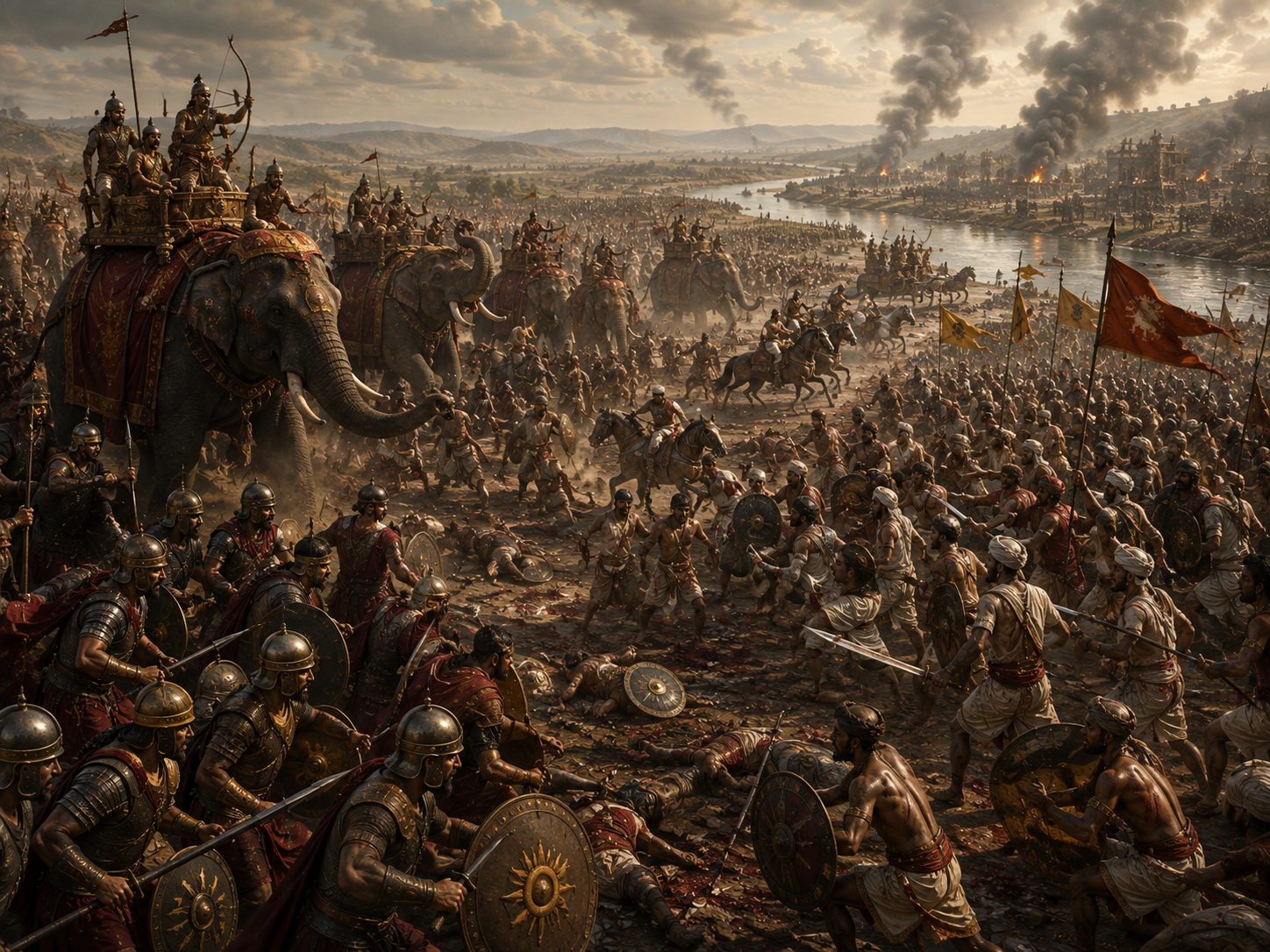
The people of Kalinga did not surrender. They fought, and they fought hard, defending their freedom with everything they had. But they were facing the largest and most powerful army in the whole of the ancient world, with its endless ranks of soldiers and its great war elephants.
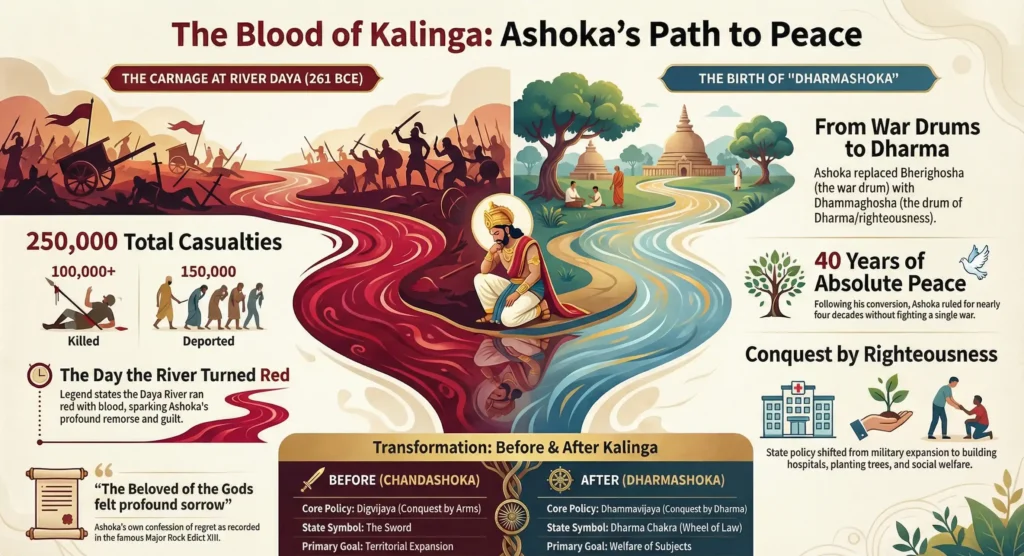
What followed was less a battle than a massacre. The army of Kalinga was destroyed, and still the killing went on and on. There is an old and terrible saying that the river beside the battlefield, the Daya, ran red with blood for days on end. When it was finally over, the human cost was staggering, and we know it in such detail because Ashoka himself would later count it all out.
By the emperor’s own count: a hundred thousand people killed, a hundred and fifty thousand more dragged away as captives, and countless others dead of their wounds and of famine afterward.
Reign of Samudragupta 335-375 CE: The Napoleon of India
The confession in stone
Ashoka had won. His empire was, at long last, complete. By every single rule that kings had ever lived by, this was the moment to celebrate, to raise a great monument to his glorious victory and have his poets sing of it for generations.
He did the exact opposite. Ashoka walked out across the ruined battlefield that he himself had made, and instead of triumph, he was overcome with horror. He saw the great piles of the dead. He saw the wounded and the dying. He saw small children weeping over the bodies of their parents. And something deep inside the mighty conqueror simply broke.
And then he did the thing that sets this war apart from almost any other in all of history. He had his sorrow carved into solid rock, for everyone, forever, to read. In an inscription that we now call the Thirteenth Rock Edict, Ashoka set down the dreadful numbers of the dead and the deported, and then he confessed, plainly and publicly, that all the suffering he had caused had filled him with deep and lasting remorse.
The most powerful man in the world had his own regret carved in stone. He set down the numbers of the dead, and then confessed that what he had done filled him with lasting sorrow.
Stop and think about how strange and how rare that truly is. We know the real horror of the Kalinga war not from its victims, and not from later historians writing safely long afterward, but from the confession of the very man who caused it. The killer wrote down his own crime. In a world where every king carved only his triumphs, here at last was one who chose instead to carve his guilt.
Reign of Akbar 1556-1605: The Golden Age of the Mughal Empire
The war drum falls silent
That confession was not merely a matter of words. It changed absolutely everything.
Ashoka swore a solemn vow that he would never again wage a war of conquest, and he kept that oath faithfully for the rest of his long reign. He set aside the war drum that had always thundered before his marching armies, and in its place he raised what he called the drum of dharma, the drum of righteousness. He turned toward the gentle teachings of the Buddha, and he spent the remainder of his life trying to rule his people by kindness rather than by the sword. The conquest of Kalinga was the very last war that he ever fought. His transformation is a whole great story of its own, but the whole of it began right here, in the ruins of a proud kingdom, with the breaking of one man’s heart.
The strangest memorial
All over the world, and all through history, there are war memorials. Most of them were raised either by the winners, in order to boast, or by the losers, in order to mourn their dead. The Kalinga war left behind something that is neither of those things. It left behind the confession of the victor.
And that, in the end, is why we still remember this one ancient battle so clearly, two thousand years on. Not because of the size of the army, or the cleverness of the general, or the sheer glory of the win. We remember it because of what happened inside one man’s heart the moment the fighting stopped, because a conqueror standing at the very summit of his power looked hard at what a victory actually costs, in blood and grief and weeping children, and then found the rare courage to say, in stone and for all time: this was wrong, and I will never do it again. Proud Kalinga was destroyed. But out of its destruction came a sound the world had never quite heard before, a sound stranger than any victory song: the sound of a conqueror weeping.
Reign of Chandragupta Maurya 321-297 BCE: The First Empire of India
If you think you have remembered everything about this topic take this QUIZ
Results


#1. What was the primary strategic reason why Ashoka decided to invade the independent state of Kalinga in 261 BCE?
#2. According to Major Rock Edict XIII, what was the devastating human cost of the Kalinga War?
#3. The intense carnage of the battle supposedly caused a nearby river to turn red with blood. Which river was it?
#4. After the war, Ashoka famously replaced the policy of ‘Bherighosha’ with ‘Dhammaghosha’. What does this shift signify?
#5. Which Buddhist monk is most commonly credited with influencing Ashoka’s spiritual transformation following the Kalinga War?
#6. According to the ‘Quick Comparison’ table, what was Ashoka’s primary goal after the Kalinga War?
#7. Why is it believed that Major Rock Edict XIII (which details the Kalinga massacre) is not found in the state of Odisha today?
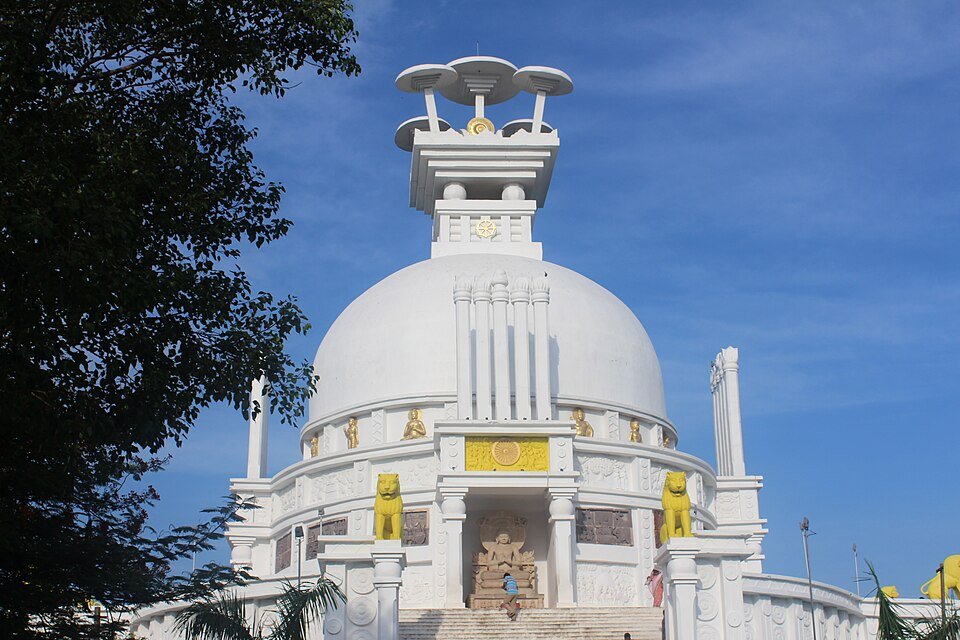
#8. What rock sculpture found at Dhauli symbolizes the beginning of Ashoka’s transformation?
When did the Kalinga War take place?
It took place in 261 BCE, in the 8th year of Ashoka’s coronation.
Which rock edict mentions the casualties of the Kalinga War?
Major Rock Edict XIII gives the details of the war and Ashoka’s remorse.
Which river is associated with the Kalinga War?
The River Daya, which is said to have turned red with blood.
Who influenced Ashoka to convert to Buddhism?
The Buddhist monk Upagupta (or Nigrodha) is credited with his conversion.
Did Ashoka fight any wars after Kalinga?
No, Kalinga was the last war of his life. He adopted a policy of non-violence (Ahimsa).
Sources and references
- Anantam IAS (“Kalinga War”) — the war fought around 261 BCE in the 8th year of Ashoka’s reign as the only major war he personally waged, and the only known war in ancient Indian history where the victor publicly recorded his remorse and renounced war, in his own words, in Rock Edict XIII.
- GKToday and Chegg India (“Kalinga War”) — Kalinga as the one prosperous, independent maritime kingdom outside Mauryan control, its coastal trade routes and naval strength, its fierce resistance, and the battle fought along the Daya River near present-day Bhubaneswar.
- Vajiram & Ravi and Testbook — the figures from Major Rock Edict XIII of about 100,000 killed and 150,000 deported with many more dying afterward, and the war marking the end of aggressive Mauryan expansion.
- History of Odisha and Orissa PCS notes — Kalinga (present-day Odisha and parts of northern Andhra Pradesh) as a resilient, fiercely independent kingdom, the immense human cost of over 250,000 killed, wounded or displaced, and the war’s transformative effect on Ashoka.
- Curious Indian’s own overview (“Kalinga War”) — the Daya River running red, Ashoka’s walk through the battlefield, his confession of profound sorrow and regret in Rock Edict XIII, and his exchange of the war drum (Bherighosha) for the drum of Dharma (Dhammaghosha).
Author


Exploring the Soul of Bharat through History, Science, Culture, and its Diversity
Our Mission
Curious Indian is a definitive knowledge portal dedicated to chronicling the events, personalities, and cultural shifts that defined the Indian subcontinent. From the ancient Vedic Period to the complexities of 21st-century politics, our goal is to provide deep-dive analysis that inspires.
Editorial Standards & E-E-A-T
Every article published under our brand undergoes a rigorous fact-checking process. We prioritize primary historical records, academic citations, and credible archives to ensure our readers receive accurate, high-authority information.
Historical Integrity Directly sourcing from ASI archives and academic journals.Topical Authority Comprehensive clustering of Indian Science, Biographies, and Wars.Managed by Paripurna Datta and TEAM | Dedicated to the Knowledge of India.