Thursday, May 21, 2026
14 °c
Columbus
Curious Indian
  • Arts & Culture
  • Festivals of India
  • Indian History
  • Indian Politics
  • Biography
    • Entertainment Personalities
    • Science Personalities
  • Unsolved India
No Result
View All Result
  • Arts & Culture
  • Festivals of India
  • Indian History
  • Indian Politics
  • Biography
    • Entertainment Personalities
    • Science Personalities
  • Unsolved India
No Result
View All Result
Curious Indian
No Result
View All Result
Home Arts & Culture

How Nandalal Bose Painted Artwork of Indian Constitution

paripurnadatta by paripurnadatta
in Arts & Culture, Indian History, Paintings & Visual Arts, Post-Independence India
Reading Time: 10 mins read
0 0
A A
Nandalal Bose
Share on FacebookShare on Twitter

Table of Contents

Toggle
  • The Blank Canvas of a New Republic
  • Gathering the Masters at Santiniketan
  • A Journey Through Millennia
  • The Brilliance of Natural Pigments and Gold
  • Preserving the Masterpiece and Its Legacy
  • Quick Comparison Table
  • Curious Indian: Fast Facts
  • Conclusion
  • If you think you have remembered everything about this topic take this QUIZ
  • Results
    • #1. Which master artist was personally entrusted by Jawaharlal Nehru to lead the illustration of the original Constitution of India?
    • #2. How many years did the lead artist and his dedicated group of students spend to complete the illustrations for the Indian Constitution?
    • #3. From which famous artistic institution at Visva-Bharati University did the team of artists originate?
    • #4. How many total illustrations are featured throughout the original Indian Constitution document?
    • #5. Which ancient civilization marks the beginning of the visual timeline in the Constitution’s illustrations, represented by a Zebu bull seal?
    • #6. Who was the talented calligrapher responsible for beautifully writing every single word of the legal text by hand in a flowing italic style?
    • #7. What material was meticulously applied by the artists to illuminate the intricate borders and give the pages a regal appearance?
    • #8. How are the original handwritten copies of the Indian Constitution stored today to preserve the delicate artwork from decaying?
    • Who illustrated the original Indian Constitution?
    • How long did it take to complete the artwork?
    • What kind of paint was used for the illustrations?
    • What historical periods are shown in the paintings?
    • Where is the original illustrated document kept today?

This comprehensive article explores the fascinating and lesser known story of how the original Indian Constitution was beautifully illustrated. It highlights the immense contribution of master artist Nandalal Bose and his talented team from Santiniketan. Through their incredible artistic vision, the foundational legal document of the nation was transformed into a breathtaking visual journey through Indian history and our rich cultural heritage.

FeatureDetail
Lead ArtistNandalal Bose
DocumentConstitution of India
Time TakenFive Years
InstitutionKala Bhavana Santiniketan
Total IllustrationsTwenty Two
Nandalal Bose

The Blank Canvas of a New Republic

When a newly independent nation is born, it requires far more than just a rigid set of rules to govern its diverse people. It deeply needs a soul. The visionary leaders of early India understood this profound truth exceptionally well. They wanted their ultimate founding document to perfectly reflect the ancient heritage, the deeply diverse regional culture, and the immense historical struggles of the common people. They envisioned a physical masterpiece that would continue to inspire countless generations to come, not just through intricate legal text, but through undeniable visual beauty.

This grand and ambitious vision directly led them to seek out a master artist capable of capturing the true essence of an entire civilization on paper. The search naturally ended with one of the most widely celebrated painters of the modern era. The monumental task required someone with a profound understanding of traditional Indian aesthetics and an unbreakable respect for the deep history of the land. It was certainly not a simple job for a mere commercial decorator. It required a true artistic visionary who could seamlessly translate the awakened spirit of a new republic into timeless imagery. The heavy responsibility of illustrating the supreme law of the land was an unprecedented historical honor.

READ MORE:  Experiencing Bhaona Traditional Theatrical Arts

The Romantic Soul of Kangra Miniature Paintings 
Gathering the Masters at Santiniketan

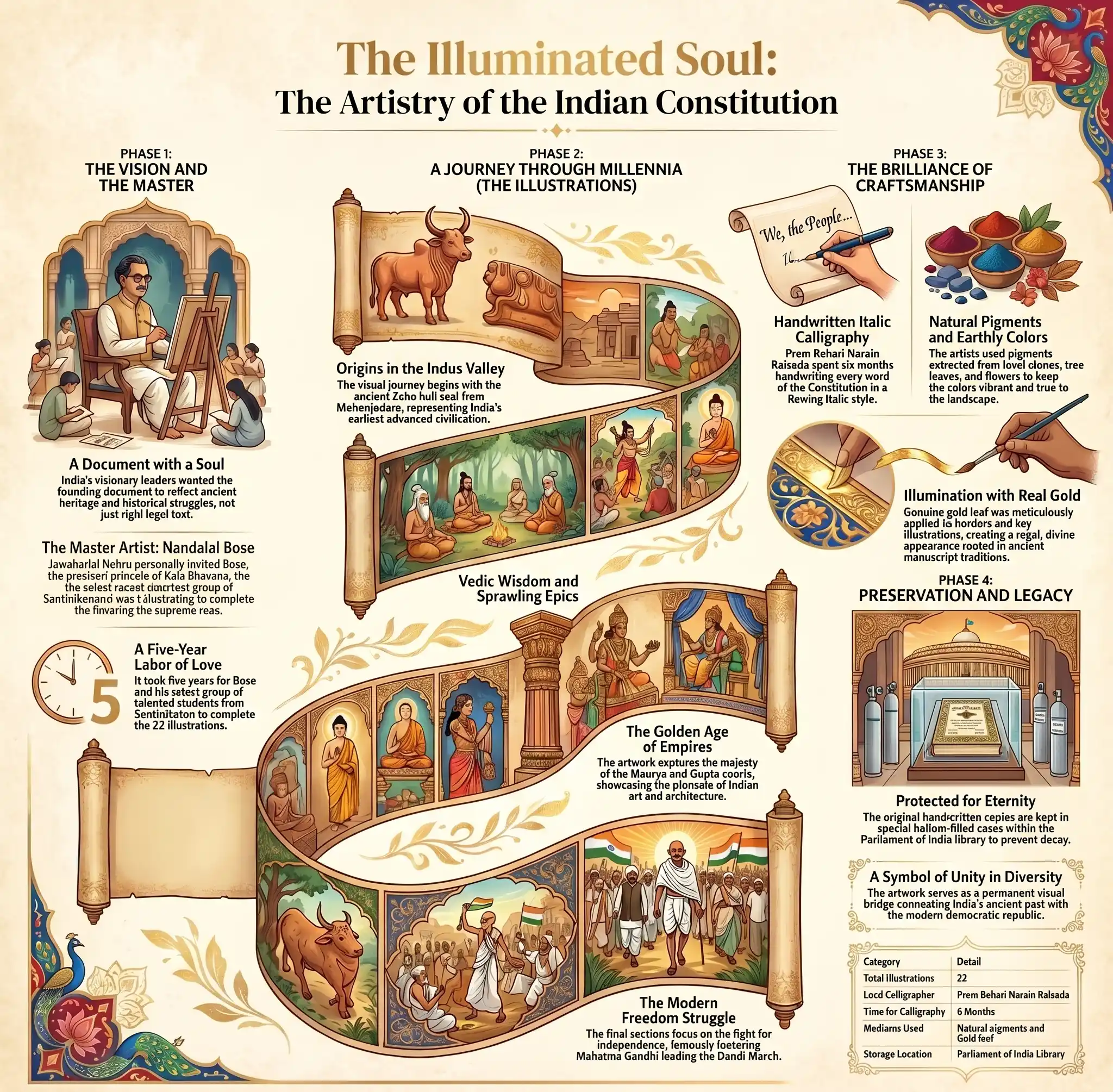
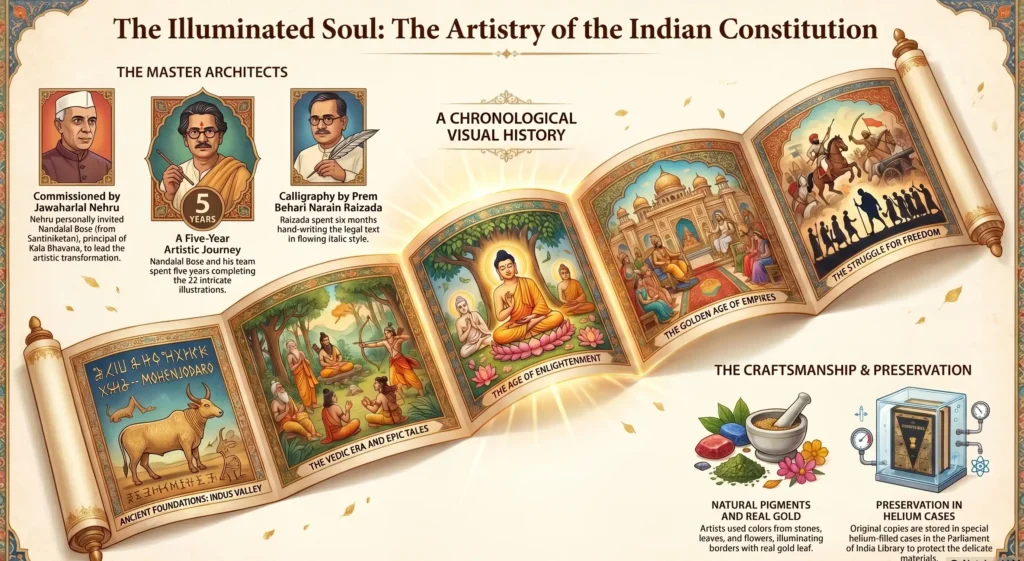
Jawaharlal Nehru personally entrusted this massive project to Nandalal Bose, who was serving as the respected principal of Kala Bhavana at Visva Bharati University. Bose was already a legendary, towering figure in the vibrant art world, known widely for his deep connection to rural Indian roots and his absolute mastery of traditional painting styles. He accepted the monumental challenge with immense national pride and a deep sense of civic duty.

Gathering a select group of his most talented and dedicated students, Bose entirely transformed his quiet studio into a bustling sanctuary of creativity and historical reflection. The atmosphere in Santiniketan was electric with profound purpose. The young artists knew they were not just painting simple pictures to fill empty space. They were officially documenting the very soul of the republic for all eternity. They meticulously poured over ancient religious texts, studied classical stone sculptures, and immersed themselves completely in the local folklore of the land to find the absolute perfect visual representations for each section of the massive legal document.

Every single brushstroke applied was a deliberate, highly calculated choice, intended to convey a specific historical or cultural narrative. This intense dedication to authentic storytelling mirrors the exact meticulous detail found in the sweeping biographical works of cultural icons like Satyajit Ray, where every single visual element serves a much greater narrative purpose. The artists worked tirelessly, guided gently by their master, to ensure that the artwork would successfully stand the test of time. The Ministry of Culture continues to widely celebrate this unparalleled artistic endeavor even today.

A Journey Through Millennia

The resulting illustrations trace a truly glorious and continuous timeline of the nation. The visual journey begins with the highly advanced ancient Indus Valley civilization, represented beautifully by the iconic Zebu bull seal originally discovered in Mohenjodaro. As you carefully turn the heavy pages, you travel seamlessly through the early Vedic period, witnessing the serene forest hermitages and the epic, sprawling tales of the Ramayana and Mahabharata. The artwork also beautifully captures the profound wisdom of Lord Buddha and Mahavira, bringing their essential messages of universal peace and strict nonviolence to the forefront of the legal text.

The artists absolutely did not shy away from depicting the grand, sprawling empires that actively shaped the vast subcontinent. The majestic, wealthy courts of the Mauryas and the Guptas are rendered with exquisite, breathtaking detail, showcasing the undeniable golden age of Indian art and complex architecture. The artwork also deeply honors the fierce regional warriors and visionary leaders who bravely defended the land against foreign invasions. This specific visual narrative seamlessly connects the ancient past with more recent struggles, directly echoing the incredible bravery detailed in the histories of the Ahom Kingdom History and the strategic military brilliance seen during the Anglo Manipuri War.

The modern historical era is heavily and emotionally featured, focusing entirely on the monumental Indian Freedom Struggle. From the early mass uprisings in eighteen fifty seven to the final glorious triumph in nineteen forty six, the artists perfectly captured the relentless, unbreakable spirit of the common masses. The highly poignant illustrations of Mahatma Gandhi leading the famous Dandi March serve as an incredibly powerful reminder of the ultimate sacrifices made for complete independence. The National Archives of India safely preserves many related historical documents that constantly highlight this exact pivotal era in human history.

READ MORE:  7 Untold Stories of Battle of Asal Uttar 1965 Victory

How Madam Bhikaiji Cama Unfurled India’s Flag in Germany

The Brilliance of Natural Pigments and Gold

The physical creation of the final document was an absolute masterclass in traditional, painstaking craftsmanship. The legal text itself was beautifully calligraphed by Prem Behari Narain Raizada, who spent six exhausting months writing every single word by hand in a flowing italic style. Once the text was finalized, Nandalal Bose and his dedicated team took over the pages, adding their intricate borders and stunning illustrations.

They deliberately chose to use natural pigments extracted directly from local stones, tree leaves, and bright flowers, ensuring that the colors remained vibrant and true to the natural Indian landscape. One of the most striking and memorable features of the entire artwork is the extensive, generous use of real gold leaf. The artists meticulously applied pure gold to illuminate the intricate borders and highlight key elements of the various illustrations, giving the pages a truly regal and almost divine appearance.

This specific technique, rooted deeply in ancient manuscript traditions, added a massive layer of profound elegance to the document. The careful application of the gold was a painstakingly slow process, requiring immense skill, a steady hand, and endless patience. The final glorious result was a breathtaking fusion of perfect calligraphy and majestic painting, creating a true masterpiece that resides safely today within the highly secure Parliament of India library.

Preserving the Masterpiece and Its Legacy

The artistic soul of the Constitution remains a highly powerful, visual symbol of unity in diversity. It reminds every citizen that the modern nation is built not just on strict laws, but on a shared cultural heritage and a common, hopeful destiny. The beautiful illustrations serve as a permanent visual bridge connecting the ancient past with the modern republic, offering a timeless source of inspiration.

Just as the nation has successfully faced profound challenges and emerged significantly stronger, much like the modern valor displayed during the Battle of Shalateng and the strategic triumphs of the The Kamarupa Ascendancy, the artwork stands as a permanent testament to human endurance and collective vision. The incredible masterpieces created in Santiniketan continue to be studied heavily and admired by art historians and scholars worldwide, with prestigious institutions like the National Gallery of Modern Art frequently highlighting the absolute genius of Nandalal Bose.

Furthermore, scholars at the World History Encyclopedia frequently point to such integrated documents as the absolute pinnacle of statecraft meeting artistic expression. Through his brilliant, confident brushstrokes, the master artist ensured that the founding document of the nation would forever remain a beautiful, emotional reflection of its people and its incredibly rich history.

READ MORE:  Establishment of the British Raj 1858: The Dawn of Imperial India

The Final Letters of Khudiram Bose and Soul of Young Bengal

Quick Comparison Table

AspectDetail
Primary MediumGenuine gold leaf and natural colors
Artistic StyleTraditional Indian mural techniques
Key ThemesVedic period up to the freedom movement

Curious Indian: Fast Facts

  • Nandalal Bose was personally invited by Jawaharlal Nehru to illustrate the massive legal document.
  • The lead artist and his students were paid a very modest sum for their incredible years of dedicated work.
  • The illustrations beautifully trace the history of the nation from the ancient Mohenjodaro period to the modern freedom struggle.
  • Real gold was utilized extensively to illuminate the borders of the pages to give them a truly royal appearance.
  • The original handwritten copies are kept in special helium filled cases to preserve the delicate artwork from decaying.

Conclusion

The original Indian Constitution stands proudly as a magnificent testament to the beautiful intersection of rigid law and flowing art. Through the visionary, dedicated leadership of Nandalal Bose, a simple legal framework was successfully elevated into a profound cultural artifact. The intricate painted borders and vivid illustrations serve as a constant, gentle reminder of the rich civilization that birthed the modern republic. Every single page whispers incredible stories of ancient sages, powerful expanding empires, and the relentless, exhausting struggle for ultimate freedom.

As we reflect deeply on the fundamental rights and duties enshrined securely in the text, we are simultaneously invited to appreciate the sheer visual beauty that surrounds those very words. The unmatched dedication of the young artists from Santiniketan ensured that the very soul of the nation was captured permanently on paper, utilizing natural pigments and pure gold to illuminate the bright path forward. This massive artistic legacy continues to inspire profound awe and deep respect, reminding every new generation that our shared history is a beautiful canvas of resilience, diversity, and enduring hope. The painted pages will forever remain a shining beacon of our collective human spirit.

Matangini Hazra: The Widow Who Walked Into Gunfire

If you think you have remembered everything about this topic take this QUIZ


Results

Share your score!
Tweet your score!
Tweet your score!
Share to other
QUIZ START

#1. Which master artist was personally entrusted by Jawaharlal Nehru to lead the illustration of the original Constitution of India?

Previous
Next

#2. How many years did the lead artist and his dedicated group of students spend to complete the illustrations for the Indian Constitution?

Previous
Next

#3. From which famous artistic institution at Visva-Bharati University did the team of artists originate?

Previous
Next

#4. How many total illustrations are featured throughout the original Indian Constitution document?

Previous
Next

#5. Which ancient civilization marks the beginning of the visual timeline in the Constitution’s illustrations, represented by a Zebu bull seal?

Previous
Next

#6. Who was the talented calligrapher responsible for beautifully writing every single word of the legal text by hand in a flowing italic style?

Previous
Next

#7. What material was meticulously applied by the artists to illuminate the intricate borders and give the pages a regal appearance?

Previous
Next

#8. How are the original handwritten copies of the Indian Constitution stored today to preserve the delicate artwork from decaying?

Previous
Finish

Who illustrated the original Indian Constitution?

Master artist Nandalal Bose and his dedicated team of talented students from Kala Bhavana at Visva Bharati University in Santiniketan beautifully illustrated the entire document.

How long did it take to complete the artwork?

It took the artistic team nearly five long years of meticulous and painstaking effort to complete all the intricate borders and historical illustrations.

What kind of paint was used for the illustrations?

The artists primarily used natural pigments derived from stones, flowers, and leaves, along with genuine gold leaf to create the vibrant and lasting colors on the pages.

What historical periods are shown in the paintings?

The vivid artwork covers a vast timeline, starting all the way from the ancient Indus Valley civilization through to the massive Indian Freedom Struggle.

Where is the original illustrated document kept today?

The original handcrafted copies are safely preserved inside special helium filled glass cases located within the central library of the Parliament in New Delhi.

Tags: Constitution ArtIndian ConstitutionIndian HistoryNandalal BoseSantiniketan
ShareTweetPin
paripurnadatta

paripurnadatta

Related Posts

Rabindranath Tagore
Artists & Cultural Icons

The Dark Ink Masks of Rabindranath Tagore

May 21, 2026
Kangra miniature paintings
Arts & Culture

The Romantic Soul of Kangra Miniature Paintings 

May 21, 2026
Khudiram Bose
Biography

The Final Letters of Khudiram Bose and Soul of Young Bengal

May 20, 2026
No Result
View All Result

Stay Updated

  • Trending
  • Latest
Life of Mahavira: From Prince Vardhamana to Great Conqueror

Life of Mahavira: From Prince Vardhamana to Great Conqueror

April 11, 2026
Life of Buddha: The Journey to Enlightenment

Life of Buddha: The Journey to Enlightenment

April 11, 2026
Christmas in India

Christmas in India: A Festive Blend of Faith, Flavors, and Tradition

April 11, 2026
From Shimla to Stardom: The Complete Biography of Anupam Kher

From Shimla to Stardom: The Complete Biography of Anupam Kher

April 11, 2026
Rabindranath Tagore

The Dark Ink Masks of Rabindranath Tagore

May 21, 2026
Kangra miniature paintings

The Romantic Soul of Kangra Miniature Paintings 

May 21, 2026
Nandalal Bose

How Nandalal Bose Painted Artwork of Indian Constitution

May 21, 2026
Khudiram Bose

The Final Letters of Khudiram Bose and Soul of Young Bengal

May 20, 2026

Widget Title

Facebook Twitter Youtube RSS
Curious Indian Logo

Explore the soul of Bharat with Curious Indian. A definitive guide to Indian history, arts, culture, biographies, and the events that defined our future.

Follow us on social media:

Recent News

  • The Dark Ink Masks of Rabindranath Tagore
  • The Romantic Soul of Kangra Miniature Paintings 
  • How Nandalal Bose Painted Artwork of Indian Constitution

Category

  • Ancient Civilizations & The Vedic Age
  • Architecture
  • Artists & Cultural Icons
  • Arts & Culture
  • Battles of India
  • Biography
  • Business & Industrialists
  • Colonial India
  • Cultural Insights
  • Dance & Music
  • Entertainment Personalities
  • Festivals of India
  • Freedom Fighters
  • Freedom Movement
  • Historical Events & Turning Points
  • Indian History
  • Indian Politics
  • Major Festivals
  • Medieval India
  • North East India
  • Paintings & Visual Arts
  • Political Leaders
  • Post-Independence India
  • Regional Culture
  • Religious & Spiritual Figures
  • Science Personalities
  • Scientific Discoveries
  • Sculpture
  • Social Issues
  • SOCIETY & MYSTERIES
  • Strange & Unknown Stories
  • Textiles & Handicrafts
  • Uncategorized
  • Unsolved India
  • Unsung Heroes

© 2026 Curious Indian- Everything about India

Welcome Back!

Login to your account below

Forgotten Password?

Retrieve your password

Please enter your username or email address to reset your password.

Log In

Add New Playlist

No Result
View All Result
  • Arts & Culture
  • Festivals of India
  • Indian History
  • Indian Politics
  • Biography
    • Entertainment Personalities
    • Science Personalities

© 2026 Curious Indian- Everything about India

This website uses cookies. By continuing to use this website you are giving consent to cookies being used. Visit our Privacy and Cookie Policy.
Are you sure want to unlock this post?
Unlock left : 0
Are you sure want to cancel subscription?
×