Kangra Valley, 1740s: when the Mughal Empire began to fall, artists ran to the hills carrying their craft. They painted love into the landscape they found there
In the 1730s, the Mughal Empire was dying. Nadir Shah had invaded in 1739. Ahmad Shah Abdali pushed into the north. The court that had patronized artists for generations collapsed. Painters who had spent their lives making portraits of emperors and hunting scenes for noblemen suddenly found there was no one to pay for portraits anymore. The work had dried up.
So they did what anyone does when there is no future where they are: they left.
Many went north, into the foothills of the Himalayas, to the small hill states of Punjab. Guler was one—a quiet principality where Raja Govardhan Chand liked paintings and had money to spend on them.
They arrived carrying everything they knew: the refined technique of Mughal art, the way to paint a face so finely it looked like porcelain, the use of light and shadow. They arrived carrying a dead tradition and a skill that no longer had a place to live.
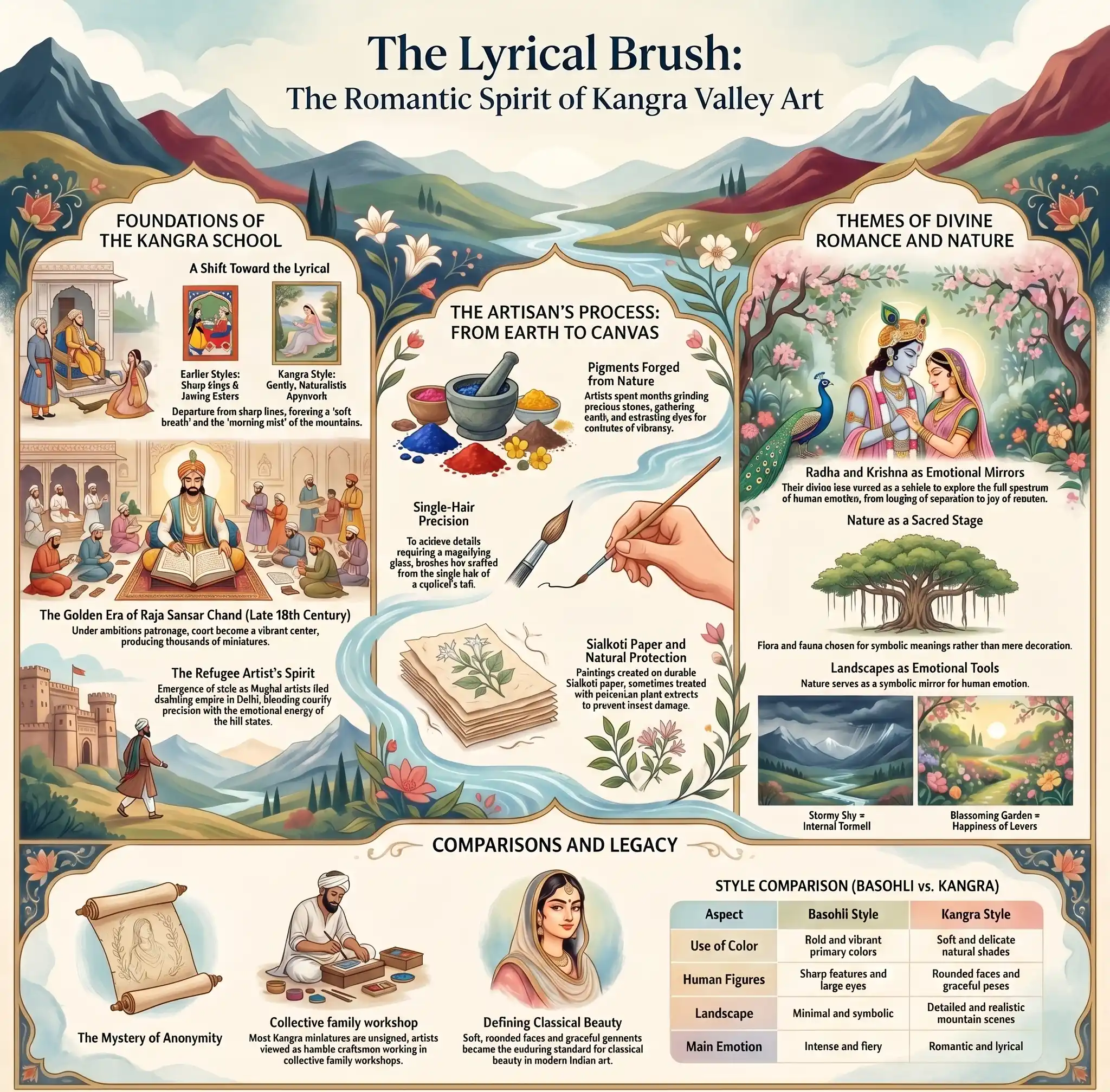
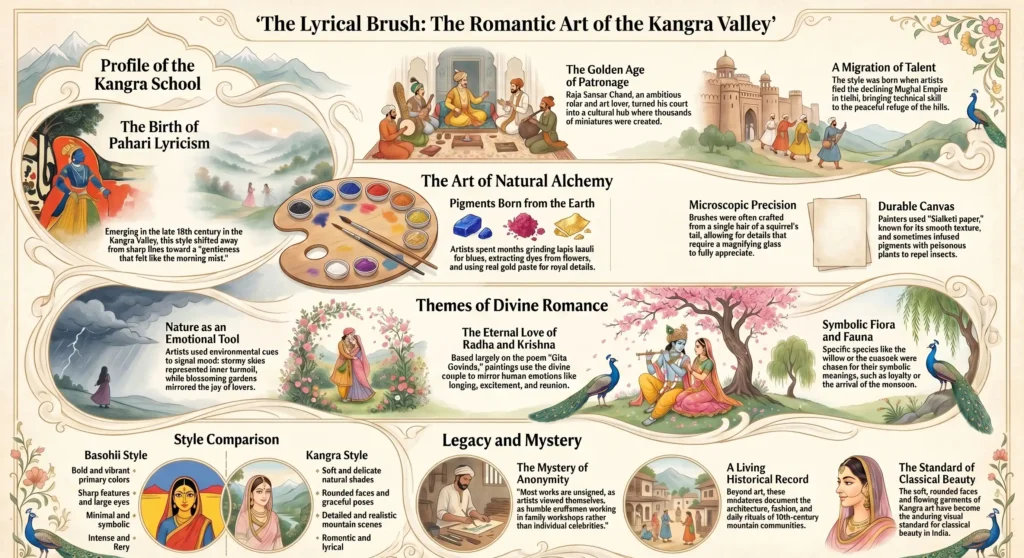
Instead of painting portraits of emperors, they painted Radha and Krishna—not as religious icons to be revered from a distance, but as lovers, tender and wanting, set in the landscape of the hills they now lived in. Gardens full of flowers. Rivers flowing down from the snow. The seasons changing. A woman waiting in the night. A man arriving. The pull between two people who could not be together and needed to be together.
The artists took the love poems of Jayadeva and Bihari and Keshav Das—old Sanskrit verses about divine love—and they began to illustrate them. And as they painted, something shifted.
The colours became softer. The Mughal style had been bold, heavy, rich—gold and reds and deep blues. But in the hills, surrounded by the light of the Himalayas, the artists started using natural dyes. Stone colours. Flower colours. Vegetable colours. Nineteen different natural pigments that gave the paintings the quality of enamelled porcelain, cool and ethereal.
The faces became more delicate. The modelling was less severe. The eyes narrowed. The noses became small and upturned. The hair was painted as a flat black mass, but the rest of the face had a softness that the Mughal style did not have.
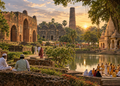
The landscapes became more intimate. Instead of the grand vistas of court hunting scenes, the artists began to paint the details of the world around them: the way water moved in a stream. The curve of a woman’s neck. The specific quality of light at a particular time of day. A garden so real you could almost step into it.
In Sanskrit aesthetic theory, there are nine rasas—emotional flavours that art can carry. One of them is called shringara rasa: the sentiment of love and desire, longing and belonging, separation and union.
The Kangra painters made this their centre. Nearly every painting depicted some version of this emotion. Radha waiting for Krishna. Krishna approaching Radha. The moment between desire and fulfillment. The pain of separation. The joy of reunion. All of it set against the Himalayan landscape, which seemed to make the emotion deeper.
Under the patronage of Maharaja Sansar Chand, who ruled Kangra in the late eighteenth century, this became the dominant art form of the region. Artists who had fled the collapsing Mughal court found in these paintings a way to make their skill matter again. They were no longer painting power. They were painting love.
What was lost and what was found
The Mughal paintings were about flattery. They showed you a man in court, surrounded by symbols of his authority. They showed you a hunt: violence and conquest and mastery. They showed you the hierarchy of the world.
The Kangra paintings showed you something else: two people reaching for each other in a garden, while mountains watched, and water ran clear, and flowers bloomed and fell.
After three hundred years, the paintings still hold that quality. The colours have not faded. The fine lines are still visible. The faces still have that quality of longing. And when you look at them, you understand what it was that the artists found in the mountains: a way to turn what had been lost into something more valuable than what they had left behind.
A dying empire’s tradition became a living art. Refugee painters became the inventors of a new way of seeing. And in the soft light of the Himalayas, they learned to paint love.
Artists used natural colors like lampblack for black, cinnabar for red, and lapis lazuli for blue, often mixing them with plant extracts.
Why are these paintings called miniatures?
They are called miniatures because of their small size and the incredible level of fine detail that requires very small brushes to execute.
Who was the most famous patron of Kangra art?
Raja Sansar Chand of Kangra is widely regarded as the most important patron who helped the style reach its highest level of perfection.
Are there any living artists who still practice this style?
Yes, there are still a few traditional artist families in the Himachal region who continue to practice and teach these ancient painting techniques.
Sources & References
Government of Himachal Pradesh, “Kangra Paintings” — Raja Govardhan Chand (1744-1773) gave asylum to refugee artists trained in Mughal style, Nadir Shah’s invasion 1739, Ahmad Shah Abdali’s incursions, the transformation from Mughal hunting scenes to Radha-Krishna themes from Gita Govinda by Jayadeva and poetry by Bihari and Keshav Das.
Rooftop, “Kangra Painting – Himachal Pradesh’s Lyrical Pahari Art” (2026) — Nainsukh of Guler as founding master, mid-eighteenth century, colour palette of soft greens and blues from mountains, brushes made from turtle hair and dove feathers, shringara rasa as central theme, Mughal techniques blended with Hindu religious themes.
Shantala Palat, “A Guide to Kangra Paintings: The Miniature Art of Himachal” (2026) — transformation from Basohli’s bold and intense style to softer, naturalistic Kangra, artists seeking refuge as Mughal Empire declined, Maharaja Sansar Chand’s patronage, fine lines and natural dyes from minerals and vegetables, depiction of seasons and gardens.
Astaguru, “Kangra Paintings – The Soulful Art of Himachal Pradesh” (2024) — soft and fresh colours from natural sources, graceful female figures with gentle features, devotional and romantic themes, Radha-Krishna stories, ragamala scenes, changing seasons.
Gaatha, “Miniature Painting Kangra — Craft Archive” (2022) — Bhakti cult as driving force, love of Radha and Krishna as main source of spiritual experience, Guler State as origin point, Kashmiri painters trained in Mughal style seeking shelter under Raja Dalip Singh (r. 1695-1741), porcelain-like delicacy of faces.
O2 IAS Academy, “Kangra Paintings: Discovering the Rich Artistic Heritage” (2024) — 19 natural colours made from local resources in Kangra valley, emphasis on ethereal beauty of female form, brooks and rivulets, paintings retaining brilliance over 300 years.
Paripurna Datta is the founder and editor of Curious Indian, an independent editorial publication focused on Indian history, culture, science, society, and the stories behind them. He oversees research, editorial standards, and the publication's long-term direction.
Paripurna Datta is the founder and editor of Curious Indian, an independent editorial publication focused on Indian history, culture, science, society, and the stories behind them. He oversees research, editorial standards, and the publication's long-term direction.