How one midnight move was both economic justice and political survival
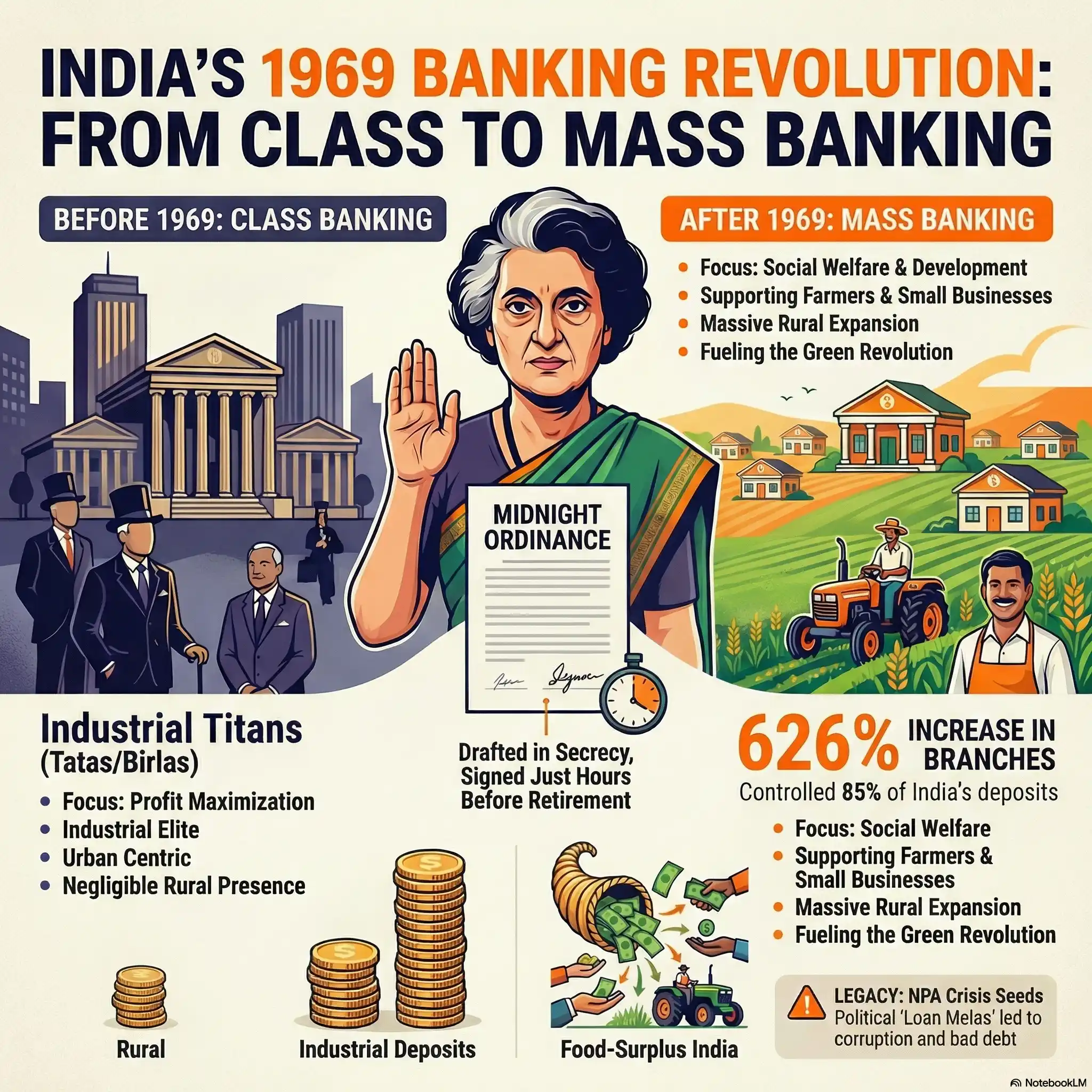
On a Saturday night in July 1969, the Prime Minister of India went on the radio and told the country that its fourteen largest banks no longer belonged to the people who owned them. As of that evening, they belonged to the government.
To millions of poor Indians, it was one of the great acts of economic justice in the nation’s history: the night the vaults of the rich were finally prised open for the common man. To her rivals inside her own party, it was something else entirely, a ruthless and brilliantly timed ambush, meant to save her own skin and to destroy them.
Here is the difficult thing that makes this story worth telling. Both of them were right.
This is the story of the nationalisation of India’s banks. But it is really the story of a tangled, very human truth: that a leader can do a genuinely good thing for genuinely self-serving reasons, and that the good and the selfish can be braided together so tightly that no one, then or now, can ever quite pull them apart.
A doll they underestimated
To understand the move, you first have to understand the trap Indira Gandhi was in.
In 1969 she was Prime Minister, but she was not yet powerful. The real muscle of the Congress party lay with a group of veteran bosses known as the Syndicate: conservative, pro-business men who had helped put her in the top job precisely because they thought she would be easy to control. They had a contemptuous nickname for her, the gungi gudiya, the dumb doll.
They were about to learn how badly they had misjudged her. As the Syndicate manoeuvred to box her in and clip her wings, Indira went looking for a weapon that would let her leap clean over the heads of the party bosses and speak straight to the ordinary voter. She found it sitting in the country’s banks.
The Indo-Pakistani War of 1971: A Victory of Humanity and Strategy
The genuine wound
And here is the part that any honest account has to put front and centre, because it is what makes the whole thing more than a mere political trick. The problem Indira pointed at was completely real.
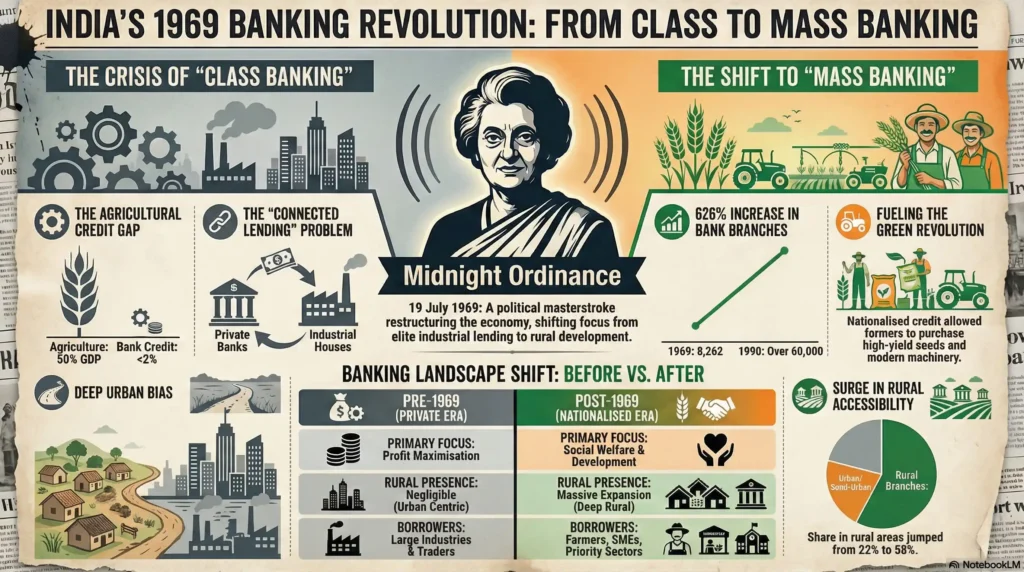
In 1969, most of India’s big banks were owned by its great industrial houses. They would gather the savings of ordinary depositors and then lend that money, quietly, largely back to their own companies, a cosy arrangement known as connected lending. The banks huddled in the big cities. The seventy per cent of Indians who lived in the villages had almost no access to a bank at all, and were left at the mercy of the local moneylender and his crushing rates. Agriculture, which was half the entire economy, received less than two paise of every rupee the banks lent.
The banks took the public’s savings and quietly lent them back to the industrialists who owned them, while the villages that held most of India got almost nothing.
Whatever was in Indira Gandhi’s heart, the wound she was pressing on was not invented. It was raw and real, and it badly needed fixing.
The midnight ordinance
The way she fixed it was pure theatre, and pure nerve.
First she removed the obstacle. Her own Finance Minister, the formidable Morarji Desai, opposed the idea, so she simply stripped him of the finance portfolio. Then she called in her trusted principal secretary, P.N. Haksar, and a tiny handful of officials, and set them to draft the takeover in secret. There was a clock ticking: the outgoing President was about to leave office, and the order had to be signed before he went. Working through the night, the small team wrote the law that would seize the banks.
On the evening of Saturday, 19 July, the ordinance was signed, and Indira went on All India Radio to tell the nation what she had done.
The tycoons who owned the banks learned that their banks were no longer theirs the same way everyone else did, sitting by the radio on a Saturday night.
India’s First Nuclear Test: The Story of Smiling Buddha
The masterstroke
As politics, it was very nearly perfect.
Overnight, Indira Gandhi had made herself the fearless champion of the poor, and left the Syndicate cornered as the grumbling defenders of rich bankers. When the Supreme Court struck down her ordinance on a technical flaw, she did not flinch. She simply passed it again in corrected form, which only made her look more like a crusader willing to fight the whole establishment for the common man. Her slogan, Garibi Hatao, “remove poverty,” became the drumbeat of a new and unstoppable political brand.
The dumb doll had, in a single stroke, crushed the men who thought they owned her and made herself the most commanding leader India had known since her father, Nehru. Whatever else it was, it was a political masterstroke.
The two ledgers
So did it actually work? The honest answer is that it did, and it didn’t, and both halves matter.
On one side of the ledger, the achievement was enormous and real. In 1969 India had barely eight thousand bank branches; within twenty years there were more than sixty thousand, and for the first time banks reached deep into the countryside. That flood of new rural credit helped power the Green Revolution and loosened the moneylender’s grip on countless farmers. For a great many ordinary Indians, a bank account and a fair loan became possible for the first time in their lives.
On the other side sat a slow and heavy cost. Over the years, banks run by the state grew sleepy and inefficient, and, worse, politically pliable. By the 1980s the notorious “loan melas,” loan fairs where credit was handed out to win votes rather than because it would ever be repaid, had begun sowing the bad-loan troubles that have dogged India’s state banks ever since.
Like the act that created them, the results had two faces: a country banked at last, and a banking system quietly taught to answer to politics instead of prudence.
The right thing and the clever thing
So what was the nationalisation of the banks, in the end? A noble reform, or a cynical grab for power?
The honest answer, and the more interesting one, is that the question itself is a trap. It was both, fully and at the very same time, and that is not a scandal to be exposed. It is simply how power usually works.
We badly want our history to arrange itself into clean heroes and clean villains, pure motives set neatly apart from impure ones. Real leaders almost never oblige us. Indira Gandhi genuinely opened the banking system to India’s poor, and she genuinely did it to save and enlarge her own power, and neither of those truths cancels out the other. They were the same decision.
That is the grown-up lesson buried in that July midnight. You cannot judge a great public act by its motives alone, because motives are nearly always mixed. And you cannot judge it by its results alone, because results are nearly always mixed too. You have to hold the whole tangled thing at once, the real good, the raw self-interest, and the long tail of consequences, and resist the easy comfort of calling it simply a triumph or simply a con.
The banks did open their doors to the ordinary Indian, and that was a genuine and lasting good. And the same iron will that flung them open carried Indira Gandhi on toward a near-total grip on power, with consequences a few years later, in the dark years of the Emergency, that were anything but good. Both of those things belong in the ledger, side by side. History, like the people who make it, rarely comes out clean.
1991 Economic Reforms: How India Pledged Gold to Buy a Future
The Emergency: When India’s Democracy Was Put in Chains
If you think you have remembered everything about this topic take this QUIZ
Results


#1. What was the specific financial threshold used to determine which banks were to be nationalised in 1969?
#2. Which political faction within the Congress party was Indira Gandhi attempting to outmanoeuvre through the nationalisation move?
#3. Why was the Banking Companies Ordinance signed specifically on the night of 19 July 1969?
#4. Before 1969, what percentage of total bank credit was allocated to the agricultural sector?
#5. What was the outcome of the landmark R.C. Cooper vs. Union of India Supreme Court case?
#6. The practice of ‘Connected Lending’ in the pre-1969 era primarily referred to which situation?
#7. By 1990, how had the landscape of Indian banking branches changed following nationalisation?
#8. Who was the Principal Secretary and key strategist who assisted Indira Gandhi in drafting the nationalisation ordinance?
How many banks were nationalized in 1969?
14 major commercial banks were nationalized on July 19, 1969.
Who was the Finance Minister who was fired before nationalization?
Morarji Desai was the Finance Minister. He was relieved of his portfolio by Indira Gandhi just days before the move because he opposed nationalization.
What was the main objective of bank nationalization?
The main objective was “Social Control”—to shift banking from “Class Banking” (serving only the rich) to “Mass Banking” (serving farmers, small businesses, and rural areas).
Did the Supreme Court support the nationalization?
Initially, no. In the R.C. Cooper case (1970), the Supreme Court struck down the ordinance, but the government quickly passed a new Act to overcome the court’s objections.
Which banks were nationalized in the second phase?
In 1980, six more banks were nationalized, including Andhra Bank, Corporation Bank, and Oriental Bank of Commerce.
Sources & References
- Encyclopaedia Britannica (“Indira Gandhi”) — the 1969 power struggle with the Syndicate, the nationalisation, and her rise to dominance.
- Reserve Bank of India (history of bank nationalisation) — the policy, its stated aims, and the expansion of banking that followed.
- Legislative Department, Government of India (the Banking Companies Acquisition and Transfer of Undertakings Act) — the law that took the banks into public ownership.
- Supreme Court of India (R.C. Cooper vs Union of India, 1970) — the legal challenge to the ordinance and its outcome.
Author


Exploring the Soul of Bharat through History, Science, Culture, and its Diversity
Our Mission
Curious Indian is a definitive knowledge portal dedicated to chronicling the events, personalities, and cultural shifts that defined the Indian subcontinent. From the ancient Vedic Period to the complexities of 21st-century politics, our goal is to provide deep-dive analysis that inspires.
Editorial Standards & E-E-A-T
Every article published under our brand undergoes a rigorous fact-checking process. We prioritize primary historical records, academic citations, and credible archives to ensure our readers receive accurate, high-authority information.
Historical Integrity Directly sourcing from ASI archives and academic journals.Topical Authority Comprehensive clustering of Indian Science, Biographies, and Wars.Managed by Paripurna Datta and TEAM | Dedicated to the Knowledge of India.