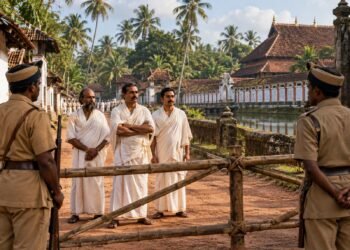
On 7 July 1855, Mahesh Lal Datta, the daroga in charge of Dighi police station, set out to arrest two brothers. Moneylenders travelled with him. By one account they had brought two cartloads of rope to tie up the prisoners.
He found Sidhu and Kanhu on the road with forty or fifty of their men. When the meeting ended the daroga was dead, killed by Sidhu, and a moneylender had been killed by Kanhu. The historian Ranajit Guha later wrote that the policeman was "a martyr to his own incomprehension." Datta thought he was dealing with two troublesome villagers. He was a week late for that.
The land at the skirts of the hills
The brothers came from Bhognadih, a village near Barhait in what is now Sahibganj district of Jharkhand. The country around it was called the Damin-i-koh, a Persian phrase meaning the skirts of the hills. The hills were the Rajmahal range, and the East India Company had marked out the tract in the 1830s as its own estate.
The Company wanted the forest cleared and farmed so that it could collect rent. The Paharia people of the hills refused the work. Santhals from the districts to the south and west took it up. In 1838 there were about 3,000 of them in the Damin. By 1851 there were 82,790, and the Company’s revenue from the tract had grown twenty-two times over.
Traders and moneylenders followed the settlers in. The Santhals called these outsiders dikus. A mahajan would lend grain or cash at a rate no harvest could repay, and when the debt came due he took the land, or the debtor’s labour, or both. W.W. Hunter, the colonial official who wrote the first long account of the rising in 1868, put it this way: "Year after year, the Santal sweated for his oppressor."
Complaints went to the police and the courts, where the mahajans had more friends than the Santhals did. From 1854 the railway was being built along the edge of the hills, and its labour contractors joined the list of people the Santhals had reason to fear.
Ten thousand at Bhognadih
There were four brothers: Sidhu, Kanhu, Chand and Bhairav. Their names are also written Sido and Kanho. In the summer of 1855 Sidhu and Kanhu said that Thakur, the Santhal god, had appeared to them and told them what had to be done.
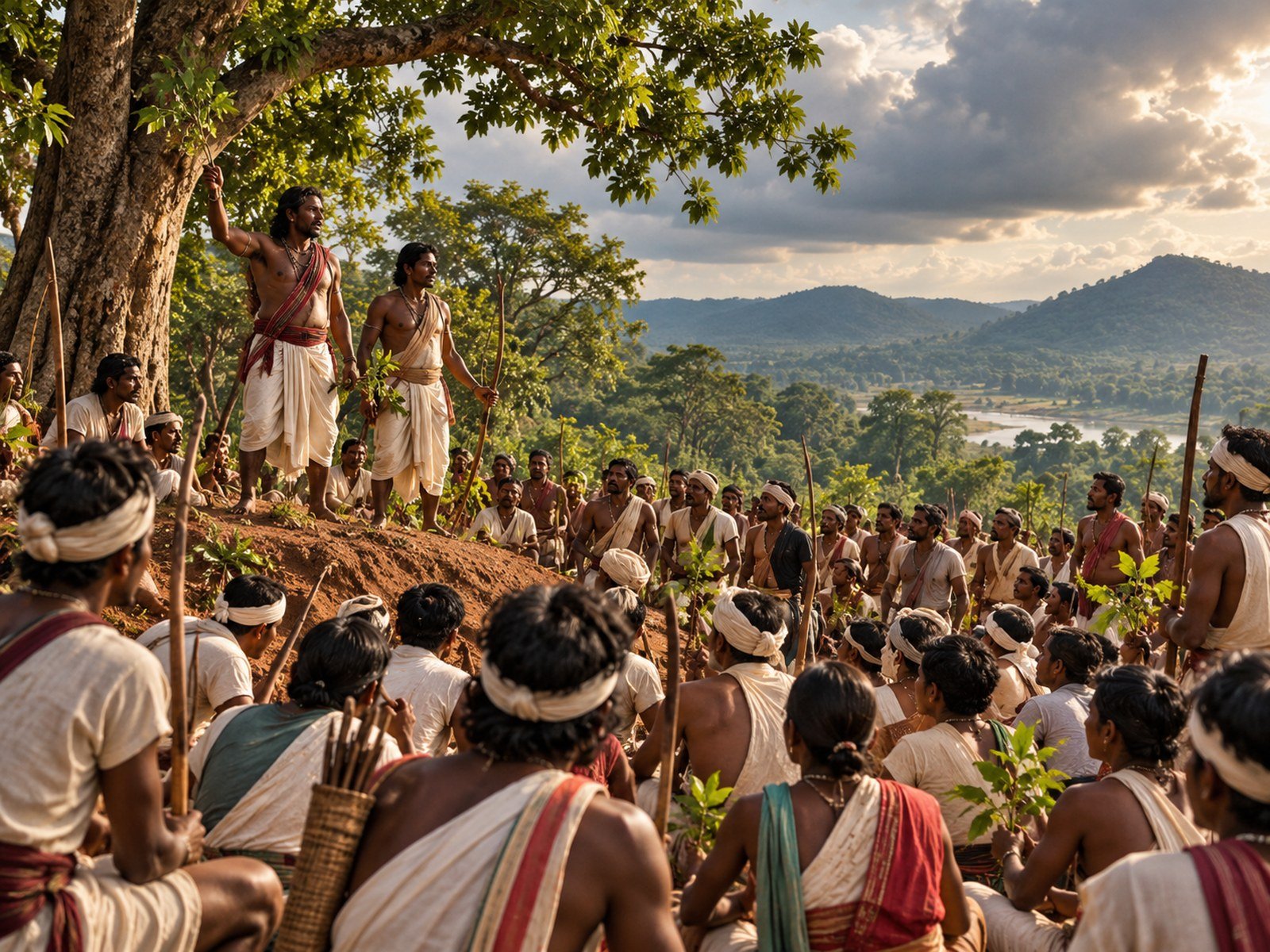
Messengers went out to the manjhis, the village headmen, across the Damin. Each carried a branch of the sal tree, which was the summons. On 30 June 1855 about ten thousand Santhals from some 400 villages gathered at Bhognadih.
What was announced there survives in the Company’s own judicial files, in the spelling of its clerks: "The Thacoor has descended in the house of Seedoo Manjee, Kanoo Manjee, Bhyrub and Chand." And: "The reign of Truth has begun. True justice will be administered."
The gathering resolved to be rid of the mahajans, the zamindars and the darogas, and to set up a Santhal raj. A petition handed to a magistrate around the same time by an old Santhal woman went further. It told the British to quit that part of the country, and it said: "the land does not belong to the sahebs."
Some accounts say the brothers then meant to walk to Calcutta and put their case to the Governor-General. If so, they did not get far. A week after the meeting, the daroga came with his ropes.
The Santhali word for what followed is hul. It means rebellion.
Bows against the Bengal Army
Within three weeks the Hul had spread from the Rajmahal hills to Bhagalpur in the north and Birbhum in the south. Bands of Santhals attacked moneylenders’ houses, zamindars’ offices and police posts, and stopped the mail. They had help from their neighbours. Gwalas, the milkmen, fed them. Lohars, the blacksmiths, made their weapons.
Those weapons were bows, arrows and axes. At first they were enough. In July a force of sepoys sent out from Bhagalpur under Major Burroughs was beaten back, and a British lieutenant was killed in an ambush.
Then the Company brought its weight to bear. Major General Lloyd took command at the end of July. The military historian Peter Stanley has calculated that about a tenth of the Bengal Army’s infantry was eventually committed against the Santhals. At Maheshpur on 24 July, a fight that lasted about ten minutes left around a hundred Santhals dead.
It went on like that into the winter. Hunter quoted an officer who had been there: "It was not war, they did not understand yielding." Martial law was declared on 10 November 1855. Villages were burned, and Stanley writes that the rising ended in starvation and disease as much as in battle. Martial law was lifted on 3 January 1856.
Nobody counted the dead. Stanley puts the figure at 10,000 Santhals at least. Many accounts say more than 15,000.
What happened to the brothers
The records do not agree on how Sidhu and Kanhu died, which says something about how little the victors cared to write down.
Most accounts say Sidhu was betrayed, handed over to the Company’s forces in the second half of 1855, and hanged after a summary trial at Barhait. Kanhu is usually said to have been captured some months later, with Chand and Bhairav, and hanged in turn. But one older history has Sidhu dying in battle, and the Sahibganj district administration’s own account says it was Kanhu who was killed in action. Chand and Bhairav are said in other tellings to have died fighting.
At Panchkatia, near Barhait, a memorial marks the place where local tradition says the two brothers were hanged.
Popular memory in Jharkhand also gives the brothers two sisters, Phulo and Jhano, who are honoured as fighters in the Hul. A recent study that went through the colonial files and the newspapers of 1855 found no mention of them there. They belong, for now, to tradition and song.
What the Hul changed
The Company had won, and it then did much of what the Santhals had asked for. In December 1855, while martial law was still in force, it passed Act XXXVII. The law cut a new district of 5,470 square miles out of Bhagalpur and Birbhum, named it the Santhal Parganas, and put it under its own officers with its headquarters at Dumka. The ordinary police were withdrawn, and keeping the peace was handed to the village headmen.
The sepoys who put down the Hul had less than two years of loyal service left in them. In 1857 the Bengal Army itself rose in the great rebellion, and most of the men who had marched through the Damin died in it.
Jharkhand keeps 30 June as Hul Diwas, and every year there is a fair at Bhognadih. The university at Dumka is named Sido Kanhu Murmu University. India Post put the brothers on a stamp in 2002.
And in the middle of Kolkata, at Esplanade, there is a street called Sido-Kanho Dahar. It is in the city that some say the brothers set out to walk to in July 1855.
Test your knowledge
Answer 5 questions about the story.
What was the Santhal Hul of 1855?
The Santhal Hul was a major uprising against colonial authority and the exploitation connected to land, debt and local administration in the Damin-i-koh region.
Who led the Santhal rebellion?
Sidhu and Kanhu Murmu were central leaders of the 1855 uprising, alongside other Santhal participants and leaders.
Where did the Santhal Hul begin?
The movement is closely associated with Bhognadih in present-day Jharkhand, where a major assembly took place in June 1855.
What were the main causes of the uprising?
Grievances included dispossession, exploitative lending practices, abuses by intermediaries, and the actions of colonial officials.
What is Hul Diwas?
Hul Diwas is observed on 30 June to commemorate the Santhal uprising and those who fought in it.
Sources and further reading
Peter Stanley, Hul! Hul! The Suppression of the Santal Rebellion in Bengal, 1855 (Hurst, 2022): https://www.hurstpublishers.com/book/hul-hul/
W.W. Hunter, The Annals of Rural Bengal (1868)
Ranajit Guha, "The Prose of Counter-Insurgency", in Subaltern Studies II (Oxford University Press, 1983)
Anirban Biswas, "One Hundred and Fifty Years of the Santal Uprising", Frontier Weekly: https://frontierweekly.com/archive/vol-number/vol/vol-39-2006-07/vol-39-10-13/santal-39-10-13.pdf
"Revisiting Uncovered Leaders and Events of Santal Hul", Sampratyaya (2024): https://sampratyaya.com/wp-content/uploads/2024/08/4-Revisiting-Uncovered-Leaders-and-Events-of-Santal-Hul.pdf
Sahibganj district administration, "History": https://sahibganj.nic.in/history/