In November 1913, a judge in British Columbia cancelled the deportation of 38 Punjabi Sikhs who had arrived on a steamer called the Panama Maru. Canada had been keeping Indians out with two regulations written in 1908, and the judge found that neither of them matched the Immigration Act they were supposed to rest on. The 38 men stayed.
News of the ruling travelled back across the Pacific. One man who took it seriously was Gurdit Singh, a contractor in his fifties from Sarhali village in Amritsar district, who had made his money in Malaya. No shipping line would carry Indians to Canada. He decided to hire a ship and carry them himself.
The rule that needed a ship nobody ran
The first of the two regulations said an immigrant had to reach Canada by a "continuous journey" from the country of his birth. The second said an Asian arrival had to have 200 dollars in hand. Neither named Indians. They did not need to. There was in practice no direct passage from India to Canada, so a man from Punjab could not comply however much he paid.
Indians were British subjects, and so were Canadians. That was Gurdit Singh’s whole argument: a subject of the King should be able to travel from one part of the King’s empire to another. By January 1914 the Canadian government had rewritten the regulations the judge had struck down and put them back in force. Gurdit Singh went ahead anyway. He meant to make the courts decide.
A ship renamed for a guru
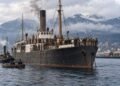
British shipping agents in Hong Kong turned him down. He found his ship through a German agent: the Komagata Maru, a steamer of just under 3,000 tons, built in Glasgow in 1890. It had spent more than twenty years under German owners before a small Japanese company bought it in 1913.
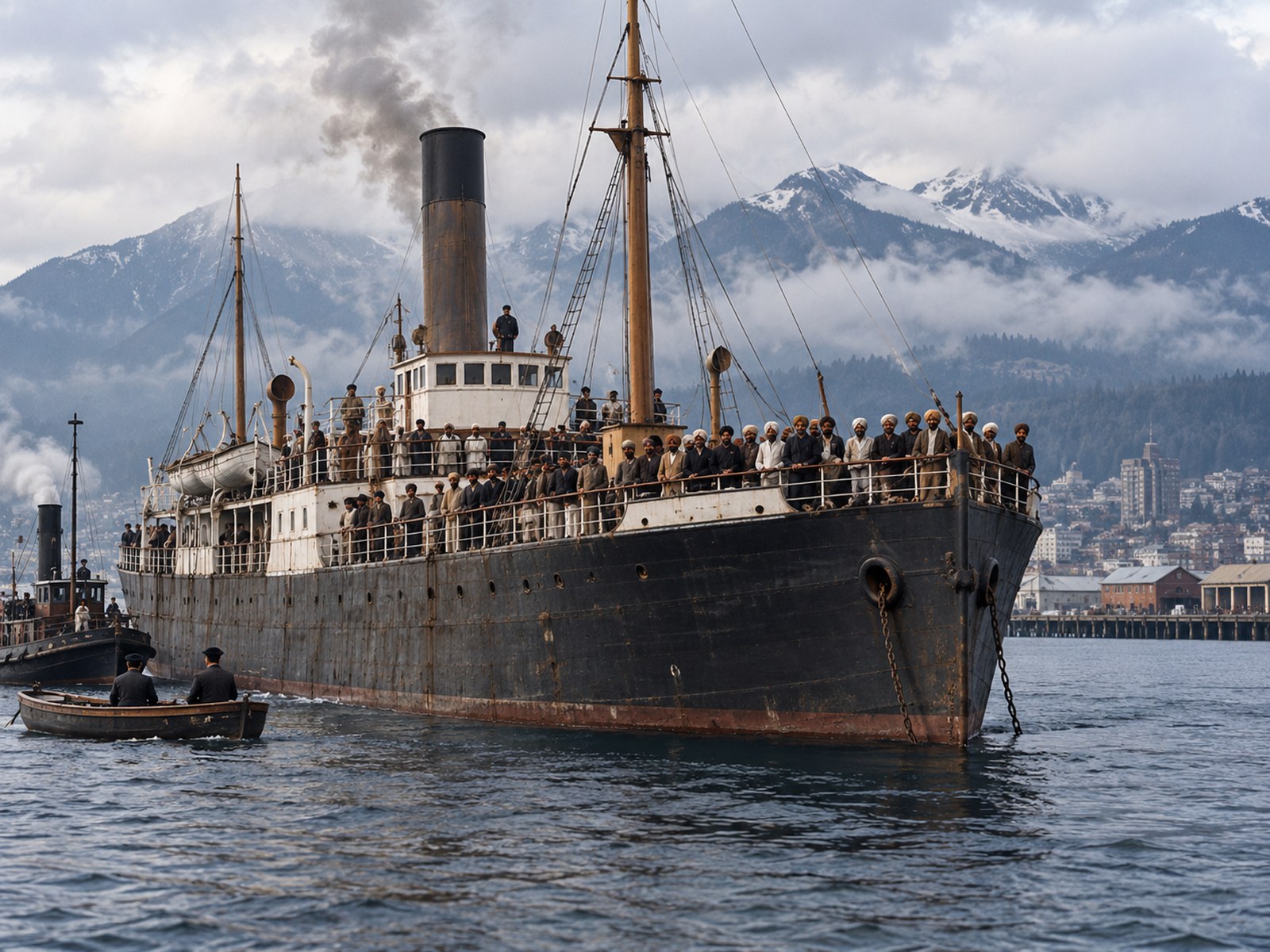
The Hong Kong police arrested Gurdit Singh shortly before sailing and then let him go. Many who had signed up dropped out, and the ship left Hong Kong on 4 April 1914 with fewer than 200 passengers. More came aboard at Shanghai, Moji and Yokohama. By the time it left Japan it carried 376 people, all Punjabis. The count usually given is 340 Sikhs, 24 Muslims and 12 Hindus, though historians treat those figures as estimates. Apart from two women and four children, all were men.
The passengers gave the ship a second name: Guru Nanak Jahaz.
Two months in Burrard Inlet
The ship anchored in Vancouver harbour on 23 May 1914. It never tied up at a dock. The local immigration agent, Malcolm Reid, kept it out in the water and kept people away from it, including J. Edward Bird, the lawyer hired to represent the passengers. About twenty men who could show they already lived in Canada were let ashore. Everyone else stayed on board.
Officials controlled when food and water reached the ship. The Canadian Museum for Human Rights records that some passengers went 48 hours without either.
The government’s hope was that the charter money would run out and the Japanese owners would call their ship home. The Indians already living in Vancouver stopped that. A shore committee led by Husain Rahim and Bhag Singh raised about 20,000 dollars in June and paid off what was owed.
So it went to court. One passenger, Munshi Singh, was put forward as the test case. On 6 July the British Columbia Court of Appeal ruled against him, unanimously. The judges found nothing in Canadian or British law that gave the passengers a right to come in.
The passengers still would not leave without provisions for the voyage back. On 19 July, Reid took a tugboat called the Sea Lion out to the ship with about 150 armed police, meaning to board it and force it to sea. The passengers drove the tug off with lumps of coal, bricks and scrap metal.
Ottawa then sent a warship. HMCS Rainbow was one of only two that the Canadian navy owned. A federal minister, Martin Burrell, negotiated the end: Canada would stock the ship for the return voyage, and the ship would go. On 23 July 1914 the Komagata Maru sailed out of the harbour with the Rainbow escorting it.
The war got home first
Twelve days later Britain was at war with Germany, and the men on the ship became a different kind of problem.
The government of India now saw a boatload of angry Punjabis who had been humiliated in front of the whole empire. Two leaders of the Ghadar movement, Maulvi Barkatullah and Bhagwan Singh, had come aboard at Yokohama on the way out. Ghadar men abroad were already calling on Indians to go home and fight, the same current that fed the wartime plots to land German arms in India. Less than a month before the ship arrived, the government passed the Ingress into India Ordinance, which let it restrict the movements of anyone entering the country.
On 26 September the ship was stopped at Kulpi, in the mouth of the Hooghly, and searched for weapons and seditious papers. Nothing was found. On 29 September it was brought to Budge Budge, about 14 miles south of Calcutta. There were 321 passengers left. A special train was waiting to take them straight to Punjab.
About sixty got on. The rest refused. They had the Guru Granth Sahib with them and wanted to place it in a gurdwara at Howrah, and many had business in Calcutta. They set out for the city on foot, with the holy book at the head of the column. British troops stopped them on the road and turned them back. At Budge Budge they sat down near the station, with police and soldiers around them.
What set off the shooting is still argued over. The government’s committee of inquiry, chaired by Sir William Vincent, concluded that the passengers were armed and attacked the police first, and that the troops fired only when they had to. The historian Hugh Johnston, who went through the same evidence decades later, found that some of the police commissioner’s own officers did not accept that version, and that some of the first shots came from police sergeants firing revolvers at close range.
The committee counted 26 dead: 20 passengers, two Europeans, two Punjab policemen and two local people. Other accounts put the passengers killed at 18 or 19, and some estimates run much higher. More than 200 passengers were arrested and held in jail in Calcutta. Twenty-eight got away. Gurdit Singh was one of them.
Seven years in hiding
He stayed hidden for seven years. On 15 November 1921, the anniversary of Guru Nanak’s birth, he walked into police custody at Nankana Sahib. Gandhi, then leading the Non-Cooperation Movement, had urged him to give himself up. He was jailed several times over the next decade, sat as a Congress delegate, and died in Amritsar on 24 July 1954.
In Vancouver the anger did not wait that long. William Hopkinson, an immigration inspector who ran informers among the city’s Sikhs, was shot dead in the courthouse on 21 October 1914 by a man named Mewa Singh. Mewa Singh gave himself up and was hanged on 11 January 1915. Sikhs in Canada still honour him as a martyr.
Punjab remembered Budge Budge. Five years later it would have a far larger grievance, at Jallianwala Bagh.
What the two shores did afterwards
The ship itself went back to ordinary work. It was sold several times, renamed Heian Maru, and wrecked off Hokkaido in 1926.
In 1952 Jawaharlal Nehru opened a memorial to the dead at Budge Budge. Canada took longer. The British Columbia legislature apologised in May 2008. Prime Minister Stephen Harper apologised that August at a Punjabi fair in a park in Surrey, where many in the crowd said plainly that they wanted it done in Parliament instead. On 18 May 2016 Prime Minister Justin Trudeau did that. Canada’s government, he told the House of Commons, was responsible for the laws that kept the passengers out. "For that, and for every regrettable consequence that followed, we are sorry."
The railway station where the passengers sat down in 1914 was renamed in 2013. Local trains from Sealdah now end their run at a platform whose signboard reads Komagata Maru Budge Budge.
Test your knowledge
Answer 5 questions about the story.
What was the Komagata Maru incident?
In 1914 a ship carrying 376 passengers, predominantly from Punjab, was prevented from landing most of its passengers at Vancouver under discriminatory Canadian immigration rules.
Who chartered the Komagata Maru?
Gurdit Singh chartered the Japanese steamship to challenge restrictions on immigration from India.
How many passengers were aboard the Komagata Maru?
The ship arrived at Vancouver carrying 376 passengers.
What was the continuous journey regulation?
Canadian immigration rules required certain immigrants to arrive by a continuous journey from their country of origin, a condition that effectively excluded many travellers from India.
What happened after the Komagata Maru returned to India?
At Budge Budge near Calcutta, a confrontation between returning passengers and colonial authorities led to deadly firing and arrests.
Sources and further reading
Hugh Johnston, "Komagata Maru", The Canadian Encyclopedia: https://www.thecanadianencyclopedia.ca/en/article/komagata-maru
Hugh J.M. Johnston, The Voyage of the Komagata Maru: The Sikh Challenge to Canada’s Colour Bar (UBC Press)
Subhas Ranjan Chakraborty, "The Tragic Journey of the Komagata Maru", IWMpost, Institute for Human Sciences, Vienna: https://iwm.at/publication/iwmpost-article/the-tragic-journey-of-the-komagata-maru
"Gurdit Singh, Baba (1861-1954)", The Encyclopaedia of Sikhism, Punjabi University, Patiala: https://eos.learnpunjabi.org/GURDIT%20SINGH%20BABA%20(1861-1954).html
Prime Minister of Canada, "Komagata Maru apology in the House of Commons", 18 May 2016: https://www.pm.gc.ca/en/news/speeches/2016/05/18/komagata-maru-apology-house-commons
Canadian Museum for Human Rights, "The story of the Komagata Maru": https://humanrights.ca/story/story-komagata-maru