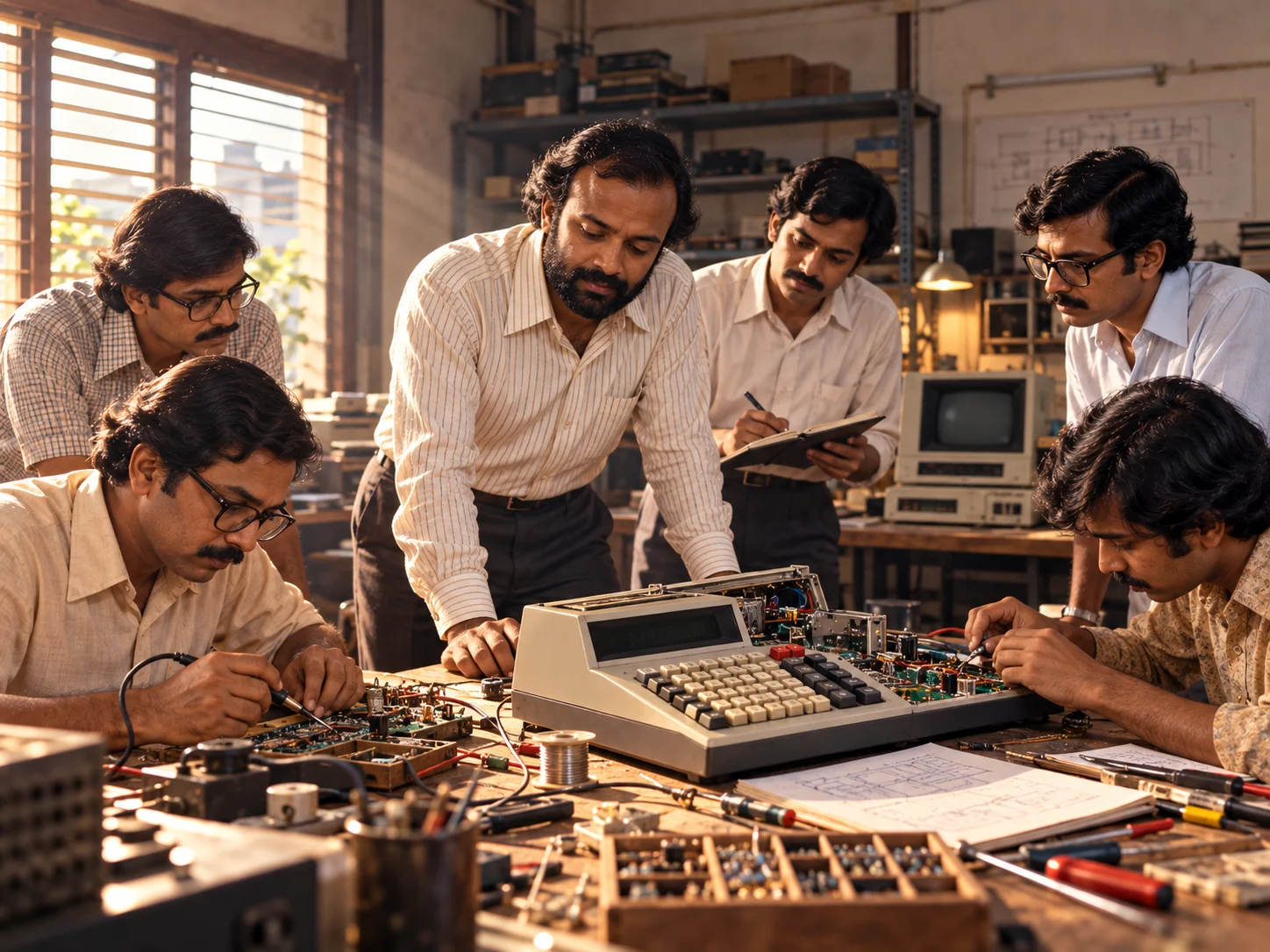
Shiv Nadar founded Hindustan Computers Limited in 1976 with six co-founders, beginning with calculator assembly and distribution before pivoting into microcomputer manufacturing at a time when the Indian government's licensing framework made hardware technology development extraordinarily difficult. His decision to manufacture India's first indigenous microcomputer, his navigation of the License Raj's restrictions and his eventual transition into software services as the global technology market shifted produced HCL Technologies, one of India's largest and most significant information technology companies.| Detail | Information |
| Subject | Shiv Nadar and HCL Technologies |
| Born | 14 July 1945, Moolaipozhi, Tamil Nadu, India |
| Profession | Entrepreneur, Technologist, Philanthropist |
| Company Founded | Hindustan Computers Limited, 1976 |
| Initial Business | Calculator assembly and distribution |
| Starting Capital | Approximately 187,000 rupees from six co-founders |
| Current Status | HCL Technologies among India’s largest IT companies |
| Awards | Padma Bhushan 2008 |
How Shiv Nadar Used a Small Calculator Business to Build HCL
Delhi in 1976 was not an obvious place to start a technology company. The city was not a technology hub. The Indian government’s industrial licensing framework, the License Raj, controlled almost every dimension of manufacturing activity through a system of approvals, quotas and restrictions that made building anything new in India an exercise in sustained bureaucratic negotiation. The technology that Shiv Nadar and his co-founders wanted to work with, computers and computing devices, was particularly sensitive because the government was simultaneously trying to develop indigenous computing capability and restricting foreign technology imports in ways that made the components required for that development difficult to obtain.
None of this was simple. All of it was navigable, if you were stubborn enough and clear eyed enough about what you were trying to do. Shiv Nadar was both.
The Six Engineers and the Pooled Capital
Shiv Nadar was born in 1945 in Moolaipozhi, a small village in Tamil Nadu. He studied electrical and electronics engineering at the PSG College of Technology in Coimbatore and then joined Delhi Cloth Mills, where he worked in its electronics division and began developing the technical and commercial understanding of the electronics industry that would eventually fund his entrepreneurial ambitions.
How Verghese Kurien Turned a Small Village Struggle Into Amul Revolution
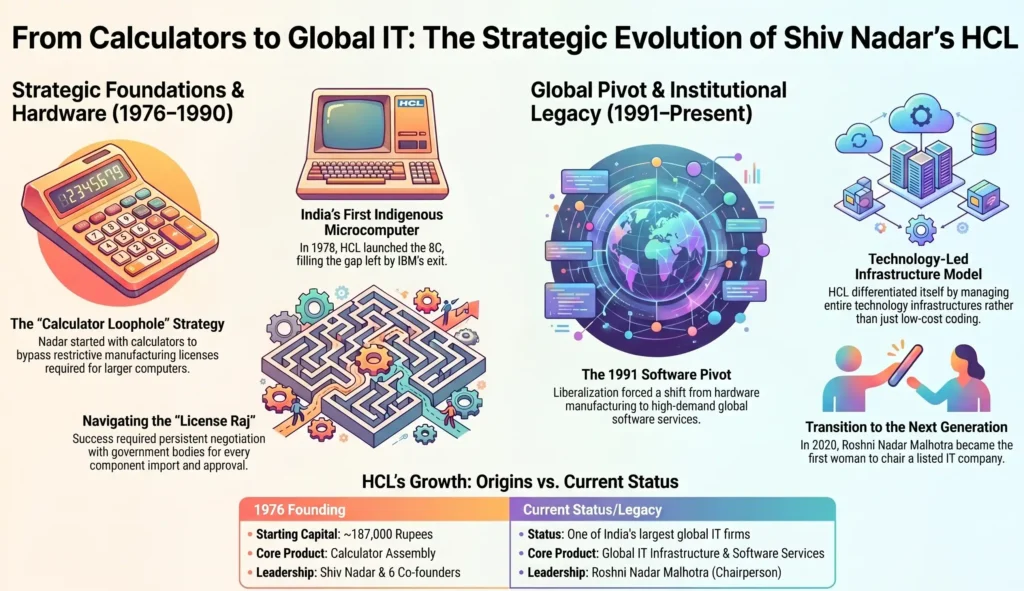
The co-founders who joined him in 1976 were colleagues from his working years, engineers who shared his conviction that the opportunity in computing technology in India was real and that the time to pursue it was before someone else did. The six of them pooled their savings, approximately 187,000 rupees in total, and registered Hindustan Computers Limited with a mandate to assemble and distribute calculators.
The calculator business was chosen as the starting point not because any of the six founders was particularly excited about calculators but because calculators represented an accessible entry point into the electronics and computing market that did not require the manufacturing licenses that more ambitious computing ventures would have needed. It generated revenue. It built commercial relationships. It gave HCL a foothold in a market from which it could observe and eventually move toward the more significant opportunity that Nadar had identified: microcomputers.
The License Raj and the Microcomputer
The Indian government’s approach to computing technology in the 1970s was shaped by competing impulses that produced contradictory policies. On one hand, the government recognized that computing technology was strategically important and wanted India to develop indigenous capability. On the other hand, the foreign exchange restrictions and technology import controls that were part of the broader economic framework of the period made obtaining the components required to manufacture computers extremely difficult.
IBM had been operating in India but withdrew in 1978 rather than comply with the government’s requirement that it dilute its Indian equity stake. The withdrawal left a significant gap in the Indian computing market and created an opportunity for Indian companies to develop indigenous alternatives. Nadar recognized this opportunity and began the process of obtaining the licenses and technical approvals required to manufacture microcomputers in India.
The process was arduous. The license applications involved navigating the Department of Electronics and multiple other government bodies. The technical specifications had to be submitted and approved. The manufacturing facility had to be established and inspected. The components that could not be manufactured in India had to be imported through a licensing process that controlled both the quantity and the specifications of what could be brought in.
Nadar navigated all of this with a patience and persistence that is difficult to fully appreciate from the outside. The regulatory environment that surrounded the development of India’s early computer industry was not simply inconvenient. It was actively hostile to the kind of entrepreneurial technology development that Nadar was attempting. Every step required official permission. Every permission required documentation, negotiation and waiting. The waiting alone could destroy a business that was trying to move fast enough to remain relevant in a technology market that was evolving rapidly.
India’s First Indigenous Microcomputer
In 1978, HCL launched what is considered India’s first indigenous microcomputer, the HCL 8C. The achievement was significant not only commercially but symbolically. In the same year that IBM was withdrawing from India, an Indian company had manufactured a microcomputer using indigenous development capability and had brought it to market.
The HCL 8C was not a particularly powerful machine by international standards of the period. It was, however, entirely real. It worked. It was manufactured in India. It was sold in India. And it demonstrated that Indian engineers, given the resources and the regulatory permission to attempt it, could design and build computing hardware that met the needs of the Indian market.
The significance of this moment in Indian technology history has been documented through the archives of the Computer Society of India, which has maintained records of the development of computing technology in India and recognized HCL’s role in the early history of Indian hardware manufacturing. The development of indigenous computing capability in this period, however limited by international standards, established the technical foundations on which subsequent generations of Indian technology development would build.
How the Murugappa Group Built a Silent Empire in Southern India
The Pivot to Software
The transition from hardware manufacturing to software services that eventually made HCL a global technology company was not a sudden strategic decision. It was a gradual response to changes in the global technology market and in the Indian regulatory environment that made hardware manufacturing increasingly difficult to sustain as a primary business.
The liberalization of the Indian economy that began in 1991 transformed the conditions under which Indian technology companies operated. Import restrictions that had protected and simultaneously constrained Indian hardware manufacturers were relaxed. Foreign technology companies could enter the Indian market more easily, bringing products that were better and cheaper than Indian manufacturers could match given the scale disadvantages of the domestic market. The hardware business that HCL had built through the 1970s and 1980s faced competitive pressure that required a strategic response.
Nadar’s response was to invest in software and IT services at a time when the global demand for software development capability was growing rapidly and when India’s reservoir of trained engineers represented a comparative advantage that the liberalized economy allowed Indian companies to leverage internationally. The transition was not painless. It required investment in new capabilities, new commercial relationships and new organizational structures that were different in important ways from what the hardware business had required.
The software services model that HCL developed through the 1990s, exporting software development capability to international clients who needed it at lower cost than their domestic markets could provide, was not unique to HCL. Infosys, Wipro and Tata Consultancy Services were pursuing similar models simultaneously. What distinguished HCL’s approach was a particular focus on deep technology engagement with clients, moving beyond pure software development into the management of clients’ entire technology infrastructure, a model that Nadar described as technology led and that distinguished HCL from competitors who focused primarily on cost based IT services delivery.
The research and analysis of HCL’s strategic evolution has been documented through institutions including the Indian School of Business in Hyderabad, which has used HCL as a case study in technology strategy and organizational transformation in its management education programs.
The Shiv Nadar Foundation and the Education Bet
Parallel to the building of HCL, Nadar developed what has become one of the most significant private philanthropic investments in Indian education. The Shiv Nadar Foundation, established in 1994, has invested in educational institutions at multiple levels including the Shiv Nadar University in Greater Noida and a network of schools serving students across socioeconomic backgrounds.
The philanthropic commitment to education reflects a conviction that has been consistent throughout Nadar’s public statements about his approach to both business and social responsibility: that India’s most important resource is its human capital and that the development of that capital through quality education is the most productive long term investment available.
The Shiv Nadar Foundation’s educational institutions have been documented by the University Grants Commission as meeting the academic standards required for degree granting institutions, and the foundation’s approach to education at the school level has been studied by organizations including Pratham, the education non profit, as a model of private philanthropic investment in educational quality.
The Transition to Roshni Nadar
In 2020, Shiv Nadar transferred the chairmanship of HCL Technologies to his daughter Roshni Nadar Malhotra, making her the first woman to chair a listed Indian IT company. The transition was planned and gradual, reflecting a long term approach to succession that Nadar had developed over years of thinking about how to ensure the institution’s continuity beyond his own direct involvement.
Jamsetji Tata: The Steel City That Outlived Its Founder by a Century
Roshni Nadar Malhotra had been involved in HCL’s activities through the HCL Foundation, the company’s corporate social responsibility arm, before taking on the chairmanship. Her leadership of the company reflects both the family ownership structure that has characterized HCL since its founding and a deliberate choice to extend that continuity into the next generation while the founder remained available as a resource and advisor.
The transition represented a significant moment in Indian corporate history, not only because of Roshni’s gender but because of the smoothness and deliberateness with which it was executed in a corporate culture that has not always managed succession well.
Quick Comparison Table
| Feature | Shiv Nadar, HCL | Narayana Murthy, Infosys | Azim Premji, Wipro | Nandan Nilekani, Infosys |
| Founded | 1976 | 1981 | 1945, IT pivot 1980s | Co-founder Infosys 1981 |
| Starting Point | Calculator business | Software services | Cooking oil company | Software services |
| Primary Innovation | Hardware first, then software | Software export model | IT services transformation | IT services, Aadhaar |
| Hometown | Tamil Nadu | Karnataka | Gujarat | Karnataka |
| Philanthropic Focus | Education, Shiv Nadar Foundation | Education, Infosys Foundation | Education, Azim Premji Foundation | Public policy, urban governance |
Curious Indian: Fast Facts
- HCL was founded in 1976 with approximately 187,000 rupees pooled from six co-founders, beginning as a calculator assembly and distribution business.
- Shiv Nadar studied electrical and electronics engineering at the PSG College of Technology in Coimbatore before starting his career at Delhi Cloth Mills.
- IBM withdrew from India in 1978 rather than dilute its Indian equity stake, creating the market opportunity that HCL’s microcomputer development filled.
- The HCL 8C, launched in 1978, is considered India’s first indigenous microcomputer.
- The liberalization of the Indian economy in 1991 forced HCL to pivot from hardware manufacturing to software services as import restrictions were relaxed.
- Shiv Nadar transferred the chairmanship of HCL Technologies to his daughter Roshni Nadar Malhotra in 2020, making her the first woman to chair a listed Indian IT company.
- The Shiv Nadar Foundation, established in 1994, has invested in educational institutions including Shiv Nadar University in Greater Noida.
- Nadar received the Padma Bhushan in 2008 for his contribution to Indian business and technology.
Conclusion
Shiv Nadar started with calculators because calculators were what he could start with. The thing he actually wanted to build was always something larger: an Indian technology company that could compete in the global market, that could demonstrate that Indian engineers working in India could produce technology products and services that the world needed and would pay for.
The path from calculators to that demonstration was long and full of obstacles that were not primarily technological. The License Raj, the foreign exchange restrictions, the import controls, the regulatory frameworks that governed every dimension of hardware manufacturing, these were the primary difficulties of the early decades. The technology itself was manageable. The permission to build with it was the harder problem.
When the liberalization of 1991 changed the terms of the problem, Nadar changed his approach. He moved from hardware to software. He moved from the domestic market to the global one. He built HCL into an institution that had the scale, the capability and the client relationships to survive and grow in the competitive global technology services market that emerged from that liberalization.
How Azim Premji Turned Cooking Oil Into a Technology Empire
The calculator that started it all is now a museum piece in the story of Indian technology. What Nadar built with it is one of the largest technology companies in India and one of the significant ones in the world. That distance, from a pooled fund of 187,000 rupees and a box of calculators to a global IT services company, is one of the most consequential journeys in Indian business history, and it was made entirely on the conviction that the technology mattered, that India needed it and that the time to build it was now.
If you think you have remembered everything about this topic take this QUIZ
Results


#1. In which year did Shiv Nadar and his five co-founders pool their savings to register Hindustan Computers Limited (HCL)?
#2. Approximately how much initial capital did the six co-founders pool together from their savings to start HCL?
#3. Why did the founders choose a calculator assembly and distribution business as HCL’s initial starting point?
#4. Which major multinational computing firm withdrew from India in 1978, creating a significant market gap that HCL moved to fill?
#5. Launched by HCL in 1978, which machine is widely recognized as India’s first indigenous microcomputer?
#6. What historic macroeconomic event in 1991 heavily pressured HCL to pivot from hardware manufacturing toward software services?
#7. Founded by Shiv Nadar in 1994, his philanthropic foundation focuses primarily on which sector?
#8. Who took over the chairmanship of HCL Technologies in 2020, becoming the first woman to chair a listed Indian IT company?
Why did Shiv Nadar and his co-founders begin with calculators rather than computers?
Calculators represented an accessible entry point into the electronics market that did not require the manufacturing licenses that more ambitious computing ventures would have needed under the License Raj. The calculator business generated revenue and built commercial relationships while HCL developed the capability and obtained the regulatory approvals required to move into microcomputer manufacturing.
What was the HCL 8C and why was it significant?
The HCL 8C was a microcomputer launched in 1978 and is considered India’s first indigenous microcomputer. Its significance was both commercial and symbolic. It demonstrated that Indian engineers could design and manufacture computing hardware using indigenous development capability, and it was launched in the same year that IBM withdrew from India, filling a significant gap in the Indian computing market.
How did the License Raj affect HCL’s early development?
The License Raj’s system of industrial approvals, quotas and restrictions controlled almost every dimension of manufacturing activity in India and was particularly complex for technology companies. HCL had to obtain licenses and approvals from multiple government bodies to manufacture microcomputers, import necessary components through a controlled licensing process and operate within foreign exchange restrictions that limited access to international technology. Navigating this system required patience and persistence that consumed significant organizational energy.
Why did HCL pivot from hardware to software in the 1990s?
The liberalization of the Indian economy in 1991 relaxed the import restrictions that had protected Indian hardware manufacturers, allowing foreign technology companies to enter the Indian market with products that were better and cheaper than Indian manufacturers could match at their scale. Simultaneously, global demand for software development capability was growing rapidly. HCL’s pivot to software services allowed it to leverage India’s comparative advantage in trained engineering talent in the international market.
What is the Shiv Nadar Foundation and what has it achieved?
The Shiv Nadar Foundation was established in 1994 as the philanthropic vehicle for Nadar’s investment in Indian education. It has built and operates Shiv Nadar University in Greater Noida, a research university offering programs across sciences, engineering, humanities and management. It also operates a network of schools serving students across socioeconomic backgrounds. The foundation reflects Nadar’s conviction that India’s human capital is its most important resource and that quality education is the most productive long term investment in its development.