D. Ramanaidu’s first film lost its money and his second was his only hit for seven years, and he never slowed down
Anuragam came out in 1963 and lost its money. He had put it together with two friends, and that was that.
The next year he started his own company and made Ramudu Bheemudu, with N.T. Rama Rao in a double role, and it was a hit. Then came Pratigna Palana, Sri Krishna Tulabharam, Shree Janma, Paapa Kosam, Sepoy Chinnaiah, and for something like seven years nothing he produced made money again.
He did not stop, slow down or move into something safer. He kept making films at the same rate, which is the single most important fact about him.
He had come off the land, where a bad year is a bad year and you sow the same field again.
Karamchedu
He was born in June 1936 in Karamchedu, a village in what is now Prakasam district, into a farming family. He dropped out of college.
Before cinema he tried most things a man with land and no patience tries: transport, a rice mill, tobacco, and then a brick factory, which is what took him to Madras. He went there to make bricks and ended up making films, and the businesses he left behind are the reason his approach to production never sounded like an artist’s.
Cooking the Manipuri Eromba Dish 365 Days
6 Unfoldings in the Subrahmanyan Chandrasekhar Biography
Suresh Productions
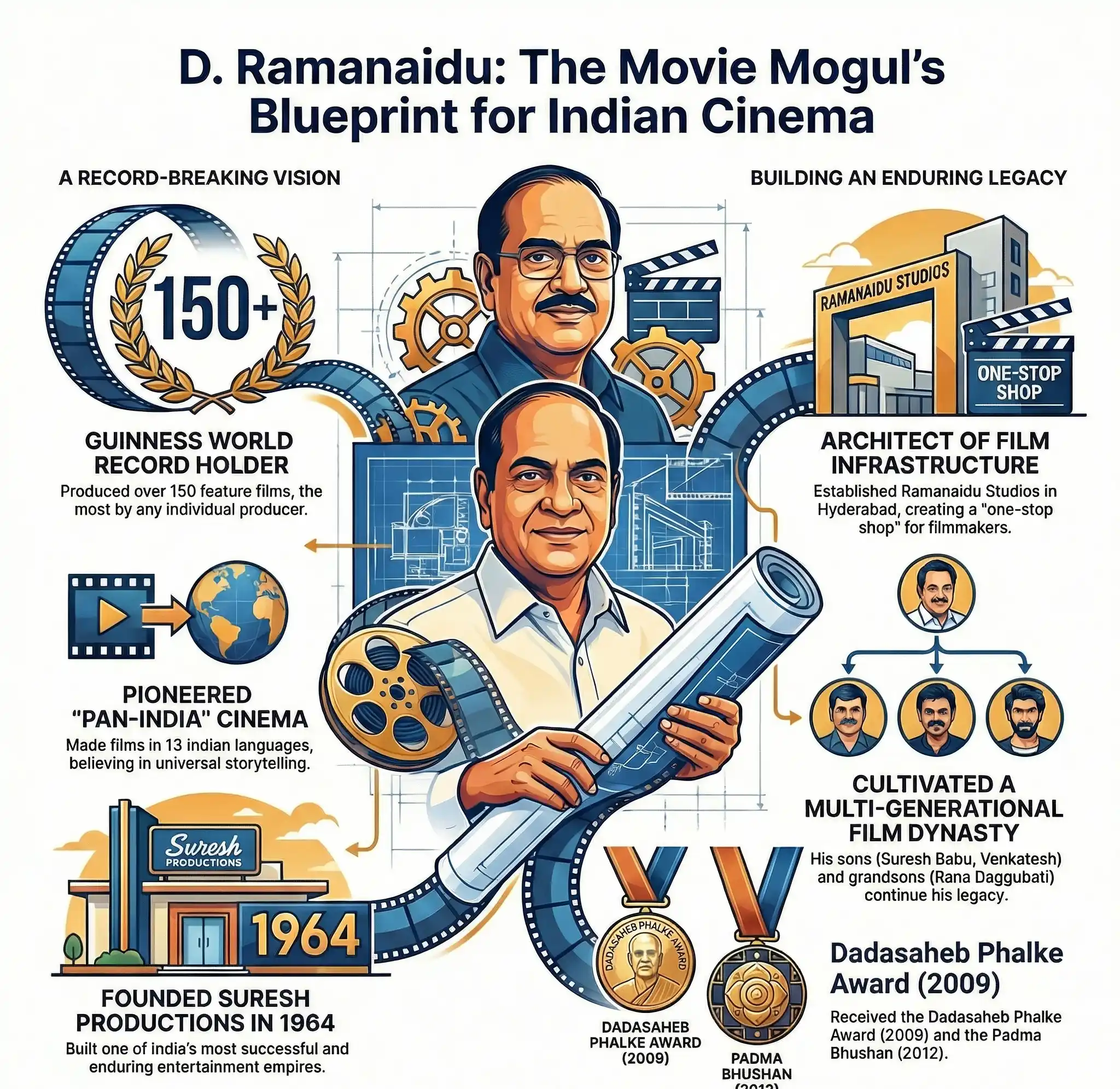
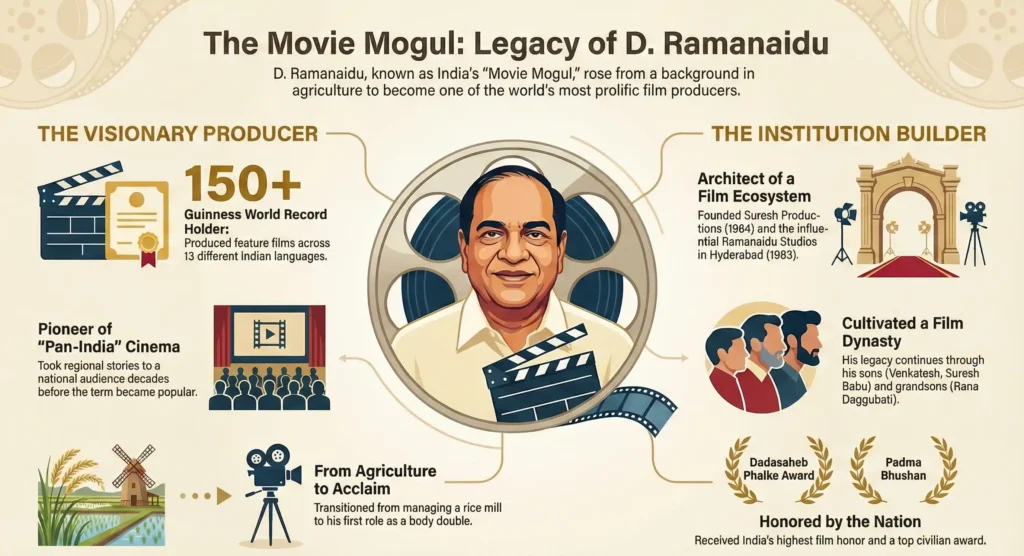
He named the company after his elder son. It has more than a hundred and fifty films to its name and is still running.
The commercial spine was Telugu, and he was very good at it: Prem Nagar, Devatha, Bobbili Raja, which made a star of his second son Venkatesh. He remade his own hits across languages, sold Tohfa and Anari to Hindi audiences, and put Kamal Haasan in Indrudu Chandrudu.
He also built the other half of the business, the half producers usually ignore. Suresh Productions distributed and exhibited on a scale that made it independent of anyone else’s goodwill, with hundreds of screens behind it, so a film that did middling business did not put the company at risk.
Thirteen languages
The part that does not fit the balance sheet is the list of languages. Telugu, Tamil, Hindi, Kannada, Malayalam, Bengali, Odia, Marathi, Gujarati, Punjabi, Bhojpuri, Assamese and English.
In the 1970s and 1980s, several of those had almost no film industry at all. Bhojpuri films were being made in ones and twos with no distribution to speak of. Assamese cinema had a handful of releases a year. There was no commercial reason for a Telugu producer to put money into either.
He did it anyway, film after film, for fifty years, and in 2008 Guinness recorded him as the most prolific individual film producer in the world. The record was a by-product. The habit came first.
Most producers count the market and then decide. He counted the languages.
Exploring The Assam Handloom Heritage And Silk
Hyderabad, 1983
Until the 1980s, Telugu cinema was made in Madras. The studios were there, the labs were there, and the industry of a Telugu-speaking state sat in a city in another one.
Moving meant building from nothing: floors, labs, equipment, and persuading technicians to uproot their families for a city with no film work in it yet.
With help from the state government, he built a studio in Hyderabad in 1983, and later another in Visakhapatnam. He was among the handful of people who moved an entire industry several hundred kilometres, and the Telugu film business as it exists today, the largest in the country by revenue in some years, sits on that decision.
The rest of it
He was a Member of Parliament for Bapatla from 1999 to 2004. He started a charitable trust in 1991 and put a great deal of the money through it. The Dadasaheb Phalke Award came in 2009 and the Padma Bhushan in 2012.
At seventy-one he took his first full-length acting role, in a Telugu film called Hope, about what the examination system does to schoolchildren. It is not the sort of subject a man with his commercial record needed to go anywhere near.
He was also the rare producer that directors and writers speak well of years afterwards, largely because he paid, on time, and did not treat a bad opening weekend as a betrayal.
He died in Hyderabad in February 2015, at seventy-eight. His sons run the company and his grandson acts in its films.
One hit in the first eight years, and a hundred and fifty films in the fifty that followed. He simply did not accept that a failure was information.
8 Fascinating Facts in the Homi Jehangir Bhabha Biography
Understanding Donyi Polo Religion Today
If you think you have remembered everything about this topic take this QUIZ
Results


#1. Before becoming a world-renowned producer, D. Ramanaidu had a very different career background. What was it?
#2. What unusual role did D. Ramanaidu play in his first ‘brush with the camera’ in 1958?
#3. D. Ramanaidu holds a Guinness World Record for producing the highest number of films. In how many different languages did he produce movies?
#4. Which major Indian city evolved into a global cinema hub largely due to Ramanaidu establishing a state-of-the-art studio there in 1983?
#5. D. Ramanaidu founded Suresh Productions in 1964. Who was the company named after?
#6. In 1999, D. Ramanaidu expanded his career into public service by serving as a Member of Parliament (MP). Which constituency did he represent?
#7. Which of his grandsons has crossed global boundaries to become an icon through films like ‘Baahubali’?
#8. Which prestigious honor did D. Ramanaidu receive in 2009 for his lifetime contribution to Indian cinema?
How many films did D. Ramanaidu produce?
D. Ramanaidu produced more than 150 films throughout his career, which earned him a place in the Guinness World Records for the highest number of films produced by an individual.
Which languages were included in the D Ramanaidu movie legacy?
His filmography spans 13 languages, including Telugu, Tamil, Hindi, Kannada, Malayalam, Bengali, Oriya, Marathi, Gujarati, Bhojpuri, Assamese, Punjabi, and English.
Is the actor Venkatesh related to D. Ramanaidu?
Yes, the acclaimed actor Venkatesh Daggubati is the younger son of D. Ramanaidu. His elder brother, D. Suresh Babu, is a successful producer.
What are the major awards received by D. Ramanaidu?
He was honored with the Dadasaheb Phalke Award in 2009 and the Padma Bhushan in 2012 for his monumental contributions to Indian cinema.
Read More: https://curiousindian.in/rishi-kapoor/
Sources & References
Cinemaazi (producer profile, D Ramanaidu) — the studio built in Hyderabad in 1983, the thirteen languages and the Guinness entry of 2008.
The Hindu — his early businesses, the failure of Anuragam and the assessment of his career at his death in 2015.
Directorate of Film Festivals, Government of India — the Dadasaheb Phalke Award of 2009.
Padma Awards portal, Government of India — the Padma Bhushan of 2012.
Author


Exploring the Soul of Bharat through History, Science, Culture, and its Diversity
Our Mission
Curious Indian is a definitive knowledge portal dedicated to chronicling the events, personalities, and cultural shifts that defined the Indian subcontinent. From the ancient Vedic Period to the complexities of 21st-century politics, our goal is to provide deep-dive analysis that inspires.
Editorial Standards & E-E-A-T
Every article published under our brand undergoes a rigorous fact-checking process. We prioritize primary historical records, academic citations, and credible archives to ensure our readers receive accurate, high-authority information.
Historical Integrity Directly sourcing from ASI archives and academic journals.Topical Authority Comprehensive clustering of Indian Science, Biographies, and Wars.Managed by Paripurna Datta and TEAM | Dedicated to the Knowledge of India.