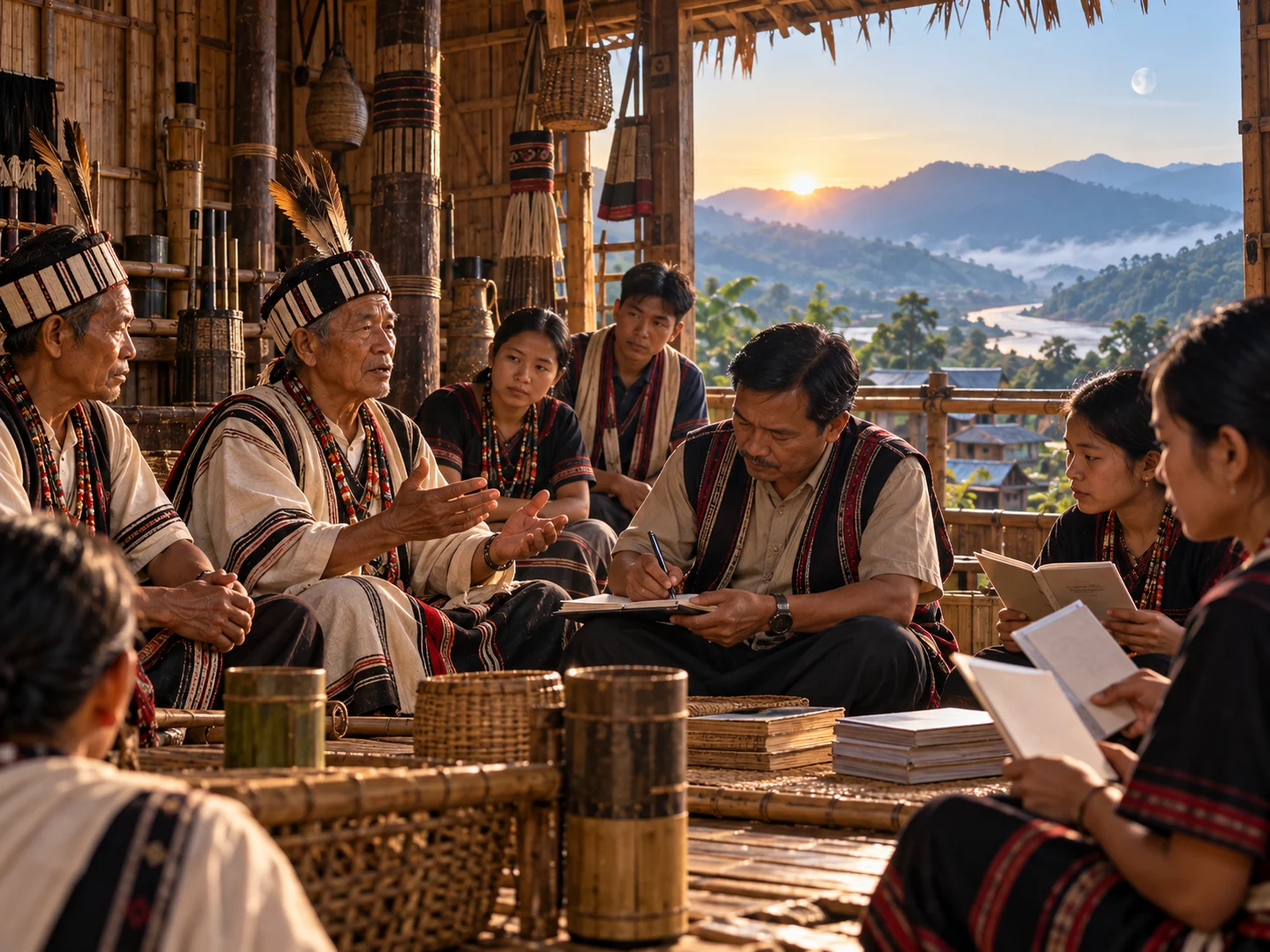
Pasighat, 1986: for as long as anyone could remember, the prayers of the Adi people to the Sun and the Moon had lived only in memory. Then a language officer named Talom Rukbo decided they had to be put on paper
On a Sunday morning in a village in Arunachal Pradesh, people gather in a hall called a gangging.
The men sit cross-legged in rows on the left. The women sit on the right. At the front are images of the gods. Nobody speaks. The only sound allowed is the sound of the hymns, sung from printed books.
It looks like a very old scene. In one way it is. In another way, it is surprisingly new.
It looks like a very old scene. In one way it is. In another way, it is surprisingly new.
Sun and Moon
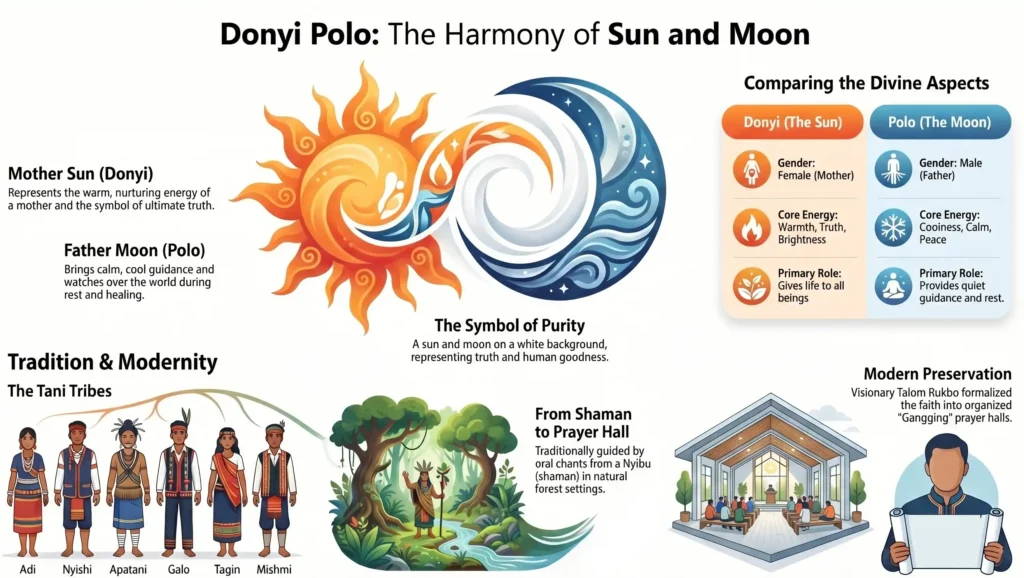
The Tani peoples of Arunachal Pradesh, among them the Adi, Galo, Nyishi, Apatani and Tagin, and the Mising of Assam, have an old way of seeing the world. At its heart are Donyi, the Sun, and Polo, the Moon. The forests, rivers and mountains around them are full of spirits, some kind, some dangerous, and all of them to be respected.
For centuries this faith had no book, no temple and no fixed day of worship. It lived in the memory of priests who could chant the long histories of gods and ancestors, and in rituals held in the village or the forest when they were needed: for a harvest, an illness, a birth, a death. Every village, and every tribe, did things a little differently.
That worked for a very long time. By the second half of the twentieth century, some people in the hills began to fear it would not work for much longer.
The Secret Letters Between G.D. Birla and Mahatma Gandhi
Struggle of Walchand Hirachand Against British Shipping Laws
The language officer
Talom Rukbo was an Adi, born in 1937 in Balek village near Pasighat. He studied at St Edmund’s College in Shillong, graduated in 1960, and joined the government. He was appointed a Language Officer.
Around him, the hills were changing fast. Roads, schools and new ideas were arriving, and so were other faiths, above all Christianity, which was growing across the north-east. Rukbo worried that the old Adi ways would simply fade away, one priest and one village at a time.
From the 1970s he threw himself into cultural revival. He wanted the Adis to be proud of their past, so that they could stay strong in the face of influences from outside.
In 1985 and 1986 he and his close friend Kaling Borang, who worked at All India Radio in Pasighat, went to conferences of the International Association for Religious Freedom. There they met members of Seng Khasi, a Khasi group from Meghalaya working to preserve their own indigenous faith. It set Rukbo thinking. After the second conference, he told Borang that the Adis must have a written scripture of Donyi-Polo.
After the second conference, Rukbo told his friend that the Adis must have a written scripture.
31 December 1986
On 31 December 1986, Rukbo and his companions founded the Donyi-Polo Yelam Kebang, the council of the Donyi-Polo faith. That date is now celebrated every year as Donyi-Polo Day.
Then the work began. Prayers and hymns that had only ever been spoken were collected, written down and printed. Images were made of the gods and of the Sun and Moon. In 1989 the first major Donyi-Polo temple was built at Pasighat. Young people were trained there, twice a year, and sent back to their villages with books to lead prayers.
From 1996 the gangging, the prayer hall, spread from village to village. Rukbo explained that the name came from Gangging Siring, a sacred land or holy tree that stands between the spirit world and the natural world. By the middle of the 2010s there were around four hundred such centres.
How Kiran Mazumdar Shaw Built Biocon From a Garage in Bengaluru
Old and new
Not everyone sees the change the same way.
To its followers, the revival saved a faith that might otherwise have disappeared, and gave the Tani peoples a shared identity and a place to pray together. To some scholars and critics, it is also something new: the weekly Sunday prayers, the printed hymns and the prayer halls borrowed their shape from the Christianity they were meant to hold back, and parts of the movement have grown close to Hindu nationalist organisations working in the north-east. Both things can be true at once. Religion in the hills has become bound up with questions of identity and politics that are still argued over.
Talom Rukbo died on 30 December 2001. It was the day before Donyi-Polo Day.
Today a statue of him stands at the Central Donyi-Polo Gangging in Pasighat. And every Sunday, in halls across Arunachal Pradesh, people open books that did not exist when he was a boy, and sing prayers to the Sun and the Moon that, for most of their long history, were never written down at all.
The Victory Over Bali and What It Means for the First Day of Chaitra
Ram Prasad Bismil: The Last Chapter of India’s Most Fearless Poet
If you think you have remembered everything about this topic take this QUIZ
Results


#1. In the Donyi Polo faith, what does the deity Donyi represent?
#2. Which group of tribes primarily follows the Donyi Polo religion?
#3. What is the name of the traditional shaman who serves as a spiritual leader and wise doctor of the soul?
#4. Who is considered the visionary leader who organized the modern structure of the Donyi Polo religion?
#5. What is the specific name for the community prayer halls where followers gather today?
#6. What do the followers of this faith believe about the gender of the Moon (Polo)?
#7. According to the text, what does the white color in the Donyi Polo symbol represent?
#8. On which date is Donyi-Polo Day celebrated as an official state holiday in Arunachal Pradesh?
What is the main concept of this indigenous faith?
The main concept revolves around worshipping nature, specifically the Sun and the Moon. Believers view the Sun as a nurturing mother of truth and the Moon as a calming father, teaching humans to live with honesty, balance, and deep respect for the environment.
Who started the modern movement for this belief system?
While the beliefs are ancient, a visionary leader named Talom Rukbo organized the faith in the late twentieth century. He helped establish formal prayer halls and structured practices to ensure the culture survived the pressures of the modern world.
Where do the followers usually gather to pray?
Followers gather in community prayer halls known as Ganggings. In these peaceful spaces, people of all ages come together to sing traditional hymns, ring bells, and participate in community rituals.
Are there specific festivals dedicated to these deities?
Yes, the tribes celebrate several agricultural and seasonal festivals, such as Solung, Mopin, and Nyokum. During these vibrant events, they offer prayers, food, and gratitude to the sun and moon for a bountiful harvest and good health.
How do the tribes pass down their religious teachings?
Historically, there were no written holy books. The religious teachings, stories, and sacred chants have been passed down orally from generation to generation, largely led by traditional spiritual guides known as Nyibus.
Sources & References
Pulitzer Center / The Citizen, “The Old New Faith in Arunachal Pradesh” (March 2021) — Talom Rukbo’s education and career, the IARF conferences, and the founding of the Donyi-Polo Yelam Kebang on 31 December 1986.
Fifty Two, “Preach” (18 March 2023) — Kaling Borang’s account of Rukbo’s cultural revival and his decision that the faith needed a written scripture.
Sarit Chaudhuri, “Conversion and Quest for Indigenous Religious Identity” (University of Göttingen) — the training of youths, the printed books and the meaning of gangging.
Northeast Now, “Donyi-Polo Day observed in Pasighat” (31 December 2025) — the statue of Talom Rukbo and the observance of Donyi-Polo Day.