How an earthquake and a drought carried a women’s folk art from the walls of Bihar to the world
For hundreds of years, some of India’s most beautiful paintings were made in a place almost no outsider would ever see them: on the inside walls of village homes, in a corner of Bihar called Mithila.
They were painted by women, for their own families. And then, in time, they simply washed away. It took an earthquake to finally show the world what the women of Mithila had been quietly making all along. This is the story of Madhubani painting.
A prayer painted on a wall
The word Madhubani means “forest of honey,” and the art grew out of the everyday life of the region.
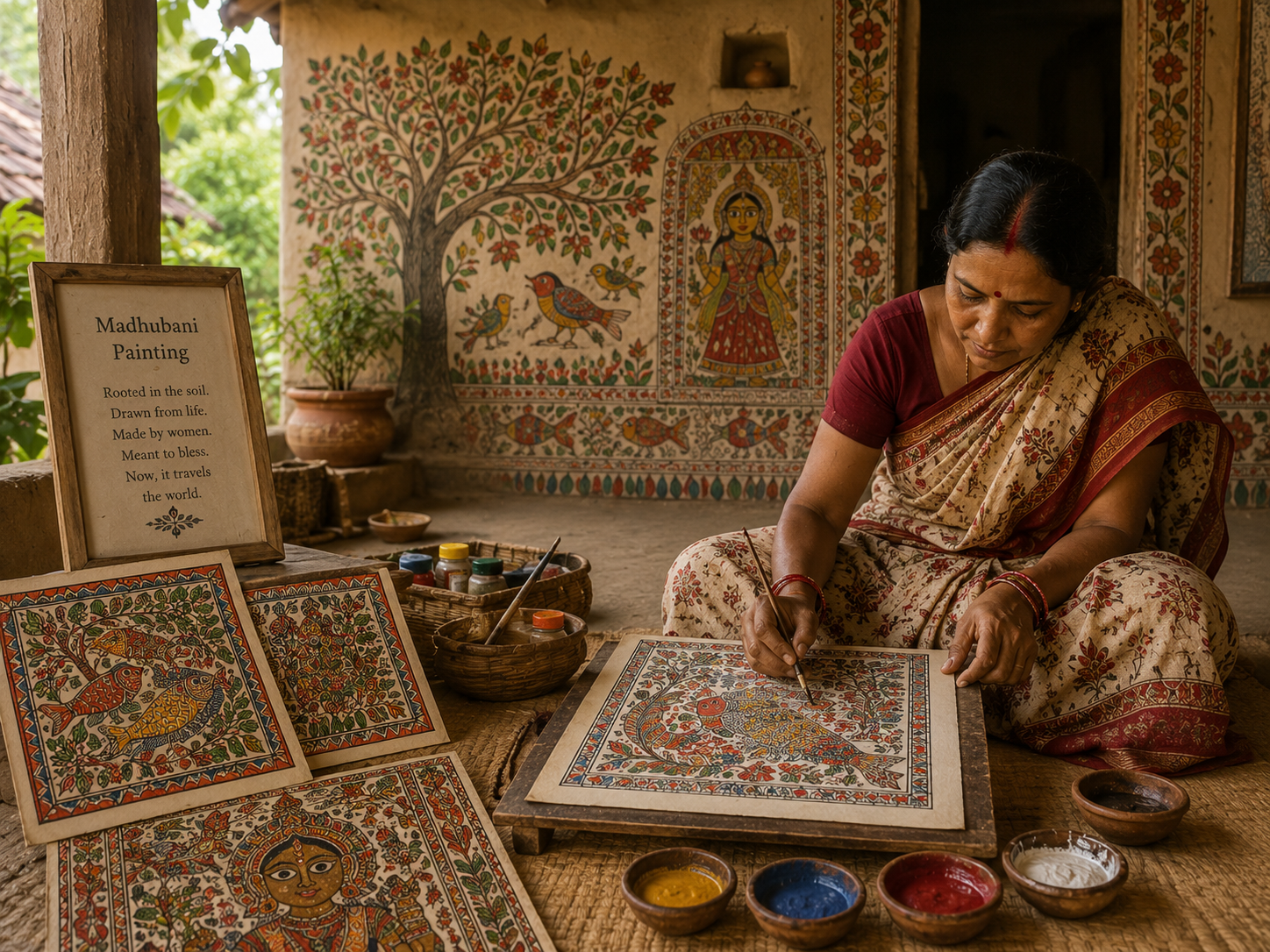
For as long as anyone could remember, the women of Mithila painted on the freshly mud-plastered walls and floors of their homes. They painted for weddings, for festivals, and for prayers, to call down blessings on the household. Mothers taught their daughters, and so the skill passed quietly down the generations.
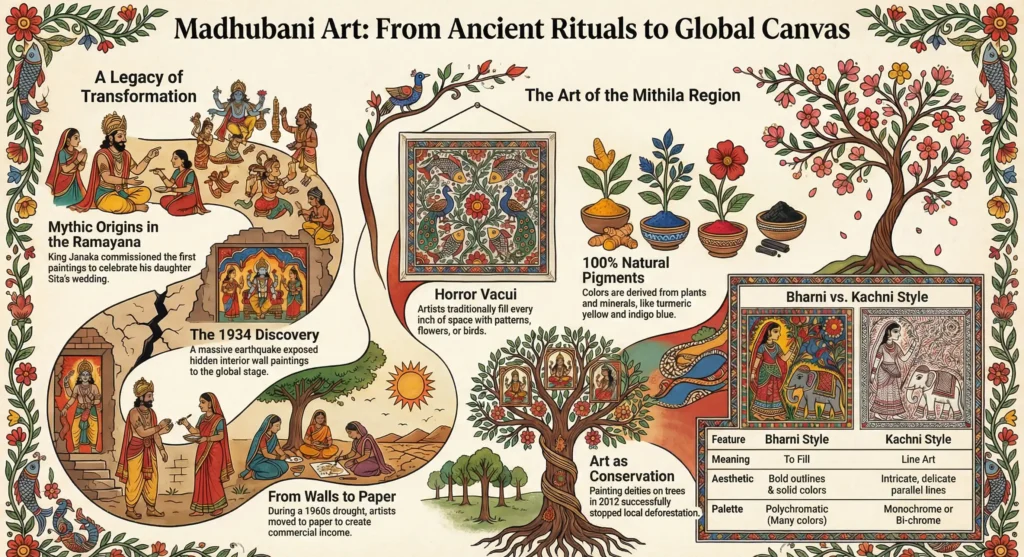
The most special of these was the kohbar, painted on the wall of the marriage chamber for a new bride and groom. It was crowded with symbols of love and of the children hoped for, a lotus pond, fish, bamboo, birds. Local legend traces the whole tradition all the way back to the Ramayana, saying that King Janaka of Mithila had his city painted for the wedding of his daughter Sita to Rama.
But here is the important thing. These paintings were never made to last or to be sold. They were part of life’s big moments, and when the wall was one day re-plastered, the artwork vanished with the old mud.
Contemporary Indian Sculpture: 20th and 21st Century Innovations
An earthquake opens the walls
In 1934, a terrible earthquake struck Bihar, cracking open thousands of homes.
A British officer named William Archer, who was there to help with the relief work, walked past the broken houses and stopped in surprise. On the exposed inner walls stood paintings so bold and striking that they reminded him of famous European artists of his own day.
A British officer thought these village women’s walls looked like the work of Europe’s most celebrated modern painters, Picasso and Miró.
He photographed what he saw, and years later he wrote about it. For the very first time, the world beyond Mithila caught sight of the art that its women had been making, unnoticed, for centuries.
Durga Puja: Celebrating the Divine Feminine in Bengal
A drought sends it out into the world
Seeing the art was one thing. What changed everything came from a second disaster.
In the late 1960s, a long drought struck Bihar. The crops failed, and hunger spread. To help, the government’s handicrafts board, led by a woman named Pupul Jayakar, sent an artist called Bhaskar Kulkarni into the villages carrying something very simple: sheets of handmade paper. His message to the women was plain. Paint exactly what you paint on your walls, but paint it here, on this paper, so that it can be sold.
It worked beyond anyone’s hopes. In villages like Jitwarpur and Ranti, the women began moving their art onto paper. And for the first time, their paintings could travel, and could earn money.
Moving the art from wall to paper turned a women’s home ritual into a livelihood that helped feed families through a famine.
This quiet change did something bigger too. It gave the women themselves names. Painters like Jagdamba Devi, Sita Devi and Ganga Devi grew famous far beyond their villages, and went on to win the Padma Shri, one of India’s highest civilian honours. Art that had once washed off a mud wall now hung in galleries around the world, signed by the women who made it.
Five ways of painting
Madhubani is not one single style but several. For a long time these styles followed caste lines, though those old boundaries have blurred a great deal now.
There is Bharni, which means “to fill,” where bold outlines are packed with bright, solid colour, often showing gods and goddesses. There is Kachni, or “line work,” made of fine, delicate lines with very little colour. There is the Tantrik style, full of sacred symbols, and the Kohbar of the wedding chamber. And there is Godna, inspired by the patterns of traditional tattoos, which was developed by Dalit women.
That last point matters. For generations the art had belonged mostly to upper-caste households. But over time, Dalit women created their own styles and won the very same fame, and the move onto paper helped loosen the old lines about who was allowed to paint what.
Indian Textiles: From Lustrous Silk Sarees to Hand-Block Prints
Every inch filled
One rule stands above all others in a Madhubani painting: leave no empty space.
Once the main figures are drawn, the artist fills every remaining gap with flowers, patterns, birds and fish, until the whole surface seems to hum with life. The tools were simply whatever lay close at hand, fingers, twigs, matchsticks, or a nib-pen, never fancy shop-bought brushes. And the colours came straight out of the earth: black from soot, yellow from turmeric, blue from the indigo plant, red from flowers, and white from a paste of rice.
The fish, the trees, and a museum in Japan
The art carries small wonders and surprises. The fish appears again and again, because in Mithila it stands for good luck and new life. In 2012, when people were cutting down roadside trees, local artists painted images of gods onto the tree trunks, and the felling stopped, because nobody dared take an axe to a tree that carried a deity. And far away, in a small town in Japan, there is a whole museum devoted to this art, holding more than fifteen thousand Madhubani paintings.
In 2007, the art was given a special “GI” tag, which means only genuine paintings from the Mithila region can be sold under the Madhubani name, protecting the women whose families first made it.
From a wall to the world
Madhubani began as something humble and passing, a woman’s prayer drawn on mud, meant to fade with the next coat of plaster. Today it feeds thousands of families, hangs in museums oceans away, and carries the name of a small Bihar region right around the globe.
Two disasters, an earthquake and a drought, pushed this art out of the house and into the wider world. But the art itself had always been there, all along, on the quiet inside walls, made by women whose names no one knew, simply waiting for the day someone would finally look.
ges the gap between the mythological past and the modern present, proving that art is not just about aesthetics—it is a tool for survival, empowerment, and cultural preservation.
The Gupta Empire: When India Led the World in Science and Culture
If you think you have remembered everything about this topic take this QUIZ
Results


#1. According to local mythology, Madhubani art originated when King Janaka commissioned artists to paint the city for whose wedding?
#2. What natural disaster in 1934 first exposed the hidden Madhubani wall paintings to the outside world?
#3. In the late 1960s, why were local women encouraged to transfer their paintings from walls to handmade paper for commercial sale?
#4. Which style of Madhubani painting relies heavily on intricate, delicate, and closely drawn parallel lines, often using a monochrome palette?
#5. Which quintessential Madhubani wedding art style is painted in the nuptial chamber and loaded with symbols of fertility?
#6. The famous Madhubani aesthetic of filling every inch of the canvas with patterns and leaving no empty space is known as what?
#7. According to the text, what natural source is traditionally used to create the black pigment in Madhubani paintings?
#8. In 2012, how did an environmental NGO brilliantly use Madhubani art to stop rampant deforestation in Bihar?
Where did Madhubani painting originate?
It originated in the Mithila region of Bihar, India, and adjoining areas of Nepal.
What is the legend behind Madhubani art?
Legend says King Janaka commissioned the first Madhubani paintings to decorate the kingdom for the wedding of his daughter, Sita, to Lord Rama.
What materials are used for Madhubani painting?
Artists use natural dyes derived from plants, soot, and minerals. Traditional tools include twigs, fingers, matchsticks, and nib-pens instead of synthetic brushes.
Why are there no empty spaces in Madhubani paintings?
The art form employs a technique often called horror vacui (fear of empty space). Any gaps are immediately filled with geometric shapes, flowers, or birds to make the painting look complete and vibrant.
What is “Kohbar” in Madhubani art?
Kohbar is a specific style of Madhubani painting created in the nuptial chamber during weddings. It features heavy symbolism related to fertility and prosperity, such as fish and lotuses.
Sources and references
- Sarmaya (“The Walls Have Eyes” and the Baua Devi feature) — the 1934 Nepal-Bihar earthquake exposing painted interiors in villages like Jitwarpur, William Archer photographing them and writing in Marg in 1949, and the 1966 drought that brought Bhaskar Kulkarni to encourage the shift from walls to paper.
- Anantam IAS and Avendi (Mithila art guides) — Pupul Jayakar of the All India Handicrafts Board sending Bhaskar Kulkarni during the drought, the Padma Shri awards to Jagdamba Devi (1975), Sita Devi (1981), Ganga Devi (1984) and later artists, and the 2007 Geographical Indication tag.
- Britannica, Incredible India and Madhubani district sources — the origin in the Mithila region of Bihar and adjoining Nepal, the Ramayana legend of King Janaka and Sita’s wedding, and the domestic tradition painted by women for weddings and festivals.
- Memeraki and MyEhaat (Mithila art resources) — the kohbar wedding-chamber paintings, Archer’s comparison of the art to Picasso and Miró, the crossing of caste boundaries, and the meaning of “Madhubani” as “forest of honey.”
- Original Curious Indian article (“Madhubani Painting”) — the five styles (Bharni, Kachni, Tantrik, Godna, Kohbar) and their historic caste associations, the “no empty space” aesthetic, the natural tools and pigments, and the fast facts on the tree-painting campaign, the Mithila Museum in Japan, and the fish symbol.
Author


Exploring the Soul of Bharat through History, Science, Culture, and its Diversity
Our Mission
Curious Indian is a definitive knowledge portal dedicated to chronicling the events, personalities, and cultural shifts that defined the Indian subcontinent. From the ancient Vedic Period to the complexities of 21st-century politics, our goal is to provide deep-dive analysis that inspires.
Editorial Standards & E-E-A-T
Every article published under our brand undergoes a rigorous fact-checking process. We prioritize primary historical records, academic citations, and credible archives to ensure our readers receive accurate, high-authority information.
Historical Integrity Directly sourcing from ASI archives and academic journals.Topical Authority Comprehensive clustering of Indian Science, Biographies, and Wars.Managed by Paripurna Datta and TEAM | Dedicated to the Knowledge of India.