How Eid al-Fitr and Eid al-Adha Place Charity at the Very Heart of the Celebration
Most festivals arrive on a date you can circle on a calendar months in advance. The two great festivals of Islam, the two Eids, are not quite like that. They begin only when someone actually sees a thin new crescent moon hanging low in the evening sky.
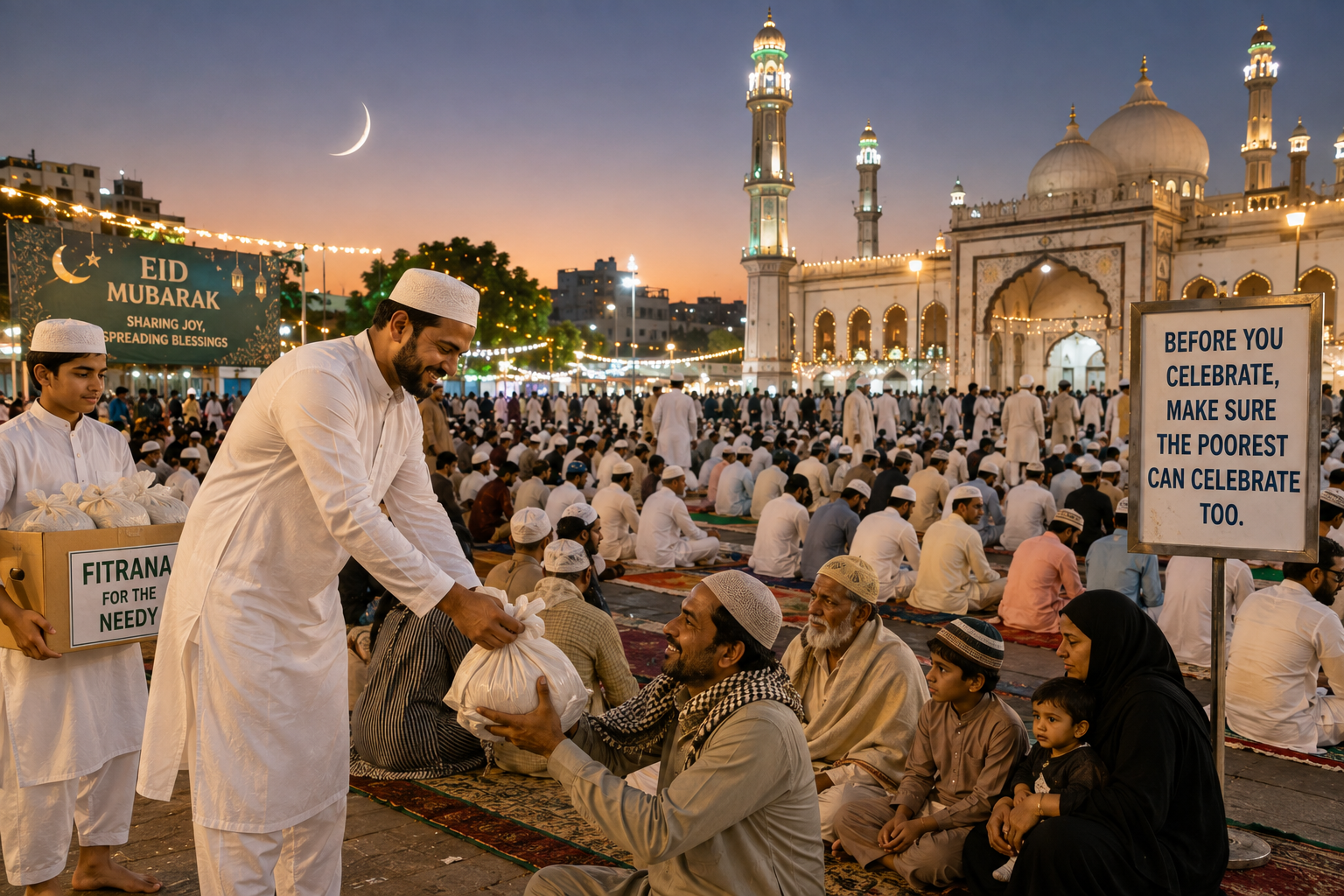
And each one carries, right at its centre, a rule that is easy to miss but easy to love. Before you are allowed to fully celebrate, you must first make sure that the poorest people around you can celebrate too. These are festivals built, from the ground up, to be shared.
A Calendar that Follows the Moon
To understand the Eids, you first have to understand the Islamic calendar, because it is counted by the moon, not the sun.
It has twelve months, and each one begins when the slim new crescent moon is sighted. Twelve of these moon-months add up to about eleven days fewer than a full year of the sun. So the Eids never settle into one season. Each year they arrive about eleven days earlier than the last, and slowly, over a lifetime, they travel backwards through the whole calendar. A Muslim will keep the fast of Ramadan in the long, hot days of summer and, many years later, in the short, cold days of winter.
Because the Eids follow the moon, they slip about eleven days earlier each year, drifting over a lifetime through every season of the year.
And because it all depends on truly seeing the moon, the exact day is not fixed far ahead. It is announced only when the crescent is sighted, which turns the eve of Eid, the “night of the moon,” into a time of happy, hopeful waiting.
The Tashkent Agreement 1966: Peace Treaty or Political Betrayal?
Eid al-Fitr: The Reward at the End of the Fast
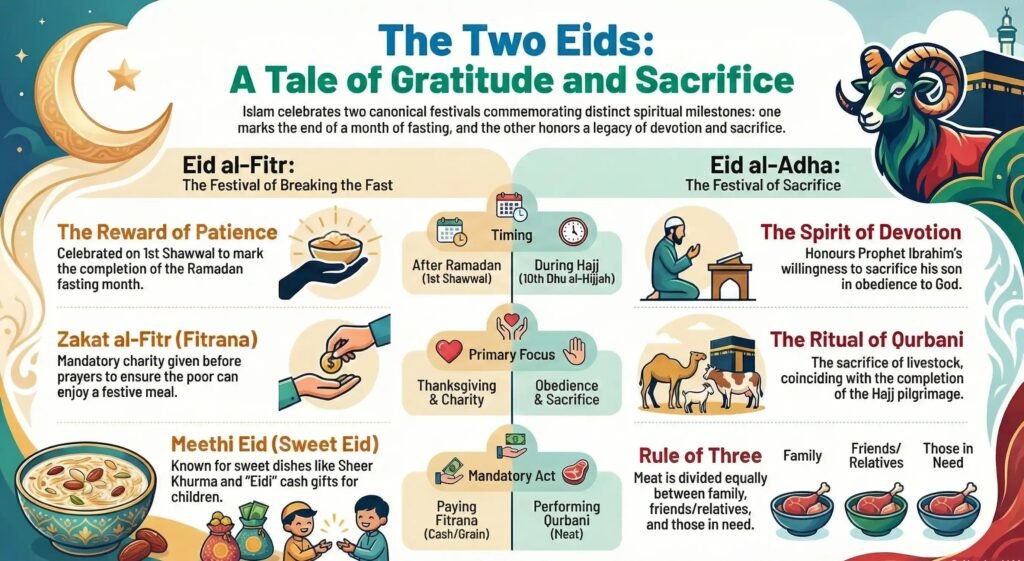
The first of the two is Eid al-Fitr, and it comes at the end of Ramadan.
For one whole month, grown Muslims fast from dawn until sunset. Through all the daylight hours they take no food and no water, and give the time instead to prayer, patience, and the remembering of God. The fasting does something quiet, too. When you yourself go hungry all day long, you begin to feel, in your own body, what the poor feel all the time.
So when the month is finally complete and the new moon is seen, Eid al-Fitr arrives as a joyful reward. It is sometimes called the “sweet Eid.” In the morning, people bathe, put on their finest or newest clothes, and gather in great crowds, often in a wide open ground, to pray together.
But one thing must happen before that prayer.
Before anyone prays on Eid, every family that can afford it must give a fixed gift of food or money to the poor, so that no household, however poor, goes without a proper Eid.
This gift is called Fitrana, and its purpose is exact and beautiful: to make sure that even the poorest family will have enough to eat well and celebrate on Eid day, just like everyone else. In this faith, a person’s own month of fasting is not even considered complete until that gift to the poor has been given. Only then come the sweet dishes, like the warm milk-and-vermicelli sheer khurma of India, the visits from house to house, the calls of “Eid Mubarak,” and the money and gifts pressed happily into the hands of children.
Reign of Akbar 1556-1605: The Golden Age of the Mughal Empire
Eid al-Adha: The Festival of Sacrifice
About two months later comes the second and “greater” Eid: Eid al-Adha, the festival of sacrifice. It remembers a very old and very hard story.
The prophet Ibrahim, known also as Abraham and honoured deeply by Jews and Christians as well, was asked by God, in a dream, to give up his beloved son as the ultimate proof of his faith. Heartbroken but obedient, Ibrahim made ready to do the unthinkable thing that had been asked of him. And at the very last moment, God stopped his hand and placed a ram there in the son’s place. It had all been a test of devotion, and Ibrahim’s willingness had been enough. God, the story teaches, had asked for his heart, and never truly wanted his child.
To honour that faith, families who can afford it sacrifice an animal, usually a goat or a sheep, on this day. And here, once again, sharing is built straight into the festival.
The meat of the sacrifice is divided into three parts: one for the family, one for relatives and friends, and one given to the poor, so that they too have a feast.
This Eid falls at the time of the Hajj, the great pilgrimage to the city of Mecca that every Muslim hopes to make once in a lifetime. So all around the world, this day is tied to that sacred journey.
Razia Sultan: The First and Only Female Ruler of Delhi Sultanate
The Joy that has to be Handed Around
Set the two Eids side by side, and you see the very same idea beating at the heart of both.
On the sweet Eid, you cannot properly celebrate until you have first given the poor enough to celebrate. On the Eid of sacrifice, you cannot keep your feast for yourself, because a full third of it already belongs to those in need. In neither case does the charity come afterwards, as a kind afterthought once the fun is over. It comes first. It is the very key that unlocks the celebration.
That is a striking way to build a festival. It says, quietly but firmly, that happiness kept for yourself alone is not quite complete. A feast, in this way of thinking, is only truly a feast when the person who has nothing is also sitting at the table.
Under the Same Moon
So when the thin crescent moon appears at last, and the word spreads that Eid has come, and the streets fill with new clothes and the smell of sweet milk and roasting meat, something more than a party is taking place. A whole community is making sure, before it lets itself rejoice, that the same moon rising over the rich man’s house is also rising over a poor man’s house, one that now has food on the table and children in new clothes. That is the quiet genius of the two Eids. They are festivals of great joy, but it is a joy with a rule attached to it: that it must be shared out, and shared out, until it has reached everyone, all the way down.
Second Battle of Tarain 1192: The Turning Point of Indian History
If you think you have remembered everything about this topic take this QUIZ
Results


#1. What is the primary reason the dates of the two Eids change every year in relation to the Gregorian calendar?
#2. According to the source material, how is the meat from the Qurbani (sacrifice) traditionally distributed?
#3. Which specific event is celebrated during ‘Chand Raat’?
#4. What is a notable difference in the recitation of the Takbir between Eid al-Fitr and Eid al-Adha?
#5. Why is Eid al-Fitr colloquially referred to as ‘Meethi Eid’ in South Asia?
#6. Which major Islamic religious obligation coincides with the celebration of Eid al-Adha?
#7. In the context of regional Indian traditions, which food item is specifically associated with the Kashmir region during Eid?
#8. When is the mandatory charity known as Fitrana (Zakat al-Fitr) required to be paid?
What is the main difference between the two Eids?
Eid al-Fitr marks the end of fasting (Ramadan), while Eid al-Adha marks the act of sacrifice (Qurbani) and the Hajj pilgrimage.
What is “Eidi”?
Eidi is a gift, usually money, given by elders to children on Eid al-Fitr.
Why is animal sacrifice performed on Eid al-Adha?
It honors Prophet Ibrahim’s willingness to sacrifice his son as an act of obedience to God.
What is the special charity given on Eid al-Fitr called?
It is called Zakat al-Fitr or Fitrana.
Can Muslims fast on Eid day?
No, fasting is strictly prohibited on the days of Eid.
Sources and References
- Wikipedia (“Eid al-Fitr” and “Zakat al-Fitr”) — Eid al-Fitr falling on 1 Shawwal after Ramadan, its dependence on the sighting of the crescent moon, the congregational Eid prayer in an open ground, and Zakat al-Fitr as an obligatory charity of staple food given to the poor before the Eid prayer so that they too can celebrate.
- Muslim Aid and Madinah Media (“guides to the two Eids”) — the requirement to give Zakat al-Fitr before the Eid prayer, the hadith that the fast is suspended until it is paid, the timing of Eid al-Adha in Dhul-Hijjah at the close of Hajj, and the giving of Eidi gifts to children.
- Islamic educational sources (Studio Arabiya, Hope Welfare Trust) — Eid al-Adha commemorating Ibrahim’s willingness to sacrifice his son Ismail and God’s replacement of him with a ram, the Qurbani sacrifice performed after the Eid prayer, and the themes of sacrifice, submission and faith.
- General references on the Islamic calendar — the lunar calendar of twelve months being about eleven days shorter than the solar year, causing the Eids to move earlier each year and shift through the seasons.
- Original Curious Indian article (“Eid al-Fitr and Eid al-Adha”) — the end-of-Ramadan celebration, the festive foods such as sheer khurma, the three-way sharing of the Qurbani meat, and the community prayers and greetings of both Eids.
Author


Exploring the Soul of Bharat through History, Science, Culture, and its Diversity
Our Mission
Curious Indian is a definitive knowledge portal dedicated to chronicling the events, personalities, and cultural shifts that defined the Indian subcontinent. From the ancient Vedic Period to the complexities of 21st-century politics, our goal is to provide deep-dive analysis that inspires.
Editorial Standards & E-E-A-T
Every article published under our brand undergoes a rigorous fact-checking process. We prioritize primary historical records, academic citations, and credible archives to ensure our readers receive accurate, high-authority information.
Historical Integrity Directly sourcing from ASI archives and academic journals.Topical Authority Comprehensive clustering of Indian Science, Biographies, and Wars.Managed by Paripurna Datta and TEAM | Dedicated to the Knowledge of India.