How a Child’s Past-Life Memories Solved a Murder in Agra
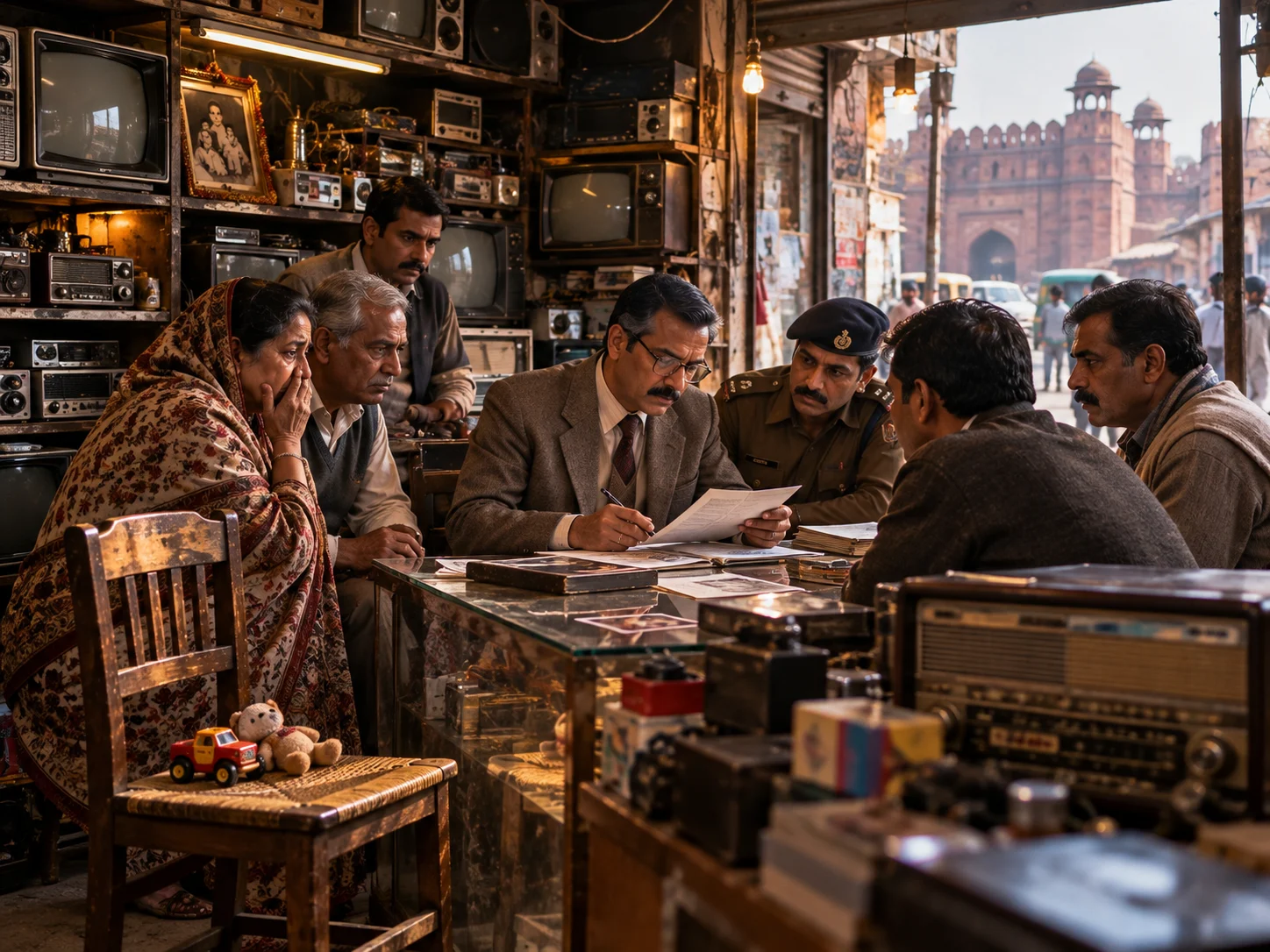
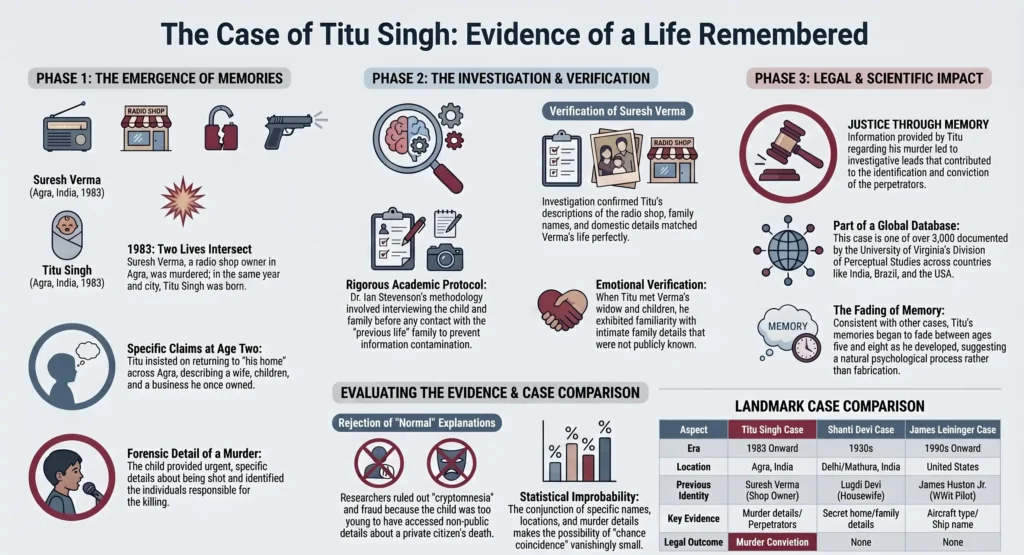
Titu Singh was born in Agra in 1983, and before he was old enough to attend school he was telling his family, with the kind of specificity that distinguishes genuine memory from childhood imagination, that he had another family across town, that he had owned a radio and television shop, that he had a wife and children whose names he knew, and that he had been murdered. His family investigated. Everything he said checked out. The shop existed. The family existed. The wife and children existed. The man whose life he described, Suresh Verma, had indeed been murdered in 1983, the same year Titu was born. And the details Titu provided about the circumstances of that murder, details that a child born in the same year as the crime could not have obtained through ordinary means, eventually contributed to the identification and conviction of the people responsible. The reincarnation case of Titu Singh is one of the most thoroughly documented and most consequentially verified claims of past-life memory in the academic literature, and it sits in that unsettling space where the evidence is too specific to dismiss and the explanation it implies is too large for most frameworks to comfortably contain.
Why Paliwal Brahmins Left Kuldhara in a Single Night and Never Returned
The Child Who Knew Too Much
How the Bhotiya Weavers of Uttarakhand Kept a Himalayan Textile Tradition Alive
Children say surprising things. They have vivid imaginations, limited understanding of the boundaries between real and invented, and a relationship with narrative that adults often find difficult to evaluate accurately. Parents learn, usually quite quickly, to distinguish between the child who is telling a story and the child who is reporting something.
Titu Singh’s parents did not have to learn this distinction gradually. It was made for them by the specific, verifiable, and ultimately consequential nature of what their son was telling them.
He was two or three years old when he began. He wanted to go home. Not to the home he was in but to another home, on the other side of Agra. He described that home. He described the shop he had owned, a radio and television shop. He described his wife. He described his children. He gave names. He described the circumstances of his death, that he had been murdered, and he described, with the particular urgency of a child trying to communicate something important to adults who were not initially sure what to do with what they were hearing, details about the people responsible for that death.
His family, initially uncertain and then increasingly troubled by the specificity of what their son was saying, investigated. They found the shop. They found the family. They found the record of the murder. They found that the names Titu had given matched the names of real people in Suresh Verma’s life. They found, in other words, that everything their child had told them was verifiable and verified.
The case that followed was one of the most thoroughly documented in the global academic literature on reincarnation research. It was also, in its practical consequences, one of the most significant, because the information Titu provided about his claimed murder did not remain simply a matter of academic documentation. It contributed to the identification and conviction of the people responsible for Suresh Verma’s death.
The Research Tradition That Found Him
To understand the significance of the Titu Singh case, it is necessary to understand something about the academic tradition within which it was investigated and documented, because that tradition is itself unusual and often misunderstood.
Dr. Ian Stevenson was a psychiatrist at the University of Virginia who spent over four decades systematically investigating cases of children who claimed memories of previous lives. His approach was rigorously empirical. He did not start from a belief in reincarnation and seek confirming evidence. He started from the observed phenomenon of children making specific, verifiable claims about previous lives and attempted to establish, through careful investigation, what the best available explanation for those claims was.
His methodology involved interviewing the child and the child’s family before any contact was made with the family of the claimed previous-life personality, documenting the specific claims that had been made before verification, then investigating those claims against the available evidence about the claimed previous-life person. Cases were classified according to the strength and specificity of the verified correspondences and the degree to which alternative explanations, including fraud, normal information transfer, and chance coincidence, could be ruled out.
Over four decades, Stevenson and his colleagues, including Dr. Jim Tucker who has continued the work, documented over three thousand cases from countries including India, Sri Lanka, Lebanon, Turkey, Brazil, and the United States. The Indian cases form the largest single national group in the database, reflecting both the cultural context in which parents and children discuss past-life claims openly and the work of Indian researchers including Dr. Satwant Pasricha, whose collaboration with the University of Virginia team produced some of the most carefully documented cases in the literature.
The academic publications produced by this research program are published by university presses and have been cited extensively in the academic literature on consciousness, survival, and the philosophy of mind. The research is not universally accepted by the broader scientific community, but it is also not simply dismissed. It occupies the uncomfortable position of well-conducted research producing results that do not fit comfortably into the dominant materialist framework of contemporary science.
Suresh Verma and the Life That Was Claimed
Goddess Kamakhya and Mythology Behind the Ambubachi Mela
Suresh Verma was a resident of Agra who owned and operated a radio and television shop. He was married, had children, and lived the ordinary life of a small business owner in a mid-sized Indian city. In 1983, he was murdered. The circumstances of his murder, including who was responsible and why, were not immediately resolved by the investigation that followed.
He was, by any ordinary measure, a private person whose life and death would have left no mark on the historical record beyond the records of his family and the investigation into his killing. What brought him into the academic literature on reincarnation research was the child born in Agra in the same year he died who began, before the age of three, to describe his life with a specificity that the investigation confirmed.
The verified correspondences between what Titu said and what was true about Suresh Verma’s life included the location and nature of Suresh Verma’s shop, the names of his wife and children, specific details about his domestic circumstances, and information about the circumstances and perpetrators of his murder. These are not the kinds of correspondences that can be attributed to chance coincidence or to the gradual accumulation of information through normal channels by a two-year-old child.
The murder-related information is the most consequential aspect of the case from a practical standpoint. Titu described the circumstances of Suresh Verma’s death and provided information about the people responsible in sufficient detail that, when investigators followed up on this information, it contributed to the identification and eventual conviction of those responsible.
What the Family Experienced
The experience of Titu’s family during the period when his claims were being made and investigated is one of the most humanly interesting dimensions of the case, and it is one that receives less attention than the forensic and academic dimensions in most accounts of the story.
For a family in Agra in the early 1980s, a young child insisting that he had another family across town and another life before this one was not simply an intellectual puzzle. It was a domestic reality that had to be managed on a daily basis, with the child’s distress at not being with his previous family, his persistent requests to visit the Verma household, his descriptions of a life that was not the life he was currently living, and the gradual, unsettling process of verification that confirmed that what he was saying had a basis in a reality that none of his family had known about.
The initial contact between Titu’s family and Suresh Verma’s family was one of the most emotionally charged moments of the case. Suresh Verma’s widow and children, dealing with an unresolved murder and a grief that had no comfortable endpoint, encountered a small child who knew things about their husband and father that should have been inaccessible to him and who related to them with the familiarity of someone who had known them in a previous life.
The emotional weight of this encounter, for both families, cannot be adequately captured in the academic language of case documentation. For Suresh Verma’s family, the child who arrived claiming to be their husband and father, knowing the names and the interior details of their life together, was not simply a scientific curiosity. He was a profound confrontation with questions about the nature of death and continuity that the loss of a family member to murder had made unbearably urgent.
For Titu’s family, the verification of his claims did not resolve the complexity of their situation. It deepened it. They now had to manage the reality that their child carried, with apparent sincerity and considerable distress, the memories of a life that had ended violently in the same city where their own family lived.
The Academic Documentation
The Titu Singh case was investigated by Dr. Satwant Pasricha, whose career at the National Institute of Mental Health and Neuro Sciences in Bangalore made her the most prominent Indian researcher in the Stevensonian tradition, and whose documentation of Indian reincarnation cases has produced the most comprehensive academic record of this phenomenon in the Indian context.
Pasricha’s documentation of the Titu case follows the standard methodology of the University of Virginia research program. She interviewed Titu and his family, documented the specific claims that had been made before verification, investigated those claims against the available evidence about Suresh Verma’s life and death, and assessed the degree to which the verified correspondences could be explained through normal information transfer.
Her assessment, published in the academic literature and cited in Stevenson’s comprehensive works on Indian reincarnation cases, classified the Titu case as one of the strongest in the Indian dataset, with a combination of specific verified correspondences, the absence of plausible normal explanations for the child’s knowledge, and the practical consequence of the murder investigation that made it unusual even within a dataset of unusual cases.
The case is also documented in Dr. Jim Tucker’s work on reincarnation cases, particularly in his book Return to Life, which presents contemporary cases from the University of Virginia research program for a general audience. Tucker, who has continued and extended Stevenson’s research program at the Division of Perceptual Studies, uses the Titu case as one of the examples of the kind of evidence that the research program considers most significant, specifically cases in which specific verifiable information was provided before investigation confirmed it.
The Division of Perceptual Studies at the University of Virginia, which houses the world’s largest academic database of reincarnation cases, continues to investigate new cases using the methodology established by Stevenson and continues to publish in peer-reviewed academic journals. The Titu case remains one of the landmark cases in their database.
The Competing Explanations
Mythological Origins of the Kumbh Mela and Descent of the Ganga
Any intellectually honest engagement with the Titu Singh case requires engagement with the explanations that skeptics of reincarnation research have proposed for cases of this type, because the academic literature has produced a sustained dialogue between advocates of the survival hypothesis and those who believe that normal explanations are adequate.
The most common alternative explanations for cases like Titu’s include cryptomnesia, the possibility that information about Suresh Verma’s life and death was somehow acquired through normal channels and then forgotten as a source while being retained as apparent memory. In the Titu case, this explanation faces the challenge that the child was between two and three years old when making his claims, in a family with no documented prior connection to Suresh Verma’s family, and was providing specific details that were not publicly known.
The possibility of deliberate fraud, in which one or both families fabricated or elaborated the case for social, financial, or psychological reasons, is assessed in the academic literature as very low for the Titu case, given the quality of the investigation and the specific nature of the verified information, particularly the murder-related information whose verification had practical legal consequences.
The possibility of chance coincidence, that a child could produce by accident a set of specific claims that happen to match a real person’s life in multiple detailed respects, is assessed statistically as extremely unlikely for cases with the degree of specificity documented in the Titu case. The combination of specific names, the shop location, the murder circumstances, and the identity of the perpetrators represents a conjunction of correspondences whose probability of arising by chance is vanishingly small.
What remains after these alternative explanations are assessed is a residual that the normal frameworks of contemporary psychology and neuroscience do not provide a satisfying account of. The reincarnation hypothesis, that Titu’s memories are genuine memories of a previous life, provides a simple and complete explanation for all observed features of the case. Its problem is not that it fails to explain the evidence but that it implies a view of the nature of consciousness and personal identity that most contemporary scientists find difficult to accept.
What the Case Implies
If the case is taken at face value, it implies that some aspect of a person’s experiential and memory content survives physical death and is transferred to or develops within a subsequently born individual in a way that produces accessible memories of the previous life. It implies that this transfer retains sufficient specificity and accuracy to allow the identification of specific people, places, and events in the previous life. And it implies that the timing of this transfer, in the Titu case occurring in the same year as both Suresh Verma’s death and Titu’s birth, is not random.
These implications do not map neatly onto any existing scientific model of consciousness or brain function. They are more compatible with some philosophical and religious frameworks than with others, and the Hindu and Buddhist traditions that dominate the cultural context in which most of the strongest reincarnation cases have been documented have conceptual frameworks that can accommodate what the cases suggest.
The question of what it means that a human being can inherit, in a new life, the specific memories of a previous one, with sufficient clarity to identify its killer and contribute to a murder conviction, is something that the available scientific frameworks describe partially and unsatisfyingly. The best they can offer is that something happened that produced in a child a body of accurate, specific, and consequential information about a dead man’s life that the child had no ordinary means of acquiring.
What that something was remains, as honestly as the evidence allows it to remain, an open question.
The Child Who Grew Up
Titu Singh grew up. Children who claim past-life memories typically lose those memories between the ages of five and eight, as the intensity of early childhood fades and the ordinary processes of development fill the cognitive and emotional space that the previous-life memories had occupied. Titu’s case followed this pattern. As he grew older, the memories became less vivid, the urgency to visit Suresh Verma’s family decreased, and the distance between the life he was living and the life he remembered grew.
This fading is itself one of the most interesting features of the broader category of cases that Stevenson documented. It is not consistent with the pattern that deliberate fabrication would produce, where memories would be maintained and elaborated over time, but is consistent with a model in which genuine memories from a previous developmental period fade as the current developmental period takes precedence.
Titu grew up in Agra, in the family that had raised him, carrying in adulthood the knowledge of what he had claimed as a child and what those claims had led to, the investigations, the families, the academic documentation, and the murder conviction to which his information had contributed. The adult he became is not the subject of the academic literature to the same degree that the child he was is. But the child he was is the reason the case matters, and the case matters because it sits at the edge of what the available frameworks can explain and asks, with the insistence of a child who knows what he knows, for a more adequate account of what a human being actually is.
The Mysterious 500 Year Old Mummy of Sangha Tenzin in Spiti Valley
If you think you have remembered everything about this topic take this QUIZ
Results


#1. In which city was Titu Singh born in 1983, where he made his claims of past-life memories?
#2. Who did Titu Singh claim to have been in his previous life?
#3. What type of commercial business did the previous personality run before being murdered in 1983?
#4. At what approximate age did Titu Singh first begin making specific claims about his past life?
#5. Which Indian researcher from the National Institute of Mental Health and Neuro Sciences investigated Titu’s case?
#6. Titu Singh’s case is housed in the academic database of which global research institution?
#7. What unique practical outcome distinguishes the Titu Singh case from most other reincarnation research cases?
#8. According to research patterns, at what approximate age do past-life memories typically fade in children?
Who was Titu Singh and what did he claim?
Titu Singh was born in Agra in 1983 and began claiming from approximately age two or three that he had previously lived as Suresh Verma, a radio and television shop owner in the same city. He provided specific details including the names of Suresh Verma’s family members, the location of the shop, and information about Suresh Verma’s murder, all of which were verified by investigators. The case was formally documented by Dr. Satwant Pasricha and is classified in the academic reincarnation research literature as among the strongest verified cases globally.
How was the case investigated academically?
The case was investigated by Dr. Satwant Pasricha of the National Institute of Mental Health and Neuro Sciences in collaboration with the research program of Dr. Ian Stevenson at the University of Virginia. The methodology involved documenting Titu’s specific claims before verification, investigating those claims against available evidence about Suresh Verma’s life and death, and assessing the degree to which alternative explanations including fraud, normal information transfer, and chance coincidence could account for the verified correspondences. The investigation concluded that the case represented one of the strongest in the Indian dataset.
What connection does the case have to a murder conviction?
The information Titu provided about the circumstances of Suresh Verma’s murder and the identity of those responsible is documented as having contributed to the identification and eventual conviction of the perpetrators. This makes the Titu case one of very few reincarnation cases anywhere in the world with a documented criminal justice consequence and adds a dimension of practical significance to what would otherwise be primarily an academic documentation.
What alternative explanations have been proposed for the case?
Skeptical explanations include cryptomnesia, the possibility that information about Suresh Verma was somehow acquired through normal channels before being forgotten as a source, deliberate fraud by one or both families, and chance coincidence. Researchers assess all three as inadequate to the specific features of the Titu case. The child’s age at the time of his claims, the absence of documented prior connection between the families, the specificity of the verified information, and the murder-related details whose verification had legal consequences collectively make the normal explanations difficult to sustain.
Do past-life memories in such cases persist into adulthood?
Research on children who claim past-life memories consistently shows that such memories typically fade between the ages of five and eight, as normal developmental processes take precedence. The Titu case followed this pattern, with the intensity of his previous-life memories decreasing as he grew older. This fading pattern is considered by researchers to be inconsistent with deliberate fabrication, which would produce maintenance and elaboration of claimed memories over time, and consistent with genuine early childhood memories that compete with and are eventually displaced by the memories and experiences of the current life.
Sources & References
Titu Singh’s claims and family investigation — Born in Agra in 1983, Titu began at age two or three describing a previous life as Suresh Verma, a radio and television shop owner, providing specific details including family names, the shop location, and information about how Suresh Verma was murdered, all of which his family verified through investigation.
The academic research tradition of Ian Stevenson — Dr. Ian Stevenson spent over four decades systematically investigating cases of children claiming past-life memories, developing rigorous methodology that involved documenting claims before verification and investigating them against available evidence, accumulating over three thousand documented cases from multiple countries.
Dr. Satwant Pasricha’s investigation and classification — Dr. Satwant Pasricha at the National Institute of Mental Health and Neuro Sciences in Bangalore investigated the Titu case and classified it as one of the strongest verified reincarnation cases in the Indian dataset, notable for specific verified correspondences and the practical consequence of the murder investigation.
Murder investigation consequences and verified correspondences — The information Titu provided about Suresh Verma’s death and the perpetrators contributed to identification and conviction in the criminal case, making it one of very few reincarnation cases globally with documented criminal justice consequences, and the verified correspondences included family names, shop details, and murder-specific information.
Fading of past-life memories with age — Children who claim past-life memories typically lose those memories between ages five and eight as normal development proceeds, a pattern consistent with genuine early childhood memory fading rather than deliberate fabrication, which would typically produce maintenance and elaboration of claimed memories.