Wednesday, May 20, 2026
19 °c
Columbus
Curious Indian
  • Arts & Culture
  • Festivals of India
  • Indian History
  • Indian Politics
  • Biography
    • Entertainment Personalities
    • Science Personalities
  • Unsolved India
No Result
View All Result
  • Arts & Culture
  • Festivals of India
  • Indian History
  • Indian Politics
  • Biography
    • Entertainment Personalities
    • Science Personalities
  • Unsolved India
No Result
View All Result
Curious Indian
No Result
View All Result
Home Indian History Battles of India

The Battle of Saraighat That Stopped a Mughal Empire

Curious Indian by Curious Indian
in Battles of India, Indian History, Medieval India, North East India
Reading Time: 16 mins read
0 0
A A
The Battle of Saraighat
Share on FacebookShare on Twitter

Table of Contents

Toggle
  • The Battle of Saraighat 1671 CE: Lachit Borphukan’s Greatest Hour
  • The Humiliation That Lit the Fire
  • Who Was Lachit Borphukan?
  • The Uncle Who Slowed the Work
  • The Mughal Machine Arrives
  • The Genius of Choosing Saraighat
  • The Difficult Months Before the Battle
  • The Day a Sick Man Saved His Kingdom
  • What Happened After the Battle
  • The Legacy of Saraighat in Modern India
  • Quick Comparison Table: Ahom vs. Mughal Forces at Saraighat 1671 CE
  • Curious Indian: Fast Facts
  • Conclusion
  • If you think you have remembered everything about this topic take this QUIZ
  • Results
    • #1. In which year did the Battle of Saraighat take place?
    • #2. Who was the Mughal commander sent by Emperor Aurangzeb to lead the campaign against the Ahom Kingdom?
    • #3. What was the name of the golden-handled sword given to Lachit Borphukan as a symbol of his authority?
    • #4. Why did Lachit Borphukan choose Saraighat as the primary battlefield?
    • #5. Which 1663 treaty had previously humiliated the Ahom Kingdom, leading to the loss of territory and treasure?
    • #6. What action did Lachit Borphukan take against his own maternal uncle during the preparation for the battle?
    • #7. How is Lachit Borphukan’s legacy specifically honored at the National Defence Academy (NDA) in Pune?
    • #8. On which date is “Lachit Divas” celebrated annually in Assam?
    • What was the Battle of Saraighat?
    • Why is the Battle of Saraighat so important in Indian history?
    • How did Lachit Borphukan use psychological warfare at Saraighat?
    • What happened to Lachit Borphukan after the battle?
    • How is Lachit Borphukan remembered today?
In 1671, on the narrow waters of the Brahmaputra River at Saraighat in present-day Guwahati, one of the most remarkable military upsets in Indian history quietly unfolded. A small but fiercely determined Ahom Kingdom, led by the brilliant and gravely ill general Lachit Borphukan, stood its ground against a colossal Mughal armada sent by Emperor Aurangzeb under the command of Raja Ram Singh I. Using riverine tactics, psychological warfare, guerrilla intelligence, and a breathtaking display of personal courage, Lachit forced the Mughals into retreat — not just from the battlefield, but from Assam forever in spirit. The Battle of Saraighat became the last serious Mughal attempt to conquer the Northeast, and Lachit Borphukan became an immortal symbol of what one person's conviction can do against seemingly impossible odds.
DetailInformation
Battle NameBattle of Saraighat
Date1671 CE (March)
LocationSaraighat, Brahmaputra River, Guwahati, Assam
Ahom CommanderLachit Borphukan
Mughal CommanderRaja Ram Singh I (Kachwaha)
Mughal EmperorAurangzeb
Type of BattleNaval + Land (primarily riverine)
OutcomeDecisive Ahom Victory
SignificanceLast major Mughal attempt to conquer Assam
Lachit’s Lifespan24 Nov 1622 – 25 April 1672
Lachit DivasCelebrated annually on 24th November in Assam
MemorialLachit Maidam, Holongapar, Jorhat

The Battle of Saraighat 1671 CE: Lachit Borphukan’s Greatest Hour

The Battle of Saraighat That Stopped a Mughal Empire

The Humiliation That Lit the Fire

To understand the Battle of Saraighat, you need to understand the shame that came eight years before it. In 1663 CE, the Mughal general Mir Jumla swept into Assam with a vast army, occupied the Ahom capital, and forced the Ahom king to accept one of the most humiliating peace agreements in the kingdom’s history. The Treaty of Ghilajharighat made the Ahom king bow before Emperor Aurangzeb. Treasure was handed over. Territory was surrendered. An Ahom princess was given away as part of the settlement.

The Ahom king Jayadhwaj Singha never recovered from this. He died not long after, but before he did, he said something to his cousin and successor Chakradhwaj Singha that became one of the most important sentences in the history of Assam. He asked him to remove the spear of humiliation from the bosom of the nation. Those words were not forgotten. They were carried forward like a flame and eventually they found the man who would act on them.

Lachit Borphukan was that man.

Who Was Lachit Borphukan?

Lachit Borphukan was born on 24 November 1622 CE. His father, Momai Tamuli Borbarua, had risen from humble origins to become one of the most powerful officials in the entire Ahom administrative system. Growing up in that household meant growing up with an intimate understanding of both the responsibilities of power and the consequences of failure.

Lachit was trained not just in warfare but in the full range of duties that a senior Ahom official was expected to master. He served as Superintendent of the Royal Horses, as Commander of the Simulgarh Fort, and as Superintendent of the Royal Household Guards. Each of these posts tested a different set of skills: logistics, fortification, and close personal loyalty to the king. By the time he was chosen to reclaim Guwahati from the Mughals, he had been shaped by every one of these experiences.

When King Chakradhwaj Singha decided the time had come to push the Mughals back, he appointed Lachit as Commander-in-Chief and gave him a golden-handled sword called the Hengdang as a symbol of the full authority and faith of the kingdom. It was more than a weapon. It was a statement. The king was putting everything he had into the hands of one man.

READ MORE:  Uddalaka Aruni: The First Scientist in History

Lachit’s first campaign, launched from his base at Kaliabor in August 1667 CE, was a success. He drove the Mughals out of Guwahati in November 1667 CE, a victory that restored Ahom honour and reclaimed the city that housed the sacred Kamakhya Temple. But everyone in the Ahom court knew that the Mughals would be back. The question was not whether they would return. The question was whether Assam would be ready.

The Uncle Who Slowed the Work

One of the most famous stories from the preparation for the Battle of Saraighat is not about strategy or weapons. It is about a moment that tells you everything about who Lachit Borphukan was.

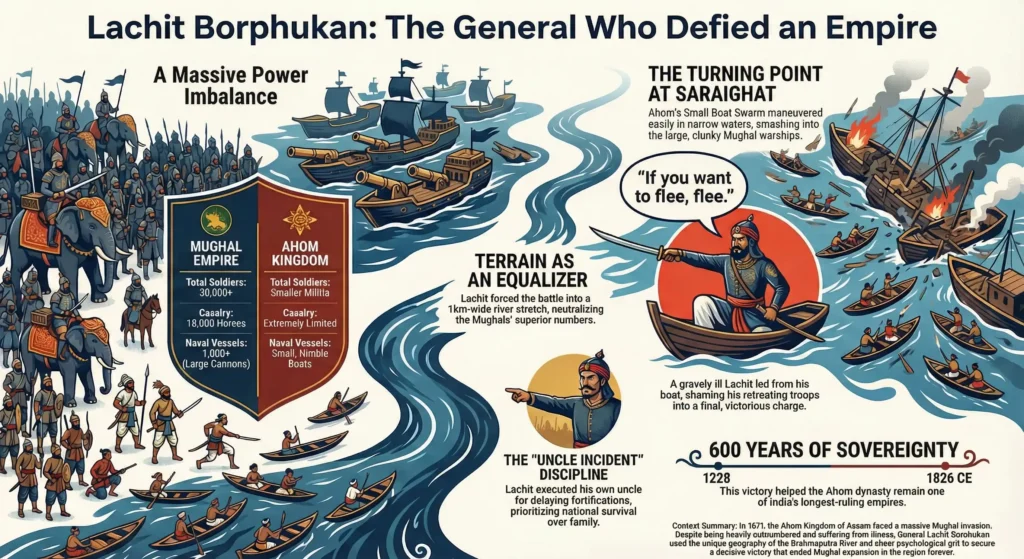
In the months before the battle, Lachit ordered the construction of a massive system of earthen embankments around Guwahati. These earthworks were central to his plan. They would make it almost impossible for Mughal cavalry to advance through the city and force the Mughals to use the river. If they came by river, they would come on Lachit’s terms.

The construction was urgent. Time was not something Lachit had in abundance. One of the supervisors responsible for a section of the embankment work was his own maternal uncle. Lachit found that his uncle had allowed the work on his section to slow down. Whether this was laziness, corruption, or simple inefficiency, the result was the same. Part of the defensive wall that Assam’s survival might depend on was not ready.

Lachit had his uncle executed.

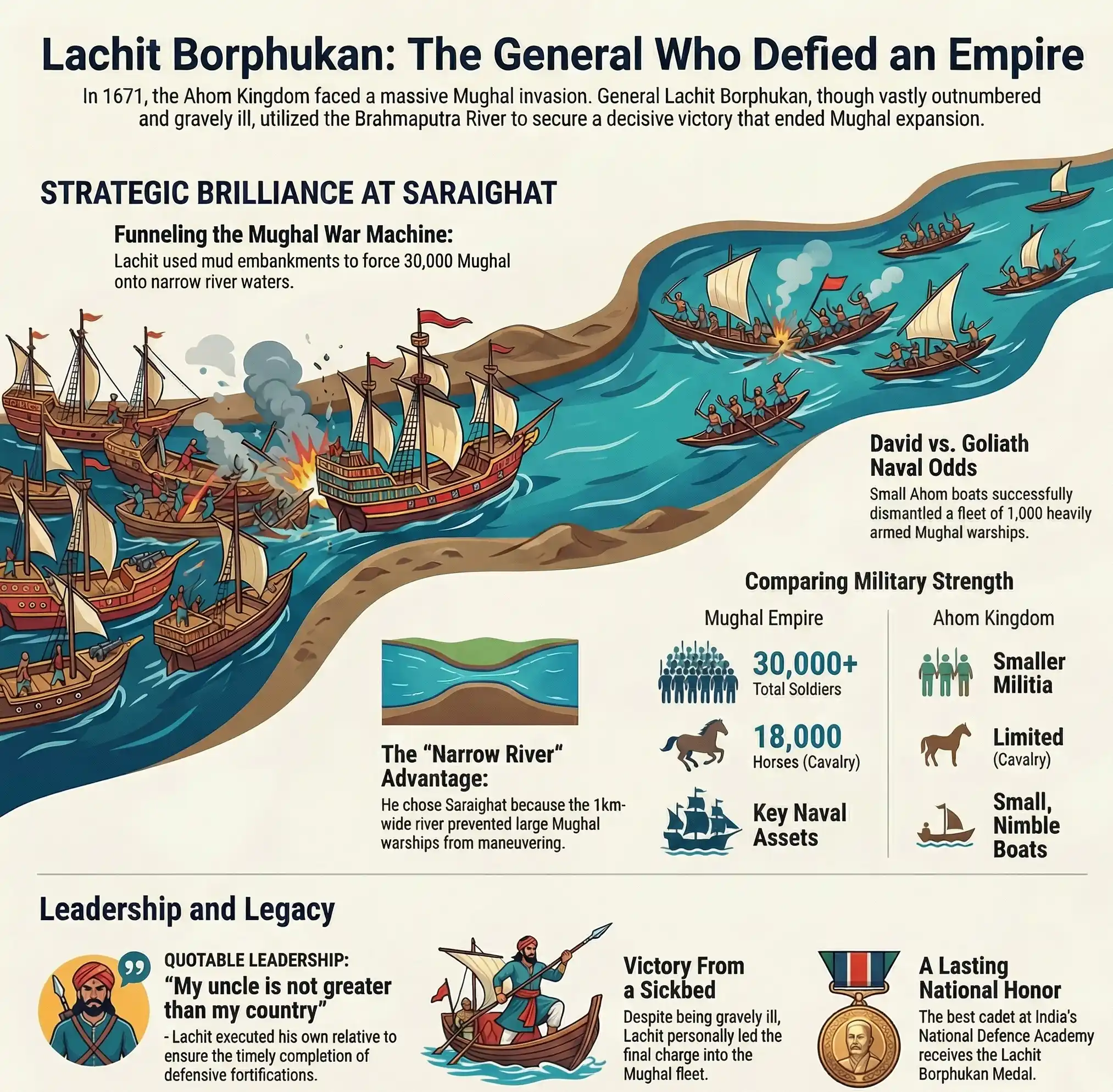
His explanation was reported in the Ahom records as something close to this: my uncle is not greater than my country. Those words became as famous as any battle order he ever gave. They tell you what kind of commander Lachit was. Not a man who confused personal loyalty with duty. Not a man who let affection override the responsibilities of his command. A man who understood that some things matter more than family and that the defence of a kingdom was one of them.

The Mughal Machine Arrives

By 1671 CE, Emperor Aurangzeb had run out of patience with Assam. He assembled one of the most powerful forces ever sent to the northeastern frontier of the empire. The command was given to Raja Ram Singh I, a Rajput general from the Kachwaha clan of Amber who was a formidable and experienced military commander.

The scale of what Ram Singh brought to Assam was genuinely overwhelming on paper. More than thirty thousand soldiers. Eighteen thousand cavalry. Over a thousand warships, some of them large vessels carrying up to sixteen cannons each and crewed in part by foreign gunners who had experience with the kind of naval warfare the Mughals were planning to fight. There were also trained war elephants, land artillery, and the full logistical support of the wealthiest empire in Asia behind them.

Against this, Lachit had the Ahom militia, a smaller fleet of lighter and more manoeuvrable boats, the earthworks he had built around Guwahati, and the Brahmaputra river itself.

He also had a plan.

The Genius of Choosing Saraighat

Lachit understood one fundamental truth about fighting a stronger enemy: you do not let them fight the battle they want to fight. You choose the ground that takes away their advantages and magnifies yours.

The Mughal strength was in open ground. Their cavalry of eighteen thousand horses was one of the most powerful offensive forces in Asia in conditions where horses could move freely. Their large warships were formidable in wide, open water where they could manoeuvre, bring their cannons to bear, and deploy their numerical superiority.

Lachit’s earthworks around Guwahati made the land option almost impossible. The embankments created channels and barriers that cavalry could not easily cross. The Mughals who tried to advance by land found themselves channelled, slowed, and vulnerable to Ahom attacks from fortified positions.

So the Mughals came by river. And Saraighat was where Lachit was waiting.

The Brahmaputra at Saraighat, near present-day Guwahati, narrows to approximately one kilometre in width. This is not much space for a fleet of a thousand warships. Large vessels that were formidable in open water became clumsy and difficult to manoeuvre in a narrow channel. Their cannons, designed to fire across open water, were less effective when ships were crowded together and unable to rotate and aim freely. The advantage that the sheer size of the Mughal fleet gave them in open conditions was drastically reduced in the narrow waters that Lachit had chosen as his battlefield.

The Ahom boats, smaller and faster, could move through these narrows with an agility that the large Mughal warships could not match. Lachit’s fighters knew these waters the way a farmer knows his fields. They had grown up beside this river. They understood its currents, its shallows, and its hidden passages in a way that no Mughal fleet commander, however capable, could replicate.

READ MORE:  Anglo-Manipuri War 1891: When Manipur Chose to Fight to the Last Man

The Difficult Months Before the Battle

The final confrontation at Saraighat did not come immediately. There were months of skirmishes, diplomatic manoeuvring, and military pressure during which both sides tested the other. The Mughals attempted to advance on multiple fronts. Lachit responded to each probe while conserving the strength of his main force for the decisive engagement.

There was also a painful defeat to absorb. At the Battle of Alaboi in 1669 CE, the Ahom forces suffered serious casualties against the Mughal land forces. It was a heavy blow. A lesser commander might have been broken by it. Lachit absorbed it, analysed what had gone wrong, and continued building toward the moment he was waiting for. He understood that one lost battle does not decide a war. The battle that decides a war is the one you choose to make decisive.

By 1671 CE, the conditions were right. The Mughals had committed their fleet to the Brahmaputra. They were coming through Saraighat. Lachit was ready.

The Day a Sick Man Saved His Kingdom

Here is where the Battle of Saraighat moves from being a story about military strategy to being a story about a human being.

When the final confrontation came, Lachit Borphukan was gravely ill. The illness that would kill him less than a year later was already consuming him. He could barely stand. His officers knew it. His soldiers knew it. Some of the Ahom boats had already begun pulling back from the advancing Mughal fleet, the morale of the fighters wavering under the weight of what they were facing.

Lachit had himself carried to a boat.

He went to the front of the Ahom line. With seven boats alongside him, he directed his vessel forward into the Mughal fleet. He called out to the men who were retreating and told them that if they wanted to leave, they could leave. He told them the king had given him a task and he would carry it out. He told them to report to the king that his general had fought well following orders.

Those words stopped the retreat.

The Ahom fleet turned and came forward together. Lachit led them into the Mughal warships, using the speed and agility of the smaller Ahom boats to get inside the range of the large Mughal cannons, where the Mughals could not bring their biggest weapons to bear. The Ahom boats moved fast, struck hard, and did not give the Mughal fleet the space it needed to organise a coordinated response.

The Mughal admiral Munnawar Khan was killed during the battle. His death shattered the command structure of the Mughal fleet at the critical moment. The Mughal ships, already struggling in the narrow waters, lost their coordination. The retreat that followed carried the entire Mughal force back to the Manas river, the western boundary of the Ahom Kingdom.

The greatest army the Mughals had ever sent to Assam had been defeated by a sick man on a small boat who refused to stop.

What Happened After the Battle

Lachit Borphukan died on 25 April 1672 CE, less than a year after his greatest victory. He was forty-nine years old. His remains lie at the Lachit Maidam in Holongapar, Jorhat, a memorial that the people of Assam have honoured and maintained for over three hundred and fifty years.

He did not live to see the Mughals expelled from Assam completely and permanently. That final expulsion came in 1682 CE, during the reign of King Gadadhar Singha, at the Battle of Itakhuli. But it was the Battle of Saraighat that made 1682 possible. Lachit’s victory broke the Mughal will to fight for Assam. Every expedition that followed the defeat at Saraighat faced an Ahom Kingdom that knew it had beaten the Mughals at their worst and every Mughal general who considered the campaign faced the memory of what had happened to the fleet of a thousand warships on the Brahmaputra.

The Mughal Empire, for all its power, never seriously tried to take Assam again.

The Legacy of Saraighat in Modern India

For most of Indian history after independence, the Battle of Saraighat and the name of Lachit Borphukan were known deeply in Assam but barely at all in the rest of the country. That has been changing.

Every year on 24 November, Assam observes Lachit Divas as a state holiday. The date marks the birthday of Lachit Borphukan and the whole of Assam stops to remember what he did for the kingdom and the culture that the Ahom rulers had built. Schools hold programmes. Government offices observe the day. Communities gather to hear the story told again, because in Assam the story of Lachit Borphukan is not history that you read once and set aside. It is something you are brought back to every year because the people of Assam know that what he protected is still worth protecting.

READ MORE:  Chola Dynasty: Architects of the Great Living Chola Temples

At the national level, the National Defence Academy in Pune, where India’s military officers are trained, has a statue of Lachit Borphukan on its grounds. He is one of the very few pre-modern Indian military commanders to receive this honour. Every year, the best graduating cadet at the National Defence Academy receives the Lachit Borphukan Gold Medal. The Indian military establishment has recognised in Lachit Borphukan the kind of military mind and personal courage that speaks to what military excellence actually means, not just numbers and firepower but the ability to think clearly, choose ground wisely, and lead from the front when the moment demands it.

Quick Comparison Table: Ahom vs. Mughal Forces at Saraighat 1671 CE

FactorAhom KingdomMughal Empire
CommanderLachit BorphukanRaja Ram Singh I
Total SoldiersSmaller militia forceOver 30,000 soldiers
CavalryLimited18,000 horses
Naval FleetSmall, fast, manoeuvrable boats1,000 warships, 16-cannon vessels
Terrain AdvantageFull knowledge of the Brahmaputra narrowsNo local knowledge
Key StrengthEarthworks, river tactics, personal leadershipNumerical and technological superiority
Admiral LostNoneMunnawar Khan killed in battle
Final OutcomeDecisive victoryRetreat to Manas river

Curious Indian: Fast Facts

Lachit Borphukan once had his own maternal uncle executed for slowing down the construction of defensive embankments before the Battle of Saraighat. His recorded words were close to: my uncle is not greater than my country. This incident is still taught as a lesson in discipline and duty across Assam.

The Brahmaputra river at Saraighat narrows to approximately one kilometre, which is precisely why Lachit chose it as his battlefield. This narrow stretch made the Mughal fleet of over a thousand ships almost impossible to manoeuvre effectively.

The best graduating cadet at India’s National Defence Academy in Pune receives the Lachit Borphukan Gold Medal every year, a national recognition of a Northeast Indian general who for most of Indian history was celebrated only within Assam.

Lachit Borphukan’s warrior Bagh Hazarika, whose name means tiger, earned his title by killing a tiger with his bare hands. He fought alongside Lachit at Saraighat and is remembered as one of the most fearless fighters in Ahom military history.

Lachit Borphukan died on 25 April 1672 CE, less than a year after his greatest victory. He was forty-nine years old. He is buried at the Lachit Maidam in Holongapar, Jorhat, which remains one of the most visited memorial sites in Assam.

The Ahom Kingdom that Lachit fought to protect had already been standing for over four hundred years by the time of the Battle of Saraighat. It would continue for another one hundred and fifty-five years until the Treaty of Yandabo in 1826 CE. The kingdom that Sukaphaa had started with a mountain crossing in 1228 CE lasted a total of nearly six hundred years, one of the longest-running dynasties in all of Indian history.

The Battle of Itakhuli in 1682 CE, which finally drove the Mughals out of Assam permanently, was made possible entirely by what Lachit Borphukan had achieved at Saraighat eleven years earlier. He never saw it but he made it happen.

Conclusion

The Battle of Saraighat is the kind of story that India does not tell itself often enough. A general from a kingdom that most history textbooks barely mention, fighting on a river that the rest of the country had largely forgotten, defeating the most powerful empire in Asia with smaller boats and bigger courage. Lachit Borphukan was ill the day he led his fleet into the Mughal armada. He could have stayed on shore. He could have let his officers handle the battle. He chose to go to the front. He chose to make his presence the thing that turned the tide. And because he did, Assam remained Assam. The Brahmaputra still flows through Guwahati. The Kamakhya Temple still stands on Nilachal Hill. And every year on 24 November, a whole state stops what it is doing to remember the man who made a choice on a boat in a narrow river and changed the course of history.

If you think you have remembered everything about this topic take this QUIZ


Results

Share your score!
Tweet your score!
Tweet your score!
Share to other
QUIZ START

#1. In which year did the Battle of Saraighat take place?

Previous
Next

#2. Who was the Mughal commander sent by Emperor Aurangzeb to lead the campaign against the Ahom Kingdom?

Previous
Next

#3. What was the name of the golden-handled sword given to Lachit Borphukan as a symbol of his authority?

Previous
Next

#4. Why did Lachit Borphukan choose Saraighat as the primary battlefield?

Previous
Next

#5. Which 1663 treaty had previously humiliated the Ahom Kingdom, leading to the loss of territory and treasure?

Previous
Next

#6. What action did Lachit Borphukan take against his own maternal uncle during the preparation for the battle?

Previous
Next

#7. How is Lachit Borphukan’s legacy specifically honored at the National Defence Academy (NDA) in Pune?

Previous
Next

#8. On which date is “Lachit Divas” celebrated annually in Assam?

Previous
Finish

What was the Battle of Saraighat?

The Battle of Saraighat was a decisive naval battle fought in 1671 on the Brahmaputra River in present-day Guwahati, Assam. The Ahom Kingdom, led by Lachit Borphukan, defeated the Mughal Empire’s forces led by Raja Ram Singh I.

Why is the Battle of Saraighat so important in Indian history?

It was the last major attempt by the Mughal Empire to conquer Assam. The Ahom victory halted Mughal expansion into Northeast India and showcased one of the most brilliant uses of riverine warfare strategy in medieval Indian military history.

How did Lachit Borphukan use psychological warfare at Saraighat?

When Ahom boats began retreating, the gravely ill Lachit had himself carried to the front of battle on a boat and publicly declared he would fight alone if needed. This act of personal courage instantly reversed the morale of his troops and terrified the Mughals.

What happened to Lachit Borphukan after the battle?

Lachit Borphukan passed away in April 1672, just about a year after his victory at Saraighat. He is buried at the Lachit Maidam in Holongapar, Jorhat, Assam, which remains a revered memorial to this day.

How is Lachit Borphukan remembered today?

Assam celebrates Lachit Divas every year on 24th November. The best graduating cadet at India’s National Defence Academy in Pune receives the Lachit Borphukan Gold Medal. His statue also stands at the NDA campus, cementing his place as one of India’s greatest military heroes.

Tags: Ahom KingdomIndian Naval HistoryLachit BorphukanMedieval IndiaMughal EmpireNorth East India
ShareTweetPin
Curious Indian

Curious Indian

Curious Indian Exploring the Soul of Bharat through History, Science, Culture, and its DIVERSITY
• Our Mission Curious Indian is a definitive knowledge portal dedicated to chronicling the events, personalities, and cultural shifts that defined the Indian subcontinent. From the ancient Vedic Period to the complexities of 21st-century politics, our goal is to provide deep-dive analysis that inspires.
• Editorial Standards & E-E-A-T Every article published under our brand undergoes a rigorous fact-checking process. We prioritize primary historical records, academic citations, and credible archives to ensure our readers receive accurate, high-authority information.
Historical Integrity Directly sourcing from ASI archives and academic journals.
Topical Authority Comprehensive clustering of Indian Science, Biographies, and Wars.
Managed by Paripurna Datta and TEAM | Dedicated to the Knowledge of India.

Related Posts

Khudiram Bose
Biography

The Final Letters of Khudiram Bose and Soul of Young Bengal

May 19, 2026
Bhikaiji Cama
Biography

How Madam Bhikaiji Cama Unfurled India’s Flag in Germany

May 19, 2026
Matangini Hazra
Biography

Matangini Hazra: The Widow Who Walked Into Gunfire

May 19, 2026
No Result
View All Result

Stay Updated

  • Trending
  • Latest
Life of Mahavira: From Prince Vardhamana to Great Conqueror

Life of Mahavira: From Prince Vardhamana to Great Conqueror

April 11, 2026
Life of Buddha: The Journey to Enlightenment

Life of Buddha: The Journey to Enlightenment

April 11, 2026
Christmas in India

Christmas in India: A Festive Blend of Faith, Flavors, and Tradition

April 11, 2026
From Shimla to Stardom: The Complete Biography of Anupam Kher

From Shimla to Stardom: The Complete Biography of Anupam Kher

April 11, 2026
Khudiram Bose

The Final Letters of Khudiram Bose and Soul of Young Bengal

May 19, 2026
Bhikaiji Cama

How Madam Bhikaiji Cama Unfurled India’s Flag in Germany

May 19, 2026
Matangini Hazra

Matangini Hazra: The Widow Who Walked Into Gunfire

May 19, 2026
Gommateshwara statue

Gommateshwara Statue and the Philosophy of Inner Peace

May 19, 2026

Widget Title

Facebook Twitter Youtube RSS
Curious Indian Logo

Explore the soul of Bharat with Curious Indian. A definitive guide to Indian history, arts, culture, biographies, and the events that defined our future.

Follow us on social media:

Recent News

  • The Final Letters of Khudiram Bose and Soul of Young Bengal
  • How Madam Bhikaiji Cama Unfurled India’s Flag in Germany
  • Matangini Hazra: The Widow Who Walked Into Gunfire

Category

  • Ancient Civilizations & The Vedic Age
  • Architecture
  • Artists & Cultural Icons
  • Arts & Culture
  • Battles of India
  • Biography
  • Business & Industrialists
  • Colonial India
  • Cultural Insights
  • Dance & Music
  • Entertainment Personalities
  • Festivals of India
  • Freedom Fighters
  • Freedom Movement
  • Historical Events & Turning Points
  • Indian History
  • Indian Politics
  • Major Festivals
  • Medieval India
  • North East India
  • Paintings & Visual Arts
  • Political Leaders
  • Post-Independence India
  • Regional Culture
  • Religious & Spiritual Figures
  • Science Personalities
  • Scientific Discoveries
  • Sculpture
  • Social Issues
  • SOCIETY & MYSTERIES
  • Strange & Unknown Stories
  • Textiles & Handicrafts
  • Uncategorized
  • Unsolved India
  • Unsung Heroes

© 2026 Curious Indian- Everything about India

Welcome Back!

Login to your account below

Forgotten Password?

Retrieve your password

Please enter your username or email address to reset your password.

Log In

Add New Playlist

No Result
View All Result
  • Arts & Culture
  • Festivals of India
  • Indian History
  • Indian Politics
  • Biography
    • Entertainment Personalities
    • Science Personalities

© 2026 Curious Indian- Everything about India

This website uses cookies. By continuing to use this website you are giving consent to cookies being used. Visit our Privacy and Cookie Policy.
Are you sure want to unlock this post?
Unlock left : 0
Are you sure want to cancel subscription?
×