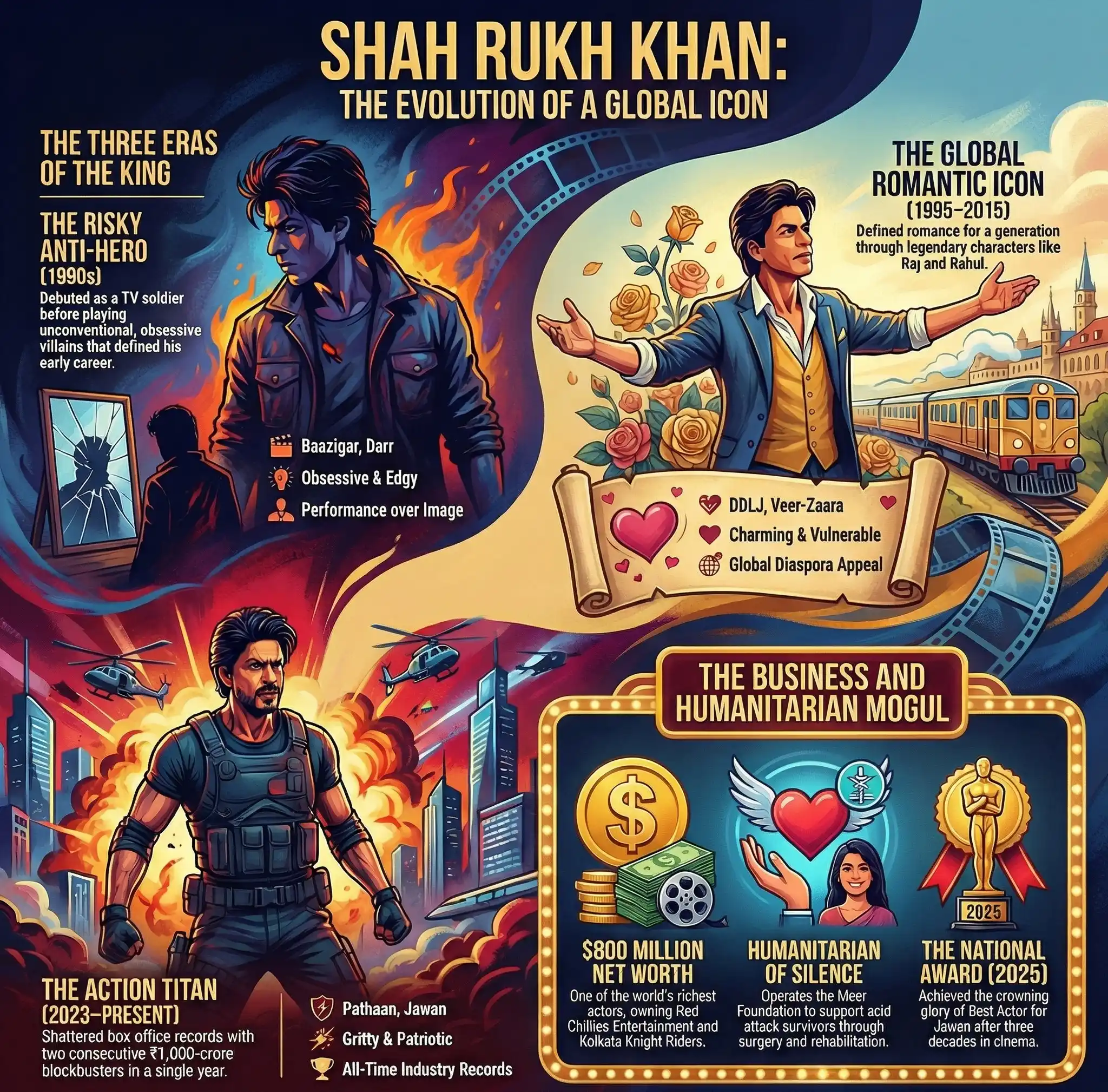
Shah Rukh Khan took the parts insiders would not touch, and then built the machinery so he would not have to be cast again
In 1993 he played a man who throws a woman off a roof, and a man who terrorises one until her husband kills him.
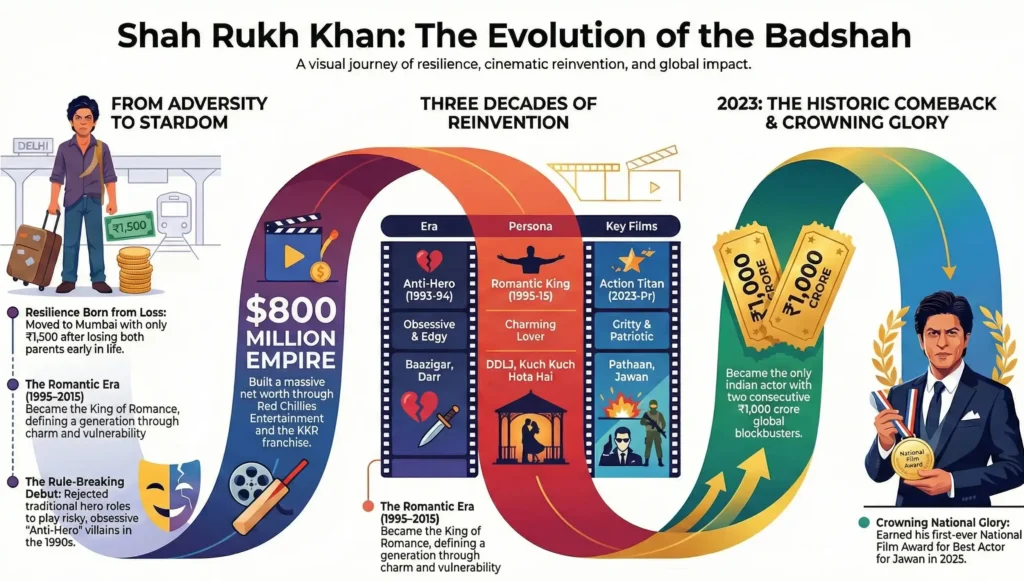
Baazigar and Darr came out within months of each other. At the time the settled wisdom was that a leading man who played a villain had finished himself, and parts of that kind went round the industry being declined. He took both. Baazigar won him the Filmfare award for best actor.
This is usually told as courage. It is at least as much arithmetic. He had no film family, no studio behind him and nothing to protect, so the risk that looked ruinous to an insider was simply the door that happened to be open.
He studied at Hansraj College, did theatre, and became known through television, playing a soldier in Fauji in the late 1980s. His father died when he was fifteen and his mother when he was twenty-five, so by the time he was working in Bombay there was nobody behind him at all.
That absence of a safety net is the whole explanation for the early choices. An actor with a surname to live up to protects it. An actor with nothing behind him takes what is on the table and finds out afterwards. Deewana in 1992 was the first film. By 1995 he was in Dilwale Dulhania Le Jayenge, which is still playing in a cinema in Bombay thirty years later, and after that the question of whether anybody would cast him was settled permanently.
This is the part most accounts skip, and it is the part that matters.
In 1999 he set up a production company called Dreamz Unlimited with the actress Juhi Chawla and the director Aziz Mirza. The first film it made, Phir Bhi Dil Hai Hindustani, was a commercial failure. The second, Asoka, was another. The company was wound up.
Aziz Mirza had directed him before and Juhi Chawla had acted opposite him repeatedly, so this was not a vanity arrangement between strangers. It still did not work. He was among the biggest stars in the world at the time, and his attempt to be something other than a hired actor had just cost him money and credibility in front of everybody.
The second attempt
He started again in 2002, with his wife Gauri Khan, and called it Red Chillies Entertainment.
The first film it produced, Main Hoon Na, was a substantial hit in 2004, and after that the company kept adding parts that had nothing to do with him being famous. Distribution. Colour grading. Television commercials. A stake in an Indian Premier League cricket franchise from 2008.
None of that requires him to be in anything. A production house that only makes films starring its owner is a vanity operation with a payroll. This was built to run whether or not he felt like acting. The one that says the most is Red Chillies VFX, begun around 2005, which is now among the largest visual effects operations in Asia and employs hundreds of people doing work on films he has no part in.
What that is actually about
Indian film stars have historically had colossal fame and owned almost nothing.
They were paid fees, sometimes enormous ones, for work that belonged to somebody else the moment it was delivered. Lata Mangeshkar spent fifty years arguing about that. Mohammed Rafi took the view that the fee settled it. Guru Dutt owned his company and nearly lost it.
What is different here is that the ownership came first and the artistry is what is negotiable. He is reported to hold half of Red Chillies directly, and the Hurun India list of 2025 put him at around twelve and a half thousand crore rupees, which made him the wealthiest actor anywhere.
Thirty-two years after Baazigar, at the seventy-first National Film Awards, he was named Best Actor for Jawan, sharing it with Vikrant Massey. He was fifty-nine. He already had the Padma Shri, from 2005, and the French Legion of Honour.
He spent a career arranging things so that he would never again have to wait for somebody else to pick him. The one thing he could not build, buy or produce was a jury’s opinion, and that took until he was nearly sixty.
Exploring the Soul of Bharat through History, Science, Culture, and its Diversity
Our Mission
Curious Indian is a definitive knowledge portal dedicated to chronicling the events, personalities, and cultural shifts that defined the Indian subcontinent. From the ancient Vedic Period to the complexities of 21st-century politics, our goal is to provide deep-dive analysis that inspires.
Editorial Standards & E-E-A-T
Every article published under our brand undergoes a rigorous fact-checking process. We prioritize primary historical records, academic citations, and credible archives to ensure our readers receive accurate, high-authority information.
Historical IntegrityDirectly sourcing from ASI archives and academic journals.
Topical AuthorityComprehensive clustering of Indian Science, Biographies, and Wars.
Managed by Paripurna Datta and TEAM | Dedicated to the Knowledge of India.