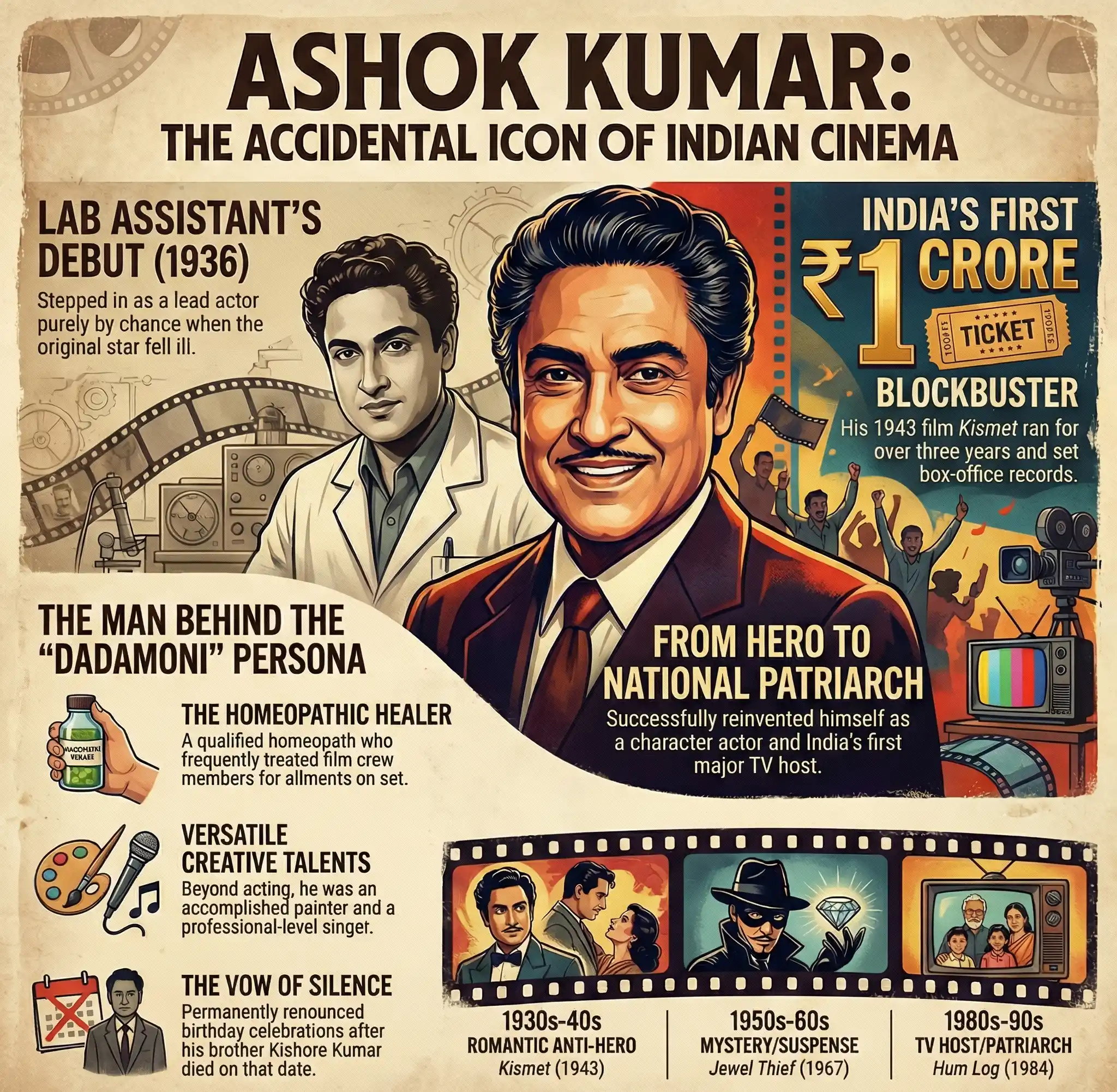
How a lab assistant, chosen because nobody would run away with him, changed the way Hindi cinema acts
In 1936 the shooting of Jeevan Naiya stopped because the leading lady had run off with the leading man.
Devika Rani was the biggest star in the country and the wife of Himanshu Rai, who owned Bombay Talkies, where the film was being made. She and Najm-ul-Hassan went to Calcutta together. Sashadhar Mukherjee, who worked at the studio, followed them and persuaded her to come back. Rai took his wife back and sacked the actor, who never recovered the career.
Then he had to recast the part, and he had a specific requirement. He wanted a man nobody would run away with.
The job description was that he should be too plain to be a risk.
The lab assistant
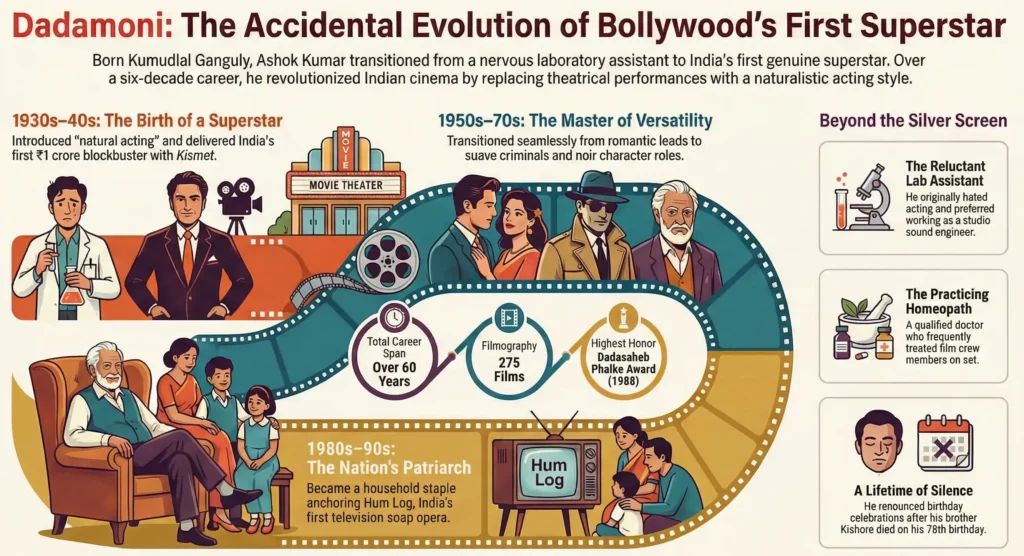
Mukherjee put forward his brother-in-law. Kumudlal Kunjilal Ganguly was twenty-five, the son of a lawyer in Bhagalpur, and worked in the Bombay Talkies laboratory. He had come to the studio for the technical side and had no interest in being looked at.
Franz Osten, who was directing, did not think he was hero material. Rai overruled him. The lab assistant was renamed Ashok Kumar and put in front of the camera, and Manto later noted what the studio was paying him: seventy-five rupees a month at the start, and he was alarmed when it went up to two hundred and fifty.
6 Unfoldings in the Subrahmanyan Chandrasekhar Biography
What he could not do
Hindi film acting in the 1930s came out of the stage. Actors declaimed, held poses and pitched everything to the back of a hall. It was the only training available and everyone had it.
He had none of it. He could not perform in that register, so he did the only other thing available, which was to talk on screen roughly the way people talk. He also watched American films closely, Bogart among them, and took what he could use.
He sang on screen too, in the years before playback, including Koi Humdum Na Raha in that first film. His youngest brother recorded the same song twenty-five years later, by which time the brother was Kishore Kumar.
The industry treated this as a limitation for a while. It became the house style of Indian screen acting, and the actors who followed, down to Amitabh Bachchan and Naseeruddin Shah, have said so.
He was cast for being ordinary, and the ordinariness turned out to be the technique.
Kismet
Achhut Kanya came the same year, with him as a Brahmin boy in love with an untouchable girl, and it was a national hit. Kangan, Bandhan and Jhoola followed, all silver jubilees, all opposite Leela Chitnis.
Then Gyan Mukherjee’s Kismet in 1943. The hero is a pickpocket who smokes, lies and steals, and the film also put an unmarried pregnant woman on screen, neither of which Indian cinema had done. It cost about two lakh rupees and took over a crore and a half.
It ran in one Calcutta cinema for more than three years. No Indian film beat that run until Sholay in 1975.
10 Remarkable Facts About Meghnad Saha Life and Achievements
The studio years
Himanshu Rai died in 1940 and Bombay Talkies split between Devika Rani and Sashadhar Mukherjee. Ashok Kumar was in the middle of it, working as a producer as well as the studio’s biggest star, and he eventually left with Mukherjee for the new Filmistan.
He had wanted the production side from the beginning. The acting was the accident that would not go away.
Growing old on time
The second unusual decision came in the 1950s. Stars of that era held on to the lead until the audience pushed them out. He stepped sideways into character parts while he was still wanted as a hero, and played fathers, uncles and grandfathers for another forty years.
It is the reason the career runs to some three hundred films and ends in the 1990s rather than the 1960s. Bandini in 1963, Mahal, Parineeta, and a long tail of supporting roles that kept him working past eighty.
Away from the set he painted and practised homeopathy, treating people who turned up at the house, and he gave interviews rarely and grudgingly.
7 Incredible Facts in the Satyendra Nath Bose Biography
The uncle on television
In 1984 Doordarshan started Hum Log, the first Indian television serial. At the end of each episode a man of seventy-two turned to the camera and talked to the audience about what they had just watched, sometimes telling them what to make of it.
Everyone already called him Dadamoni, elder brother. For a year and a half he was the person the country listened to at the end of the episode, which is a strange final act for a man who joined a film studio to work in the laboratory.
He was chosen because nobody would look twice at him, and he spent sixty-five years being looked at.
8 Fascinating Facts in the Homi Jehangir Bhabha Biography
If you think you have remembered everything about this topic take this QUIZ
Results


#1. What was Ashok Kumar’s real birth name?
#2. Before becoming an actor, in what capacity did Ashok Kumar join the Bombay Talkies studio?
#3. Which 1943 film starring Ashok Kumar is considered India’s first major blockbuster, running for over three years?
#4. Ashok Kumar famously anchored and delivered concluding monologues for which pioneering Indian soap opera?
#5. Besides acting and painting, Ashok Kumar was a qualified practitioner of which system of medicine?
#6. Why did Ashok Kumar stop celebrating his birthday (October 13) after 1987?
#7. Which film marked Ashok Kumar’s acting debut in 1936?
#8. Ashok Kumar was the eldest brother of which other legendary Bollywood icon?
Who was Ashok Kumar famously known as?
He was affectionately known as “Dadamoni,” which translates to “Elder Brother” in Bengali.
What was Ashok Kumar’s first film?
His debut film was Jeevan Naiya (1936), produced by Bombay Talkies.
Was Ashok Kumar related to Kishore Kumar?
Yes, Ashok Kumar was the eldest brother of the legendary singer and actor Kishore Kumar.
What is the significance of the movie Kismet?
Released in 1943, Kismet was the first blockbuster in Indian cinema history and ran for over three years in a single theater in Kolkata.
Did Ashok Kumar receive the Dadasaheb Phalke Award?
Yes, he was honored with the Dadasaheb Phalke Award, India’s highest award in cinema, in 1988.
Read More: https://curiousindian.in/ilaiyaraaja-june-1943-present/
Sources & References
Cinemaazi (artist profile, Ashok Kumar) — his Bombay Talkies films, the salary Manto recorded and the run of Kismet.
Australian Centre for the Moving Image (“Before Bollywood there was Bombay Talkies”) — the 1936 elopement and his elevation from the laboratory to the lead role.
Directorate of Film Festivals, Government of India — the Dadasaheb Phalke Award of 1988.
Padma Awards portal, Government of India — the Padma Shri of 1962 and the Padma Bhushan of 1999.
Author


Exploring the Soul of Bharat through History, Science, Culture, and its Diversity
Our Mission
Curious Indian is a definitive knowledge portal dedicated to chronicling the events, personalities, and cultural shifts that defined the Indian subcontinent. From the ancient Vedic Period to the complexities of 21st-century politics, our goal is to provide deep-dive analysis that inspires.
Editorial Standards & E-E-A-T
Every article published under our brand undergoes a rigorous fact-checking process. We prioritize primary historical records, academic citations, and credible archives to ensure our readers receive accurate, high-authority information.
Historical Integrity Directly sourcing from ASI archives and academic journals.Topical Authority Comprehensive clustering of Indian Science, Biographies, and Wars.Managed by Paripurna Datta and TEAM | Dedicated to the Knowledge of India.