Why so many faiths and regions light the same lamp on the year’s darkest night
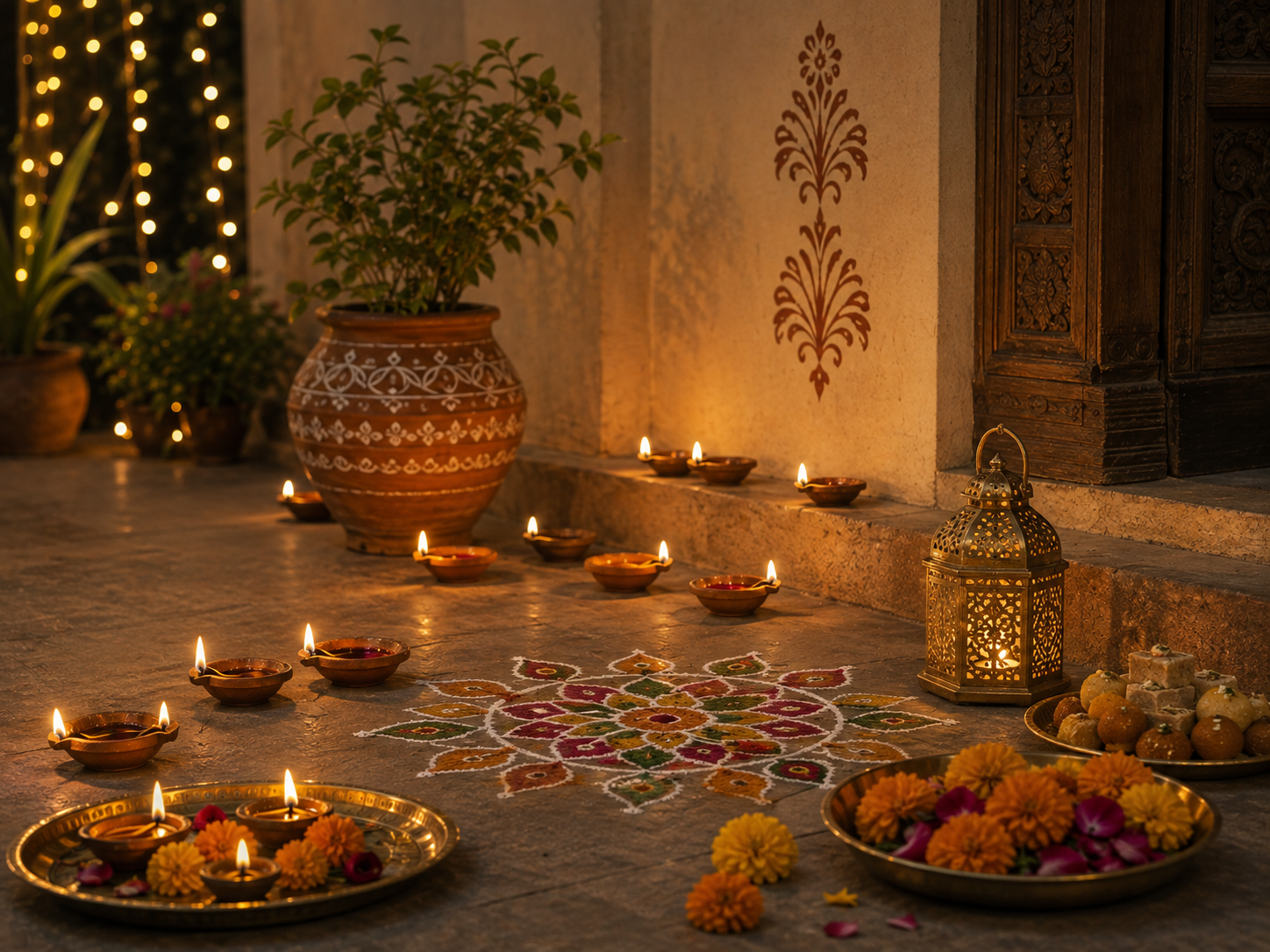
On the darkest night of the whole year, the new-moon night when the sky holds no moon at all, millions of homes across India do the very same small thing. They light little clay lamps and set them out in rows against the dark.
The festival is Diwali, and its name simply means “a row of lights.” But here is the surprising part. If you walked from house to house on that night and asked people why they were lighting their lamp, you would not get one answer. You would get many. Diwali is not a single story. It is dozens of different stories, told by different people, all on the very same night.
Pongal and Makar Sankranti: India’s Harvest Festivals
The prince who came home
The most famous story belongs to the north of India.
After fourteen long years of exile in the forest, and after defeating the demon king Ravana, Prince Rama finally came home to his city of Ayodhya, together with his wife Sita and his brother Lakshmana. The people were so overjoyed that they lit thousands of small lamps to guide him back through the darkness and welcome him home. In much of North India, every Diwali lamp is still, in a way, a lamp lit for a prince coming home.
The goddess who visits bright homes
Across most of the country, the main night of Diwali belongs to Lakshmi, the goddess of wealth and good fortune.
People believe that on this darkest of nights, Lakshmi wanders from house to house, and that she steps only into homes that are clean and glowing with light. So for weeks beforehand, families scrub their houses from top to bottom. Then, on the night itself, they fill every corner with lamps and draw beautiful patterns called rangoli on the floor by the front door. It is all a way of saying to the goddess, “you are welcome here.”
Ganesh Chaturthi: Honoring the Elephant-Headed God
The teacher who found freedom
For the Jains, this same night means something quieter and deeper.
On Diwali, more than two and a half thousand years ago, their great teacher Mahavira, the last of their twenty-four Tirthankaras, reached moksha, the final freedom from the endless cycle of birth and death. The story says the night was very dark, so his followers lit rows of lamps to keep the light of his knowledge shining after he was gone.
For Jains, the Diwali lamp is the light of a teacher’s wisdom, kept burning by his followers after he has left the world.
Durga Puja: Celebrating the Divine Feminine in Bengal
The guru who would not walk free alone
For Sikhs, Diwali carries yet another story, and it is one of the most moving of all. They call it Bandi Chhor Divas, the “Day of Liberation.”
In 1619, the sixth Guru, Guru Hargobind, was being held prisoner in the great Gwalior Fort by the Mughal emperor Jahangir. When the emperor at last agreed to release him, the Guru refused to go unless he could take with him the fifty-two princes who were locked up alongside him.
So a special cloak was made with fifty-two long tassels. As the Guru walked out of the fort, each prisoner held on to one tassel and walked free beside him.
The Guru returned to Amritsar, and his people lit up the Golden Temple with countless lamps to welcome him home. To this day, the temple glows with light on Diwali night.
The fierce goddess of the dark
In Bengal, Assam and Odisha, the very same night turns in a completely different direction.
Here, people do not welcome the gentle Lakshmi. Instead they worship Kali, the fierce, dark goddess who destroys all evil. On the blackest night of the year, they call upon the most powerful force they know to stand against the darkness. And there are still more versions across the land: in the west, the night recalls the humbling of a proud king named Bali, and in the south, it marks Krishna’s defeat of a cruel demon named Narakasura, who had thousands of captives set free.
Five days, not one
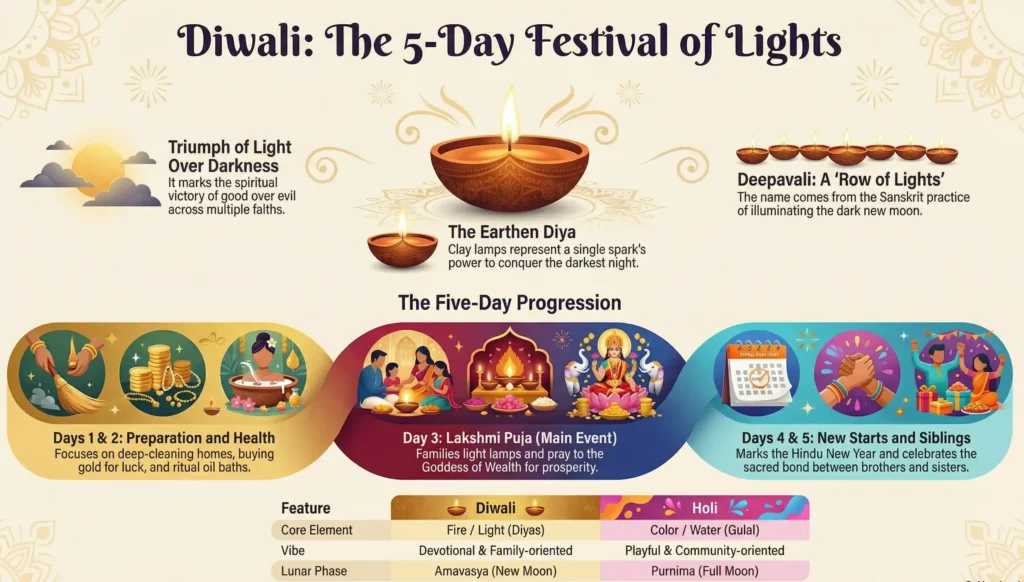
Most people picture Diwali as a single evening, but it is really a festival of five days.
It opens with Dhanteras, when people buy gold or new pots for good luck. Then comes the little Diwali, and then the main night itself, dark and blazing with lamps. The fourth day remembers Krishna lifting a whole hill to shelter his village from a storm, and it begins the new year for many trading families. The festival closes with Bhai Dooj, a warm day set aside for the love between sisters and brothers.
The small joys around the flame
Around all these stories cluster the same happy customs. Trays of sweets travel from house to house. Fireworks crackle in the night sky. Families gather to play card games, because an old tale says the goddess Parvati once played dice on this night and blessed it with good luck. Even the stock market opens for a special, lucky hour of trading.
In recent years, though, a gentle argument has grown up around the fireworks. In big cities like Delhi, the smoke can thicken into dangerous, choking air, and so more and more families now choose a quieter “green Diwali” of lamps and lights over loud, smoky crackers. It is an old and honest question in new form: how to celebrate with joy without causing harm.
Why the same lamp, everywhere
So why does one small flame come to mean so many different things? A prince coming home, a goddess visiting, a teacher set free, a guru leading prisoners out of a fort, a fierce mother destroying evil. Look closely, and you notice something. Each of these very different stories is, underneath, telling the same one. Every single one is about light winning over darkness: a good man returning from exile, a soul winning its freedom, captives walking out of a prison, evil being beaten back. That is the quiet genius of Diwali. On the darkest night of the entire year, when there is not even a moon in the sky, millions of people who believe many different things all reach for the very same answer. Light one small lamp, and the darkness cannot win.
If you think you have remembered everything about this topic take this QUIZ
Results


#1. What does the Sanskrit word “Deepavali” literally translate to?
#2. During which lunar phase is the main day of Diwali celebrated?
#3. For followers of Jainism, what highly significant event does Diwali commemorate?
#4. What is the name of the first day of the five-day Diwali festival, which focuses on wealth, health, and buying new utensils or gold?
#5. While Goddess Lakshmi is worshipped in the North and West, which fierce deity is primarily worshipped during Diwali in Bengal and Assam?
#6. On the fifth day of the festival, known as Bhai Dooj or Bhai Phonta, what specific bond is celebrated?
#7. According to the comparison table, which of the following is a key difference between Diwali and Holi?
Why is Diwali celebrated?
Diwali celebrates the spiritual victory of light over darkness and good over evil. Historically, it marks Lord Rama’s return to Ayodhya, and it is a day to worship Goddess Lakshmi for prosperity.
What are the 5 days of Diwali?
Dhanteras, Naraka Chaturdashi (Choti Diwali), Lakshmi Puja (Main Diwali), Govardhan Puja, and Bhai Dooj.
What does the word “Deepavali” mean?
It is a Sanskrit word meaning “a row of lights” (Deepa = light/lamp, Avali = row).
Do Sikhs celebrate Diwali?
Yes, Sikhs celebrate Bandi Chhor Divas on the same day, marking the release of their sixth Guru, Guru Hargobind, from prison.
Who is worshipped on the main night of Diwali in East India?
In West Bengal, Assam, and Odisha, Goddess Kali is worshipped instead of Goddess Lakshmi during Diwali.
Sources and references
- Britannica (“Diwali”) and general festival histories — the meaning of Deepavali as “row of lights,” the timing on the new-moon night of Kartika, the theme of light over darkness, and the story of Rama’s return to Ayodhya and the worship of Lakshmi.
- Outlook India and Gale in Context (on Diwali’s many traditions) — Mahavira attaining nirvana at Pavapuri in 527 BCE as the Jain meaning of Diwali, and the lamps lit to honour his passing.
- Wikipedia (“Bandi Chhor Divas”) and Sikh sources — the 1619 release of Guru Hargobind from Gwalior Fort along with 52 princes, the cloak with 52 tassels, and the illumination of the Golden Temple.
- Regional festival accounts — Kali Puja in Bengal, Assam and Odisha, the western story of King Bali, and the southern story of Krishna defeating Narakasura and freeing his captives.
- Original Curious Indian article (“Diwali: The Festival of Light”) — the five days of the festival (Dhanteras, Naraka Chaturdashi, Lakshmi Puja, Govardhan Puja and Bhai Dooj), the cleaning and rangoli customs, the sweets, the gambling tradition and Muhurat trading, and the modern shift toward a “green Diwali.”
Author


Exploring the Soul of Bharat through History, Science, Culture, and its Diversity
Our Mission
Curious Indian is a definitive knowledge portal dedicated to chronicling the events, personalities, and cultural shifts that defined the Indian subcontinent. From the ancient Vedic Period to the complexities of 21st-century politics, our goal is to provide deep-dive analysis that inspires.
Editorial Standards & E-E-A-T
Every article published under our brand undergoes a rigorous fact-checking process. We prioritize primary historical records, academic citations, and credible archives to ensure our readers receive accurate, high-authority information.
Historical Integrity Directly sourcing from ASI archives and academic journals.Topical Authority Comprehensive clustering of Indian Science, Biographies, and Wars.Managed by Paripurna Datta and TEAM | Dedicated to the Knowledge of India.