Saturday, May 23, 2026
12 °c
Ashburn
Curious Indian
  • Arts & Culture
  • Festivals of India
  • Indian History
  • Indian Politics
  • Biography
    • Entertainment Personalities
    • Science Personalities
  • Unsolved India
No Result
View All Result
  • Arts & Culture
  • Festivals of India
  • Indian History
  • Indian Politics
  • Biography
    • Entertainment Personalities
    • Science Personalities
  • Unsolved India
No Result
View All Result
Curious Indian
No Result
View All Result
Home Arts & Culture

Warli Paintings and the Ancient Visual Language of Maharashtra’s Tribes

paripurnadatta by paripurnadatta
in Arts & Culture, Paintings & Visual Arts, Regional Culture
Reading Time: 17 mins read
0 0
A A
Warli paintings
Share on FacebookShare on Twitter

Table of Contents

Toggle
  • The Rhythmic Circles and Tribal Life of Warli Paintings
  • A Tradition Older Than Most of What We Call History
    •  
  • The Geometry of a Worldview
  • The Tarpa Dance and the Circle as Community
  • The 1970s Discovery and What It Changed
  • What Survives When Art Travels
  • The Living Practice in Palghar
  • Quick Comparison Table
  • Curious Indian: Fast Facts
  • Conclusion
  • If you think you have remembered everything about this topic take this QUIZ
    • Who are the Warli and where do they live?
    • What materials are used in traditional Warli painting?
    • What is the Chauk in Warli painting?
    • How did Warli painting reach an international audience?
    • What does the Geographical Indication tag mean for Warli painting?
Warli painting is one of India's oldest living art traditions, practiced by the Warli tribe of Palghar district in Maharashtra. Using white rice paste on dark mud-colored backgrounds, Warli artists create compositions built from circles, triangles and lines that depict daily life, nature, ritual and the deep rhythms of the agricultural calendar. What began as sacred wall art painted by women during ceremonies has evolved into a globally recognized visual language that now appears on everything from canvas to textiles. This piece traces the tradition from its ritual origins through its modern journey, and asks what survives of the original meaning when an art form travels this far from its source.
DetailInformation
SubjectWarli Paintings
OriginPalghar district, Maharashtra, India
CommunityWarli tribe
PeriodTradition dates to at least 2500 BCE
Primary SurfaceMud walls of homes, now also paper and canvas
MediumRice paste on dark backgrounds
Primary MotifsCircles, triangles, human figures, nature
GI TagGranted by Government of India
RecognitionUNESCO intangible cultural heritage consideration

The Rhythmic Circles and Tribal Life of Warli Paintings

Warli paintings

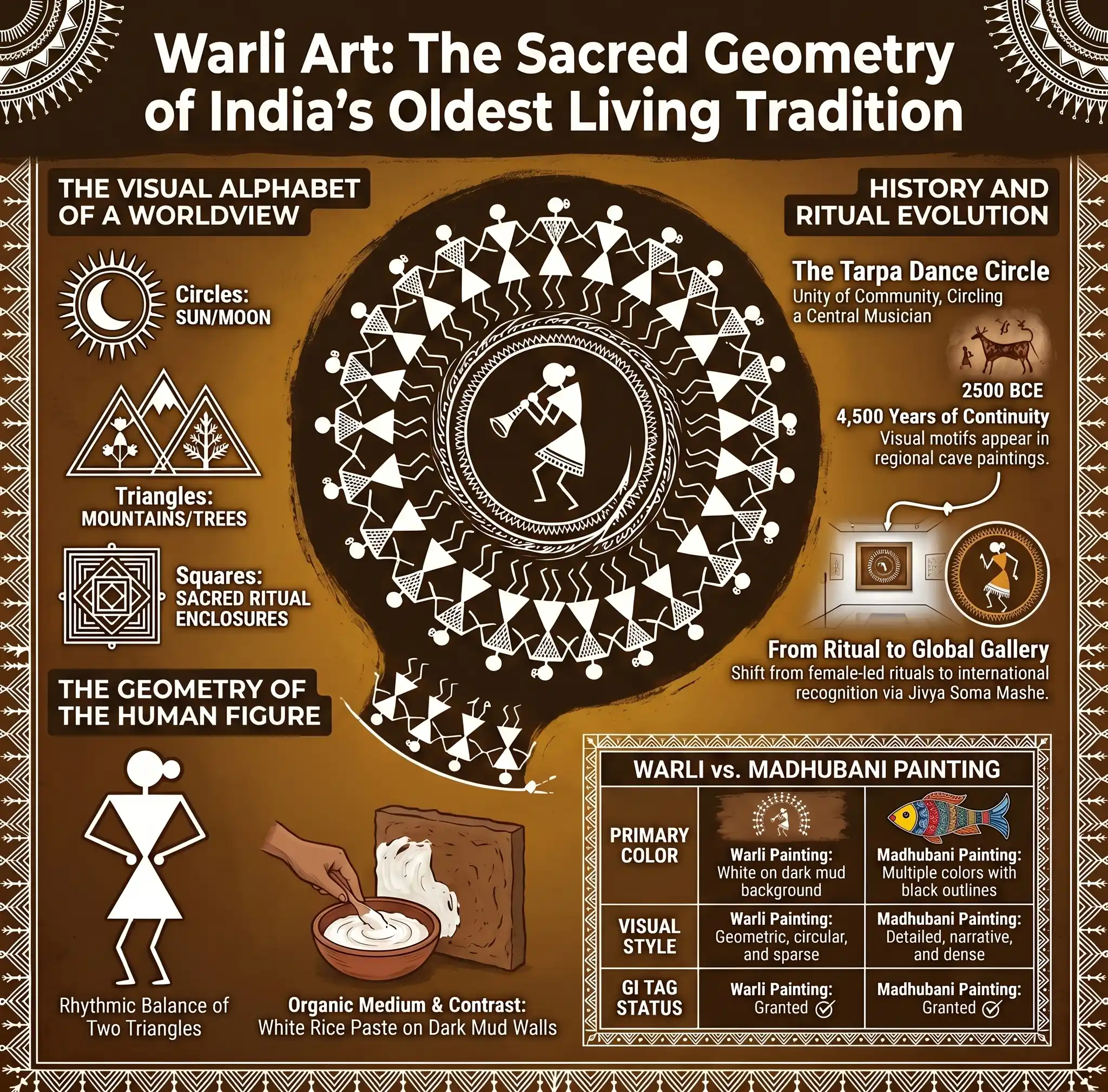
There is a particular image that appears in Warli paintings so consistently that it has become the tradition’s most recognizable signature. A circle of figures, their bodies formed from two triangles joined at a point, their arms and legs extending outward like spokes, moving around a central form in what is clearly a dance. The composition is called the Tarpa dance, named after the wind instrument that traditionally accompanies it, and it appears on walls across the Warli villages of Maharashtra’s Palghar district.

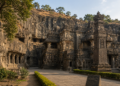
Look at it long enough and something happens. The figures stop being stick figures and start being people. The circle stops being a decorative motif and starts being a community. The whole image begins to feel less like art and more like a diagram of what it means to live together. This profound transformation of raw material into a rhythmic community ritual echoes the structural and symbolic precision seen in classic temple architecture, such as the grand design principles that defined the peak of medieval India.

That shift, from decoration to meaning, is what Warli painting is fundamentally about.

A Tradition Older Than Most of What We Call History


1 of 2
– +
Warli paintings
Warli paintings

The Warli tribe inhabits the forested hills and coastal plains of Palghar district in the northern part of Maharashtra, a region where the land transitions from the Western Ghats toward the Arabian Sea. They are one of the largest tribal communities in Maharashtra, and their painting tradition is one of the oldest continuously practiced art forms in India.

Scholars studying prehistoric rock art in the region have identified visual motifs similar to Warli figures in cave paintings dating to as early as 2500 BCE. Whether these represent a direct ancestral lineage to the current tradition or simply reflect the persistence of certain fundamental visual forms is debated. What is not debated is that the Warli painting tradition as it is practiced today carries within it a visual vocabulary so elemental and so consistent that it points to roots far deeper than most living art forms can claim. This deep historical continuity forms an irreplaceable archive of early Indian heritage, a focus shared by major conservation bodies such as the Archaeological Survey of India in their efforts to protect ancient rock art across the subcontinent.

The tradition was for most of its history practiced exclusively by women. Warli women painted the interior walls of their homes as part of ritual observance, particularly in preparation for weddings and harvests. The act of painting was not separated from the ceremony it accompanied. It was part of the ceremony, a form of invocation in which the images called the gods and forces were honored into the space of the home.

READ MORE:  Inside the Bhushan Kumar T-Series Success Journey

The Geometry of a Worldview

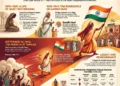
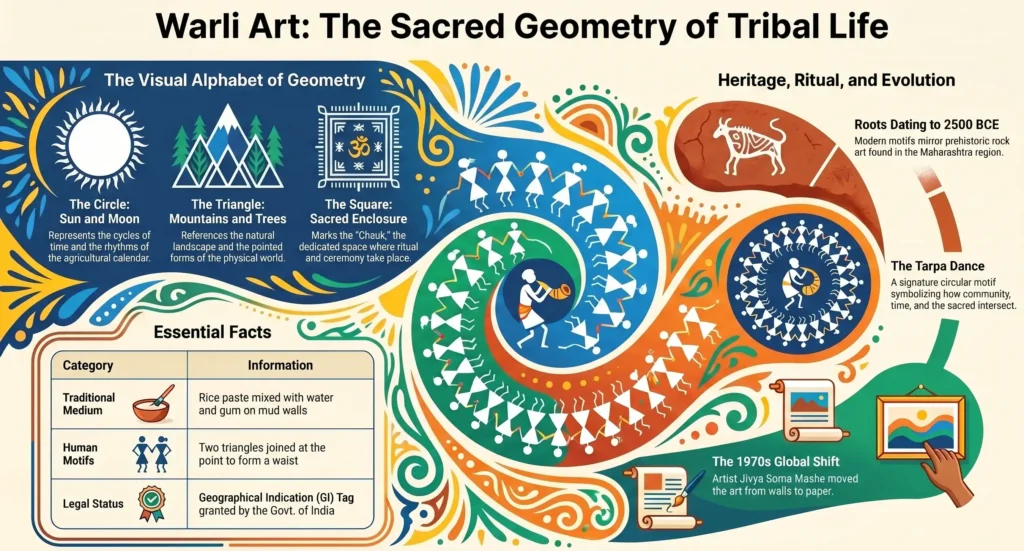
The visual language of Warli painting uses three primary geometric forms: the circle, the triangle and the square. Each carries specific meaning within the tradition. The circle represents the sun and moon, the cycles of time that govern agricultural life. The triangle refers to the mountains and the pointed forms of trees, the natural landscape within which Warli communities live. The square represents a sacred enclosure, the space set apart from ordinary life where ritual takes place.

From these three forms, Warli painters build compositions of remarkable complexity. Human figures are made from two triangles, one pointing up for the body and one pointing down for the legs, joined at their tips to create a waist. Animals are rendered with similar economy. Trees, rivers, fields and houses are all assembled from the same restricted vocabulary of shapes.

This restriction is not a limitation. It is a discipline that produces a particular kind of visual clarity. Because every element is built from the same basic forms, the compositions feel unified in a way that more varied pictorial languages sometimes do not. A busy Warli scene showing a harvest festival, with dozens of human figures, animals, trees and ritual objects all present simultaneously, still reads as a coherent whole because every element speaks the same geometric language. To see how other regional styles managed to project dense narratives through highly specific visual vocabularies without academic constraints, you can read our comprehensive exploration of textiles and handicrafts at curiousindian.in.

The Tarpa Dance and the Circle as Community

The Tarpa dance image that appears so consistently in Warli painting is worth examining in some detail because it encapsulates what the tradition is most fundamentally trying to say. The Tarpa is a wind instrument shaped like a horn, played by a single musician who stands at the center of the dance circle. The dancers move around the musician, connected to each other and to the music, forming a community whose shape is the circle itself.

The image that Warli painters make of this scene is compositionally identical to many other circular arrangements in the tradition: the circle of seasons, the circle of the agricultural year, the circular boundary of the sacred space. By using the same form to represent the dance, the year and the sacred enclosure, Warli painting says something that takes several sentences to explain in words. It says that community, time and the sacred are all the same shape. That they organize themselves by the same principle. That to dance in a circle is to participate in the same fundamental rhythm as the turning of the seasons and the movement of the sun and moon.

This is not a naive or accidental insight. It is a sophisticated philosophical position expressed through geometric form, which is precisely what abstract art at its most powerful does. This focus on pure geometry and centralized energy as a philosophical map of the cosmos is a recurring master theme in twentieth-century Indian modernism, explored deeply in our archival study of S.H. Raza at curiousindian.in.

The 1970s Discovery and What It Changed

For most of its history, Warli painting was entirely internal to Warli communities. It was made by women for ritual purposes, on walls that were replastered and repainted as needed, leaving no permanent record and seeking no outside audience. It was not invisible, but it was not offered to the wider world either.

That changed in the early 1970s when a social activist and artist named Jivya Soma Mashe began working with the Warli tradition in a new context. Mashe, who became the most celebrated individual Warli artist of the 20th century, began painting on paper rather than walls and brought the tradition to the attention of urban Indian artists, galleries and eventually an international audience. His work was shown in exhibitions across India and abroad, and the response it generated transformed how the tradition was understood and valued.

READ MORE:  Unique Flavor Driving Bamboo Shoot Politics

The significance of this shift is documented through records held at institutions including the Tribal Research and Training Institute of Maharashtra, which has been involved in both documenting and supporting the Warli tradition as part of broader efforts to preserve Maharashtra’s tribal cultural heritage. This historic validation of rural, indigenous art forms over standard colonial training was first champion-led during the early national revivalist movements, a pivotal transformation analyzed in our detailed resource on Abanindranath Tagore at curiousindian.in.

The commercialization that followed brought both opportunity and tension. Warli motifs began appearing on textiles, ceramics, stationery, clothing and architectural surfaces across India and internationally. The visual language that had been developed for specific ritual purposes in specific community contexts was now available to anyone who wanted to use it. Questions about authenticity, ownership and the meaning of a sacred visual language when removed from its sacred context became unavoidable.

What Survives When Art Travels

The question of what remains of Warli painting’s original meaning when it appears on a corporate office wall or a designer tote bag is not a simple one to answer. There are two positions worth taking seriously. The first is that the commercialization of a traditional art form inevitably dilutes its meaning, that a Warli motif on a product has been emptied of the ritual context that gave it significance and reduced to a visual style available for purchase. The second is that the spread of the tradition, even in commercialized form, keeps the visual language alive, creates economic opportunity for Warli artists and introduces the tradition’s philosophical vocabulary to audiences who would never otherwise encounter it.

Both positions contain truth. What they agree on is that the original ritual practice, the women painting their walls in preparation for weddings and harvests, the invocation of specific deities through specific compositions, the connection between the act of painting and the ceremony it accompanied, is the irreplaceable core of what Warli painting actually is. This protective stance toward regional craft integrity reflects the wider international conservation frameworks promoted by bodies like the International Council on Monuments and Sites to safeguard endangered global heritage.

The Geographical Indication tag granted to Warli painting by the Government of India represents a formal attempt to protect that core by establishing standards for what can legitimately be called authentic Warli art. The GI tag places the tradition specifically in Palghar district and connects it to the community that developed it, providing a degree of legal protection against appropriation and misrepresentation. How effective this protection is in practice, given the global spread of Warli motifs across commercial contexts, remains a question that the Geographical Indication Registry of India and advocacy organizations continue to work through. This ongoing tension between global visibility and pristine site preservation is a challenge shared by many isolated cultural wonders across the subcontinent, a central narrative theme in our architectural study of Unakoti at curiousindian.in.

The Living Practice in Palghar

Despite commercialization and the pressures of the modern economy, the ritual practice of Warli painting continues in Palghar district. Women in Warli villages still paint their walls for weddings. The Chauk, the sacred central image painted at the heart of a wedding mural, still depicts the goddess Palaghata surrounded by the geometric forms that have always accompanied her. The Tarpa dance image still circles across mud surfaces in the weeks before and after harvest.

This continuity is not guaranteed. Younger generations in Warli communities face the same economic pressures as young people in rural communities across India, pressures that push toward urban migration and away from the time-consuming practice of traditional craft. The organizations working to support the tradition, including those operating within the framework of the Crafts Council of India, recognize that economic viability for practicing Warli artists within their own communities is the most important factor in whether the ritual tradition survives the commercial one. To track how similar folk traditions have historically transformed their local geographies to record fast-changing modern landscapes, check out our resource on historical events and turning points at curiousindian.in.

READ MORE:  The Inner Line Permit System And Indigenous Tribes

Quick Comparison Table

FeatureWarli PaintingMadhubani PaintingGond ArtPattachitra
CommunityWarli tribe, MaharashtraMithila community, BiharGond tribe, Madhya PradeshOdisha and Bengal tradition
Primary ColorWhite on dark mud backgroundMultiple colors, black outlineMultiple colors, dot patternsNatural colors on cloth or palm leaf
StyleGeometric, circular, sparseDetailed, narrative, denseFilled with texture and patternIntricate, mythological
Primary SurfaceMud walls, paper, canvasPaper, cloth, mud wallsPaper, canvasCloth, palm leaf
GI Tag StatusGrantedGrantedGrantedGranted
Current StatusLiving tradition, commercializedLiving tradition, globally recognizedLiving tradition, growing marketLiving tradition, temple maintained

Curious Indian: Fast Facts

  • Warli painting uses only three geometric forms: the circle, the triangle and the square, from which all figures and compositions are built
  • The tradition was practiced exclusively by women for most of its history, as part of ritual preparation for weddings and harvests
  • Similar motifs to Warli figures have been identified in prehistoric rock art in the region dating to around 2500 BCE
  • Jivya Soma Mashe, the most celebrated individual Warli artist of the 20th century, was instrumental in bringing the tradition to national and international attention in the 1970s
  • The Tarpa dance, one of the most recognizable Warli compositions, depicts a community of dancers circling a central musician playing a horn-shaped wind instrument
  • Warli painting received a Geographical Indication tag from the Government of India, formally connecting the tradition to Palghar district and the Warli community
  • The white pigment used in traditional Warli painting is made from rice paste mixed with water and gum, applied with a bamboo stick chewed at the end to create a brush
  • Warli motifs now appear on textiles, ceramics and commercial surfaces globally, raising ongoing questions about authenticity and cultural ownership

Conclusion

Warli painting began as a conversation between a community and the forces it depended on: the seasons, the rain, the harvest, the gods who governed all of these. The women who painted those first circles on mud walls were not making art in the way we now use that word. They were performing a necessary act, calling the sacred into the domestic space through the disciplined use of form.

What that discipline produced, across thousands of years of practice, was a visual language of extraordinary economy and power. Three shapes. White on dark. A circle of dancers. A goddess at the center of a wedding wall. These are not simple things dressed up in simple clothes. They are complex ideas expressed with the confidence that comes from knowing exactly what you need to say and having spent a very long time learning how to say it.

The challenge that now faces the tradition is the same one that faces every living art form that has been discovered by the world beyond its origin community. How to remain alive in its own terms while also existing in the wider world’s terms. There is no clean answer to that challenge. What there is, in the villages of Palghar district, is a practice still being carried forward. For now, the circles are still turning.

If you think you have remembered everything about this topic take this QUIZ

Who are the Warli and where do they live?

The Warli are one of the largest tribal communities in Maharashtra, living primarily in the Palghar district in the northern part of the state. The region covers forested hills and coastal plains at the edge of the Western Ghats. The community has maintained its distinct cultural traditions including its painting practice across centuries of political and social change in the surrounding region.

What materials are used in traditional Warli painting?

Traditional Warli painting uses a white pigment made from rice paste mixed with water and gum, applied with a bamboo stick that has been chewed at one end to create a flexible brush. The background is typically the dark surface of a mud wall, which provides the contrast against which the white figures are visible. Contemporary Warli artists working on paper or canvas recreate this contrast using brown or ochre backgrounds.

What is the Chauk in Warli painting?

The Chauk is the sacred central image of a traditional Warli wedding mural. It depicts the goddess Palaghata, associated with fertility and the harvest, surrounded by concentric squares and other geometric forms that mark out the sacred space of the ritual. Painting the Chauk is one of the most significant acts in the Warli wedding ceremony, performed by senior women of the community.

How did Warli painting reach an international audience?

The primary figure in the tradition’s wider recognition was Jivya Soma Mashe, a Warli artist who began painting on paper in the 1970s and whose work attracted attention from urban Indian artists and galleries. His exhibitions in India and abroad introduced the tradition to audiences outside the Warli community and generated the interest that eventually led to the widespread commercial adoption of Warli motifs across multiple industries.

What does the Geographical Indication tag mean for Warli painting?

The GI tag formally recognizes Warli painting as a product originating specifically from the Palghar district of Maharashtra and connected to the Warli community. It provides a degree of legal protection against misrepresentation and appropriation by establishing that products claiming to be authentic Warli art must meet defined standards of origin and craft. It is an important tool in protecting the community’s cultural ownership of the tradition, though enforcement in a global commercial context remains an ongoing challenge.

Tags: GI tag IndiaIndian folk artJivya Soma MasheMaharashtra tribal artPalghar districtSacred geometry IndiaTarpa danceWarli paintingWarli tribe
ShareTweetPin
paripurnadatta

paripurnadatta

Related Posts

Shekhawati murals
Arts & Culture

Shekhawati Murals and the Stories Painted on Desert Walls
May 23, 2026
S.H. Raza Bindu
Artists & Cultural Icons

S.H. Raza and the Bindu: How a Dot Held the Universe

May 23, 2026
Abanindranath Tagore
Artists & Cultural Icons

How Abanindranath Tagore Built a Distinctly Indian Art Movement

May 23, 2026
No Result
View All Result

Stay Updated

  • Trending
  • Latest
Life of Mahavira: From Prince Vardhamana to Great Conqueror

Life of Mahavira: From Prince Vardhamana to Great Conqueror

April 11, 2026
Life of Buddha: The Journey to Enlightenment

Life of Buddha: The Journey to Enlightenment

April 11, 2026
Christmas in India

Christmas in India: A Festive Blend of Faith, Flavors, and Tradition

April 11, 2026
From Shimla to Stardom: The Complete Biography of Anupam Kher

From Shimla to Stardom: The Complete Biography of Anupam Kher

April 11, 2026
Warli paintings

Warli Paintings and the Ancient Visual Language of Maharashtra’s Tribes

May 23, 2026
Shekhawati murals

Shekhawati Murals and the Stories Painted on Desert Walls

May 23, 2026
S.H. Raza Bindu

S.H. Raza and the Bindu: How a Dot Held the Universe

May 23, 2026
Abanindranath Tagore

How Abanindranath Tagore Built a Distinctly Indian Art Movement

May 23, 2026

Widget Title

Facebook Twitter Youtube RSS
Curious Indian Logo

Explore the soul of Bharat with Curious Indian. A definitive guide to Indian history, arts, culture, biographies, and the events that defined our future.

Follow us on social media:

Recent News

  • Warli Paintings and the Ancient Visual Language of Maharashtra’s Tribes
  • Shekhawati Murals and the Stories Painted on Desert Walls
  • S.H. Raza and the Bindu: How a Dot Held the Universe

Category

  • Ancient Civilizations & The Vedic Age
  • Architecture
  • Artists & Cultural Icons
  • Arts & Culture
  • Battles of India
  • Biography
  • Business & Industrialists
  • Colonial India
  • Cultural Insights
  • Dance & Music
  • Entertainment Personalities
  • Festivals of India
  • Freedom Fighters
  • Freedom Movement
  • Historical Events & Turning Points
  • Indian History
  • Indian Politics
  • Lesser-Known Facts
  • Major Festivals
  • Medieval India
  • North East India
  • Paintings & Visual Arts
  • Political Leaders
  • Post-Independence India
  • Regional Culture
  • Religious & Spiritual Figures
  • Science Personalities
  • Scientific Discoveries
  • Sculpture
  • Social Issues
  • SOCIETY & MYSTERIES
  • Strange & Unknown Stories
  • Textiles & Handicrafts
  • Uncategorized
  • Unsolved India
  • Unsung Heroes

© 2026 Curious Indian- Everything about India

Welcome Back!

Login to your account below

Forgotten Password?

Retrieve your password

Please enter your username or email address to reset your password.

Log In

Add New Playlist

No Result
View All Result
  • Arts & Culture
  • Festivals of India
  • Indian History
  • Indian Politics
  • Biography
    • Entertainment Personalities
    • Science Personalities

© 2026 Curious Indian- Everything about India

This website uses cookies. By continuing to use this website you are giving consent to cookies being used. Visit our Privacy and Cookie Policy.
Are you sure want to unlock this post?
Unlock left : 0
Are you sure want to cancel subscription?
×