Thanjavur, 16th century: artists looked at the grand temples and asked a simple question. How do you make a god fit inside a home?
The temples of South India were vast. The Brihadeeswarar Temple in Thanjavur rose up stone by stone, and inside its walls were paintings and sculptures that filled the entire space with presence. Gods lived there. Devotees came and stood in the halls and felt the weight of divinity pressing down on them from every wall.
But what if you didn’t live near a temple? What if you were a merchant in Thanjavur, or a farmer, or a nobleman in a smaller kingdom? What if you wanted to bring that feeling of the sacred into your own space—not the vast, overwhelming grandeur, but the intimate knowledge that a god was present in your home?
This was the question the Nayaka rulers asked their artists around 1600. And the answer they found changed how we understand the relationship between art and prayer.
The question was simple. The answer would transform a continent.
In the courts of Thanjavur, the Nayaka rulers were patrons of everything: sculpture, fresco work, dance, music. They had invited master craftsmen to their courts and told them to innovate. And so the artists did what humans do when they need to solve a problem: they experimented.
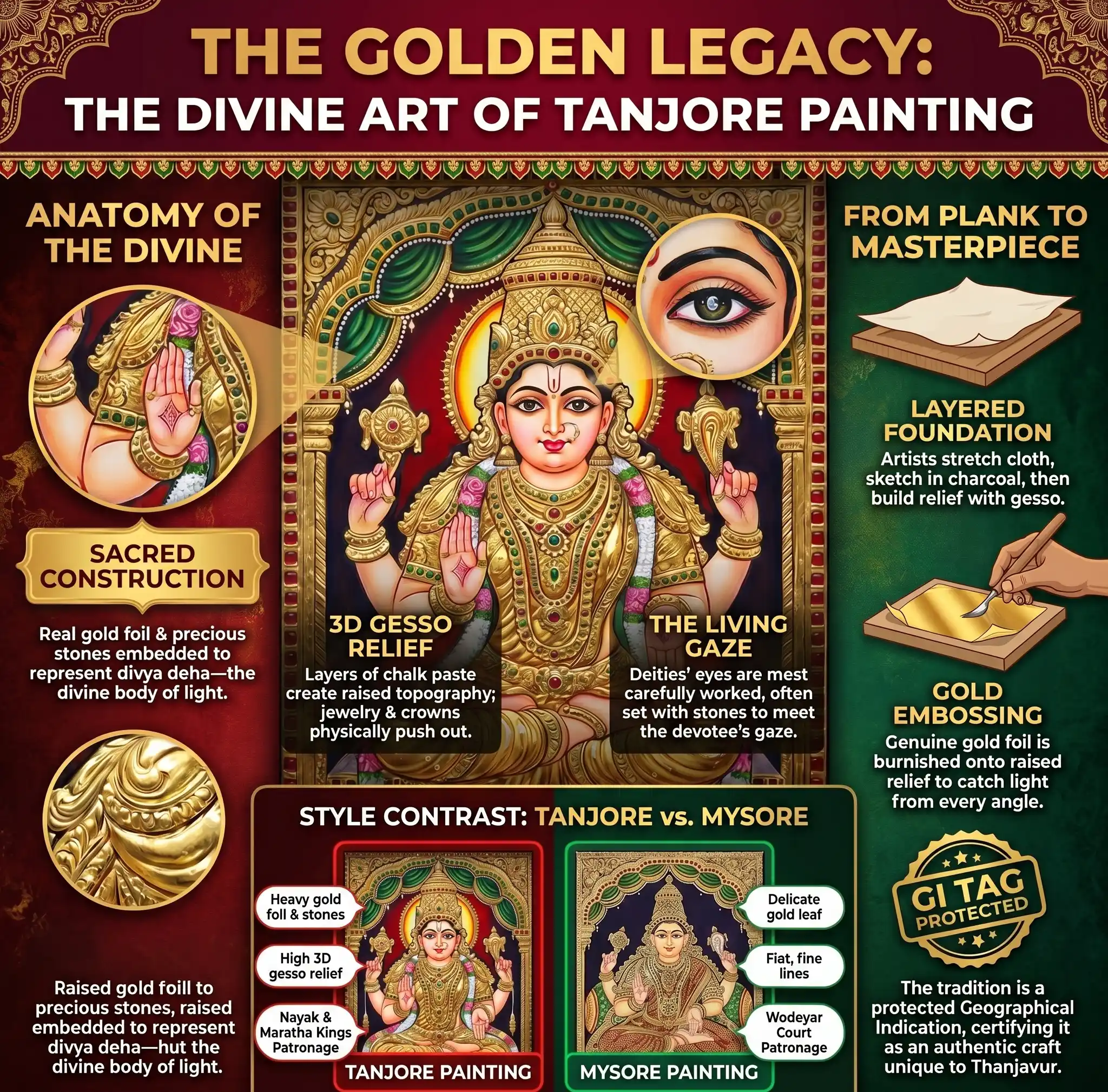
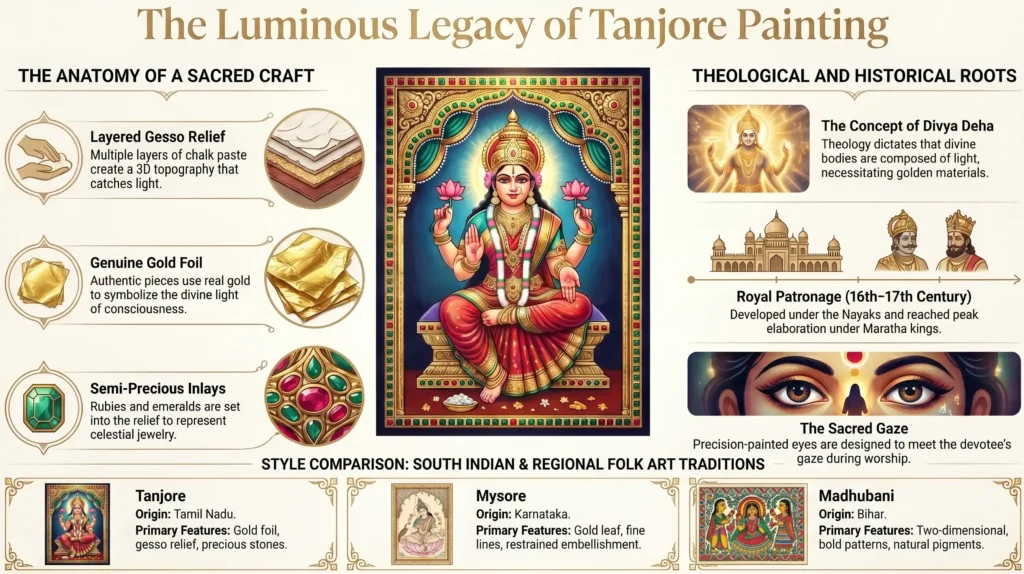
They took a wooden plank—called a palagai. They stretched cloth over it to create a smooth surface. Then they began to build. They mixed lime with tamarind seed powder and adhesive and created a paste. With this paste, they raised designs in relief, creating patterns that stood up from the surface. This mixture, called gesso, could be carved and shaped. It could be made into ornaments, into decorative frames, into the outlines of divine figures.
They took sheets of gold foil—22-carat gold, thin enough to catch the light, thick enough to hold its form. They pressed this gold onto the gesso relief. They inlaid semi-precious stones and glass beads into the raised patterns. They used vivid natural dyes to paint the faces and bodies of gods and saints, set against backgrounds of deep blue or black.
What emerged was something that had never been seen before: a painting that was not flat. A painting that had depth. A painting that caught the light and threw it back at you, so that when you looked at an image of Krishna in his divine court, the gold seemed to move, seemed to pulse with an inner light.
They took sheets of gold foil—22-carat gold, thin enough to catch the light, thick enough to hold its form.
Imagine standing in front of a Tanjore painting for the first time. You are in a home, not a temple. The space is human-scaled, not vast. But as your eyes adjust, you see the figure of a god rising up at you. The gold catches the light from your oil lamp. The gems embedded in the ornaments sparkle. The face of the deity is rendered with delicate brushwork, watching you with an expression of infinite patience and presence.
This was not a reproduction. This was not a copy of the temple image reduced to fit a wall. This was a completely new form of the sacred object. It was small enough to fit in a home, precious enough that owning one meant something, and alive in a way that a flat painting could never be.
These paintings—of Krishna in his divine court, of Rama’s coronation, of saints lost in ecstatic devotion, of the goddess in her multiple forms—were not made to be decorative. They were made to be worshipped. They were sacred objects. When a merchant or a noble brought one home, they were not adding decoration to their walls. They were inviting the divine into their domestic space.
The process of making a Tanjore painting required patience that borders on the meditative. The artist would first sketch the image on the cloth. Then came the gesso work—this required skill and precision, because any error in the relief would show when the gold was applied. The gesso had to be raised at exactly the right height to catch the light, to create shadow and depth.
Then the gold leaf application. This could not be rushed. The gold had to be placed with care, adhered to the gesso with an adhesive that was itself a closely guarded secret. Any tear in the foil would be visible. Any air bubble would show.
Then the gemstones and beads were inlaid into specific areas—the ornaments, the jewels, the decorative borders. Each stone was placed by hand. Then finally, the painting—the colours applied with brushes of hair, layered carefully to build up the image.
An artist might spend weeks or months on a single painting. It was work that required you to be present every moment, to bring your full attention to the act of creation.
What this says about faith
Here’s what matters about this: the invention of Tanjore painting was born from a spiritual need and solved with technical genius. The artists were not trying to make something beautiful. They were trying to make something that would allow people to pray.
And they understood something that often gets lost: that the materials matter. That gold is not just pretty. Gold is precious. It is rare. It catches light differently than other things catch light. When you use gold to paint a god, you are making a statement with material. You are saying: this is precious. This deserves the best we have. This is worth the months of labour, the expense, the skill.
This is why Tanjore paintings became so coveted. Not because they were expensive—though they were—but because they made visible something that faith had always known: that devotion is a thing of substance. That the sacred is not abstract. That when you want to be in the presence of the divine, you might need to hold something in your hands.
The living tradition
Five centuries later, Tanjore painting is still made in Thanjavur. Artists still mix gesso from lime and tamarind seed powder. They still apply 22-carat gold. They still inlay stones by hand. The technique has barely changed, because it was never broken. It was never something that needed to be fixed or modernized.
Families have kept this knowledge alive, passing it from parent to child, from master to apprentice. The paintings still hang in homes and temples. They still catch the light. They still invite prayer.
And every time someone looks at a Tanjore painting, they are looking at an answer to a question asked five hundred years ago: how do you make the sacred portable? How do you bring a god into a home and have that god remain, still, a god?
The answer was: you use gold. You use precision. You use time. You use your hands and your skill and your understanding that some things are worth the work.
If you think you have remembered everything about this topic take this QUIZ
Results
QUIZ START
#1. Under which 16th-century South Indian dynasty did the distinctive visual language of Tanjore painting first emerge?
Previous
Next
#2. Which subsequent rulers of Thanjavur further deepened the Tanjore art tradition in the late 17th century by making the use of gold and gems more systematic?
Previous
Next
#3. In Hindu theological tradition, what does the extensive use of gold leaf on a deity’s body visually represent?
Previous
Next
#4. What specialized material is applied in multiple layers to build up the raised, three-dimensional relief topography before the gold foil is pressed down?
Previous
Next
#5. What is the traditional base material onto which the cloth is stretched and fixed before a Tanjore painting begins?
Previous
Next
#6. Which specific element of the deity’s face is considered among the most precisely worked, often set with stones to meet the gaze of the devotee?
Previous
Next
#7. What official status was granted by the Government of India to protect authentic Tanjore paintings from cheap synthetic imitations?
Previous
Next
#8. According to the Quick Comparison Table, how does the style of Tanjore painting primarily differ from Mysore painting?
Previous
Finish
What materials are used in authentic Tanjore paintings?
Authentic Tanjore paintings are made on a cloth-covered wooden plank base. The process involves natural pigments, gesso paste made from chalk powder and adhesive for building relief surfaces, genuine gold foil pressed onto those raised areas, and precious or semi-precious stones set into the gesso. In more affordable contemporary versions, glass stones and synthetic gold-colored materials are sometimes used, but these are considered departures from the traditional standard.
Why do Tanjore paintings primarily depict Hindu deities?
The tradition emerged as a devotional art form under royal patronage that was closely tied to temple culture and private religious practice in South India. The paintings were made for puja rooms and temple settings where they served as objects of worship. The frontal presentation of deities, the rich materials and the careful rendering of the divine gaze were all designed to support the act of devotional viewing rather than aesthetic appreciation alone.
How long does it take to create a traditional Tanjore painting?
The time required depends on the size and complexity of the work. A moderately sized traditional piece can take several weeks because the gesso relief must be built up in layers and dried between applications before gold foil can be applied. The setting of stones and the detailed paintwork on the deity’s face add further time. Large and highly elaborate pieces can take several months to complete.
What is the Geographical Indication tag for Tanjore paintings?
A Geographical Indication tag is a form of intellectual property protection granted by the Government of India that certifies a product as originating from a specific region and meeting defined quality standards. The GI tag for Tanjore paintings establishes that authentic works in this tradition are produced in the Thanjavur region of Tamil Nadu by craftsmen following the established technical conventions of the form.
Are Tanjore paintings still being made today?
Yes. Tanjore painting is a living craft tradition with active practitioners in and around Thanjavur. Families who have maintained the practice across generations continue to produce work using traditional materials and techniques. The tradition is supported by government craft bodies and institutions like the Crafts Council of India, and there is both a domestic devotional market and a growing international interest in authentic Tanjore works.
Sources & References
ExoticIndiaArt, “Tanjore Art – A Divine Legacy of Gold in South India’s Cradle of Arts” (2021) — Popular from 16th century, evolved under Chola emperors, famous for use of gold, Marathas invaded and ruled with flourishing of art form, examples of Sri Rama Pattabhishekam and Darbaar Krishna, gesso work and gold foil techniques.
Artflute, “What is Tanjore Painting? History, Art Style & Famous Tanjore Paintings” (2026) — 16th century, artists combined Chola temple aesthetics with Nayaka court culture, revolutionary material innovation, gesso mixture of lime, tamarind seed powder, adhesive raised into relief, 22-carat gold foil adhered to relief, precious stones inlaid, born from necessity and genius, portable cloth-mounted boards allowed sacred imagery to reach homes, courts, smaller temples.
EthnicTanjoreArts, “Traditional Tanjore Paintings: A Timeless Art from South India” (n.d.) — 16th century during Nayak rule of Vijayanagara Empire, Nayakas great patrons of art, encouraged temple art forms including murals, sculptures, paintings, living tradition deeply interwoven with spiritual and cultural identity of Tamil Nadu.
Tamil Story, “Tanjore Painting Art: Gold and Colors of Classical Tamil Heritage” (2025) — 16th century Nayaka rulers of Thanjavur, Maratha kings patronized and encouraged refinement and spread, created to decorate temples, palaces, homes, both aesthetic and devotional purposes, flourished as visual expression of bhakti or devotion, depicted Hindu deities, saints, mythological scenes.
EnRoute Indian History, “Flair of Gold-Layering on Tanjore Artwork” (2025) — 16th century dawned in Tamil Nadu, Nayakas under Vijayanagara Rayas, characterized by vivid colours, lucid iconic composition, glittering gold foils on delicate gesso work, inlay of glass beads and precious/semi-precious gems, panel paintings on wooden planks called palagai padam, 22-24 carat gold, three-dimensional effect, backgrounds of black or navy-blue.
IndianArtHistory, “Tanjore Painting: The Timeless Gold-Leaf Legacy of South Indian Art” (2025) — Classical art form from Thanjavur, Tamil Nadu, recognized by rich use of gold foil, vibrant colors, embossed relief work creating three-dimensional effect, both artistic masterpieces and devotional objects, saints shown in ecstatic worship, connects art form to lived religious culture of Tamil Nadu.
Paripurna Datta is the founder and editor of Curious Indian, an independent editorial publication focused on Indian history, culture, science, society, and the stories behind them. He oversees research, editorial standards, and the publication's long-term direction.
Paripurna Datta is the founder and editor of Curious Indian, an independent editorial publication focused on Indian history, culture, science, society, and the stories behind them. He oversees research, editorial standards, and the publication's long-term direction.