Namdapha, Arunachal Pradesh: a guide to one of India’s wildest national parks, told through the animal it kept hidden for four decades
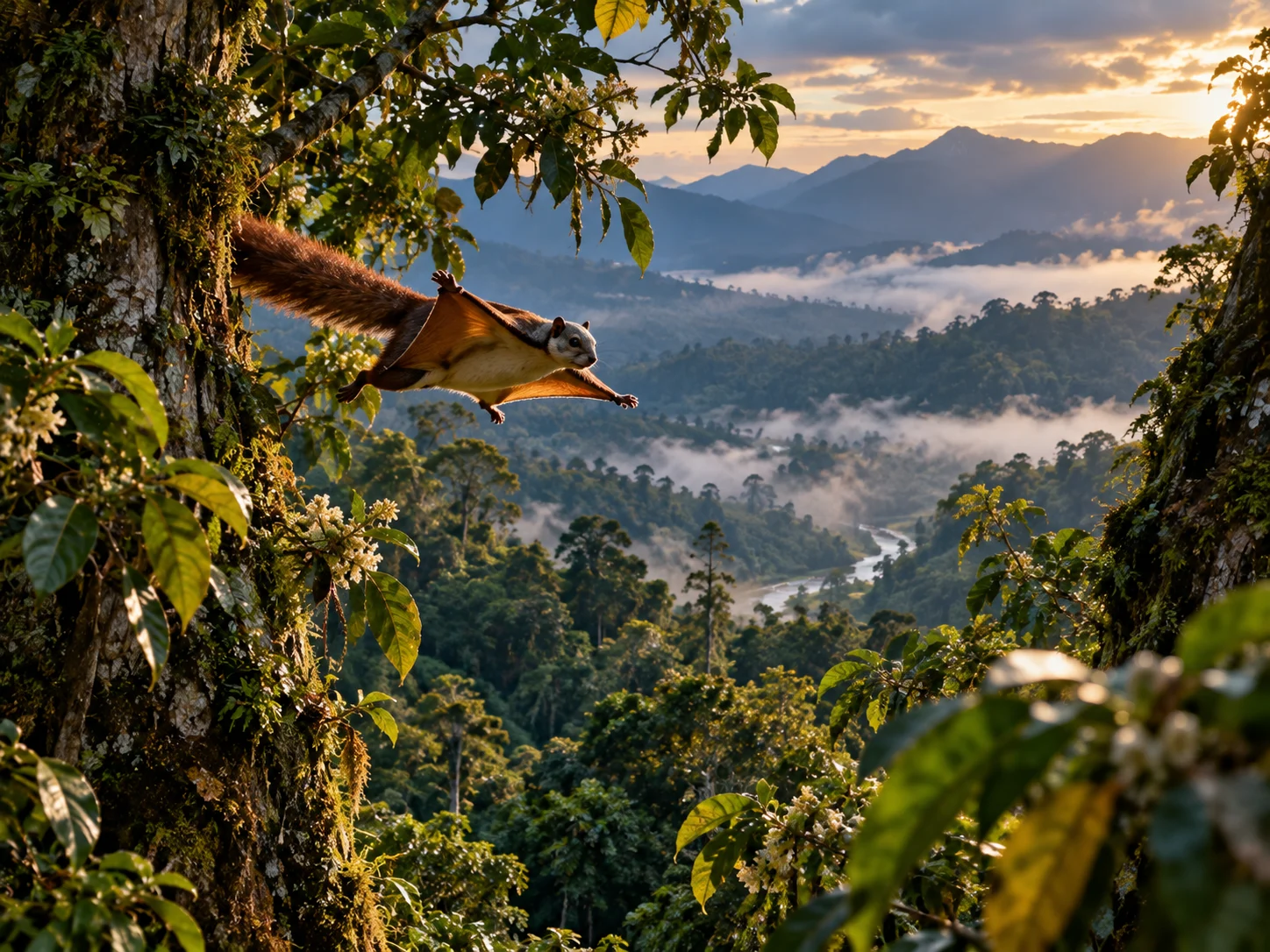
In 1981, in a remote forest in eastern Arunachal Pradesh, a large, reddish flying squirrel was collected that turned out to be unlike any known to science. It had grizzled red fur, a pale grey crown, white underparts, and an orange flap of skin stretched between its legs for gliding from tree to tree. From head to rump it was about forty centimetres long, and its tail was longer still.
It was a species new to science. It was named after the forest where it was found: the Namdapha flying squirrel.
Then, for more than forty years, nobody could prove they had seen another one.
It was a species new to science. Then, for more than forty years, nobody could prove they had seen another one.
Where it is
Namdapha National Park and Tiger Reserve lies in Changlang district, in the far east of Arunachal Pradesh, close to the border with Myanmar. It covers about 1,985 square kilometres, wedged between the Patkai range and the Dapha Bum ridge of the Mishmi Hills.
The park takes its name from a river, the Namdapha, which runs down from Dapha Bum to join the larger Noa-Dihing. In the local language, bum means the peak of a hill.
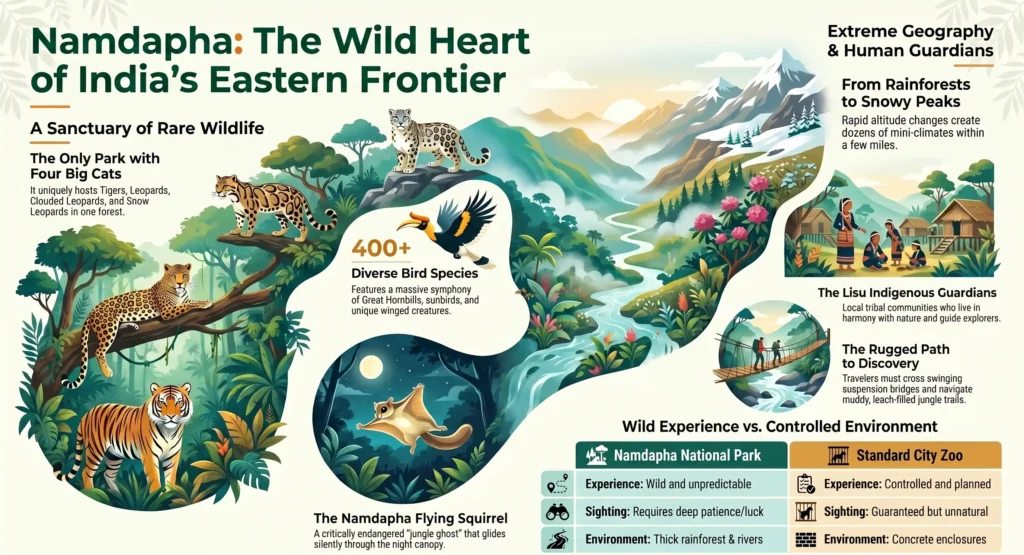
What makes Namdapha extraordinary is its height. The land inside the park rises from low river valleys a few hundred metres above sea level to snowy peaks around 4,500 metres. In one park you pass from steamy tropical rainforest, through temperate forest, to alpine meadows and snow. Every band of altitude has its own plants and animals.
The Powerful Meira Paibis Legacy In Northeast India
Four cats
That range of heights gives Namdapha a claim no other park in the world can make. It is home to four species of big cat: the tiger, the leopard, the clouded leopard in the forests, and the snow leopard on the high slopes.
They are not easy to see. Namdapha’s forests are thick, and most of its big cats are known from signs, camera traps and rare glimpses rather than open sightings. But the fact that all four share one protected area tells you how varied, and how wild, it is.
It is home to four species of big cat: the tiger, the leopard, the clouded leopard, and the snow leopard.
What else lives here
The list is long. Hoolock gibbons, India’s only ape, call through the canopy in the mornings. Several kinds of macaque live here, including the Assamese, pig-tailed and stump-tailed macaques. More than four hundred and fifty species of birds have been recorded, which makes Namdapha one of the richest birding sites in the country. Its plant life is just as rich.
And somewhere, in the tall forests of Mesua ferrea, the Indian ironwood, on the hill slopes above the Noa-Dihing, lives the squirrel.
Discovering The Hearty Zan Millet Porridge
The lost species
For decades the Namdapha flying squirrel was one of the world’s most wanted lost species. Researchers searched for it and came back without proof. It is nocturnal, it lives high in the trees, and it looks very like the more common red giant flying squirrel, which makes any glimpse hard to confirm. It is listed as critically endangered.
In December 2023, a team from the conservation group Aaranyak reported that they had watched and photographed one for over an hour, recognising it by its prominent ear tufts and its behaviour. The news was celebrated as a rediscovery after forty-two years. Scientists are cautious, though: as of 2025, only the single 1981 specimen had actually been studied, and other reported sightings remained unconfirmed.
Either way, the squirrel’s story tells you what kind of place this is. Namdapha is big enough, thick enough and wild enough for an animal the size of a house cat to stay hidden from science for four decades.
If you go
Namdapha is not an easy park, and that is part of its appeal. The usual starting point is the town of Miao, outside the park. From there a road leads in towards Deban, a forest camp on the banks of the Noa-Dihing, from where treks go deeper into the forest. Much of the park can only be reached on foot.
Arunachal Pradesh requires Indian visitors from outside the state to carry an Inner Line Permit, and you will also need permission from the park authorities. The drier months, roughly from October to March, are generally the best time to visit, as the monsoon makes paths slippery and rivers high.
Go without expecting to tick off tigers. Go for the gibbons at dawn, the birds, the rivers, the sheer size of the trees. And if, at dusk, something large glides silently from one ironwood tree to the next, look carefully. You may be seeing one of the rarest animals in India, in the only forest in the world that it calls home.
Cooking the Manipuri Eromba Dish 365 Days
If you think you have remembered everything about this topic take this QUIZ
Results


#1. In which Indian state is Namdapha National Park located?
#2. Namdapha is the only park in the world where which four big cats live together?
#3. What is the name of the rare, critically endangered mammal that was once thought to be a “jungle ghost story”?
#4. Which indigenous tribal community lives on the edges of this deep jungle and acts as forest guides?
#5. What unique geographic feature allows both tropical tigers and alpine snow leopards to coexist in the park?
#6. Which river must travelers cross via a swaying suspension bridge to enter the actual forest?
#7. Approximately how many different species of birds can be found in this national park?
#8. What is the only species of ape found in India that swings through the trees of Namdapha?
What is the best time to visit this dense rainforest?
The best time to visit is during the dry winter months between October and March when the heavy monsoon rains have stopped and the leeches are much less active.
Do I need special permission to enter the park?
Yes, all visitors must obtain an Inner Line Permit to enter the state of Arunachal Pradesh and a separate tourist permit from the local forest office to enter the park itself.
Can I drive my car inside the forest?
No vehicles are only allowed up to a certain base camp. After that you must explore the deep jungle entirely on foot with an official local guide.
Is it safe to camp inside the jungle overnight?
Yes there are designated safe camping spots managed by the forest department where you can pitch a tent safely under the supervision of your guide.
Is there mobile connectivity inside the park?
Connectivity is extremely limited or non-existent once you move deep into the forest past Miao. This is the perfect place to truly disconnect from the digital world.
Sources & References
Encyclopædia Britannica, “Namdapha flying squirrel” (2026) — its discovery in 1981 and the status of sightings by 2025.
DD News, “Namdapha Flying Squirrel resurfaces in Arunachal Pradesh after 42 years” — Aaranyak’s sighting, the features used to identify it, and its listing among the most wanted lost species.
Re:wild, “Namdapha Flying Squirrel” (2022) — the squirrel’s habitat and the searches that failed to find it.
Department of Environment, Forest & Climate Change, Government of Arunachal Pradesh, “Namdapha National Park & Tiger Reserve” — the park’s 1,985.24 sq km area, 200–4,571 m altitudinal range and four big-cat species; S. S. Saha (1981), Bulletin of the Zoological Survey of India — the original description of the Namdapha flying squirrel.