Sunday, April 5, 2026
Curious Indian
  • Arts & Culture
  • Festivals of India
  • Indian History
  • Indian Politics
  • Biography
    • Entertainment Personalities
    • Science Personalties
  • More
    • Unsolved India
No Result
View All Result
  • Arts & Culture
  • Festivals of India
  • Indian History
  • Indian Politics
  • Biography
    • Entertainment Personalities
    • Science Personalties
  • More
    • Unsolved India
No Result
View All Result
Curious Indian
No Result
View All Result
Home Indian History

Pa Togan Nengminza: The Garo Resistance Against British Annexation

paripurnadatta by paripurnadatta
in Indian History
Reading Time: 18 mins read
0 0
A A
Pa Togan Nengminza
Share on FacebookShare on Twitter

Table of Contents

Toggle
  • The Garo Resistance 1872 CE: Pa Togan Nengminza’s Defiance
    • The Garo Hills Before the Final Push
    • RelatedPosts
    • Anglo-Manipuri War 1891: When Manipur Chose to Fight to the Last Man
    • The Jaintia Rebellion: The Farmer Who Defied the British Empire
    • Treaty of Yandabo 1826: How Assam Lost Its Greatest Dynasty Forever
    • Who Was Pa Togan Nengminza?
    • The British Move to Consolidate the Garo Hills
    • The Nighttime Raids: Strategy Born from the Forest
    • The Impact on British Administration
    • Other Voices of Garo Resistance
    • The Capture and Its Aftermath
    • Pa Togan Nengminza’s Legacy in Modern Meghalaya
  • Quick Comparison Table: Pa Togan Nengminza vs. U Tirot Sing
  • Curious Indian: Fast Facts
  • Conclusion
  • If you think you have remembered everything about this topic take this QUIZ
  • Results
    • #1. In which year did the Garo Resistance led by Pa Togan Nengminza take place?
    • #2. What was the primary weapon used by Garo fighters that also served as an agricultural tool?
    • #3. What specific strategy did Pa Togan Nengminza employ to neutralize the British advantage in rifles and training?
    • #4. Which major matrilineal clan did Pa Togan Nengminza belong to?
    • #5. What did the British administration seek to restrict, viewing it as a source of “unpredictability”?
    • #6. Who was another noted Garo resistance fighter mentioned as defying British authority during the same period?
    • #7. According to the text, what does the title “Pa” signify in Garo society?
    • #8. Which modern-day Indian state officially recognizes Pa Togan Nengminza as a national hero and freedom fighter?
    • Who was Pa Togan Nengminza and why is he important?
    • What tactics did Pa Togan Nengminza use against the British?
    • Why did the Garo resist British annexation in 1872 CE?
    • How does Pa Togan Nengminza compare to U Tirot Sing of the Khasi?
    • What is Pa Togan Nengminza’s legacy today?
By 1872 CE, the British East India Company and its successor the British Crown had been steadily pushing deeper into the forested hills of Northeast India for decades. The Garo Hills of Meghalaya were among the last to be fully brought under colonial administration. The Garo people, who called themselves Achik Mande, had already resisted British encroachment for the better part of a century. But by the 1870s, the British were moving with new purpose and new force to complete their administrative control of the hills. Into this moment walked a Garo warrior and community leader named Pa Togan Nengminza. Refusing to accept the loss of Garo independence, he organised a resistance built around the one advantage his fighters had over the British: the ability to move silently through the Garo Hills at night. His raids were swift, unexpected, and deeply unsettling to the British forces who had not expected to find this level of organised resistance in what they had assumed would be a straightforward administrative takeover. Pa Togan Nengminza was eventually captured and his resistance crushed. But his name never left the hills he fought for and today he stands as one of the most celebrated freedom fighters in the history of Meghalaya.
DetailInformation
EventGaro Resistance against British annexation
Year1872 CE
LocationGaro Hills, present-day Meghalaya
Garo LeaderPa Togan Nengminza Sangma
British AdministrationBengal Presidency, British Crown
Weapons of Garo FightersTraditional swords (dao), shields, bows
TacticsNighttime guerrilla raids, forest ambushes
OutcomeBritish military victory, Pa Togan captured
LegacyNational hero of Meghalaya, celebrated freedom fighter
Related ContextBroader British pacification of the Garo Hills 1860s to 1870s

The Garo Resistance 1872 CE: Pa Togan Nengminza’s Defiance

Pa Togan Nengminza

The Garo Hills Before the Final Push

The story of Pa Togan Nengminza cannot be understood without first understanding how the Garo Hills had been changing in the decades before 1872 CE. The British had been edging into Garo territory since the late 18th century. As we have seen in the history of the Garo tribe, the first British military expeditions into the hills began as early as 1788 CE. For nearly a century after that, the relationship between the British administration in Bengal and the Garo communities of the hills was a complicated and often violent back and forth. The British would push in, the Garo would resist, and an uneasy arrangement would follow until the next push came.

By the 1860s, the British had decided they needed to move beyond these partial measures and bring the Garo Hills fully under their administrative control. This was part of a wider pattern across Northeast India, where the British were systematically working to remove every remaining pocket of genuine independence in the hill communities they had surrounded. The Khasi hills had already seen the Anglo-Khasi War of 1829 to 1833 CE, when U Tirot Sing had fought his four-year guerrilla resistance before being captured and exiled. The lesson the British drew from that experience was not to move more carefully but to move more decisively.

RelatedPosts

Anglo-Manipuri War 1891: When Manipur Chose to Fight to the Last Man

The Jaintia Rebellion: The Farmer Who Defied the British Empire

Treaty of Yandabo 1826: How Assam Lost Its Greatest Dynasty Forever

The Integration of Princely States: The Making of a United India

In the Garo Hills, this meant a combination of military pressure and administrative reorganisation. The British began establishing posts, collecting revenue, and requiring the Garo Nokmas to accept the authority of the colonial system. For Garo communities that had governed themselves through the Nokma chieftainship and the village council for centuries, this was not merely an inconvenience. It was a direct assault on the way their world worked.

Pa Togan Nengminza grew up in this world of mounting pressure. He was a Garo man of the hills, raised in the traditions of the Achik Mande, familiar with the forest paths and the river crossings of his homeland, and deeply aware of what was being taken from his people piece by piece.

READ MORE:  The Mathematical Genius of Aryabhatta

Who Was Pa Togan Nengminza?

Pa Togan Nengminza Sangma was a Garo warrior and community leader from the Garo Hills. The title Pa in Garo society is a mark of respect, placed before the name of a man who has earned it through his standing in the community. It tells you immediately that this was not a young hothead acting alone. He was a recognised and respected figure among his people, someone whose community believed in him enough to follow him into a resistance against one of the most powerful military forces in the world.

He came from the Sangma clan, one of the major matrilineal clans of the Garo people. Like all Garo men, he had grown up in a society where courage was expected, where the forest was a familiar friend rather than an obstacle, and where the independence of the Achik Mande was not an abstract political idea but a lived daily reality. Every aspect of Garo life, from the Nokma chieftainship to the Wangala festival to the practice of Jhum cultivation, depended on the freedom of the Garo people to govern their own hills in their own way. Pa Togan Nengminza was not fighting for a political theory. He was fighting for the actual texture of his people’s everyday life.

The Koch Ascendancy: How a New Kingdom Changed Assam Forever

He was also a man who understood warfare. The Garo had a long tradition of martial skill. Their warriors were known across the Northeast for their effectiveness with the dao, the curved blade that doubled as both an agricultural tool and a weapon of war, and for their use of traditional shields made from wood and cane that could deflect arrows and blows with impressive reliability. Garo warriors were trained from youth in the skills of moving through dense jungle quickly, quietly, and without leaving an easy trail.

These were the skills Pa Togan Nengminza brought to the resistance of 1872 CE.

The British Move to Consolidate the Garo Hills

To understand the specific trigger for the 1872 resistance, it helps to understand what the British were doing in the Garo Hills in the years leading up to it. By the early 1870s, the British administration in Bengal had made a firm decision to bring the remaining independent or semi-independent communities of the Garo Hills under full colonial administrative control.

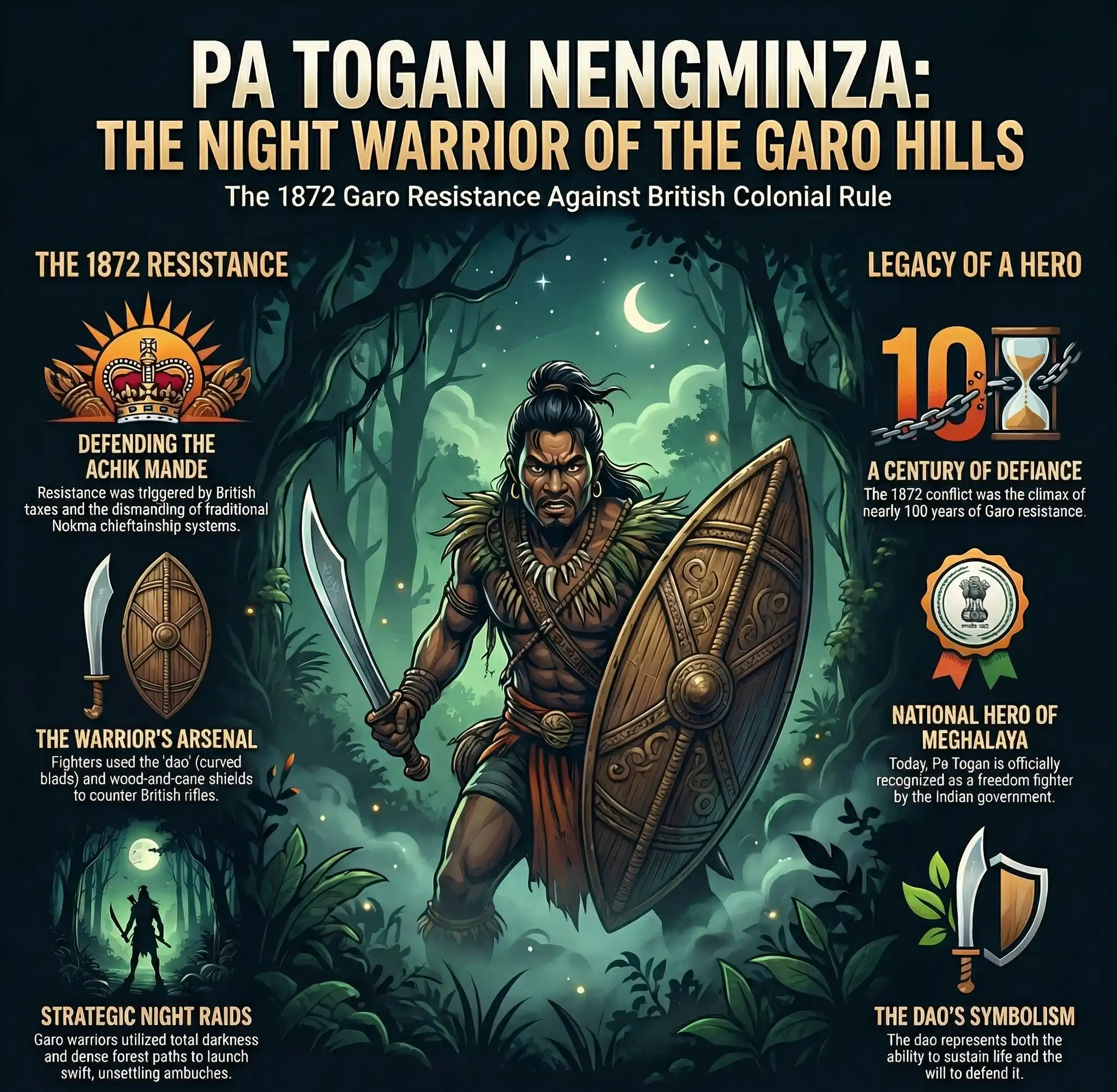
This meant, in practice, a number of things that the Garo found deeply unacceptable. It meant the collection of taxes in forms that were foreign to the traditional Garo economy. It meant the requirement that Garo Nokmas accept the authority of British-appointed officials who outranked them in the colonial system. It meant restrictions on the traditional practice of Jhum cultivation, which the British viewed through an economic lens as wasteful and through an administrative lens as a source of movement and unpredictability that made controlling the population difficult. And it meant the gradual dismantling of the traditional Nokma governance system in favour of structures that were more convenient for colonial administrators but had no roots in Garo life.

For many Garo communities, each of these changes on its own was painful. Together, they amounted to the elimination of Garo self-determination. The Achik Mande were being told, through a series of administrative decisions made in offices far from the Garo Hills, that their centuries-old way of living, governing, and understanding themselves was going to be replaced by something decided in Calcutta and enforced by soldiers with rifles.

The Burmese Invasions and the Treaty That Ended the Ahom Kingdom
Pa Togan Nengminza looked at what was happening and made his decision. If the British were going to take the Garo Hills by force, they were going to have to pay for every step of the way.

The Nighttime Raids: Strategy Born from the Forest

The most distinctive feature of Pa Togan Nengminza’s resistance was its timing. He struck at night.

This was not a random choice. It was the product of clear strategic thinking about where the Garo advantage lay and where the British advantage lay. In daylight, with open visibility and time to organise, British forces with their rifles and disciplined military training had an overwhelming advantage over Garo fighters armed with traditional weapons. Meeting the British in a daytime engagement was not a strategy. It was a way to lose quickly.

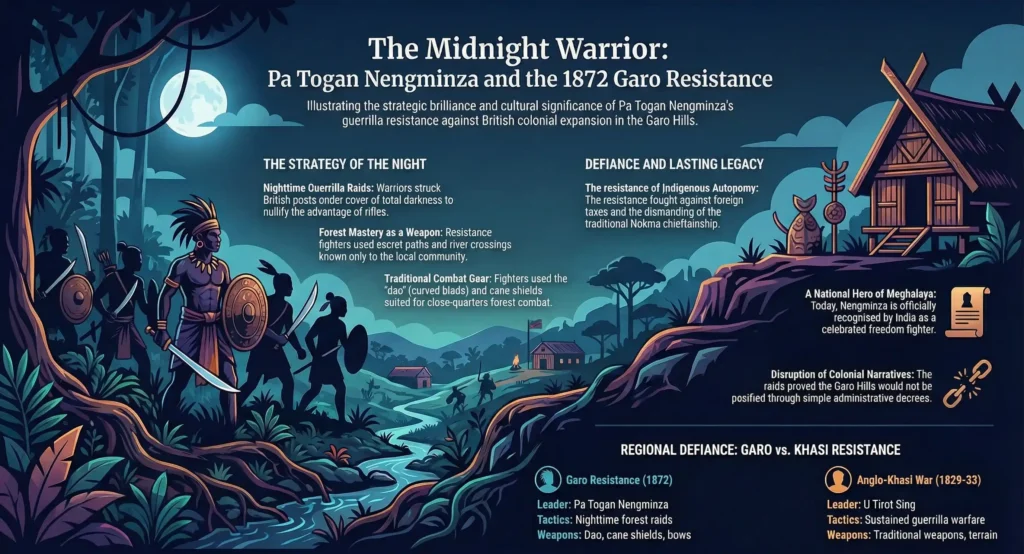
But at night, in the dense forests of the Garo Hills, the calculation changed completely. The Garo fighters knew every path, every stream crossing, every ridge and hollow of their homeland. British soldiers, even experienced ones, were moving through unfamiliar terrain in darkness, unable to see clearly, unable to organise effectively, and deeply vulnerable to sudden attacks from fighters who could appear from one direction, strike hard, and vanish into the forest before anyone could mount a coordinated response.

Pa Togan Nengminza organised his warriors into small, fast-moving groups. They would assemble quietly in the forest as darkness fell, move through paths that the British patrols did not know existed, and strike at British posts or supply lines at the moment of maximum darkness and minimum British alertness. The raids were designed to achieve specific goals: destroying supplies, creating fear and uncertainty, demonstrating that the Garo Hills were not the pacified territory that the colonial administration wanted to believe they were, and keeping the spirit of resistance alive in the broader Garo community.

The dao carried by each Garo warrior was not a ceremonial object. It was a practical and deadly weapon in the hands of someone who had been using it since childhood. Combined with the traditional cane and wood shields that Garo warriors carried, it gave each fighter a personal weapons system suited perfectly to the close-quarters fighting that nighttime forest raids involved.

READ MORE:  Mature Harappan Phase: When India Built the World's First Planned Cities

The British were not accustomed to this kind of warfare from the Garo. They had expected that the administrative decisions being handed down from Calcutta would simply be accepted, or at most resisted through complaint and petition. What they found instead was a community that had decided to fight physically, on its own terms, in its own landscape, at its own chosen time.

The Impact on British Administration

The raids led by Pa Togan Nengminza did not defeat the British. No single leader’s guerrilla resistance in this period of Indian history had the resources to do that. But they did something important: they disrupted the British narrative that the pacification of the Garo Hills was a smooth and inevitable process.

British administrative reports from the period reflect the genuine difficulty and anxiety that Pa Togan Nengminza’s resistance created. Officials who had been managing what seemed like a straightforward administrative expansion suddenly found themselves dealing with a military situation that required a different kind of response. Troops had to be redeployed. Schedules had to be changed. The movement of British officials through the hills at night, which had previously been routine, became a matter that required security planning.

U Tirot Sing: The Khasi Chief Who Fought an Empire for Four Years

More broadly, the resistance demonstrated to the British what the Anglo-Khasi War had also shown: that the hill communities of Northeast India were not passive recipients of colonial administration. They were peoples with deep roots in their land, with martial traditions and leadership capable of mounting serious resistance, and with the specific advantage of fighting on ground they knew better than any outsider ever would.

The fact that Pa Togan Nengminza was able to sustain his resistance for a meaningful period, attracting followers and maintaining the operational security necessary to keep launching raids without being immediately captured, is a testament to both his own leadership and to the depth of support for resistance within the broader Garo community. He was not operating alone. He was the visible face of a widespread refusal among the Achik Mande to simply accept what was being done to them.

Other Voices of Garo Resistance

Pa Togan Nengminza was the most celebrated leader of the 1872 resistance, but he was not alone. The history of Garo resistance to British annexation includes several other figures whose names are preserved in the oral traditions and historical records of the Garo Hills.

Among these was Sokol Marak, another Garo resistance fighter of the same period whose defiance of British authority added to the broader pattern of armed opposition that made the British consolidation of the Garo Hills far more difficult and costly than they had planned. The Marak and Sangma clans, two of the largest and most important matrilineal clans of the Garo people, both produced leaders who refused to accept colonial rule without resistance.

This breadth of resistance across different clans and communities is significant. It tells us that what Pa Togan Nengminza was doing was not the act of one unusual individual but the expression of a much wider Garo unwillingness to surrender. The nighttime raids were the most dramatic and visible form of this resistance, but underneath them was a whole community that fed, sheltered, and protected its fighters and kept the knowledge of what they were doing away from the British for as long as possible.

The Capture and Its Aftermath

Like U Tirot Sing before him, Pa Togan Nengminza was eventually captured. The British, once they committed fully to ending the resistance in the Garo Hills, brought significantly greater military force and intelligence resources to bear. The network of forest paths and community shelter that had protected Pa Togan Nengminza’s fighters could not hold indefinitely against a colonial administration determined to break it.

The details of his capture, like many aspects of resistance history from this period, are preserved more fully in oral tradition than in colonial administrative records, which tended to describe such events in the dry language of pacification operations rather than in terms that acknowledged the humanity and courage of the people being captured.

The Garo Tribe: Their Ancient History, Culture and Legacy

What the historical record does confirm is that the resistance was broken, that Pa Togan Nengminza was taken by the British, and that the Garo Hills subsequently came under full British administrative control. The same colonial framework that had been imposed on the Khasi hills, the Assam plains, and the Ahom territories was now extended to the Achik Mande.

The Garo Hills were reorganised as a British administrative district. The Nokma system was not entirely destroyed but was subordinated to the colonial administrative hierarchy. Jhum cultivation continued but faced increasing restrictions. The Baptist missionary activity that had been growing since the 1860s continued and accelerated. And the deep, old world of the Achik Mande, which had been built over centuries on the principles of matrilineal identity, forest knowledge, and community self-governance, began the long process of adapting to a world it had not chosen.

Pa Togan Nengminza’s Legacy in Modern Meghalaya

The story of Pa Togan Nengminza did not end with his capture. In the hills he had fought for, his memory became part of the living culture of the Garo people. Songs carried his name from generation to generation. The places where his raids had taken place became part of the sacred geography of Garo historical memory. Grandparents told grandchildren about the warrior who had picked up his dao and shield and refused to let the British walk into the Garo Hills without a fight.

READ MORE:  U Tirot Sing: The Khasi Chief Who Fought an Empire for Four Years

As India moved toward independence in the 20th century and the new Indian nation began the work of building a national memory that honoured resisters from every corner of the country, Pa Togan Nengminza was recognised as part of that story. He was not a famous name in the textbooks of distant cities, the way the leaders of the 1857 uprising or the non-cooperation movement were. But in Meghalaya, his name carried the same weight.

Today Pa Togan Nengminza is officially recognised as a freedom fighter by the Government of India and the Government of Meghalaya. His name has been given to educational institutions, public spaces, and civic organisations across the Garo Hills. The district of South Garo Hills, one of the most remote and forested parts of Meghalaya, has particular reason to remember him, as it sits close to the heartland of the territory his raiders moved through in the darkness of 1872 CE.

His story also holds a special place in the tradition of Northeast Indian resistance history. Alongside U Tirot Sing of the Khasi hills, he represents the specific character of hill community resistance to colonialism in this region: deeply rooted in the land, expressed through the genius of the forest rather than the power of numbers, and driven by something far more personal than political ideology. The Garo Hills were not an abstraction to Pa Togan Nengminza. They were the ground under his feet, the trees above his head, and the community that had shaped everything he knew about what it meant to be alive and free.

Quick Comparison Table: Pa Togan Nengminza vs. U Tirot Sing

FeaturePa Togan NengminzaU Tirot Sing
PeopleGaro, Achik MandeKhasi
Year of Resistance1872 CE1829 to 1833 CE
LocationGaro Hills, MeghalayaKhasi Hills, Meghalaya
Primary TacticNighttime forest raids with traditional weaponsSustained guerrilla warfare in hill forests
WeaponsDao, traditional shields, bowsTraditional weapons, forest terrain
EnemyBritish Crown administrationBritish East India Company
How CapturedMilitary pressure and intelligence operationsBetrayal
LegacyFreedom fighter, hero of the Garo HillsNational hero of Meghalaya, Assembly named after him
Community StructureNokma chieftainship, matrilineal clansSyiem chieftainship, matrilineal clans

Curious Indian: Fast Facts

Pa Togan Nengminza is officially recognised as a freedom fighter by both the Government of India and the Government of Meghalaya, placing him in the same national record of resistance as the most celebrated names of the independence movement.

The dao, the curved blade carried by Pa Togan Nengminza’s warriors during their nighttime raids, was not just a weapon. It was the same tool that Garo farmers used to clear forest for Jhum cultivation. In Garo hands, it was a symbol of both the ability to sustain life and the will to defend it.

The Garo Hills that Pa Togan Nengminza fought to protect are home to some of the most biodiverse tropical forests in all of India. The Nokrek Biosphere Reserve and Balpakram National Park in the Garo Hills are now protected areas whose preservation owes something to the centuries of careful Garo relationship with the forest that men like Pa Togan Nengminza were defending.

The Baptist missionary movement in the Garo Hills was already active when Pa Togan Nengminza launched his resistance. The coexistence of armed resistance to British political control and the spread of British-introduced Christianity within the same community at the same time is one of the most fascinating complexities of Garo history in this period.

The matrilineal clan system that structured Pa Togan Nengminza’s world, where he belonged to the Sangma clan through his mother’s line, continues to function as the organising principle of Garo social identity today. The Sangma clan is one of the most widely recognised and respected clans in the entire Garo community.

The resistance of 1872 CE in the Garo Hills happened just fifteen years after the great uprising of 1857 CE across North India. It was part of a continent-wide pattern of resistance to British expansion that the colonial administration worked hard to describe as isolated and disconnected but which shared a common cause: the refusal of India’s many peoples to accept the loss of their independence without a fight.

Conclusion

Pa Togan Nengminza walked into the darkness of the Garo forests with a sword and a shield and the weight of his people’s freedom on his shoulders. He did not have the resources of a kingdom or the manpower of a professional army. What he had was the night, the forest, and the absolute conviction that the Garo Hills belonged to the Achik Mande and not to any empire that arrived with rifles and administrative forms. His raids could not stop the British. But they could and did make the British understand that taking the Garo Hills was going to cost something. Every step into the forest was going to be earned. That understanding, that a people’s resistance matters even when it cannot achieve immediate victory, is the most important thing Pa Togan Nengminza left behind. The Garo Hills remember it. They always will.

If you think you have remembered everything about this topic take this QUIZ


Results

Share your score!
Tweet your score!
Tweet your score!
Share to other
QUIZ START

#1. In which year did the Garo Resistance led by Pa Togan Nengminza take place?

Previous
Next

#2. What was the primary weapon used by Garo fighters that also served as an agricultural tool?

Previous
Next

#3. What specific strategy did Pa Togan Nengminza employ to neutralize the British advantage in rifles and training?

Previous
Next

#4. Which major matrilineal clan did Pa Togan Nengminza belong to?

Previous
Next

#5. What did the British administration seek to restrict, viewing it as a source of “unpredictability”?

Previous
Next

#6. Who was another noted Garo resistance fighter mentioned as defying British authority during the same period?

Previous
Next

#7. According to the text, what does the title “Pa” signify in Garo society?

Previous
Next

#8. Which modern-day Indian state officially recognizes Pa Togan Nengminza as a national hero and freedom fighter?

Previous
Finish

Who was Pa Togan Nengminza and why is he important?

Pa Togan Nengminza Sangma was a Garo warrior and community leader who led a resistance against British annexation of the Garo Hills in 1872 CE. He organised daring nighttime raids using traditional weapons against British forces and is celebrated today as one of Meghalaya’s most important freedom fighters.

What tactics did Pa Togan Nengminza use against the British?

Pa Togan Nengminza used nighttime guerrilla tactics, organising small groups of Garo warriors to strike British posts and supply lines in the darkness when the colonial forces were least prepared and the Garo advantage in forest knowledge was greatest. His fighters used traditional weapons including the dao, shields, and bows.

Why did the Garo resist British annexation in 1872 CE?

The British were imposing new taxes, restricting traditional Jhum cultivation, and dismantling the Nokma chieftainship governance system that had organised Garo community life for centuries. The resistance was a direct response to the systematic removal of Garo self-determination and the forced replacement of Garo ways of life with colonial administrative structures.

How does Pa Togan Nengminza compare to U Tirot Sing of the Khasi?

Both Pa Togan Nengminza and U Tirot Sing were hill community leaders who used guerrilla tactics in dense forest terrain to resist British colonial expansion in Meghalaya. U Tirot Sing led a longer resistance from 1829 to 1833 CE while Pa Togan Nengminza’s raids in 1872 CE were characterised specifically by their nighttime timing. Both were eventually captured and both are celebrated today as freedom fighters of Meghalaya.

What is Pa Togan Nengminza’s legacy today?

Pa Togan Nengminza is officially recognised as a freedom fighter by the Government of India and the Government of Meghalaya. His name has been given to educational institutions and public spaces across the Garo Hills. He is remembered in Garo oral tradition, songs, and community memory as a warrior who chose resistance over surrender when the independence of the Achik Mande was threatened.

Tags: British annexationGaro resistanceIndian Freedom FightersNokma systemNortheast India historySangma clan Garo
ShareTweetPin
paripurnadatta

paripurnadatta

Related Posts

Anglo-Manipuri War
Indian History

Anglo-Manipuri War 1891: When Manipur Chose to Fight to the Last Man

April 5, 2026
The Jaintia Rebellion: The Farmer Who Defied the British Empire
Indian History

The Jaintia Rebellion: The Farmer Who Defied the British Empire

April 4, 2026
Treaty of Yandabo
Indian History

Treaty of Yandabo 1826: How Assam Lost Its Greatest Dynasty Forever

April 4, 2026
No Result
View All Result

Stay Updated

TAGS

Ahom Kingdom Akbar Ancient India Architectures of India Arthashastra Ashoka Ayurveda History Bollywood Icon Bollywood legend British East India Company Buddha Buddhism Chandragupta Maurya Chola dynasty Dadasaheb Phalke Award Dadasaheb Phalke Awardee Delhi Sultanate Events That Changed History Festivals film director Gupta Empire Harappa History of Science Indian cinema Indian Cinema History Indian Freedom Fighters Indian History Indian National Congress Indian Scientists Indira Gandhi Mahatma Gandhi Mathematics Mauryan Empire Mughal Empire Music Icon National Award Winner Northeast India history Oscar Winner Parallel cinema Partition of India Pataliputra Rigveda Swadeshi Movement Tamil cinema Unsolved India

Archives

  • April 2026
  • March 2026
  • February 2026
  • December 2025
  • November 2025
  • October 2025
  • September 2025
  • August 2025
  • April 2025
  • March 2025
  • July 2017
Facebook Twitter Youtube RSS
Curious Indian Logo

Explore the soul of Bharat with Curious Indian. A definitive guide to Indian history, arts, culture, biographies, and the events that defined our future.

Follow us on social media:

Recent News

  • Anglo-Manipuri War 1891: When Manipur Chose to Fight to the Last Man
  • Pa Togan Nengminza: The Garo Resistance Against British Annexation
  • The Jaintia Rebellion: The Farmer Who Defied the British Empire

Category

  • Arts & Culture
  • Battles of India
  • Biography
  • Entertainment Personalities
  • Festivals of India
  • Indian History
  • Indian Politics
  • More
  • Places
  • Science Personalties
  • Uncategorized
  • Unsolved India

© 2025 Curious Indian- Everything about India

Welcome Back!

Login to your account below

Forgotten Password?

Retrieve your password

Please enter your username or email address to reset your password.

Log In

Add New Playlist

No Result
View All Result
  • Arts & Culture
  • Festivals of India
  • Indian History
  • Indian Politics
  • Biography
    • Entertainment Personalities
    • Science Personalties
  • More
    • Unsolved India

© 2025 Curious Indian- Everything about India

This website uses cookies. By continuing to use this website you are giving consent to cookies being used. Visit our Privacy and Cookie Policy.
Are you sure want to unlock this post?
Unlock left : 0
Are you sure want to cancel subscription?
×