Barpeta, the 1560s: a Koch king asked a saint to show him Krishna’s childhood in Vrindavan. The saint answered with a cloth, and a team of weavers spent months making it
In the 1560s, the king of the Koch kingdom, Naranarayan, made an unusual request of an old man.
The old man was Srimanta Sankardev, the saint, poet, playwright and reformer who had filled the Brahmaputra valley with a new, simple devotion to Krishna. The king, as the story is told, wanted to see the lilas of Krishna’s childhood in Vrindavan: the mischief, the cowherds, the river, the dance.
Sankardev could have described them. He had written about them all his life. Instead he decided to weave them.
Sankardev could have described them. Instead he decided to weave them.
Two brothers
The Koch kingdom was at its height. Naranarayan ruled from Cooch Behar over a realm that stretched across western Assam and north Bengal. His younger brother Shukladhwaj was the kingdom’s great general, so quick in battle that people called him Chilarai, the kite. Between them they made the Koch court a centre of learning, poetry and music.
They were also Sankardev’s protectors. The saint had spent years in the Ahom lands further east, and on the river island of Majuli he had met Madhavdev, the young man who would become his closest disciple. But his new movement, which welcomed people of every caste and rejected the old rituals of sacrifice, made enemies among the powerful. He came west, into Koch territory, and settled at Patbausi near Barpeta. Chilarai took him under his protection.
So when the request came, it came from friends.
Sukaphaa’s Crossing: How the Ahom Kingdom Was Born in Assam
Gupta Empire: When India Led the World in Science and Culture
The weavers of Tantikuchi
Sankardev chose his weavers from Tantikuchi, near Barpeta. There is a twist in their story. By Assamese tradition, they had not always lived there. They were master weavers from Nazira in the Ahom country, and Chilarai had brought them west and settled them at Tantikuchi after one of his campaigns against the Ahoms.
Their leader was a master weaver named Gopal. Sankardev did not simply hand him a subject. He worked out the design himself: the sequence of scenes from Krishna’s childhood, drawn from the Bhagavata Purana, the patterns, the threads, the colours. Red, white, black, yellow, green, and blended shades with names of their own. He trained the weavers in what he wanted, scene by scene.
Madhavdev, the disciple from Majuli, oversaw the looms. Under him, the story goes, the work advanced by about four inches of cloth a day, and Sankardev was so pleased that he gave Madhavdev an affectionate title, Badhar Po.
About four inches a day. Scene by scene, Krishna’s childhood came off the looms.
The cloth, by tradition, was enormous: a hundred and twenty cubits long and sixty wide, woven in panels and joined together. It took months, six by one telling, nearly a year by another.
The gift
When it was finished, Sankardev took it by boat to Cooch Behar and presented it to Naranarayan and Chilarai. The accounts say the two brothers were overwhelmed, and that the saint explained every scene to them. The king offered him the charge of the Barpeta territory as a reward. Sankardev turned it down.
They called it the Vrindavani Vastra, the cloth of Vrindavan. Sankardev died soon afterwards, in 1568.
The Integration of Princely States: The Making of a United India
Scattered
The original cloth is lost. Nobody knows what became of it.
But the weavers of Barpeta went on making Vrindavani cloths long after the saint’s death, for the satras, the Vaishnava monasteries he inspired, where they hung as backdrops for devotional plays. About twenty such pieces survive today, scattered across the world. There is one in the Musée Guimet in Paris and one at the Los Angeles County Museum of Art, both thought to date from close to Sankardev’s own time. The best known, in the British Museum, is over nine metres long, was woven around a century later, and carries lines from Sankardev’s own play about Krishna and the serpent Kaliya. One fragment was found, of all places, sewn into the lining of a Chinese silk coat in Wales.
Assam has worked for years to see the cloth again. The state government has now signed an agreement with the British Museum to bring its Vrindavani Vastra to Assam on loan in 2027, the first time it will have been there in more than a century.
The thread
It is a very Assamese story. A Koch king asked. A saint who had fled the Ahom country answered. Weavers who had been brought from the Ahom country did the weaving. A disciple from Majuli kept the looms moving. The finished cloth was the work of the whole valley, whatever its kingdoms happened to be doing to one another at the time.
Naranarayan had asked to see Krishna in Vrindavan. What he was given, in the end, was the Brahmaputra valley’s own picture of him, woven thread by thread, four inches at a time.
Akbar the Great: The Emperor of Sulh-i-Kul
Kamarupa Kingdom: Assam’s Golden Age and the Silk Route
If you think you have remembered everything about this topic take this QUIZ
Results


#1. Who is considered the founder of the Koch dynasty, reigning approximately from 1515 to 1540 CE?
#2. What was the original name of the Ahom kingdom, which translates to “casket of gold”?
#3. Which famous general was known as “Chilarai” because of his ability to attack the enemy like a hawk?
#4. In 1563, which treaty was signed between the Ahoms and the Koches following a Koch victory?
#5. After the division of the Koch kingdom, which territory east of the Sankosh river was given to Raghu Deb?
#6. What was the name of the silver currency introduced during the reign of Nara Narayan?
#7. Majuli became the first island in India to be designated as a district in which year?
#8. Which spiritual leader founded the Neo-Vaishnavite movement and established the Satras (monasteries) on Majuli?
Who founded the Koch Kingdom and when?
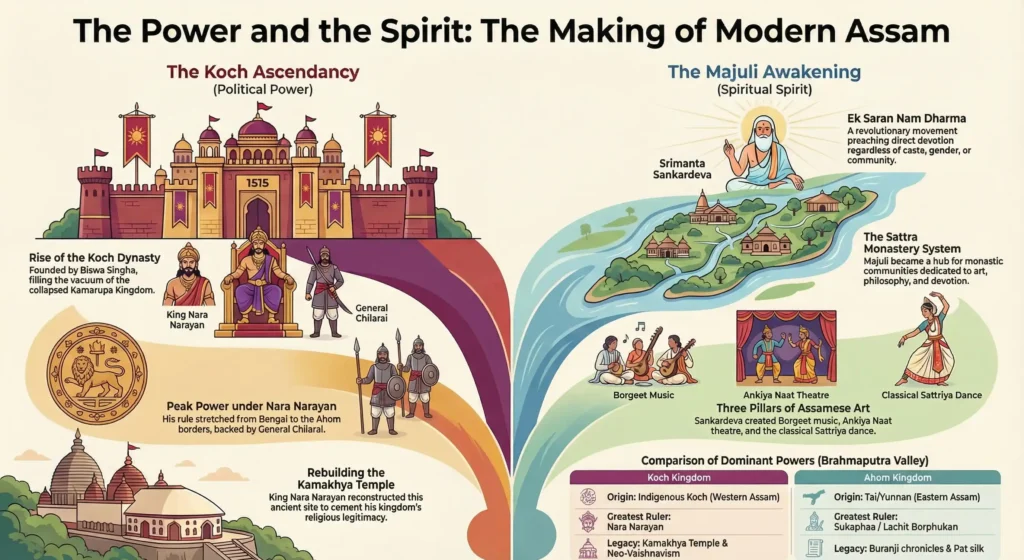
The Koch Kingdom was founded by Biswa Singha around 1515 CE. He united the Koch clans of western Assam and the Duars region under a single royal authority and established the capital at Cooch Behar.
Who was the greatest king of the Koch dynasty?
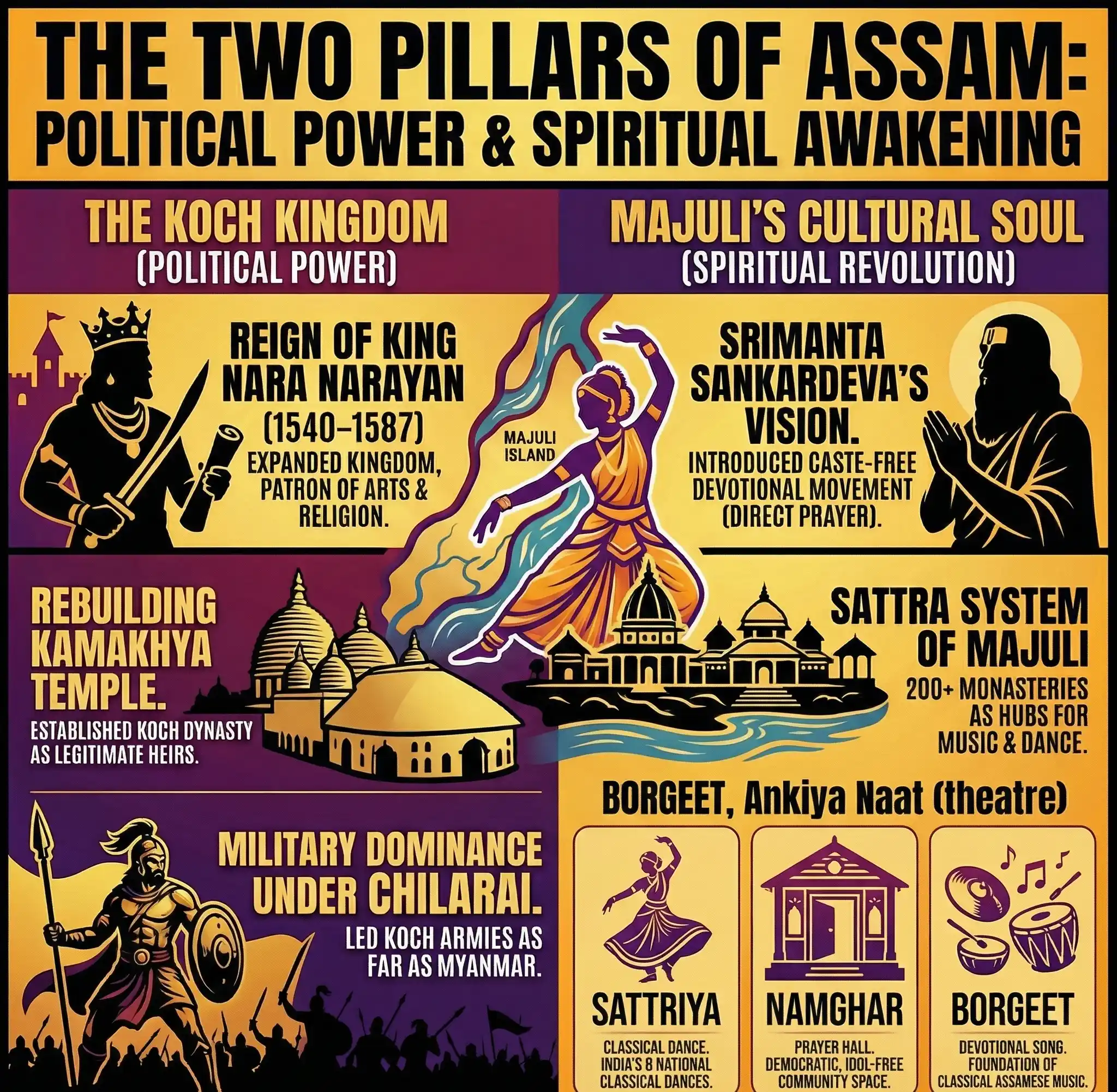
Nara Narayan, who ruled from around 1540 to 1587 CE, is considered the greatest Koch king. He expanded the kingdom across eastern India, rebuilt the Kamakhya Temple, and gave royal patronage to the saint Srimanta Sankardeva.
Who was Srimanta Sankardeva and what did he create?
Srimanta Sankardeva was a 15th and 16th century saint, scholar, musician, playwright, and choreographer from Assam. He founded the Ek Saran Nam Dharma movement and created Borgeet devotional music, Ankiya Naat theatre, Sattriya dance, and the Namghar community prayer hall system.
Why is Majuli Island important to Assamese culture?
Majuli is the home of the Sattra monastery system established by Sankardeva’s disciples. These monasteries became the living centres of Assamese Vaishnavite culture, preserving classical music, theatre, and dance traditions for five hundred years. Majuli is considered the cultural capital of Assam.
What happened to the Koch Kingdom?
After the death of Nara Narayan, the kingdom split into two halves: Koch Bihar in the west and Koch Hajo in the east. Both halves weakened over time. The eastern part was gradually absorbed by the Ahom Kingdom and the Mughals. The western part, Koch Bihar, became a princely state and was merged into independent India in 1949 CE.
Sources & References
The Sentinel, “Vrindabani Vastra” (24 November 2023) — the Tantikuchi weavers brought from Nazira, the design, the surviving fragments and the Chepstow coat.
The Sentinel, “Vrindavani Vastra” (1 September 2025) — Naranarayan’s request and the loan agreement with the British Museum.
A Tribute to Sankaradeva, “Vrindavani-Vastra, the Crest of the Art of Weaving” — the master weaver Gopal, the size and colours of the cloth, and its presentation at Cooch Behar.
British Museum collection, “Vrindavani Vastra” — the surviving textile, its Krishna imagery, Sankaradeva association and later Tibetan additions.