Sankarabharanam was a film about a Carnatic master, and the voice it gave him belonged to a man who had never studied classical music
K. Viswanath’s Sankarabharanam, in 1980, is about a Carnatic musician whose art is being pushed aside by film music, and about what is lost when that happens.
The composer K.V. Mahadevan wanted M. Balamuralikrishna, one of the great Carnatic vocalists then living, to sing for him. He ended up using S.P. Balasubrahmanyam, who had no formal training in Carnatic music or in any other classical system, and who sang nine of the film’s ten songs.
It is the performance that made the country pay attention to him, and it won him the first of his six National Awards.
A film arguing that the classical tradition deserved better than film music was sung, throughout, by a film singer who had never sat in a class.
Nellore
He was born in June 1946 in Nellore district in Andhra Pradesh. His father, S.P. Sambamurthy, was a Harikatha artist, which is storytelling carried on music, so there was music in the house, but it was not the concert circuit and it came with no lessons attached.
His sister S.P. Sailaja became a singer and his son S.P. Charan sings and produces, so the household did eventually turn into a musical one, but not by design.
The plan was engineering. His father wanted a degree and a government job, and he enrolled and went at it, singing in competitions on the side and not treating that as the career.
Architecture of Truth: How Dignaga Buddhist Logic Changed the World
How Vagbhata Ayurveda Harmonized Ancient Healing
15 December 1966
A friend and flatmate pushed him to a recording studio. He said afterwards that without that shove he would not have become a film singer at all.
The song was for S.P. Kodandapani, for the Telugu film Sri Sri Sri Maryada Ramanna. A week later he recorded in Kannada. What training he got came after that, on the floor, from the composers he worked for, and he never stopped naming them: Kodandapani, Sathyam, K.V. Mahadevan, later Ilaiyaraaja.
He learned the job by doing it in front of a microphone with a full orchestra waiting.
How fast
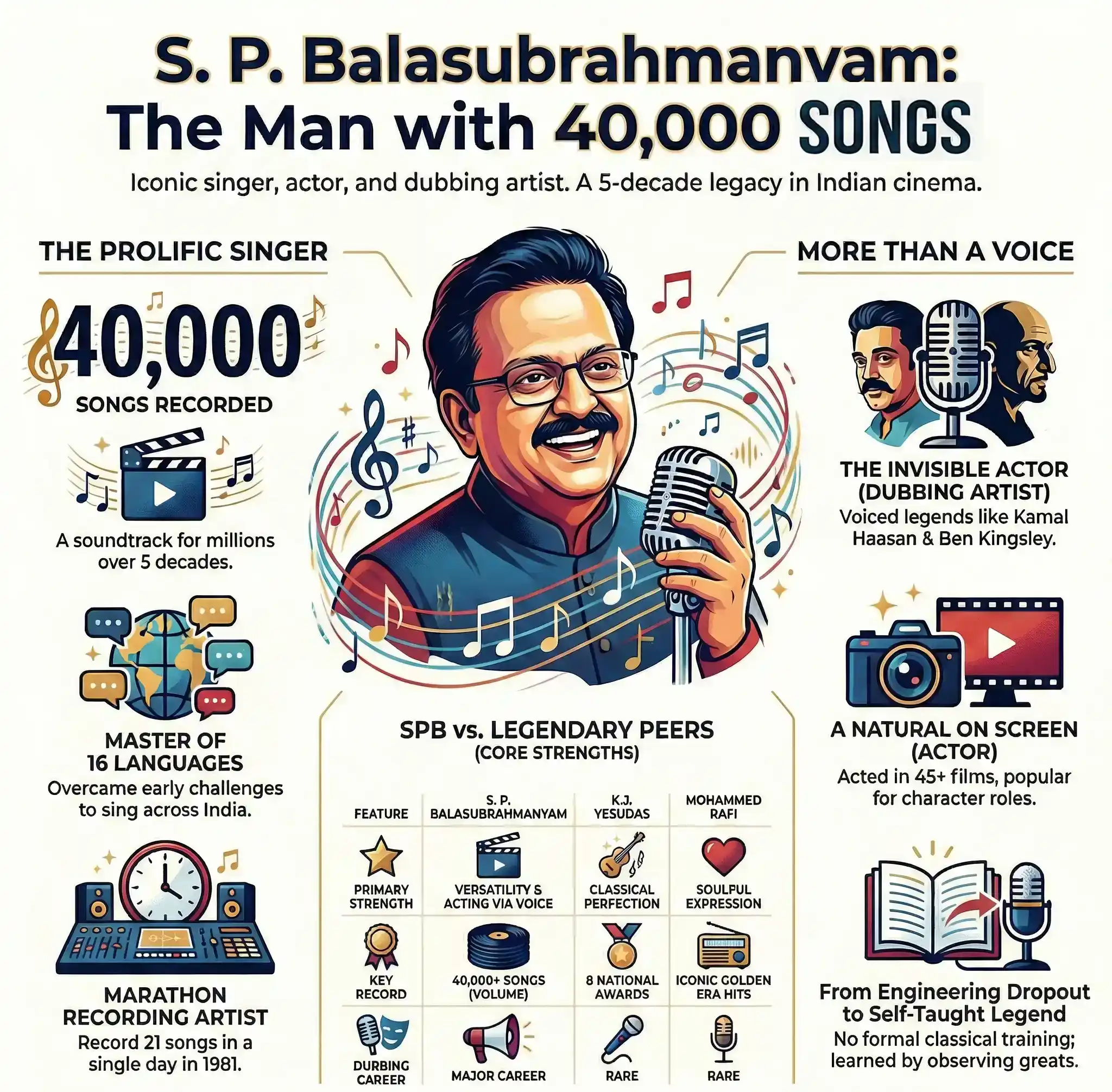
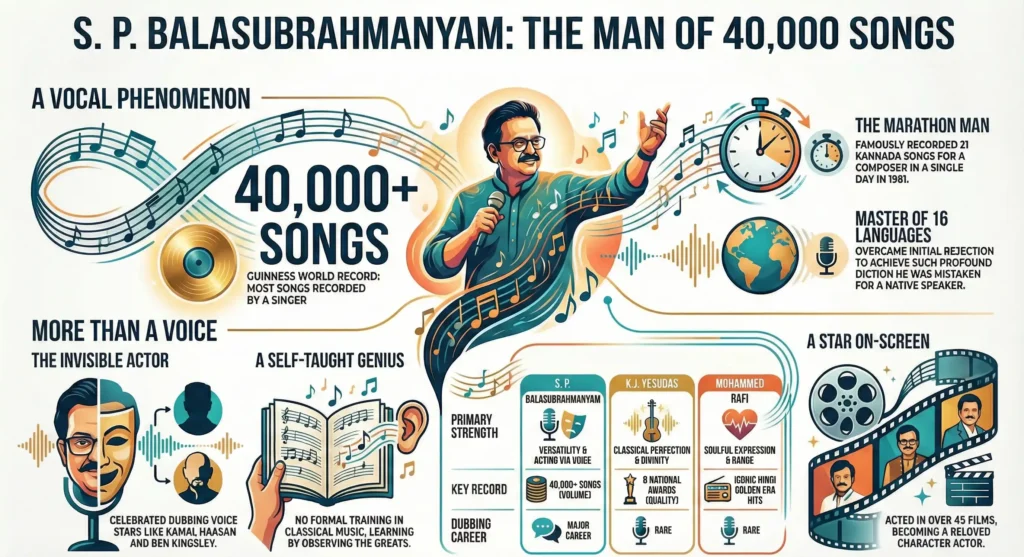
On 8 February 1981 he recorded twenty-one Kannada songs in Bengaluru for the composer Upendra Kumar, between nine in the morning and nine at night. He also has days of nineteen songs in Tamil and sixteen in Hindi.
The career total is usually given as more than forty thousand songs in sixteen languages, though the counts vary and nobody can properly audit a number like that. It works out to something near three songs a day for fifty years.
That pace is only possible for a singer who works by ear. He could take a tune once, hold it and give it back in a language he did not speak, which is a specific and unusual skill, and not the one music schools teach.
It also explains the range of what he sang. Composers with something odd on their hands, a classical piece, a comic number, a drunk song, a lullaby, sent it to him, because he had no school style to protect and would try it.
Jivaka: The King of Physicians Who Healed the Buddha
The other industries
Ek Duuje Ke Liye in 1981 was his first Hindi film and brought a second National Award. Maine Pyar Kiya in 1989 made him, at forty-three, the singing voice of a new young star, and for a stretch of years he was what Salman Khan sounded like.
He also spoke for actors, dubbing dialogue for Kamal Haasan among others, and acted in some seventy films himself. The six National Awards came in four different languages, which nobody else has done.
The songs and who owns them
Through the 1980s he, Ilaiyaraaja and S. Janaki made a great deal of Tamil film music between them. In 2017 Ilaiyaraaja had notice served on him over the performance of those songs in concert without permission, and the two of them, who had spent thirty years in the same rooms, ended up on opposite sides of a question about who a song belongs to once a voice has carried it.
Both positions are defensible, which is what made it painful to watch in the Tamil press at the time. A composer owns the work. A singer has spent his life being the reason people recognise it.
He kept performing. The audiences that came were not turning up for the composition credit.
2020
He was admitted to hospital in Chennai in August 2020 with COVID-19 and died there on 25 September, at seventy-four. The Padma Shri had come in 2001 and the Padma Bhushan in 2011. The Padma Vibhushan was announced the following year, after his death.
He never learned the grammar. The nation’s award came to him for singing a film about why the grammar matters.
Sage Atreya and the Birth of Internal Medicine
If you think you have remembered everything about this topic take this QUIZ
Results


#1. Approximately how many songs is S. P. Balasubrahmanyam estimated to have recorded in his career?
#2. Before pursuing music full-time, what was SPB studying at JNTU College?
#3. What was unique about SPB’s musical training?
#4. Which legendary composer accompanied SPB on the harmonium in their early days before fame?
#5. In which language did SPB set a record by recording 21 songs in a single day?
#6. For which actor was SPB the primary dubbing voice in Telugu versions of their films for decades?
#7. In which film did SPB gain massive popularity for acting as the “cool father”?
#8. What reason was given by a composer for rejecting SPB early in his career?
Uddalaka Aruni: The First Scientist in History
How many songs did S. P. Balasubrahmanyam sing in total?
SPB is credited with recording over 40,000 songs in 16 Indian languages, a feat recognized by the Guinness World Records.
Which actor did SPB dub for most frequently?
He was the permanent Telugu dubbing voice for Kamal Haasan for decades. He also dubbed for Rajinikanth, Salman Khan, and Anil Kapoor in various dubbed versions of their films.
Did S. P. Balasubrahmanyam win a National Award for Hindi songs?
Yes, he won a National Film Award for Best Male Playback Singer for the song “Tere Mere Beech Mein” from the Hindi film Ek Duuje Ke Liye (1981).
Was SPB classically trained?
Surprisingly, no. SPB did not have formal training in Carnatic music when he started his career. He learned by listening and through his association with composers like K.V. Mahadevan and Ilaiyaraaja.
What was the cause of SPB’s death?
S. P. Balasubrahmanyam passed away on September 25, 2020, due to cardio-respiratory arrest following complications from COVID-19.
Read More: https://curiousindian.in/devika-rani-march-1908-march-1994/
Sources & References
Onmanorama — the casting of the Sankarabharanam songs, Balamuralikrishna as first choice, and his lack of classical training.
The Hindu — the twenty-one songs recorded in twelve hours for Upendra Kumar and the scale of his recorded output.
Directorate of Film Festivals, Government of India — his six National Film Awards for best male playback singer across four languages.
Padma Awards portal, Government of India — the Padma Shri of 2001, the Padma Bhushan of 2011 and the Padma Vibhushan of 2021.
Author


Exploring the Soul of Bharat through History, Science, Culture, and its Diversity
Our Mission
Curious Indian is a definitive knowledge portal dedicated to chronicling the events, personalities, and cultural shifts that defined the Indian subcontinent. From the ancient Vedic Period to the complexities of 21st-century politics, our goal is to provide deep-dive analysis that inspires.
Editorial Standards & E-E-A-T
Every article published under our brand undergoes a rigorous fact-checking process. We prioritize primary historical records, academic citations, and credible archives to ensure our readers receive accurate, high-authority information.
Historical Integrity Directly sourcing from ASI archives and academic journals.Topical Authority Comprehensive clustering of Indian Science, Biographies, and Wars.Managed by Paripurna Datta and TEAM | Dedicated to the Knowledge of India.