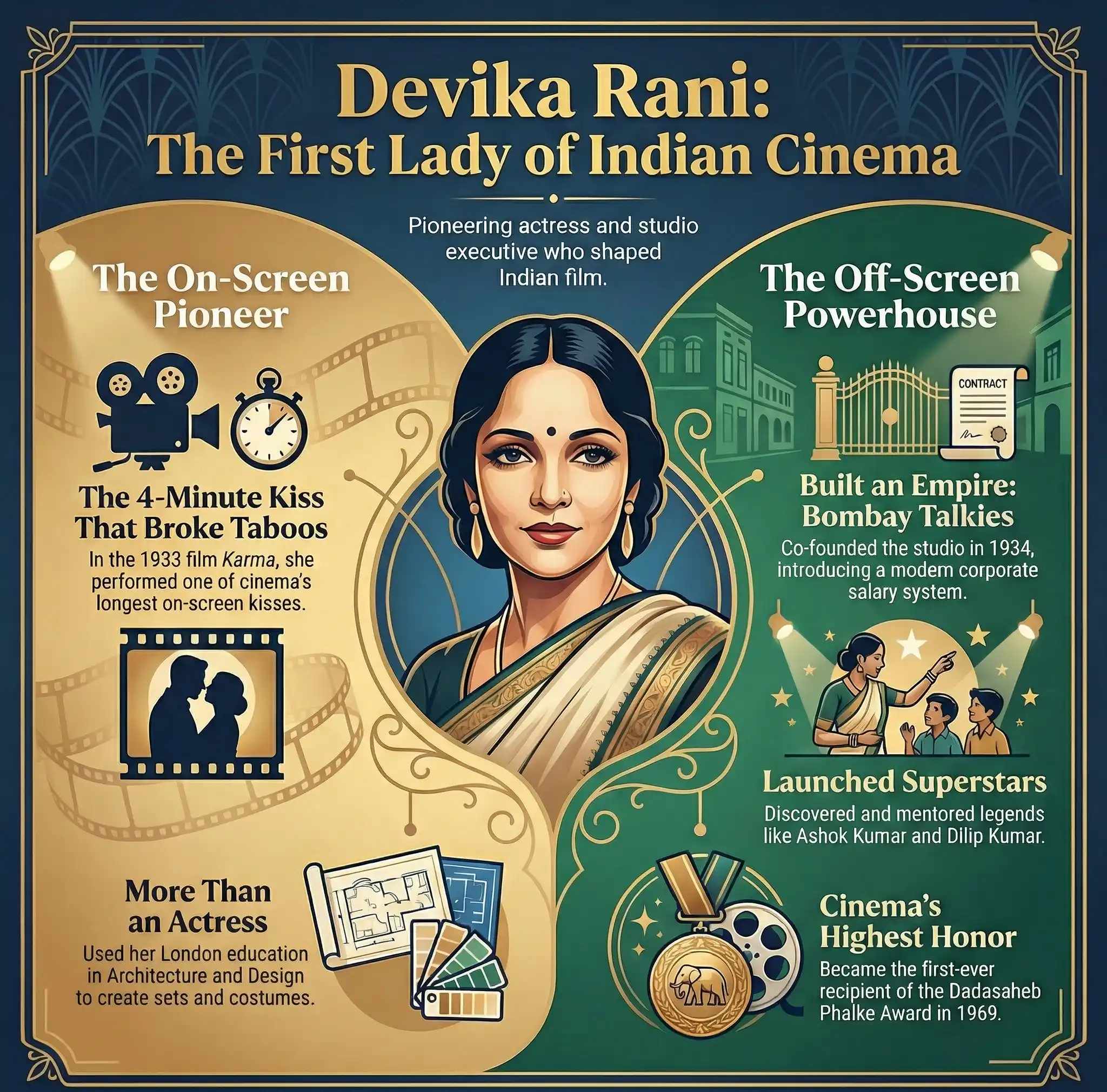
Devika Rani ran the best studio in India, and the industry’s answer was to leave and start another one
Himanshu Rai died in 1940 and the board of Bombay Talkies handed the studio to his widow.
Bombay Talkies was the best-equipped film studio in the country, built at Malad in 1934 with German technicians and German cameras. Devika Rani was thirty-two, and no woman in India was running anything comparable in any industry.
She held it for five years. What the trade did about it is the part worth knowing.
Not a discovery
She had not been found by anyone. Born at Waltair in 1908, daughter of the first Indian to be Surgeon-General of Madras and a grandniece of Rabindranath Tagore, she was sent to school in England at nine and stayed.
In London she trained at the Royal Academy of Dramatic Art and the Royal Academy of Music, studied architecture and textile design and spent a while apprenticed to Elizabeth Arden. She met Himanshu Rai in 1928, and he hired her to design his next film. They married the following year.
The film was edited in Germany, so she went too, joined UFA in Berlin, met Fritz Lang and G.W. Pabst, and worked on the set of Der blaue Engel while Marlene Dietrich was making it. She came into cinema through design and the cutting room, not through a screen test.
She was a trained technician who happened to photograph well, which the industry has never quite known what to do with.

Ekta Kapoor : Breaking Norms and Building Empires
Karma
Karma, in 1933, was the first English-language talkie made by an Indian, and she starred in it. She sang in it too, in English and in Hindi. It contains a kiss that runs about four minutes, which is the only thing most accounts of her career find room to mention.
There was a screening for the royal family at Windsor and warm reviews in the British press. In India the film did no business at all.
The studio
Bombay Talkies opened in 1934 and she ran the floor with Rai and the writer Niranjan Pal. Achhut Kanya in 1936, in which she played an untouchable girl, was the studio’s defining picture, and her pairing with Ashok Kumar carried the decade. In 1936 she left the set of Jeevan Naiya with her co-star Najm-ul-Hassan and was persuaded to return, and the studio recast the part.
The studio made about forty films at Malad in its working life, and the run of them that people still watch is almost entirely from the years she was either on the screen or in charge of the floor.
Then Rai had a breakdown and died, and the job was hers.
Five years in charge
She produced Basant in 1942 and presided over a studio that in 1943 released Kismet, which ran more than three years in one Calcutta cinema and was the biggest Indian hit for the next thirty. It was made under an uneasy arrangement in which she and Sashadhar Mukherjee each supervised their own films.
In old age she said plainly that the films she supervised tended to do worse than the ones her partners supervised. Few people who have run a studio have said anything so unhelpful about themselves.
Her real instinct was for people. She cast an unknown named Yusuf Khan as the lead of Jwar Bhata in 1944, and had a hand in the name he was given for it, which was Dilip Kumar. Raj Kapoor turned up in a small part in Hamari Baat. Madhubala was a child on her sets.
The studio she was running was manufacturing the next thirty years of Indian cinema, and it was doing it under a woman.
Salman Khan : Decades of Ruling Hearts and Box Offices
The walkout
In 1943 Mukherjee left to set up Filmistan and took much of the studio with him, Ashok Kumar included. She stayed and could not hold the rest together.
In 1945 she married the Russian painter Svetoslav Roerich, sold her shares and left. She was thirty-seven. She moved to Manali and later to an estate outside Bangalore, filmed some wildlife footage, kept out of the trade entirely and did not come back for any of it.
Bombay Talkies did not last much longer. Ashok Kumar and Mukherjee came back and got one more big hit out of it with Mahal in 1949, and by 1953 the studio had been sold and closed. The lot at Malad stands derelict.
She lived another forty-nine years, more of her life outside cinema than in it, and died in Bangalore in 1994.
1969
The Government of India gave her the Padma Shri in 1958. In 1969 it instituted the Dadasaheb Phalke Award, the highest honour Indian cinema has, and made her the first recipient.
The founding award of the Indian film industry went, at the first attempt, to a woman who had walked out of it twenty-four years earlier and never once looked back.
Sridevi Biography: From Sivakasi to Eternal Stardom
If you think you have remembered everything about this topic take this QUIZ
Results


#1. Apart from literature, what technical subjects did Devika Rani study in London?
#2. Which 1933 film featured Devika Rani in a famous 4-minute kissing scene?
#3. What was the name of the pioneering film studio Devika Rani co-founded in 1934?
#4. Who was the laboratory assistant promoted by Devika Rani to replace Najam-ul-Hussain, eventually becoming a legend?
#5. Which legendary actor, originally named Yusuf Khan, was discovered and renamed by Devika Rani?
#6. Devika Rani was the first-ever recipient of which prestigious Indian award in 1969?
#7. After retiring from films in 1945, whom did Devika Rani marry?
#8. Where did Devika Rani spend her reclusive later years after leaving the film industry?
Chapters of the Smita Patil Life Story
Why is Devika Rani called the First Lady of Indian Cinema?
She is called this because of her pioneering role in establishing Bombay Talkies, her status as a top star of the 1930s, and being the first recipient of the Dadasaheb Phalke Award.
Which film features the longest kiss in Indian cinema history?
The 1933 film Karma, starring Devika Rani and her husband Himanshu Rai, features a kissing scene reported to be four minutes long.
Did Devika Rani discover Dilip Kumar?
Yes. She spotted Yusuf Khan (Dilip Kumar) at Bombay Talkies, hired him, gave him his screen name, and cast him in his debut film Jwar Bhata (1944).
Who was Devika Rani’s second husband?
After the death of Himanshu Rai, she married the famous Russian painter Svetoslav Roerich in 1945 and moved to Bangalore.
What was Devika Rani’s connection to Rabindranath Tagore?
Devika Rani was the grand-niece of the Nobel Laureate Rabindranath Tagore. Her father, Col. M.N. Chaudhuri, was highly respected, and her mother was Tagore’s niece.
Read More: https://curiousindian.in/rakesh-roshan-september-1949-present/
Sources & References
South Asian Britain, University of Exeter — her training at RADA and the Royal Academy of Music, the Elizabeth Arden apprenticeship and her work at UFA in Berlin.
Cinemaazi (artist profile, Devika Rani) — the Bombay Talkies production years, Jwar Bhata and the casting of Dilip Kumar, and her retirement in 1945.
Directorate of Film Festivals, Government of India — the first Dadasaheb Phalke Award.
Padma Awards portal, Government of India — the Padma Shri of 1958.
Author


Exploring the Soul of Bharat through History, Science, Culture, and its Diversity
Our Mission
Curious Indian is a definitive knowledge portal dedicated to chronicling the events, personalities, and cultural shifts that defined the Indian subcontinent. From the ancient Vedic Period to the complexities of 21st-century politics, our goal is to provide deep-dive analysis that inspires.
Editorial Standards & E-E-A-T
Every article published under our brand undergoes a rigorous fact-checking process. We prioritize primary historical records, academic citations, and credible archives to ensure our readers receive accurate, high-authority information.
Historical Integrity Directly sourcing from ASI archives and academic journals.Topical Authority Comprehensive clustering of Indian Science, Biographies, and Wars.Managed by Paripurna Datta and TEAM | Dedicated to the Knowledge of India.