How Madhuri Dixit walked out of Hindi cinema at the top and found her place still open
In November 1999 a London newspaper covered the wedding of an Indian actress as a piece of national heartbreak.
Madhuri Dixit was thirty-two and the most valuable woman in Hindi cinema. She had married Shriram Nene, a cardiovascular surgeon working in the United States, and she was going to live with him in Denver, Colorado.
The industry had a settled rule about this. Actresses who married stopped working, and stayed stopped.
She left while she was still winning. Eleven years later the place was still hers.
Four years of nothing
She was seventeen when Abodh came out in 1984, playing a child bride. Films followed in 1985, 1986 and 1987 that nobody now remembers, and by the standards of the trade she was finished before she had started.
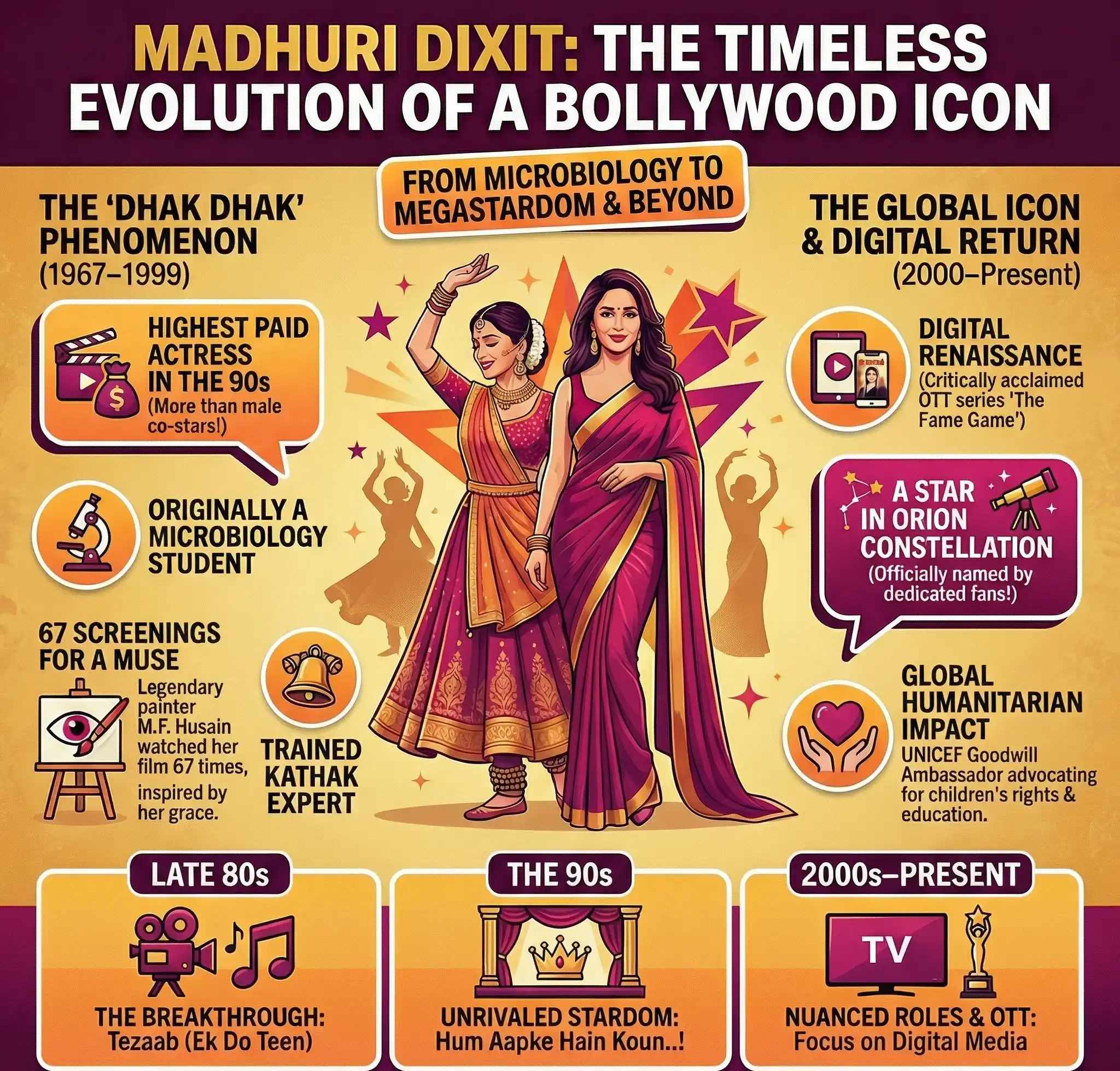
What she had was the dancing. She began Kathak at three and trained for eight years, which is an unusual thing to bring to a commercial film set.
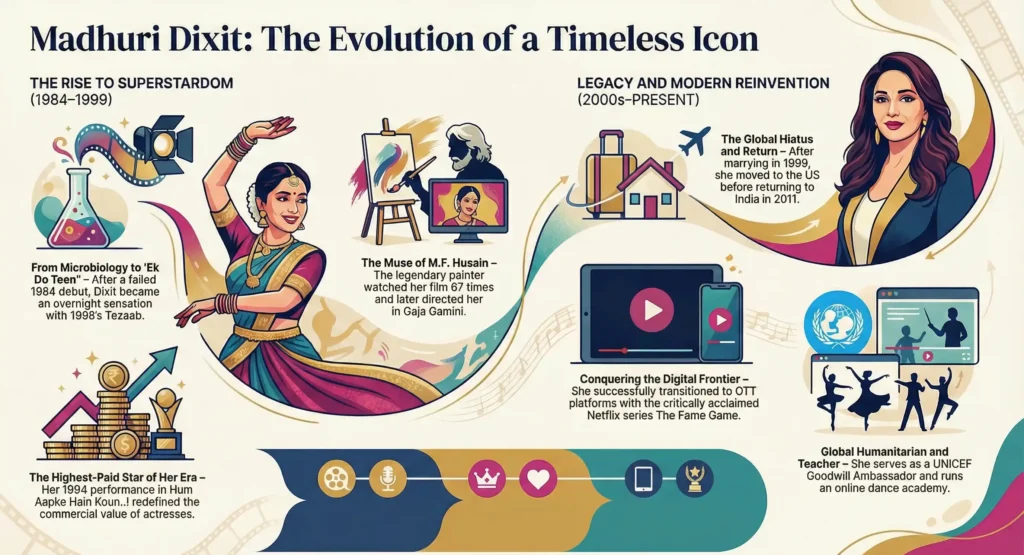
Tezaab in 1988 was the highest-grossing film of the year and “Ek Do Teen” made her a name overnight. Dil followed in 1990, the biggest hit of its year and her first Filmfare Award for best actress. By 1993 the trade press was putting her fee at thirty to thirty-five lakh rupees a film, just behind Sridevi on forty, and closing.
Hum Aapke Hain Koun..! in 1994 ran in cinemas for the better part of a year and was the highest-grossing Indian film made up to that point. It made her the most bankable woman in the business, and the painter M.F. Husain watched it sixty-seven times and then built a film, Gaja Gamini, around her.
6 Unfoldings in the Subrahmanyan Chandrasekhar Biography
The last film before the silence
She did not go quietly at once. Devdas was shot after the wedding, screened at Cannes and released in 2002, and her Chandramukhi won her a Filmfare Award for best supporting actress. Then she stopped.
There was work on offer and she turned it down, including, by her own account, approaches from Hollywood while she was pregnant. She has said she never really felt like a star, and that the apparatus around stardom mattered little to her, so vanishing from view cost her less than people assumed.
Arin was born in 2003 and Ryan in 2005. She has said since that those were the years she got an ordinary life, outdoors, among people who were not meeting a star.
In 2008 the Government of India gave her the Padma Shri. She had not released a film in six years and was living in a Denver suburb.
Aaja Nachle
Yash Raj Films built her return around a dance picture in 2007. Aaja Nachle did poor business, and a line in the title song was held to insult a caste, which got the film blocked in parts of north India until the words were changed.
She went back to Colorado.
10 Remarkable Facts About Meghnad Saha Life and Achievements
2011
The family moved to Mumbai in 2011, this time for good. Madame Tussauds put up a figure of her in London in March 2012. Forbes India has carried her on its Celebrity 100 every year since the list began that same year.
The re-entry was a dance number. She appeared for one song, Ghagra, in Yeh Jawaani Hai Deewani in 2013, and the audience that turned up for it was largely people who had been at school when she left.
The work came back in a different shape. Dedh Ishqiya and Gulaab Gang in 2014. A decade on the judging panel of dance shows, which kept her in front of an audience that had not been born when she left. The Netflix series The Fame Game in 2022, in which she played a film star who disappears. Total Dhamaal and Bhool Bhulaiyaa 3, the two highest-grossing releases of her career, arriving in 2019 and 2024.
The question they only ask women
For twenty years she was asked in every interview when she was coming back. She has pointed out that when a male star is off the screen for years, nobody asks him anything, and that a woman’s absence is treated as a problem needing explanation.
The rule she walked out on has loosened since. Actresses in Hindi cinema now marry, have children and keep working, and nobody treats it as a retirement announcement.
In 1998, on a terrace at the Royal Opera House in Bombay between shots, she told a reporter what she wanted from the whole thing: “I want to be remembered as a lady who walked tall.”
She spent away the years an actress is told she cannot afford to lose, and came back to the two biggest films of her career.
8 Fascinating Facts in the Homi Jehangir Bhabha Biography
If you think you have remembered everything about this topic take this QUIZ
Results


#1. Madhuri Dixit is a professionally trained dancer in which classical form?
#2. Before becoming an actress, what profession did Madhuri Dixit aspire to pursue?
#3. Which 1988 film marked Madhuri’s commercial breakthrough and featured the iconic song “Ek Do Teen”?
#4. Madhuri Dixit was the muse for which legendary painter, who reportedly watched her film Hum Aapke Hain Koun..! 67 times?
#5. In 1999, Madhuri Dixit married Dr. Shriram Nene. What is his profession?
#6. Which Netflix series marked Madhuri Dixit’s digital debut?
#7. What is the popular nickname given to Madhuri Dixit in Bollywood?
#8. Madhuri Dixit launched an online dance academy to make dance education accessible. What is it called?
8 Remarkable Secrets in the Jagadish Chandra Bose Biography
What was Madhuri Dixit’s first movie?
Her debut film was Abodh, released in 1984.
Who is Madhuri Dixit’s husband?
She is married to Dr. Shriram Nene, a cardiovascular surgeon.
Is Madhuri Dixit a trained dancer?
Yes, she is a professionally trained Kathak dancer and began her training at the age of three.
What is Madhuri Dixit’s famous nickname?
She is popularly known as the “Dhak Dhak Girl” after her hit song “Dhak Dhak Karne Laga” from the movie Beta.
When was Madhuri Dixit awarded the Padma Shri?
She received the Padma Shri, India’s fourth-highest civilian award, in 2008.
Read More: https://curiousindian.in/gulzar-august-1934-present/
Sources & References
Encyclopaedia Britannica (“Madhuri Dixit”) — her breakthrough in Tezaab, the run of hits through the 1990s and her later work.
The Guardian (8 November 1999) — the marriage to Shriram Nene and how it was received in India.
Padma Awards portal, Government of India — the Padma Shri of 2008.
Film Companion, Anupama Chopra (“The Solidity of Madhuri Dixit”) — her fees in the early 1990s, the 1998 interview and her account of the years in the United States.
Author


Exploring the Soul of Bharat through History, Science, Culture, and its Diversity
Our Mission
Curious Indian is a definitive knowledge portal dedicated to chronicling the events, personalities, and cultural shifts that defined the Indian subcontinent. From the ancient Vedic Period to the complexities of 21st-century politics, our goal is to provide deep-dive analysis that inspires.
Editorial Standards & E-E-A-T
Every article published under our brand undergoes a rigorous fact-checking process. We prioritize primary historical records, academic citations, and credible archives to ensure our readers receive accurate, high-authority information.
Historical Integrity Directly sourcing from ASI archives and academic journals.Topical Authority Comprehensive clustering of Indian Science, Biographies, and Wars.Managed by Paripurna Datta and TEAM | Dedicated to the Knowledge of India.