How Gulzar kept writing in Urdu after the town he was born in ended up in another country
In February 2024 the Jnanpith committee gave India’s highest literary award to an eighty-nine-year-old Sikh, for his work in Urdu.
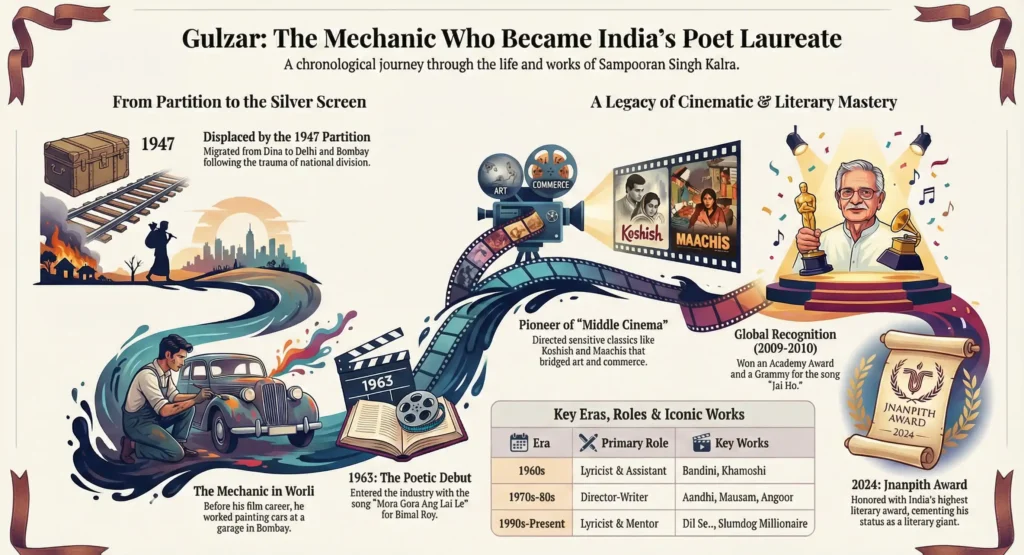
Two names were announced that year, Jagadguru Rambhadracharya for Sanskrit and Gulzar for Urdu. It was the fifty-eighth award in the series and only the fifth time it had gone to a writer in Urdu. Gulzar was born Sampooran Singh Kalra on 18 August 1934 in Dina, a market town in the Jhelum district of Punjab, which has been in Pakistan since he was thirteen.
The prize is eleven lakh rupees, a citation and a bronze of Vagdevi, the goddess of speech. Weeks before the announcement his collected poems had come out as Baal-o-Par: six hundred and fifty poems over more than twelve hundred pages, written in Urdu and printed in Devanagari.
The language crossed the border with him in 1947. The script largely did not.
Gulzar of Dina
His mother died while he was still an infant, and he grew up around his father’s shop in the Dina market rather than at home.
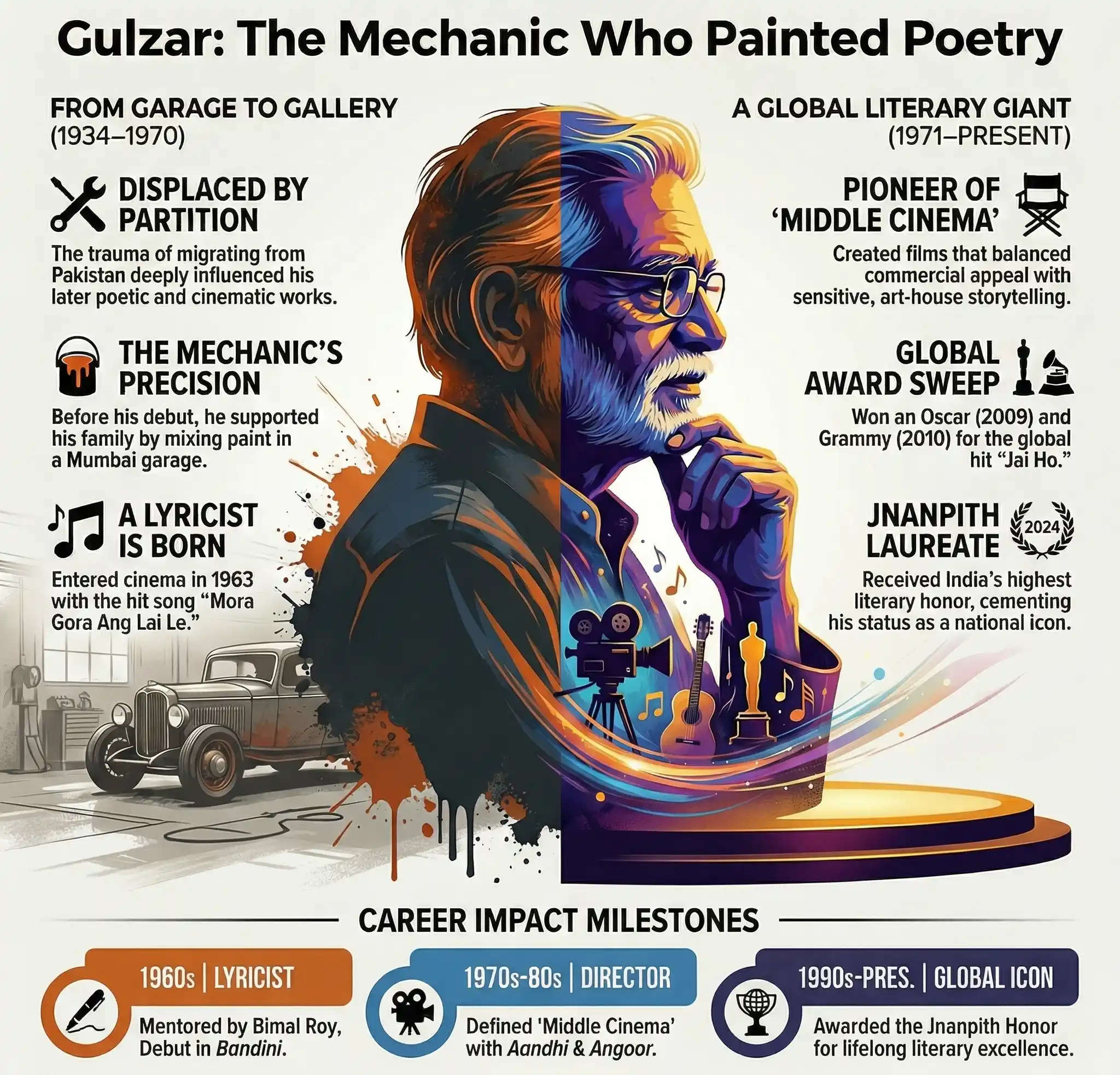
He was a reader early and without discipline, borrowing books from lending libraries for a few paise at a time until the librarians grew tired of the sight of him. He read Tagore in translation at school and has pointed to it ever since as the turn his life took. Partition split the family. They camped at Amritsar, then settled in Delhi, in Sabzi Mandi, and his studies stopped. He went to Bombay as a teenager to earn.
When he began publishing he signed himself Gulzar Deenvi. Gulzar is Urdu for garden. Deenvi means of Dina.
He lost the town at thirteen and carried it in his signature for years afterwards.
8 Fascinating Facts in the Homi Jehangir Bhabha Biography
7 Incredible Facts in the Satyendra Nath Bose Biography
The garage
In Bombay he took work at a garage, painting cars, and wrote in the hours that were left.
He went to the meetings of the Progressive Writers’ Association, where he met the lyricist Shailendra, who took him to Bimal Roy. Roy wanted a lyricist for Bandini. He was twenty-eight. In 1963 Gulzar wrote “Mora Gora Ang Lai Le” for Lata Mangeshkar and did not go back to the garage.
His father had never wanted a poet in the family, and said so.
Middle cinema
He directed his first film, Mere Apne, in 1971, and spent the next twenty years on pictures that sat between the commercial trade and the art house. Koshish, about a deaf and mute couple raising a child. Aandhi. Ijaazat, with R.D. Burman. Angoor, out of The Comedy of Errors. Maachis, about young men in Punjab during the insurgency. He married the actress Rakhee in 1973, separated from her a year later and never divorced. Their daughter, Meghna Gulzar, directs films of her own.
The songs went further than the films did. Gulzar has made the point himself that most of what Hindi cinema actually speaks is Urdu, whatever the credits call it, and that Gandhi was right to suggest the whole argument be settled by calling the language Hindustani.
Great Departure: Journey Through the Gautam Buddha Story
Partition on the page
He has written the crossing of 1947 more often than any other subject. Ravi Paar. Dhuan, the Urdu short stories that won him the Sahitya Akademi Award in 2002. Footprints on Zero Line. The novel Do Log in 2017. The songs for Pinjar, from Amrita Pritam’s novel about a woman abducted on the wrong side of the new line.
None of it argues a case. It follows one person at a time across a border and stops there.
Jai Ho, and the alphabet
In 2009 “Jai Ho” from Slumdog Millionaire won the Academy Award for best original song, and a Grammy the year after. The Dadasaheb Phalke Award for 2013 followed. In India he is known first as a film lyricist, and he has always kept the books in a separate room from the film work.
The Jnanpith was for the other room. Urdu was the ordinary written language of undivided Punjab before 1947. Since then Punjabi has been written in Gurmukhi on the Indian side and in the Persian script on the Pakistani side, and the Urdu still in daily use in India is mostly set in Devanagari. That is what has happened to his own poems, in the twelve hundred pages that came out the month before the prize.
He lost the town, the schooling and the script in the same year. He kept the language, and at eighty-nine the country he moved to gave him its highest literary prize for it.
Shalihotra: The First Father of Veterinary Medicine
If you think you have remembered everything about this topic take this QUIZ
Results


#1. What is Gulzar’s real birth name?
#2. Before joining the film industry, what job did Gulzar hold in Mumbai?
#3. Gulzar made his directorial debut with which 1971 film exploring youth unrest?
#4. For which song from the movie Slumdog Millionaire did Gulzar win an Academy Award (Oscar)?
#5. Gulzar penned the popular title song “Jungle Jungle Baat Chali Hai” for which animation series?
#6. Gulzar is married to which famous actress, though they live separately?
#7. Which prestigious literary honor was conferred upon Gulzar in 2024?
#8. Which legendary director gave Gulzar his first break as a lyricist for the film Bandini?
What is Gulzar’s real name?
His real name is Sampooran Singh Kalra.
Which song won Gulzar an Oscar?
He won the Oscar for “Jai Ho” from the movie Slumdog Millionaire (2008).
Who is Gulzar’s wife?
He is married to the veteran actress Rakhee Gulzar. Although they live separately, they are not divorced.
Has Gulzar directed any comedy films?
Yes, he directed the cult classic comedy Angoor (1982), based on Shakespeare’s The Comedy of Errors.
What is the Jnanpith Award that Gulzar received?
The Jnanpith Award is India’s highest literary honor, which Gulzar received in 2024 for his contribution to Urdu literature.
Read More: https://curiousindian.in/javed-akhtar-the-legendary-wordsmith-january-17-1945-present/
Sources & References
Encyclopaedia Britannica (“Gulzar”) — the Hindustani he writes in, publication of his work in both scripts, and the record of his awards.
Bharatiya Jnanpith (58th Jnanpith Award for 2023, announced February 2024) — the award to Gulzar for Urdu and to Jagadguru Rambhadracharya for Sanskrit.
Rekhta (poet profile, Gulzar) — his birth in Dina, the death of his mother, and the family’s move through Amritsar to Delhi.
Academy of Motion Picture Arts and Sciences (81st Academy Awards) — the 2009 award for best original song for “Jai Ho”.
Author


Exploring the Soul of Bharat through History, Science, Culture, and its Diversity
Our Mission
Curious Indian is a definitive knowledge portal dedicated to chronicling the events, personalities, and cultural shifts that defined the Indian subcontinent. From the ancient Vedic Period to the complexities of 21st-century politics, our goal is to provide deep-dive analysis that inspires.
Editorial Standards & E-E-A-T
Every article published under our brand undergoes a rigorous fact-checking process. We prioritize primary historical records, academic citations, and credible archives to ensure our readers receive accurate, high-authority information.
Historical Integrity Directly sourcing from ASI archives and academic journals.Topical Authority Comprehensive clustering of Indian Science, Biographies, and Wars.Managed by Paripurna Datta and TEAM | Dedicated to the Knowledge of India.