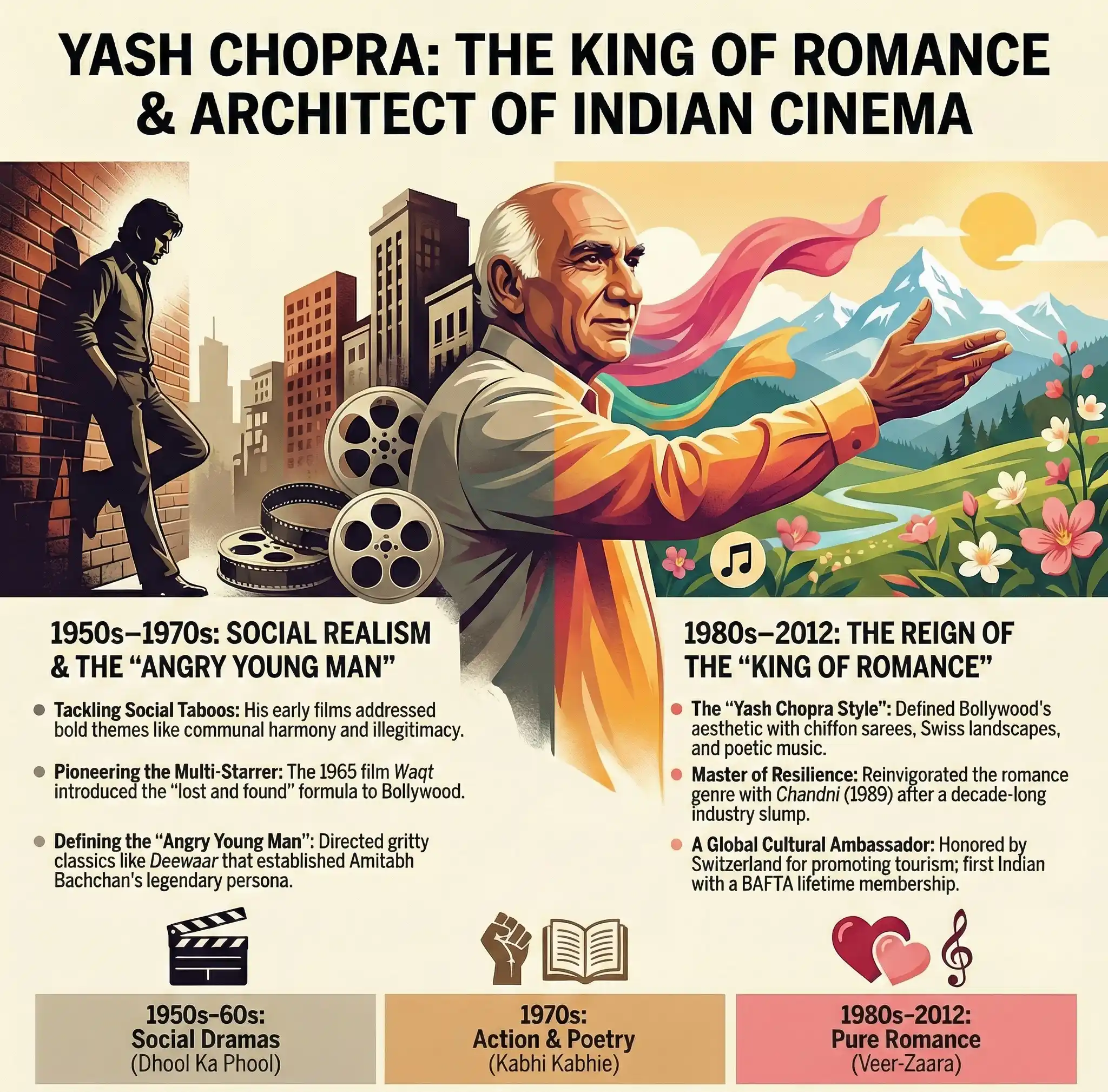
Yash Chopra made the first Hindi film about Partition at twenty-nine, and spent the next fifty years making something else
In 1961 a director two films into his career made a picture about a Hindu fanatic who discovers he was born Muslim.
Dharmputra was the first Hindi film to deal with the Partition of India directly, and it did it while the wounds were fourteen years old. It won the National Film Award for the best Hindi feature. Screenings of it were broken up by violent demonstrations over the way it showed the riots, and it lost money.
Yash Chopra was twenty-nine. He never made anything like it again.
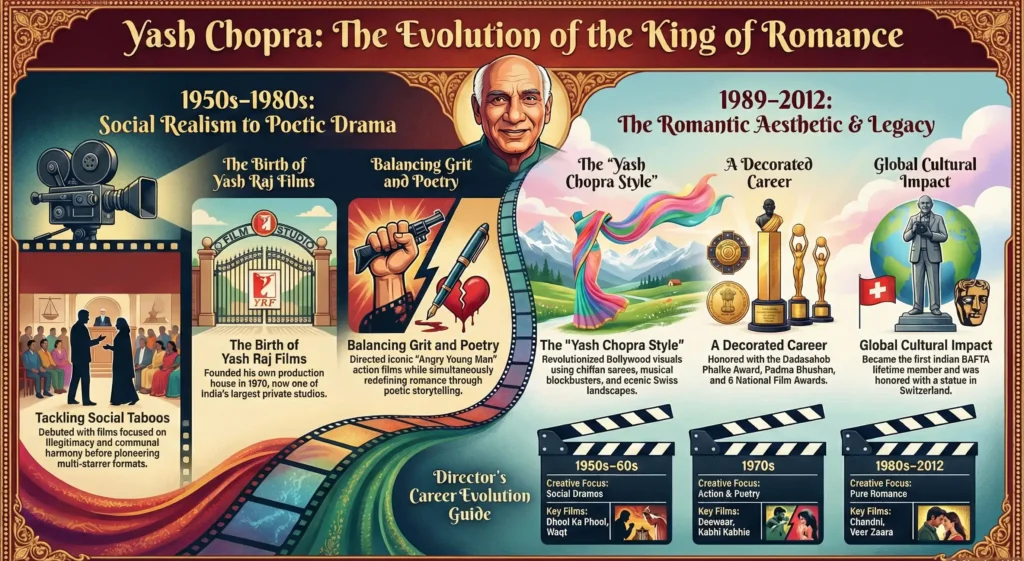
He was writing about himself
The family had come across in 1947, from Lahore to Jalandhar, through the violence.
His first film as a director, Dhool Ka Phool in 1959, is about a Muslim man raising an abandoned Hindu child, and contains the song that tells the boy he will grow up neither Hindu nor Muslim but a human being. That was not a decorative sentiment in 1959. It was a position, and the country was still deciding whether it agreed.
The dialogue was written by Akhtar-Ul-Iman and the lyrics by Sahir Ludhianvi, and the young man cast as the fanatic was Shashi Kapoor, in his first real role. None of the people who made it were doing so from a safe distance.
Dharmputra took the same argument and pushed it much harder, into fanaticism and the riots themselves. Both films were produced by his elder brother B.R. Chopra, who had been burned out of Lahore himself.
Shabana Azmi: Redefining Cinema and Society
What the market said
The verdict was delivered quickly and it was not ambiguous.
Dharmputra was a commercial failure and people had rioted outside the cinemas showing it. Four years later he made Waqt, a glossy multi-starrer about a family separated by an earthquake and reunited in the last reel, and it was an enormous hit that invented a formula the industry used for the next thirty years.
Waqt also gave him his first Filmfare award for direction, which is its own kind of message. The awards and the audience had agreed with each other for once, and they had agreed against the braver film.
He was a professional with a company to feed and he had just been shown, very clearly, which of the two things India would pay for.
The angry years
He did not go soft immediately, and the middle of his career is the part people forget.
He left his brother’s company and set up Yash Raj Films in 1970. Then came Deewaar in 1975 and Trishul in 1978, which are films about class, money and men who have been cheated, and they are as hard as anything Hindi cinema made in that decade. Kabhi Kabhie and Silsila have real arguments inside them too.
Deewaar in particular is the film that made Amitabh Bachchan what he became, and its argument is about what independence had actually delivered to the people it was promised to.
Then the 1980s went wrong. Mashaal, Faasle and Vijay all failed, one after another, and by the middle of the decade he was being written off as a man whose time had passed.
Chandni
What rescued him in 1989 also decided what he would be remembered as.
Chandni worked, enormously, and everything that now gets called the Yash Chopra style follows from it. The chiffon, the mustard fields, the snow. His son made Dilwale Dulhania Le Jayenge for the company in 1995 and the identity was sealed.
It would be cheap to call this a retreat. He was extremely good at it, he plainly enjoyed it, and it built the largest studio in the country. It is simply worth remembering that he did not start there.
21 October 2012
He died of dengue at eighty, three weeks before his last film opened.
Switzerland had already begun thanking him. Interlaken made him its Ambassador in 2011, the Jungfrau railway named a train after him, an honour it had otherwise given only to its own founder, and a hotel there named a suite. In 2016 his widow unveiled a bronze of him in a public garden in Interlaken.
A country that is not his has a statue of him for making its mountains famous. The film he made about his own country’s deepest injury had to be taken out of cinemas because of what happened outside them.
Shah Rukh Khan: Romance, Resilience, and Ruling the World
If you think you have remembered everything about this topic take this QUIZ
Results


#1. Yash Chopra founded which famous production house in 1970?
#2. Which film marked Yash Chopra’s directorial debut in 1959?
#3. Yash Chopra is popularly known by which title in Indian cinema?
#4. Which European country honored Yash Chopra with a statue and a train named after him?
#5. Which 1965 multi-starrer film directed by Yash Chopra pioneered the “lost and found” formula in Bollywood?
#6. Who was Yash Chopra’s elder brother and mentor, under whom he started his career?
#7. Which was the final film directed by Yash Chopra before his death in 2012?
#8. In 2001, Yash Chopra was honored with which prestigious award?
Rajesh Khanna: The Man Who Taught India How to Romance
What was Yash Chopra’s first movie as a director?
His directorial debut was Dhool Ka Phool, released in 1959.
When was Yash Raj Films founded?
Yash Chopra founded his production house, Yash Raj Films (YRF), in 1970.
Which award did Yash Chopra receive from the Swiss government?
He was honored with the title of “Ambassador of Interlaken” and has a statue and a train named after him in Switzerland for promoting tourism.
What was Yash Chopra’s last film?
His final film as a director was Jab Tak Hai Jaan (2012), starring Shah Rukh Khan, Katrina Kaif, and Anushka Sharma.
Did Yash Chopra win the Dadasaheb Phalke Award?
Yes, he received the Dadasaheb Phalke Award, India’s highest cinematic honor, in 2001.
Sources & References
Encyclopaedia Britannica (“Yash Chopra”) — his career from the B.R. Films years to Yash Raj Films.
Directorate of Film Festivals, Government of India — the National Film Award for Best Feature Film in Hindi for Dharmputra.
Gulzar, Govind Nihalani and Saibal Chatterjee (eds.), Encyclopaedia of Hindi Cinema (2003) — the reception of Dharmputra and its place in Partition cinema.
swissinfo.ch, May 2016 — the Interlaken statue, the Ambassador title, the Jungfrau train and the hotel suite.
Author


Exploring the Soul of Bharat through History, Science, Culture, and its Diversity
Our Mission
Curious Indian is a definitive knowledge portal dedicated to chronicling the events, personalities, and cultural shifts that defined the Indian subcontinent. From the ancient Vedic Period to the complexities of 21st-century politics, our goal is to provide deep-dive analysis that inspires.
Editorial Standards & E-E-A-T
Every article published under our brand undergoes a rigorous fact-checking process. We prioritize primary historical records, academic citations, and credible archives to ensure our readers receive accurate, high-authority information.
Historical Integrity Directly sourcing from ASI archives and academic journals.Topical Authority Comprehensive clustering of Indian Science, Biographies, and Wars.Managed by Paripurna Datta and TEAM | Dedicated to the Knowledge of India.