From Victorian Gothic to Art Deco, the empire wrote its power in stone and India rewrote it
A building is never only a building. It is also an argument about who is in charge.
The British, when they ruled India, understood this better than almost anyone. They used stone and brick to make their power look grand, permanent, and even rightful. But history played a quiet trick on them. The very buildings they raised to glorify their empire were built by Indian hands, and when the empire finally fell, India did not tear them down. It kept them, and slowly changed what they meant. This is the story of colonial architecture in India.
Stone that says “we are in charge”
After the great revolt of 1857, the British Crown took direct control of India in 1858, and it wanted buildings that would make people look up and feel small. At first, it spoke in a borrowed European voice.
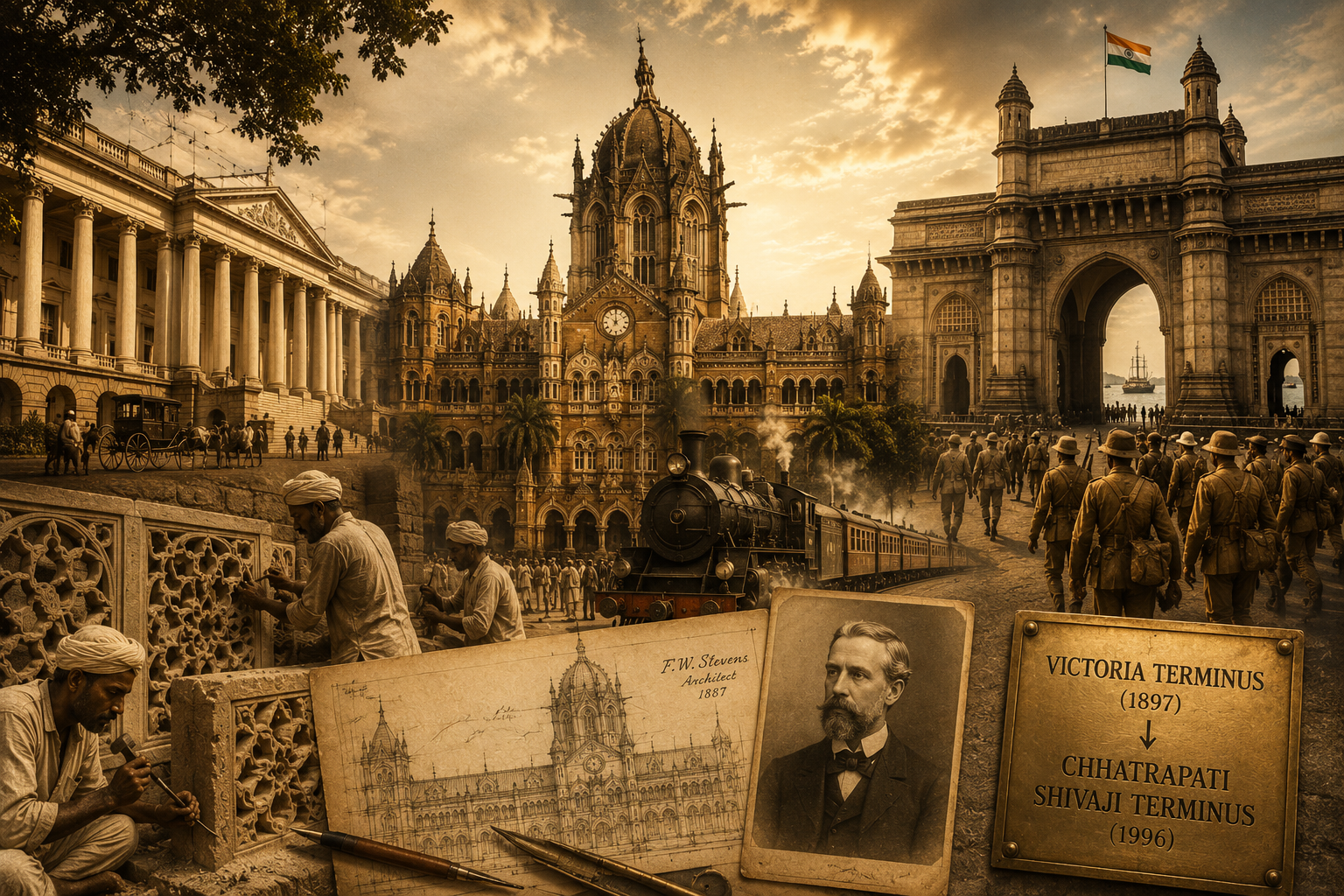
In Calcutta and Madras came grand Neo-Classical buildings, all towering Roman and Greek columns, meant to look like the proud centres of European civilisation dropped onto Indian soil. Then, as Bombay grew into a giant port city, the British built in a soaring, spiky style called Victorian Gothic: railway stations, universities and courts bristling with spires. The grandest of all was the great railway station then named Victoria Terminus, designed by the architect F.W. Stevens, a building so magnificent it looked less like a station than a cathedral for trains.
Dressing power in Indian clothes
By the late 1800s, the British noticed a problem. Purely European buildings looked alien on the Indian landscape, like an unwelcome guest who would not fit in. So they changed their costume.
They created a clever new hybrid style called Indo-Saracenic. Underneath, the building was fully modern and Western, with a Western floor plan and bones of iron and steel. But its “skin”, the part everyone saw, was entirely Indian: Mughal-style onion domes, little umbrella-topped pavilions borrowed from Rajput palaces, scalloped arches, and carved stone screens.
Why go to all this trouble? Because the rulers wanted to look less like foreign conquerors and more like the rightful heirs of India’s own kings. If your railway station or museum looked a little like a Mughal palace, perhaps the people would feel that you belonged here. It was, in the end, power dressed up in fancy clothes.
You can still see it in the Gateway of India and the Prince of Wales Museum in Bombay, and the Victoria Memorial in Kolkata. Even Indian princes liked the look and built their own palaces this way, such as the famous palace at Mysore.
The city that chose the future
In the 1930s, a sleek new style swept in from around the world: Art Deco, full of clean lines, rounded corners and a feeling of speed and modern life.
Here something telling happened. It was often wealthy Indians, returning home from Europe, who fell in love with this style and built with it. Bombay filled up with Art Deco so completely that Mumbai today has the second-largest collection of Art Deco buildings in the world, after only Miami.
These buildings had stepped tops, smooth curved corners, and round porthole windows like those on a great ocean liner. And Indians made the style their own. They added deep, shady balconies and screens to soften the fierce sun, and swapped European patterns for Indian ones, lotuses, elephants and sunbursts. Bright new cinemas like the Eros rose up in this style, and ordinary Indians walked, quite literally, into a modern world.
The Chola Dynasty 850-1279 CE: The Imperial Age of South India
Built by Indian hands
Whatever the style on the outside, every single one of these buildings leaned on Indian skill.
The carved stone screens that let a cool breeze pass through, the shaded balconies, the fine and patient stonework, all of it was the work of Indian masons, carvers and plasterers. Even the most “British” building on the skyline was shaped, stone by careful stone, by Indian hands, and built to stand up to the Indian heat. The empire’s proudest monuments were, underneath their grand surfaces, made by the very people the empire ruled.
The Indus Valley Civilization: The First Urban Society
The buildings change sides
When the British finally left in 1947, India faced a strange question. What should it do with these huge, beautiful monuments to its own conquest?
It did not smash them in anger. It did something much wiser. It kept them, and quietly turned their meaning inside out.
The Viceroy’s House in New Delhi, built by the architect Edwin Lutyens as the palace of Britain’s ruler in India, is today Rashtrapati Bhavan, the home of India’s own President. The Gateway of India in Bombay had been built to welcome a British king-emperor onto Indian shores. In 1948, it became the doorway through which the very last British troops marched out. The arch built for a grand welcome became the arch of a final goodbye.
And the greatest turn of all came in 1996.
The mighty station named Victoria Terminus, after the Empress of India, was renamed Chhatrapati Shivaji Terminus after the Maratha warrior-king who had once fought against empire. The stone did not change. Its meaning did.
Reign of Akbar 1556-1605: The Golden Age of the Mughal Empire
Whose monuments now
The British built in stone to announce that they were mighty and here to stay. They were mighty. They did not stay.
But what they left behind did not vanish with them. Today an office worker hurries to catch a train under the great dome of Shivaji Terminus. A family wanders past the Gateway of India as the sun goes down over the sea. India’s own President lives and works beneath Lutyens’ quiet dome in Delhi.
These were once monuments to an empire, meant to remind Indians who was in charge. They are now, quite simply, India’s own, kept and used and loved and renamed by the very people they were built to rule.
Contemporary Indian Sculpture: 20th and 21st Century Innovations
If you think you have remembered everything about this topic take this QUIZ
What is Indo-Saracenic architecture?
It is a hybrid architectural style developed by British architects in late 19th-century India, combining Western floor plans with Indian and Islamic exterior motifs like domes, arches, and chhatris.
Which Indian city has the largest collection of Art Deco buildings?
Mumbai (Bombay) has the largest collection of Art Deco buildings in India, and the second-largest in the world after Miami.
What are the key features of Art Deco in India?
Geometric shapes, curved corners, stepped profiles, pastel colors, and deep balconies adapted for tropical weather (Tropical Deco).
Can you name a famous Indo-Saracenic building?
The Gateway of India in Mumbai and the Victoria Memorial in Kolkata are iconic examples.
What was the purpose of the “Jali” in colonial buildings?
The Jali (perforated stone or metal screen) was used for cross-ventilation, allowing cool breezes to enter while blocking the harsh Indian sun.
Sources and references
UNESCO World Heritage Centre and Ministry of Culture (Chhatrapati Shivaji Terminus) — Victoria Terminus designed by F.W. Stevens and built between 1878 and 1888, its High Victorian Gothic style blended with Indian palace architecture, its World Heritage inscription in 2004, and its role as a meeting of two cultures with British architects and Indian craftsmen.
Historical markers and heritage records — the station named Victoria Terminus in 1887 during Queen Victoria’s Golden Jubilee, renamed Chhatrapati Shivaji Terminus in March 1996 after the Maratha king Shivaji, and again Chhatrapati Shivaji Maharaj Terminus in 2017.
Britannica (“Indo-Saracenic architecture”) and heritage sources — the hybrid style layering Indian and Islamic motifs (domes, chhatris, jalis, chhajjas) over Western structural plans, its use to make British rule appear rooted, and examples such as the Gateway of India and the Prince of Wales Museum by George Wittet.
Art Deco Mumbai and UNESCO — Mumbai’s Art Deco precincts as the second-largest such collection in the world, the “tropicalised” features (deep balconies and sun-screens), and the 2018 inscription of the Victorian Gothic and Art Deco Ensembles of Mumbai.
Records on New Delhi and the Gateway of India — Edwin Lutyens and Herbert Baker’s New Delhi (from 1911), the Viceroy’s House now serving as Rashtrapati Bhavan, and the Gateway of India as the point of departure for the last British troops in 1948.
Original Curious Indian article (“Colonial Architecture in India”) — the 1858 shift to Crown rule and the drive to project authority, the Neo-Classical and Victorian Gothic beginnings, the “Delhi Order” of Lutyens, the Deco cinemas, and the origin of the term “Saracenic.”
Author


Exploring the Soul of Bharat through History, Science, Culture, and its Diversity
Our Mission
Curious Indian is a definitive knowledge portal dedicated to chronicling the events, personalities, and cultural shifts that defined the Indian subcontinent. From the ancient Vedic Period to the complexities of 21st-century politics, our goal is to provide deep-dive analysis that inspires.
Editorial Standards & E-E-A-T
Every article published under our brand undergoes a rigorous fact-checking process. We prioritize primary historical records, academic citations, and credible archives to ensure our readers receive accurate, high-authority information.
Historical Integrity Directly sourcing from ASI archives and academic journals.Topical Authority Comprehensive clustering of Indian Science, Biographies, and Wars.Managed by Paripurna Datta and TEAM | Dedicated to the Knowledge of India.